

Geochemical Characteristics and Significance of shale Gas Well Flowback Fluid in Zheng’An Block, Guizhou


Article Information
Abstract
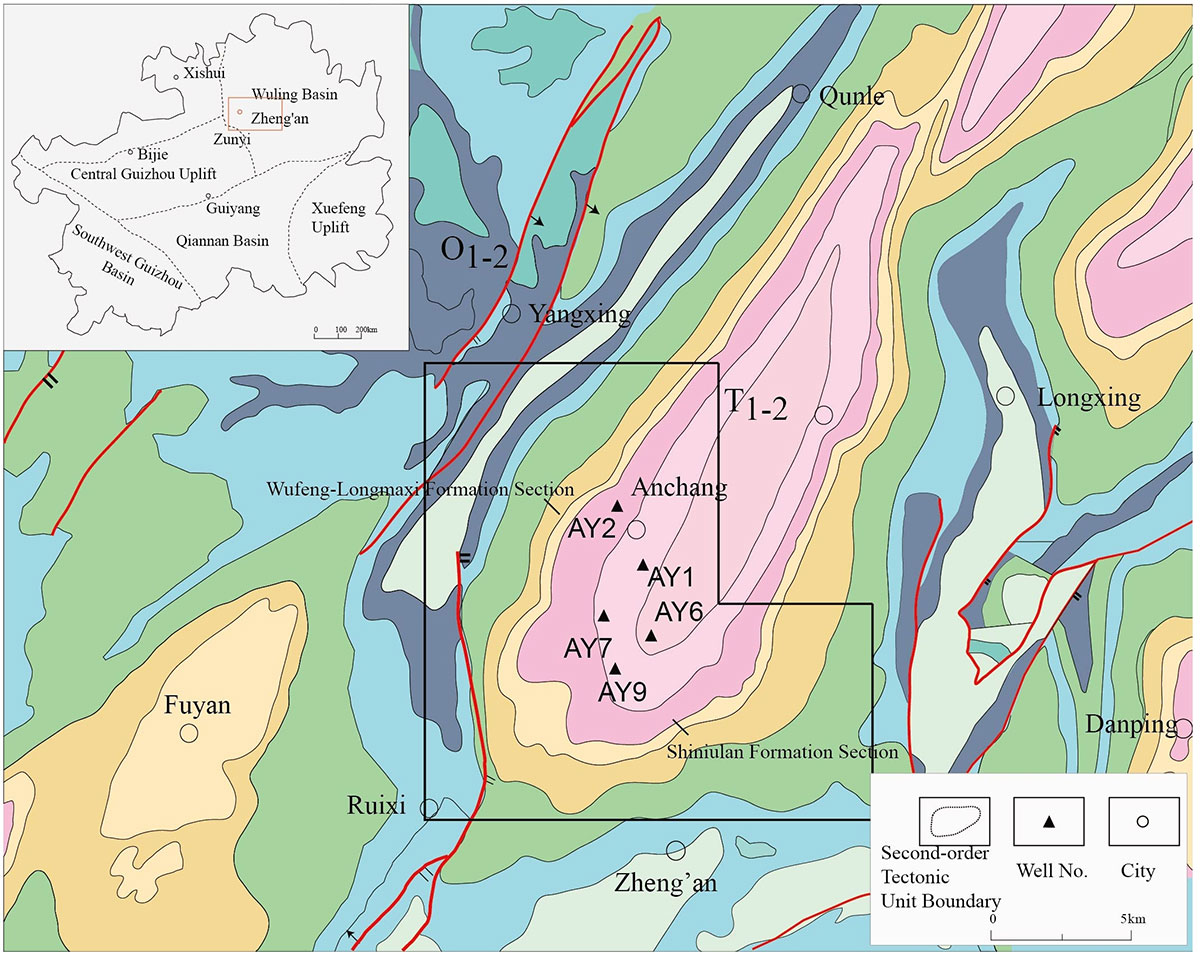
Analysis of fracturing flowback fluids from 14 shale gas wells across 7 platforms in the Zheng'an block, Guizhou, reveals that the fluids are characterized by high salinity, elevated Na\(^+\) and Cl\(^-\) concentrations, and high levels of chemical oxygen demand (COD) and ammonia nitrogen. Na\(^+\) concentrations range from 7370 to 27396~mg/L (mean 18689~mg/L), Cl\(^-\) from 9000 to 43000~mg/L (mean 29438~mg/L), and total salinity from 17074 to 70950~mg/L (mean 48744~mg/L). The dominant microbial populations comprise iron bacteria (FEB), saprophytic bacteria (TGB), and sulfate-reducing bacteria (SRB). These characteristics indicate that the flowback fluid cannot be discharged directly without treatment. However, following appropriate pretreatment—including advanced oxidation for COD reduction, chemical flocculation for suspended solids removal, and biocide addition for microbial control—the fluid can be either recycled for further shale gas development or discharged after meeting the required standards, such as those specified in the Guizhou Province Pollution Discharge Standard (DB 52/864-2022). Sulfate-reducing bacteria and other microorganisms contribute to scaling, corrosion, and perforation of downhole tubing, surface equipment, and gas transmission pipelines; such damage can be effectively mitigated by regular biocide application during shale gas production. These findings provide critical data support for the treatment and recycling of shale gas flowback fluids in Guizhou, contributing to improved shale gas reserve development and production efficiency in the region.
Graphical Abstract
Keywords
Data Availability Statement
Funding
Conflicts of Interest
AI Use Statement
Ethical Approval and Consent to Participate
References
- Caineng, Z. O. U., Dazhong, D. O. N. G., Yuman, W. A. N. G., Xinjing, L., Shufang, W. A. N. G., Quanzhong, G. U. A. N., ... & Zhen, Q. I. U. (2016). Shale gas in China: Characteristics, challenges and prospects (II). Petroleum exploration and development, 43(2), 182-196.
[CrossRef] [Google Scholar] - Vincent, M. C. (2012). The next opportunity to improve hydraulic-fracture stimulation. Journal of Petroleum Technology, 64(03), 118-127.
[CrossRef] [Google Scholar] - Ferrer, I., & Thurman, E. M. (2015). Chemical constituents and analytical approaches for hydraulic fracturing waters. Trends in Environmental Analytical Chemistry, 5, 18-25.
[CrossRef] [Google Scholar] - Liu, D., Li, J., Zou, C., Cui, H., Ni, Y., Liu, J., ... & Vengosh, A. (2020). Recycling flowback water for hydraulic fracturing in Sichuan Basin, China: Implications for gas production, water footprint, and water quality of regenerated flowback water. Fuel, 272, 117621.
[CrossRef] [Google Scholar] - Ni, Y., Yao, L., Liao, F., Gao, J., Chen, J., Sui, J., & Zhang, D. (2021). Geochemical characteristics of the elements in hydraulic fracturing flowback water from the Weiyuan shale gas development area in Sichuan Basin, China. Natural Gas Geoscience, 32(4), 492–509. http://www.nggs.ac.cn/EN/10.11764/j.issn.1672-1926.2020.12.015
[Google Scholar] - Wu, F., Zhou, Z., Zhang, S., Cheng, F., Tong, Y., Li, L., ... & You, J. (2023). Toxicity identification evaluation for hydraulic fracturing flowback and produced water during shale gas exploitation in China: Evidence from tissue residues and gene expression. Water Research, 241, 120170.
[CrossRef] [Google Scholar] - Vengosh, A., Jackson, R. B., Warner, N., Darrah, T. H., & Kondash, A. (2014). A critical review of the risks to water resources from unconventional shale gas development and hydraulic fracturing in the United States. Environmental Science & Technology, 48(15), 8334-8348.
[CrossRef] [Google Scholar] - Ni, Y., Yao, L., Sui, J., & Chen, J. (2022). Isotopic geochemical characteristics and identification indexes of shale gas hydraulic fracturing flowback/produced water. Journal of Natural Gas Geoscience, 7(1), 1-13.
[CrossRef] [Google Scholar] - Fu, Y., Jiang, Y., Hu, Q., Luo, T., Li, Y., Zhian, L., ... & Yin, X. (2021). Fracturing flowback fluids from shale gas wells in western Chongqing: Geochemical analyses and relevance for exploration & development. Journal of Natural Gas Science and Engineering, 88, 103821.
[CrossRef] [Google Scholar] - Ni, Y., Zou, C., Cui, H., Li, J., Lauer, N. E., Harkness, J. S., Kondash, A. J., Coyte, R. M., Dwyer, G. S., Liu, D., Dong, D., Liao, F., & Vengosh, A. (2018). Origin of flowback and produced waters from Sichuan Basin, China. Environmental Science & Technology, 52(24), 14519-14527.
[CrossRef] [Google Scholar] - Ou, Z., Chang, C., Xie, W., Zhang, H., Hu, H., Gao, R., ... & Xia, Z. (2025). Implications of the geochemical characteristics of post-fracturing flowback fluids for shale gas exploration and exploitation. Energy Geoscience, 6(4), 100416.
[CrossRef] [Google Scholar] - Ni, Y., Liu, S., Li, L., Zhang, B., Yao, L., Sui, J., & Chen, J. (2024). Geochemical characteristics of shale gas hydraulic fracturing flowback/produced water in Zheng'an block, northern Guizhou Province, China. Journal of Natural Gas Geoscience, 9(1), 27-37.
[CrossRef] [Google Scholar] - Lan, B., Zhao, F., Li, S., Jiang, H., Liu, S., & Zhang, Z. (2022). Investigation of the enrichment and accumulation of normal pressure shale gas in Anchang syncline outside of Sichuan Basin. Frontiers in Earth Science, 9, 802142.
[CrossRef] [Google Scholar] - Li, P., Yu, J., Xie, M., Lu, D., Li, G., Chen, X., ... & Deng, Y. (2026). Lithofacies Identification and Gas-Bearing Potential Evaluation of Shallow Shale Gas in China: A Case Study of the Wufeng-Longmaxi Formations, Northern Guizhou. Minerals, 16(2), 203.
[CrossRef] [Google Scholar] - Yu, J., Tao, Y., & Bao, Z. (2026). Shale Gas Sweet Spot Prediction and Optimal Well Deployment in the Wufeng–Longmaxi Formation of the Anchang Syncline, Northern Guizhou. Processes, 14(4), 652.
[CrossRef] [Google Scholar] - Paukert Vankeuren, A. N., Hakala, J. A., Jarvis, K., & Moore, J. E. (2017). Mineral reactions in shale gas reservoirs: barite scale formation from reusing produced water as hydraulic fracturing fluid. Environmental science & technology, 51(16), 9391-9402.
[CrossRef] [Google Scholar] - Liu, D., Xiong, W., Zhang, X., Guo, W., Li, W., Gao, J., ... & Ni, Y. (2024). Hydrogeochemistry and indicators of flowback and produced water from wells that are hydraulically fractured with recycled wastewater: A case study of the Changning gas field in the Sichuan Basin. Applied Geochemistry, 162, 105897.
[CrossRef] [Google Scholar] - Gao, J., Zou, C., Li, W., Ni, Y., Liao, F., Yao, L., ... & Vengosh, A. (2020). Hydrochemistry of flowback water from Changning shale gas field and associated shallow groundwater in Southern Sichuan Basin, China: Implications for the possible impact of shale gas development on groundwater quality. Science of the Total Environment, 713, 136591.
[CrossRef] [Google Scholar] - Ni, Y., Yao, L., Sui, J., Chen, J., Liu, F., Wang, F., ... & Vengosh, A. (2022). Shale gas wastewater geochemistry and impact on the quality of surface water in Sichuan Basin. Science of the Total Environment, 851, 158371.
[CrossRef] [Google Scholar] - Wang, B., Xiong, M., Wang, P., & Shi, B. (2020). Chemical characterization in hydraulic fracturing flowback and produced water (HF-FPW) of shale gas in Sichuan of China. Environmental science and pollution research, 27(21), 26532-26542.
[CrossRef] [Google Scholar] - Tang, P., Zhong, C., Zhang, D., Wang, J., Su, Y., & Liu, B. (2024). Microbial insights into shale gas wastewater from the Sichuan Basin: Diversity, potential functions, and implications. Energy & Fuels, 38(4), 2992-3001.
[CrossRef] [Google Scholar] - Holland, H. D. (2020). The chemical evolution of the atmosphere and oceans. Princeton University Press.
[CrossRef] [Google Scholar] - Yin, X., Fu, X., Jiang, Y., Fu, Y., Zhang, H., Jiang, L., ... & Li, M. (2024). The Indicative Role of Geochemical Characteristics of Fracturing Flowback Fluid in Shale Gas Wells on Production Performance. Processes, 12(10), 2097.
[CrossRef] [Google Scholar] - Zhou, J., Li, J., Yan, Y., Yang, N., Deng, X., & Ren, J. (2026, March). Screening and performance evaluation of bactericides for produced flowback fluid in shale gas fields. In Journal of Physics: Conference Series (Vol. 3202, No. 1, p. 012043). IOP Publishing.
[CrossRef] [Google Scholar] - Gao, J., Zou, C., Zhang, X., Guo, W., Yu, R., Ni, Y., ... & Vengosh, A. (2024). The water footprint of hydraulic fracturing for shale gas extraction in China. Science of the Total Environment, 907, 168135.
[CrossRef] [Google Scholar]
Cite This Article
TY  - JOUR
AU  - Yang, Fengying
AU  - Chen, Zhongyun
AU  - Zhu, Xiaojun
PY  - 2026
DA  - 2026/08/08
TI  - Geochemical Characteristics and Significance of shale Gas Well Flowback Fluid in Zheng’An Block, Guizhou
JO  - Journal of Geo-Energy and Environment
T2  - Journal of Geo-Energy and Environment
JF  - Journal of Geo-Energy and Environment
VL  - 2
IS  - 4
SP  - 276
EP  - 286
DO  - 10.62762/JGEE.2026.556688
UR  - https://www.icck.org/article/abs/JGEE.2026.556688
KW  - shale gas
KW  - flowback fluid
KW  - water quality
KW  - geochemical characteristics
KW  - gas well impact
KW  - Guizhou Zheng'an
AB  - Analysis of fracturing flowback fluids from 14 shale gas wells across 7 platforms in the Zheng'an block, Guizhou, reveals that the fluids are characterized by high salinity, elevated Na\(^+\) and Cl\(^-\) concentrations, and high levels of chemical oxygen demand (COD) and ammonia nitrogen. Na\(^+\) concentrations range from 7370 to 27396~mg/L (mean 18689~mg/L), Cl\(^-\) from 9000 to 43000~mg/L (mean 29438~mg/L), and total salinity from 17074 to 70950~mg/L (mean 48744~mg/L). The dominant microbial populations comprise iron bacteria (FEB), saprophytic bacteria (TGB), and sulfate-reducing bacteria (SRB). These characteristics indicate that the flowback fluid cannot be discharged directly without treatment. However, following appropriate pretreatment—including advanced oxidation for COD reduction, chemical flocculation for suspended solids removal, and biocide addition for microbial control—the fluid can be either recycled for further shale gas development or discharged after meeting the required standards, such as those specified in the Guizhou Province Pollution Discharge Standard (DB 52/864-2022). Sulfate-reducing bacteria and other microorganisms contribute to scaling, corrosion, and perforation of downhole tubing, surface equipment, and gas transmission pipelines; such damage can be effectively mitigated by regular biocide application during shale gas production. These findings provide critical data support for the treatment and recycling of shale gas flowback fluids in Guizhou, contributing to improved shale gas reserve development and production efficiency in the region.
SN  - 3069-3268
PB  - Institute of Central Computation and Knowledge
LA  - English
ER  -
@article{Yang2026Geochemica,
  author = {Fengying Yang and Zhongyun Chen and Xiaojun Zhu},
  title = {Geochemical Characteristics and Significance of shale Gas Well Flowback Fluid in Zheng’An Block, Guizhou},
  journal = {Journal of Geo-Energy and Environment},
  year = {2026},
  volume = {2},
  number = {4},
  pages = {276-286},
  doi = {10.62762/JGEE.2026.556688},
  url = {https://www.icck.org/article/abs/JGEE.2026.556688},
  abstract = {Analysis of fracturing flowback fluids from 14 shale gas wells across 7 platforms in the Zheng'an block, Guizhou, reveals that the fluids are characterized by high salinity, elevated Na\(^+\) and Cl\(^-\) concentrations, and high levels of chemical oxygen demand (COD) and ammonia nitrogen. Na\(^+\) concentrations range from 7370 to 27396~mg/L (mean 18689~mg/L), Cl\(^-\) from 9000 to 43000~mg/L (mean 29438~mg/L), and total salinity from 17074 to 70950~mg/L (mean 48744~mg/L). The dominant microbial populations comprise iron bacteria (FEB), saprophytic bacteria (TGB), and sulfate-reducing bacteria (SRB). These characteristics indicate that the flowback fluid cannot be discharged directly without treatment. However, following appropriate pretreatment—including advanced oxidation for COD reduction, chemical flocculation for suspended solids removal, and biocide addition for microbial control—the fluid can be either recycled for further shale gas development or discharged after meeting the required standards, such as those specified in the Guizhou Province Pollution Discharge Standard (DB 52/864-2022). Sulfate-reducing bacteria and other microorganisms contribute to scaling, corrosion, and perforation of downhole tubing, surface equipment, and gas transmission pipelines; such damage can be effectively mitigated by regular biocide application during shale gas production. These findings provide critical data support for the treatment and recycling of shale gas flowback fluids in Guizhou, contributing to improved shale gas reserve development and production efficiency in the region.},
  keywords = {shale gas, flowback fluid, water quality, geochemical characteristics, gas well impact, Guizhou Zheng'an},
  issn = {3069-3268},
  publisher = {Institute of Central Computation and Knowledge}
}
Article Metrics
Publisher's Note
ICCK stays neutral with regard to jurisdictional claims in published maps and institutional affiliations.
Rights and Permissions
 Copyright © 2026 by the Author(s). Published by Institute of Central Computation and Knowledge. This article is an open access article distributed under the terms and conditions of the Creative Commons Attribution (CC BY) license (https://creativecommons.org/licenses/by/4.0/), which permits use, sharing, adaptation, distribution and reproduction in any medium or format, as long as you give appropriate credit to the original author(s) and the source, provide a link to the Creative Commons licence, and indicate if changes were made.


Portico
