

Study on Reservoir Space Characteristics and Gas Storage Mechanism of Low-Rank Coal Reservoir in Junggar Basin


Article Information
Abstract
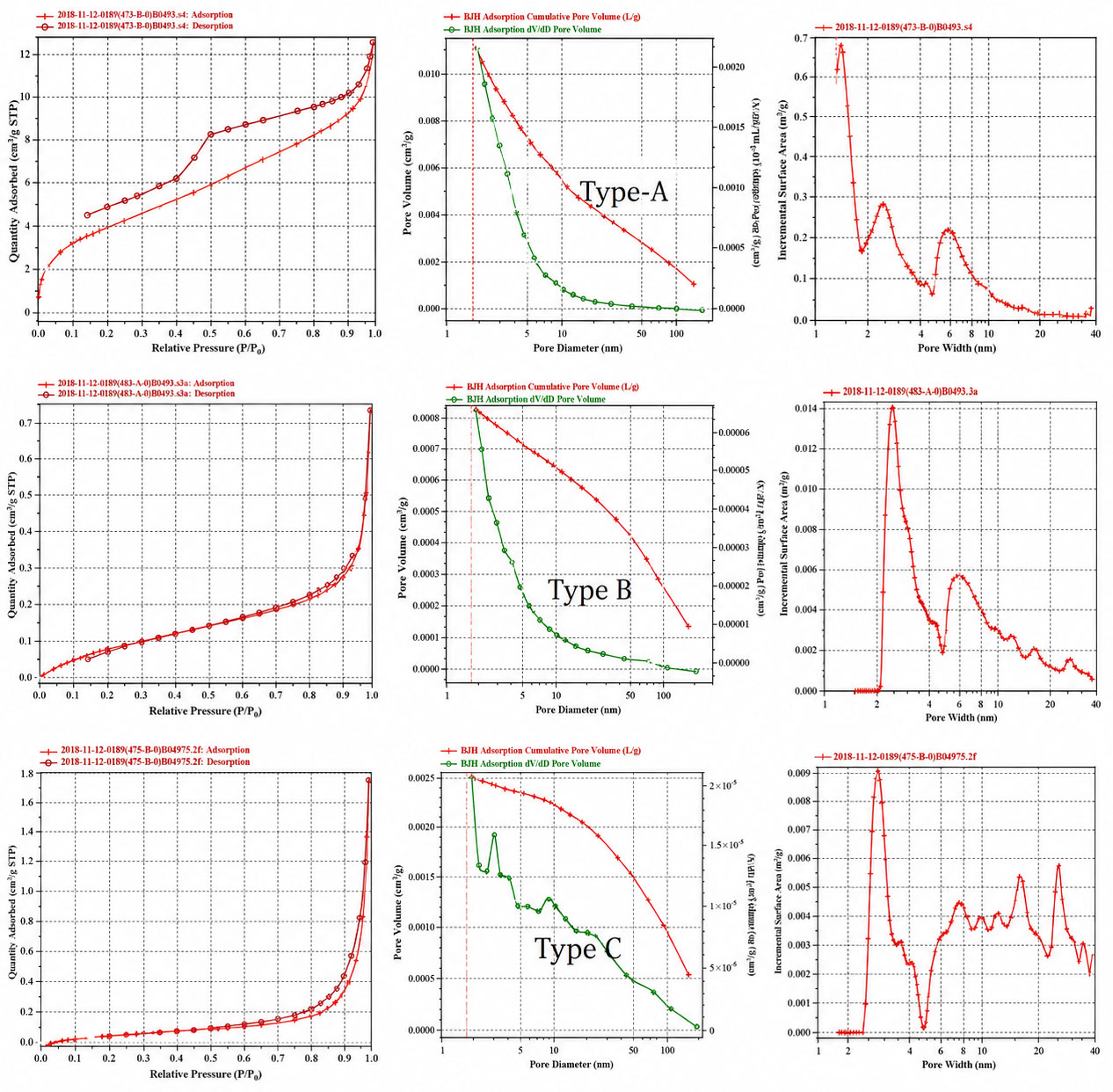
The Junggar Basin contains widely distributed Jurassic low-rank coal seams (Badaowan Fm. J\(_1\)b, Xishanyao Fm. J\(_2\)x) with abundant coalbed methane (CBM) resources. Integrating proximate analysis, maceral identification, vitrinite reflectance, low-temperature N\(_2\) adsorption, high-pressure mercury intrusion, and NMR, this study characterizes the petrological properties, pore-space characteristics, and gas storage mechanisms of J\(_1\)b and J\(_2\)x low-rank coals in the Baijiahai-Dinan area. Results show: J\(_1\)b is bright coal (vitrinite: 74.1%-88.3%, R\(_o\): 0.67%), while J\(_2\)x ranges from semibright to dull coal (vitrinite: 57.2%, R\(_o\): 0.71%), corresponding to long-flame coal-lignite stage. J\(_2\)x coal exhibits better reservoir properties (porosity: 9.4%; permeability: 19.64 mD) with well-developed meso/macropores favorable for free-gas storage; J\(_1\)b coal has abundant micropores offering greater adsorption capacity. Low-temperature N\(_2\) adsorption curves classify pores as Type A (cylindrical/slit-shaped), B (parallel-plate/wedge-shaped), and C (closed-end wedge-shaped), with J\(_2\)x showing more diverse pore types and higher meso/macropore proportions. A hierarchical adsorption model for low-rank coal was developed: micropores fill rapidly at low pressure, transition pores approach monolayer saturation, and meso/macropores remain in unsaturated monolayer adsorption. Critical desorption pressures are 3.7-4.7 MPa for J\(_2\)x and 4.5-6.8 MPa for J\(_1\)b. Free-gas storage is controlled by both microscopic pore competition and macroscopic geological conditions. This study provides a key reference for CBM exploration and development in the Baijiahai-Dinan area.
Graphical Abstract
Keywords
Data Availability Statement
Funding
Conflicts of Interest
AI Use Statement
Ethical Approval and Consent to Participate
References
- Changbo, C., Hulin, Y., Fubing, L., Chenglin, L., Jie, Z., & Yuxi, L. (2008). Exploration and development prospects of coal bed methane (CBM) resources in China. China Mining Magazine, 17(5), 1-4. http://www.chinaminingmagazine.com/en/article/id/314d5457-ffc4-4132-884d-542c2fae9e97
[Google Scholar] - Wang, Y. T., Xie, S., Liu, Q. Y., He, L. J., & Meng, Q. H. (2002). Analysis of low-rank coalbed methane resources and exploration potential in Junggar Basin. Journal of Xinjiang Petroleum Institute, 2002(3), 5-7+12. https://caod.oriprobe.com/articles/17465918/The_Analysis_of_the_Resources_and_Exploration_Pote.htm
[Google Scholar] - Luo, B., Wang, H., Sun, B., Ouyang, Z., Yang, M., Wang, Y., & Zhou, X. (2024). Gas Content and Geological Control of Deep Jurassic Coalbed Methane in Baijiahai Uplift, Junggar Basin. Processes, 12(12), 2671.
[CrossRef] [Google Scholar] - Yuan, Y. U. A. N., Shan, Y., Tang, Y., & Cao, D. (2020). Coalbed methane enrichment regularity and major control factors in the Xishanyao Formation in the western part of the southern Junggar Basin. Acta Geologica Sinica‐English Edition, 94(2), 485-500.
[CrossRef] [Google Scholar] - Bustin, R. M., & Clarkson, C. R. (1998). Geological controls on coalbed methane reservoir capacity and gas content. International Journal of Coal Geology, 38(1-2), 3-26.
[CrossRef] [Google Scholar] - Moore, T. A. (2012). Coalbed methane: A review. International Journal of Coal Geology, 101, 36-81.
[CrossRef] [Google Scholar] - Clarkson, C. R., & Bustin, R. M. (2011). Coalbed methane: current field-based evaluation methods. SPE Reservoir Evaluation & Engineering, 14(01), 60-75.
[CrossRef] [Google Scholar] - Cao, D. Y., Yao, Z., & Li, J. (2014). Evaluation status and development trend of unconventional gas in coal measure. Coal Sci. Technol, 42(1), 89-92. https://www.mtkxjs.com.cn/en/article/id/ae5aef03-cda4-4b01-841d-9d78dd5ee301
[Google Scholar] - Clarkson, C. R., & Bustin, R. M. (1999). The effect of pore structure and gas pressure upon the transport properties of coal: a laboratory and modeling study. 2. Adsorption rate modeling. Fuel, 78(11), 1345-1362.
[CrossRef] [Google Scholar] - Fu, H., Tang, D., Xu, T., Xu, H., Tao, S., Li, S., ... & Wang, L. (2017). Characteristics of pore structure and fractal dimension of low-rank coal: A case study of Lower Jurassic Xishanyao coal in the southern Junggar Basin, NW China. Fuel, 193, 254-264.
[CrossRef] [Google Scholar] - Fu, H., Tang, D., Xu, H., Xu, T., Chen, B., Hu, P., ... & He, G. (2016). Geological characteristics and CBM exploration potential evaluation: A case study in the middle of the southern Junggar Basin, NW China. Journal of Natural Gas Science and Engineering, 30, 557-570.
[CrossRef] [Google Scholar] - Carroll, A. R., Graham, S. A., & Smith, M. E. (2010). Walled sedimentary basins of China. Basin Research, 22(1), 17-32.
[CrossRef] [Google Scholar] - Li, X., Chen, G., Wu, C., Li, J., Haproff, P. J., Geng, M., ... & Yang, D. (2023). Tectono-stratigraphic framework and evolution of east Junggar Basin, central asia. Tectonophysics, 851, 229758.
[CrossRef] [Google Scholar] - Zhang, B., Tao, S., Sun, B., Tang, S., Chen, S., Wen, Y., & Ye, J. (2024). Genesis and accumulation mechanism of external gas in deep coal seams of the Baijiahai Uplift, Junggar Basin, China. International Journal of Coal Geology, 286, 104506.
[CrossRef] [Google Scholar] - Clarkson, C. R., & Bustin, R. M. (1999). The effect of pore structure and gas pressure upon the transport properties of coal: a laboratory and modeling study. 1. Isotherms and pore volume distributions. Fuel, 78(11), 1333-1344.
[CrossRef] [Google Scholar] - Tao, S., Chen, S., Tang, D., Zhao, X., Xu, H., & Li, S. (2018). Material composition, pore structure and adsorption capacity of low-rank coals around the first coalification jump: A case of eastern Junggar Basin, China. Fuel, 211, 804-815.
[CrossRef] [Google Scholar] - Yao, Y., Liu, D., Cai, Y., & Li, J. (2010). Advanced characterization of pores and fractures in coals by nuclear magnetic resonance and X-ray computed tomography. Science China Earth Sciences, 53(6), 854-862.
[CrossRef] [Google Scholar] - Yao, Y., & Liu, D. (2012). Comparison of low-field NMR and mercury intrusion porosimetry in characterizing pore size distributions of coals. Fuel, 95, 152-158.
[CrossRef] [Google Scholar] - Li, Y., Zhang, C., Tang, D., Gan, Q., Niu, X., Wang, K., & Shen, R. (2017). Coal pore size distributions controlled by the coalification process: An experimental study of coals from the Junggar, Ordos and Qinshui basins in China. Fuel, 206, 352-363.
[CrossRef] [Google Scholar] - Cai, Y., Liu, D., Pan, Z., Yao, Y., Li, J., & Qiu, Y. (2013). Pore structure and its impact on CH4 adsorption capacity and flow capability of bituminous and subbituminous coals from Northeast China. Fuel, 103, 258-268.
[CrossRef] [Google Scholar]
Cite This Article
TY  - JOUR
AU  - Chen, Yuqing
AU  - Wang, Yi
PY  - 2026
DA  - 2026/09/02
TI  - Study on Reservoir Space Characteristics and Gas Storage Mechanism of Low-Rank Coal Reservoir in Junggar Basin
JO  - Journal of Geo-Energy and Environment
T2  - Journal of Geo-Energy and Environment
JF  - Journal of Geo-Energy and Environment
VL  - 3
IS  - 1
SP  - 1
EP  - 15
DO  - 10.62762/JGEE.2026.780406
UR  - https://www.icck.org/article/abs/JGEE.2026.780406
KW  - junggar basin
KW  - low-rank coal
KW  - pore space
KW  - pore structure
KW  - gas storage mechanism
KW  - adsorbed gas
KW  - free gas
AB  - The Junggar Basin contains widely distributed Jurassic low-rank coal seams (Badaowan Fm. J\(_1\)b, Xishanyao Fm. J\(_2\)x) with abundant coalbed methane (CBM) resources. Integrating proximate analysis, maceral identification, vitrinite reflectance, low-temperature N\(_2\) adsorption, high-pressure mercury intrusion, and NMR, this study characterizes the petrological properties, pore-space characteristics, and gas storage mechanisms of J\(_1\)b and J\(_2\)x low-rank coals in the Baijiahai-Dinan area. Results show: J\(_1\)b is bright coal (vitrinite: 74.1%-88.3%, R\(_o\): 0.67%), while J\(_2\)x ranges from semibright to dull coal (vitrinite: 57.2%, R\(_o\): 0.71%), corresponding to long-flame coal-lignite stage. J\(_2\)x coal exhibits better reservoir properties (porosity: 9.4%; permeability: 19.64 mD) with well-developed meso/macropores favorable for free-gas storage; J\(_1\)b coal has abundant micropores offering greater adsorption capacity. Low-temperature N\(_2\) adsorption curves classify pores as Type A (cylindrical/slit-shaped), B (parallel-plate/wedge-shaped), and C (closed-end wedge-shaped), with J\(_2\)x showing more diverse pore types and higher meso/macropore proportions. A hierarchical adsorption model for low-rank coal was developed: micropores fill rapidly at low pressure, transition pores approach monolayer saturation, and meso/macropores remain in unsaturated monolayer adsorption. Critical desorption pressures are 3.7-4.7 MPa for J\(_2\)x and 4.5-6.8 MPa for J\(_1\)b. Free-gas storage is controlled by both microscopic pore competition and macroscopic geological conditions. This study provides a key reference for CBM exploration and development in the Baijiahai-Dinan area.
SN  - 3069-3268
PB  - Institute of Central Computation and Knowledge
LA  - English
ER  -
@article{Chen2026Study,
  author = {Yuqing Chen and Yi Wang},
  title = {Study on Reservoir Space Characteristics and Gas Storage Mechanism of Low-Rank Coal Reservoir in Junggar Basin},
  journal = {Journal of Geo-Energy and Environment},
  year = {2026},
  volume = {3},
  number = {1},
  pages = {1-15},
  doi = {10.62762/JGEE.2026.780406},
  url = {https://www.icck.org/article/abs/JGEE.2026.780406},
  abstract = {The Junggar Basin contains widely distributed Jurassic low-rank coal seams (Badaowan Fm. J\(\_1\)b, Xishanyao Fm. J\(\_2\)x) with abundant coalbed methane (CBM) resources. Integrating proximate analysis, maceral identification, vitrinite reflectance, low-temperature N\(\_2\) adsorption, high-pressure mercury intrusion, and NMR, this study characterizes the petrological properties, pore-space characteristics, and gas storage mechanisms of J\(\_1\)b and J\(\_2\)x low-rank coals in the Baijiahai-Dinan area. Results show: J\(\_1\)b is bright coal (vitrinite: 74.1\%-88.3\%, R\(\_o\): 0.67\%), while J\(\_2\)x ranges from semibright to dull coal (vitrinite: 57.2\%, R\(\_o\): 0.71\%), corresponding to long-flame coal-lignite stage. J\(\_2\)x coal exhibits better reservoir properties (porosity: 9.4\%; permeability: 19.64 mD) with well-developed meso/macropores favorable for free-gas storage; J\(\_1\)b coal has abundant micropores offering greater adsorption capacity. Low-temperature N\(\_2\) adsorption curves classify pores as Type A (cylindrical/slit-shaped), B (parallel-plate/wedge-shaped), and C (closed-end wedge-shaped), with J\(\_2\)x showing more diverse pore types and higher meso/macropore proportions. A hierarchical adsorption model for low-rank coal was developed: micropores fill rapidly at low pressure, transition pores approach monolayer saturation, and meso/macropores remain in unsaturated monolayer adsorption. Critical desorption pressures are 3.7-4.7 MPa for J\(\_2\)x and 4.5-6.8 MPa for J\(\_1\)b. Free-gas storage is controlled by both microscopic pore competition and macroscopic geological conditions. This study provides a key reference for CBM exploration and development in the Baijiahai-Dinan area.},
  keywords = {junggar basin, low-rank coal, pore space, pore structure, gas storage mechanism, adsorbed gas, free gas},
  issn = {3069-3268},
  publisher = {Institute of Central Computation and Knowledge}
}
Article Metrics
Publisher's Note
ICCK stays neutral with regard to jurisdictional claims in published maps and institutional affiliations.
Rights and Permissions
 Copyright © 2026 by the Author(s). Published by Institute of Central Computation and Knowledge. This article is an open access article distributed under the terms and conditions of the Creative Commons Attribution (CC BY) license (https://creativecommons.org/licenses/by/4.0/), which permits use, sharing, adaptation, distribution and reproduction in any medium or format, as long as you give appropriate credit to the original author(s) and the source, provide a link to the Creative Commons licence, and indicate if changes were made.


Portico
