

Comprehensive Provenance Analysis of the Es3$^3$ Sub - Member in the Eastern Shichang Sub - Sag, Nanpu Sag, Bohai Bay Basin


Article Information
Abstract
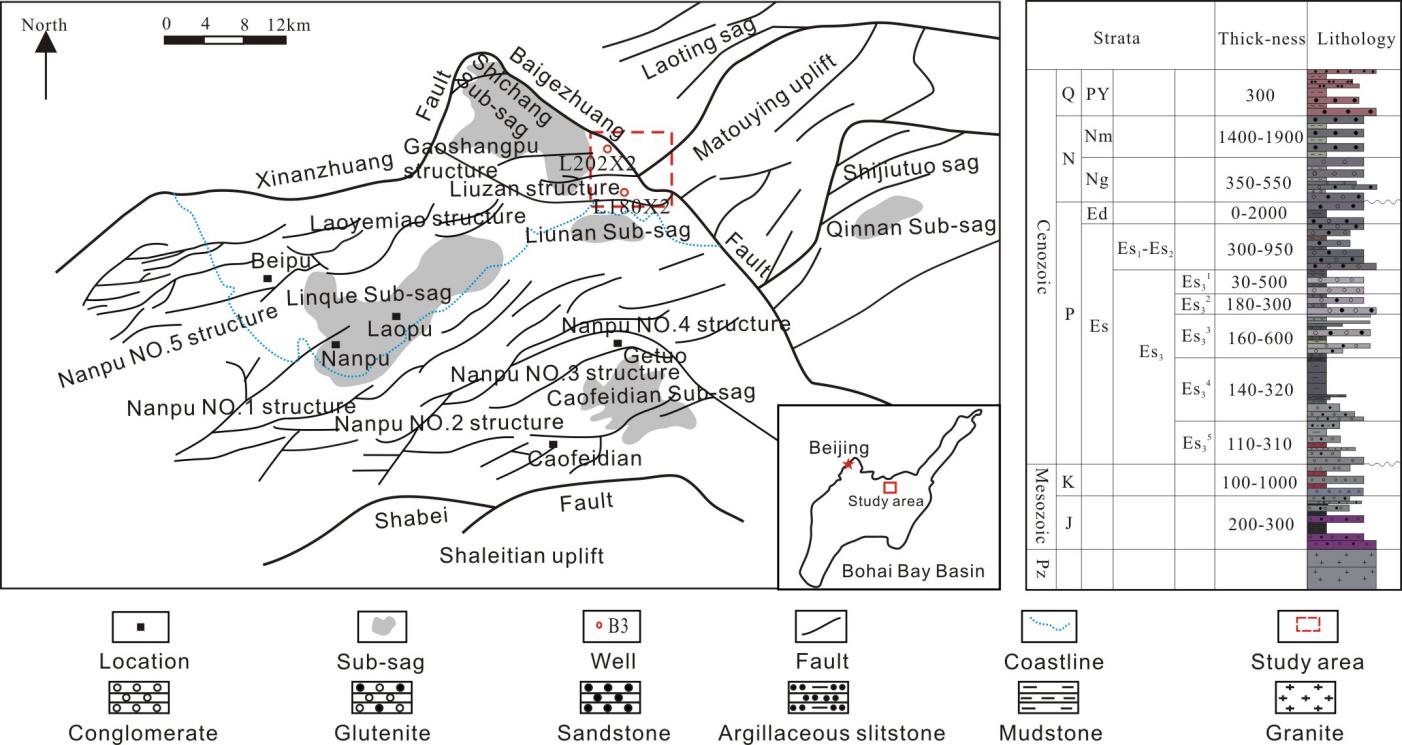
The eastern part of the Shichang Sub-sag in the Nanpu Sag is influenced by multiple provenance systems. However, there are divergent opinions regarding the directions of sediment supply and the relative contributions of different provenances to this area, which have led to controversies over the types of slope-breaks, the depositional models, and the sand-body distribution under different provenance regimes. These uncertainties have severely constrained the exploration of lithologic hydrocarbon reservoirs in the western slope area of the sub-sag. The provenance systems and the distribution range of sand bodies were clarified through Dickinson ternary diagrams, seismic reflection characteristics, as well as analyzing rock clastic grain components, heavy mineral assemblages, and sandbody distribution patterns. Research revealed that there are two main provenance areas supplying the Es3$^3$ submember in the eastern Shichang Subsag: one originating from the northeast and the other from the east. The ZTR index and sandbody distribution patterns indicate that the northeastern provenance exerts a widespread influence over the eastern Shichang Sub-sag and serves as the dominant sediment-supply area, whereas the eastern provenance has a comparatively limited impact. The northeastern provenance in the eastern part of the Shichang Sub-sag controls the fan-delta sand bodies on the western slope, which are favorable zones for lithologic reservoir development, whereas the eastern provenance controls the fan‑delta front sand bodies in the eastern sector, which are favorable zones for structural reservoir development. Provenance system determination in the eastern Shichang Subsag provides a reference for studying sedimentary systems and sandbody distribution under varying slope-break types and provenance controls, and additionally provides guidance for reserve growth and production enhancement efforts in the eastern Shichang Sub-sag.
Graphical Abstract
Keywords
Data Availability Statement
Funding
Conflicts of Interest
AI Use Statement
Ethical Approval and Consent to Participate
References
- Weltje, G. J., & von Eynatten, H. (2004). Quantitative provenance analysis of sediments: review and outlook. Sedimentary Geology, 171(1-4), 1-11.
[CrossRef] [Google Scholar] - Dickinson, W. R. (1985). Interpreting provenance relations from detrital modes of sandstones. In Provenance of arenites (pp. 333-361). Dordrecht: Springer Netherlands.
[CrossRef] [Google Scholar] - Crook, K. A. W. (1974). Lithogenesis and geotectonics: The significance of compositional variation in flysch arenites (graywackes). Special Publications, 19, 304–310.
[CrossRef] [Google Scholar] - Morton, A. C. (1985). A new approach to provenance studies: electron microprobe analysis of detrital garnets from Middle Jurassic sandstones of the northern North Sea. Sedimentology, 32(4), 553-566.
[CrossRef] [Google Scholar] - Blatt, H. (1973). Origin of sedimentary rocks. Soil Science, 115(5), 400. https://www.ovid.com/00010694-197305000-00019
[Google Scholar] - Bhatia, M. R. (1983). Plate tectonics and geochemical composition of sandstones. The Journal of geology, 91(6), 611-627.
[CrossRef] [Google Scholar] - Bhatia, M. R., & Crook, K. A. (1986). Trace element characteristics of graywackes and tectonic setting discrimination of sedimentary basins. Contributions to mineralogy and petrology, 92(2), 181-193.
[CrossRef] [Google Scholar] - Morton, A. C., & Hallsworth, C. R. (1999). Processes controlling the composition of heavy mineral assemblages in sandstones. Sedimentary geology, 124(1-4), 3-29.
[CrossRef] [Google Scholar] - von Eynatten, H., & Dunkl, I. (2012). Assessing the sediment factory: the role of single grain analysis. Earth-Science Reviews, 115(1-2), 97-120.
[CrossRef] [Google Scholar] - Zhang, Z., & Wang, H. (2019). Comprehensive Provenance Analysis and Its Applications to Eocene Clastic Rocks in the Huimin Depression, Bohai Bay Basin, China. Minerals, 9(9), 517.
[CrossRef] [Google Scholar] - Liu, Q., Zhu, X., Zhou, Z., Bao, Y., & Shi, W. (2023). Provenance identification and source-to-sink studies from an intrabasinal subaqueous uplift in the Eocene western Bohai Bay Basin, eastern north China. Marine and Petroleum Geology, 149, 106087.
[CrossRef] [Google Scholar] - Tolosana-Delgado, R., von Eynatten, H., Krippner, A., & Meinhold, G. (2018). A multivariate discrimination scheme of detrital garnet chemistry for use in sedimentary provenance analysis. Sedimentary Geology, 375, 14-26.
[CrossRef] [Google Scholar] - Krippner, A., Meinhold, G., Morton, A. C., & von Eynatten, H. (2014). Evaluation of garnet discrimination diagrams using geochemical data of garnets derived from various host rocks. Sedimentary Geology, 306, 36-52.
[CrossRef] [Google Scholar] - Meinhold, G. (2010). Rutile and its applications in earth sciences. Earth-Science Reviews, 102(1-2), 1-28.
[CrossRef] [Google Scholar] - Fu, C., Li, S., Li, S., & Xu, J. (2022). Tectonostratigraphic evolution of a rift basin and corresponding source-to-sink systems: Implications for the western Bohai Bay Basin, North China. Marine and Petroleum Geology, 139, 105587.
[CrossRef] [Google Scholar] - Qin, Y., Zhu, X., Zhu, S., Tan, C., Zhang, S., Zhu, J., ... & Zhao, F. (2024). Evolution of provenance and sedimentary records in multiphase rift basins: Insights from petrology, detrital zircon geochronology, and seismic reflections of Oligocene Liaozhong Depression, Bohai Bay Basin, China. Marine and Petroleum Geology, 163, 106789.
[CrossRef] [Google Scholar] - Wang, J., He, Y., Li, H., Guo, T., Guan, D., Huang, X., ... & Chen, Q. (2025). Synergistic Detrital Zircon U-Pb and REE Analysis for Provenance Discrimination of the Beach-Bar System in the Oligocene Dongying Formation, HHK Depression, Bohai Bay Basin, China. Journal of Marine Science and Engineering, 13(7), 1331.
[CrossRef] [Google Scholar] - Liu, L., Liu, Z., Zhao, R., Li, X., Li, X., Luo, X., ... & Liu, T. (2024). The source-to-sink character of the Shahejie formation in the Shulu slope, Bohai Bay basin, China. Russian Geology and Geophysics, 65(9), 1098-1109.
[CrossRef] [Google Scholar] - Feng, B., He, Y., Li, H., Li, T., Du, X., Huang, X., & Zhou, X. (2023). Paleogeographic reconstruction of an ancient source-to-sink system in a lacustrine basin from the Paleogene Shahejie formation in the Miaoxibei area (Bohai Bay basin, east China). Frontiers in Earth Science, 11, 1247723.
[CrossRef] [Google Scholar] - Fossum, K., Morton, A. C., Dypvik, H., & Hudson, W. E. (2019). Integrated heavy mineral study of Jurassic to Paleogene sandstones in the Mandawa Basin, Tanzania: Sediment provenance and source-to-sink relations. Journal of African Earth Sciences, 150, 546-565.
[CrossRef] [Google Scholar] - Akinlotan, O. O., & Rogers, G. H. (2021). Heavy mineral constraints on the provenance evolution of the English Lower Cretaceous (Wessex Basin). Marine and Petroleum Geology, 127, 104952.
[CrossRef] [Google Scholar] - Ding, X., Tian, J., Chen, J., Yao, J., Deng, X., & Li, Y. (2015). Paleogeographic framework and provenance features during late Triassic Chang 9 time of the Yanchang formation, Ordos basin, China. Arabian Journal of Geosciences, 8(9), 6731-6743.
[CrossRef] [Google Scholar] - Jiang, R., Liu, Z., Xia, S., Zhu, M., Tang, J., Wu, G., & Wu, W. (2024). A Multi-Faceted Approach to Determining the Provenance of the Lacustrine Rift Basin in the Initial Rifting Stage: A Case Study of the Paleocene Qintong Sag, Subei Basin, East China. Minerals, 14(4), 420.
[CrossRef] [Google Scholar] - Chen, S., Zhao, R., Chen, C., Wang, H., Ma, J., Gong, T., & Yu, Z. (2023). Tectono-sedimentary evolution of the Paleogene Qikou Sag, Bohai Bay Basin, NE China. Marine and Petroleum Geology, 148, 106057.
[CrossRef] [Google Scholar] - Liu, L., Liu, Z., Zhao, R., Cong, L., Liu, X., Xin, S., & Mu, Z. (2025). The source-to-sink system in continental rift lacustrine basins of the Nantun Formation in X Sag of the Tamtsag Basin, Mongolia. Scientific reports, 15(1), 25354.
[CrossRef] [Google Scholar] - Yao, Z., Yu, H., Yang, F., Jianatayi, D., Zhang, B., Li, T., ... & Zhao, W. (2023). Provenance, depositional environment, and paleoclimatic conditions of a Near-Source fan delta: A case study of the permian Jiamuhe formation in the Shawan sag, Junggar basin. Minerals, 13(10), 1251.
[CrossRef] [Google Scholar] - Cheng, Y., Wang, Z., Liu, J., Wu, Q., Yu, S., Ma, X., ... & Zhang, Y. (2023). Sequence architecture, depositional system evolution and controlling factors in a lacustrine basin: a case study from Changdi Area, Bohai Bay Basin, Eastern China. Journal of Geophysics and Engineering, 20(2), 255-273.
[CrossRef] [Google Scholar] - Lei, C., Yin, S., Shi, S., & Meng, L. (2021). Depositional environment and sediment provenance of the third member of the Palaeogene Shahejie Formation in the Nanpu Sag of the Bohai Bay Basin, eastern China: Evidence from trace and rare earth element geochemistry. Geological Journal, 56(11), 5780-5791.
[CrossRef] [Google Scholar] - Liu, S., Lin, G., Liu, Y., Zhou, Y., Gong, F., & Yan, Y. (2007). Geochemistry of middle oligocene-pliocene sandstones from the Nanpu Sag, Bohai Bay Basin (Eastern China): Implications for provenance, weathering, and tectonic setting. Geochemical Journal, 41(5), 359-378.
[CrossRef] [Google Scholar] - Lu, C., Liu, Z., Jia, H., Dai, Q., Li, M., Ren, M., ... & Wang, S. (2018). The controls of geomorphology and sediment supply on sequence stratigraphic architecture and sediment partitioning of the lacustrine rift basin in the Es3 of Liuzan area, Nanpu Sag, Bohai Bay Basin, China. Australian Journal of Earth Sciences, 65(2), 275-301.
[CrossRef] [Google Scholar] - Zhang, H., Lan, Z., Li, X., & Huang, X. (2021). The Sedimentary Facies and Evolution Characteristics of the Middle and Deep Strata in the Nanpu No. 3 Structural Area. Frontiers in Earth Science, 9, 703070.
[CrossRef] [Google Scholar] - Dong, Y., Xiao, L., Zhou, H., Wang, C., Zheng, J., Zhang, N., ... & Huang, H. (2010). The Tertiary evolution of the prolific Nanpu Sag of Bohai Bay Basin, China: Constraints from volcanic records and tectono-stratigraphic sequences. Bulletin, 122(3-4), 609-626.
[CrossRef] [Google Scholar] - Sun, Z., Lin, S., Wang, G., Liu, L., & Wang, M. (2024). Sedimentary evolution pattern influenced by sequence stratigraphy: a case study of the Nanpu Sag, Bohai Bay Basin, China. Geoscience Letters, 11(1), 30.
[CrossRef] [Google Scholar] - Ren, M. Y., Jiang, Q. C., Liu, Z., & Wang, H. (2020). Sequence architecture and structural response of the third member of Shahejie Formation in Liuzan area, Nanpu Sag. Lithologic Reservoirs, 32(3), 93–103.
[CrossRef] [Google Scholar] - Kang, H. T., Wang, H. Y., Fan, T. L., & Liu, Y. (2015). Structure-sequence stratigraphic characteristics of the third member of Shahejie Formation in Gaoliu area, Nanpu Sag. Lithologic Reservoirs, 27(6), 30–37, 47. http://www.yxyqc.net/CN/10.3969/j.issn.1673-8926.2015.06.005
[Google Scholar] - Yu, J., Liu, T., Jia, H., Jiang, Z., Wei, S., Li, Y., & Ma, S. (2021). Controlling factors analyses of sediment dispersal from source-to-Sink systems of Lacustrine Rift Basin: a Case Study from Paleogene Shahejie-Dongying formations of Nanpu Sag, Eastern China. Frontiers in Earth Science, 9, 716176.
[CrossRef] [Google Scholar] - Liu, L., Chen, H., Zhong, Y., Wang, J., Du, X., & Zou, H. (2021). Depositional architectures and sedimentation processes in strike-slip extensional basins: Examples from the Oligocene of the Liaodong Bay Sub-basin, Bohai Bay Basin, China. Marine and Petroleum Geology, 123, 104788.
[CrossRef] [Google Scholar] - Lin, C. S., Xia, Q. L., Shi, H. S., & Zhang, L. (2015). Geomorphological evolution, source to sink system and basin analysis. Earth Science Frontiers, 22(1), 9–20. https://www.earthsciencefrontiers.net.cn/CN/10.13745/j.esf.2015.01.002
[Google Scholar] - Liu, J. E., Jian, X. L., Kang, B., & Li, Y. (2014). Paleogeomorphology of the middle part of 3rd member of Shahejie formation and their effects on depositional systems, Dongying delta, Dongying depression. Petroleum Geology and Recovery Efficiency, 21(1), 20–23. https://yqcs.publish.founderss.cn/thesisDetails?columnId=62002395&Fpath=home&index=0&lang=en
[Google Scholar] - Zhu, X., Liu, Y., Gao, X., Xia, M., Zha, X., & Luo, J. (2024). Geochemistry, sedimentary environment and source characteristics of the Lower Jurassic Sangonghe Formation in the southern margin of Junggar Basin. Xinjiang Geology, 42(1), 33-40. https://www.sciengine.com/XG/doi/10.0000/1000-8845(2024)01-033-08
[Google Scholar] - Tian, J. C., Wu, Q., Wang, F., & Wang, H. (2011). Research on development factors and the depositional model of large area reservoir sandstones of He8 section of Xiashihezi Formation of Permian in Ordos basin. Acta Petrologica Sinica, 27(8), 2403–2412. http://www.ysxb.ac.cn/en/article/id/aps_20110817?viewType=HTML
[Google Scholar] - Shi, G. Z., Wang, H., Xu, B., & Chen, J. (2011). Activity of Baigezhuang Fault of Nanpu Depression and its controlling on sedimentation. Acta Scientiarum Naturalium Universitatis Pekinensis, 47(1), 85–90. https://xbna.pku.edu.cn/EN/Y2011/V47/I1/85
[Google Scholar] - Dickinson, W. R., Beard, L. S., Brakenridge, G. R., Erjavec, J. L., Ferguson, R. C., Inman, K. F., ... & Ryberg, P. T. (1983). Provenance of North American Phanerozoic sandstones in relation to tectonic setting. Geological Society of America Bulletin, 94(2), 222-235.
[CrossRef] [Google Scholar] - Caracciolo, L. (2020). Sediment generation and sediment routing systems from a quantitative provenance analysis perspective: Review, application and future development. Earth-Science Reviews, 209, 103226.
[CrossRef] [Google Scholar] - Yang, K., Zhu, X., Colombera, L., McArthur, A., Mountney, N. P., Zhu, S., ... & Jin, X. (2023). Sediment provenance and dispersal in the early Eocene Dongying Depression, Bohai Bay Basin, Eastern China: Evidence from detrital zircon geochronology, geochemistry and petrology. Sedimentary Geology, 454, 106453.
[CrossRef] [Google Scholar] - Guan, X., Wu, C., Zhang, X., Jia, W., & Zhang, W. (2022). Sedimentary and Source-to-Sink Evolution of Intracontinental Basins: Implications for tectonic and Climate Evolution in the Late Mesozoic (Southern Junggar Basin, NW China). Frontiers in Earth Science, 9, 785659.
[CrossRef] [Google Scholar] - Morton, A. C., & Hallsworth, C. (2007). Stability of detrital heavy minerals during burial diagenesis. Developments in sedimentology, 58, 215-245.
[CrossRef] [Google Scholar] - Zheng, Y., & Kong, P. (2013). Provenance and origin of the Late Cenozoic Dayi conglomerates in the western margin of the Sichuan Basin: New insights from heavy mineral and spore-pollen assemblages. Acta Petrologica Sinica, 29(8), 2949–2958. https://www.sciengine.com/APS/doi/10.0000/577416b2bda44f7f8e268228f6806156
[Google Scholar] - Garzanti, E., & Andò, S. (2019). Heavy minerals for junior woodchucks. Minerals, 9(3), 148.
[CrossRef] [Google Scholar] - Xiong, L., Yu, H., Xu, J., Zhu, R., Lei, Z., & Du, W. (2025). Analysis of Cenozoic Structural Evolution and Basin Formation Models in the Nanpu Sag, Bohai Bay Basin, China. Geosciences, 15(12), 466.
[CrossRef] [Google Scholar]
Cite This Article
TY  - JOUR
AU  - Li, Hening
AU  - Wang, Shilin
AU  - Dang, Yijia
AU  - Pan, Liao
AU  - Luo, Mei
AU  - Yang, Tao
AU  - Ye, Ximing
PY  - 2026
DA  - 2026/09/21
TI  - Comprehensive Provenance Analysis of the Es3$^3$ Sub - Member in the Eastern Shichang Sub - Sag, Nanpu Sag, Bohai Bay Basin
JO  - Journal of Geo-Energy and Environment
T2  - Journal of Geo-Energy and Environment
JF  - Journal of Geo-Energy and Environment
VL  - 3
IS  - 1
SP  - 16
EP  - 27
DO  - 10.62762/JGEE.2026.797398
UR  - https://www.icck.org/article/abs/JGEE.2026.797398
KW  - provenance
KW  - detrital grain
KW  - comprehensive
KW  - sedimentary facies
KW  - Es3$^3$ submember
KW  - Shichang Subsag
AB  - The eastern part of the Shichang Sub-sag in the Nanpu Sag is influenced by multiple provenance systems. However, there are divergent opinions regarding the directions of sediment supply and the relative contributions of different provenances to this area, which have led to controversies over the types of slope-breaks, the depositional models, and the sand-body distribution under different provenance regimes. These uncertainties have severely constrained the exploration of lithologic hydrocarbon reservoirs in the western slope area of the sub-sag. The provenance systems and the distribution range of sand bodies were clarified through Dickinson ternary diagrams, seismic reflection characteristics, as well as analyzing rock clastic grain components, heavy mineral assemblages, and sandbody distribution patterns. Research revealed that there are two main provenance areas supplying the Es3$^3$ submember in the eastern Shichang Subsag: one originating from the northeast and the other from the east. The ZTR index and sandbody distribution patterns indicate that the northeastern provenance exerts a widespread influence over the eastern Shichang Sub-sag and serves as the dominant sediment-supply area, whereas the eastern provenance has a comparatively limited impact. The northeastern provenance in the eastern part of the Shichang Sub-sag controls the fan-delta sand bodies on the western slope, which are favorable zones for lithologic reservoir development, whereas the eastern provenance controls the fan‑delta front sand bodies in the eastern sector, which are favorable zones for structural reservoir development. Provenance system determination in the eastern Shichang Subsag provides a reference for studying sedimentary systems and sandbody distribution under varying slope-break types and provenance controls, and additionally provides guidance for reserve growth and production enhancement efforts in the eastern Shichang Sub-sag.
SN  - 3069-3268
PB  - Institute of Central Computation and Knowledge
LA  - English
ER  -
@article{Li2026Comprehens,
  author = {Hening Li and Shilin Wang and Yijia Dang and Liao Pan and Mei Luo and Tao Yang and Ximing Ye},
  title = {Comprehensive Provenance Analysis of the Es3\$^3\$ Sub - Member in the Eastern Shichang Sub - Sag, Nanpu Sag, Bohai Bay Basin},
  journal = {Journal of Geo-Energy and Environment},
  year = {2026},
  volume = {3},
  number = {1},
  pages = {16-27},
  doi = {10.62762/JGEE.2026.797398},
  url = {https://www.icck.org/article/abs/JGEE.2026.797398},
  abstract = {The eastern part of the Shichang Sub-sag in the Nanpu Sag is influenced by multiple provenance systems. However, there are divergent opinions regarding the directions of sediment supply and the relative contributions of different provenances to this area, which have led to controversies over the types of slope-breaks, the depositional models, and the sand-body distribution under different provenance regimes. These uncertainties have severely constrained the exploration of lithologic hydrocarbon reservoirs in the western slope area of the sub-sag. The provenance systems and the distribution range of sand bodies were clarified through Dickinson ternary diagrams, seismic reflection characteristics, as well as analyzing rock clastic grain components, heavy mineral assemblages, and sandbody distribution patterns. Research revealed that there are two main provenance areas supplying the Es3\$^3\$ submember in the eastern Shichang Subsag: one originating from the northeast and the other from the east. The ZTR index and sandbody distribution patterns indicate that the northeastern provenance exerts a widespread influence over the eastern Shichang Sub-sag and serves as the dominant sediment-supply area, whereas the eastern provenance has a comparatively limited impact. The northeastern provenance in the eastern part of the Shichang Sub-sag controls the fan-delta sand bodies on the western slope, which are favorable zones for lithologic reservoir development, whereas the eastern provenance controls the fan‑delta front sand bodies in the eastern sector, which are favorable zones for structural reservoir development. Provenance system determination in the eastern Shichang Subsag provides a reference for studying sedimentary systems and sandbody distribution under varying slope-break types and provenance controls, and additionally provides guidance for reserve growth and production enhancement efforts in the eastern Shichang Sub-sag.},
  keywords = {provenance, detrital grain, comprehensive, sedimentary facies, Es3\$^3\$ submember, Shichang Subsag},
  issn = {3069-3268},
  publisher = {Institute of Central Computation and Knowledge}
}
Article Metrics
Publisher's Note
ICCK stays neutral with regard to jurisdictional claims in published maps and institutional affiliations.
Rights and Permissions
 Copyright © 2026 by the Author(s). Published by Institute of Central Computation and Knowledge. This article is an open access article distributed under the terms and conditions of the Creative Commons Attribution (CC BY) license (https://creativecommons.org/licenses/by/4.0/), which permits use, sharing, adaptation, distribution and reproduction in any medium or format, as long as you give appropriate credit to the original author(s) and the source, provide a link to the Creative Commons licence, and indicate if changes were made.


Portico
