Volume 1, Issue 1, PWU Journal of Research, Innovation, and Transformation
Volume 1, Issue 1, 2026
Submit Manuscript Edit a Special Issue
Article QR Code
Article QR Code
Scan the QR code for reading
Popular articles
PWU Journal of Research, Innovation, and Transformation, Volume 1, Issue 1, 2026: 49-64

Open Access | Research Article | 06 March 2026
International Students’ Cross-Cultural Experiences in The Philippines: A Netnographic Study
1 Department of Communication Arts, Philippine Women’s University, Manila 1004, Philippines
2 Faculty of Education, University of Regina, Regina, Saskatchewan, Canada
* Corresponding Author: Satwinder Rehal, [email protected]
ARK: ark:/57805/jrit.2025.485535
Received: 02 November 2025, Accepted: 08 February 2026, Published: 06 March 2026  
Abstract
The international higher education sector is characterized by the mobility of international students, who undergo transitions in unfamiliar cultural environments that may negatively affect their academic experiences and overall well-being. Culture shock often arises from insufficient knowledge of, and limited understanding about, the norms of the host culture, as well as cultural gaps between international students and the host country. Drawing on a netnographic study of YouTube vlogs by a purposive sample of international students in the Philippines, this paper examines their experiences of culture shock. The findings indicate that international students act as active agents in adapting to these experiences. The study recommends further research adopting nuanced phenomenological perspectives on international students’ cross-cultural experiences to inform the design of responsive interventions that promote cross-cultural adaptation. This recommendation is grounded in scholarly arguments that successful cross-cultural adaptation among international students enhances their overall satisfaction in the host country as well as their academic performance—outcomes that are particularly critical for emerging players in the global higher education market, including the Philippines.

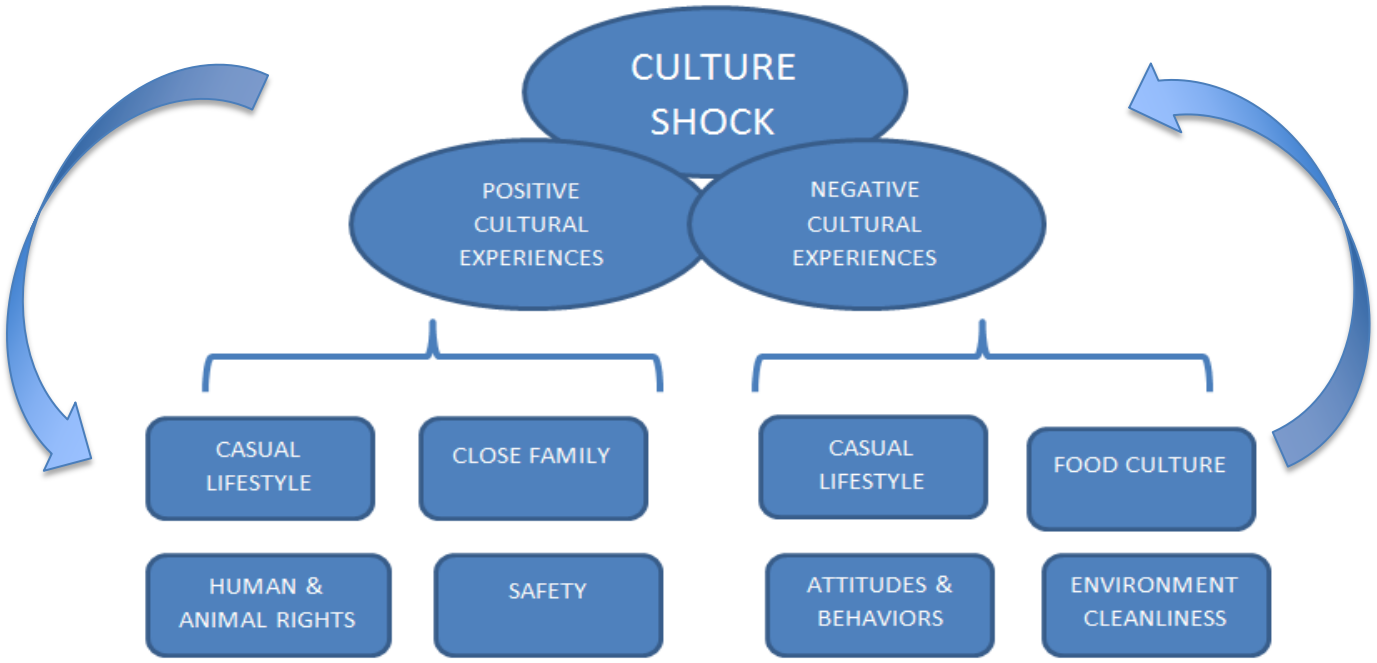
Graphical Abstract
International Students’ Cross-Cultural Experiences in The Philippines: A Netnographic Study

Keywords
culture shock
culture learning
international students
netnography
Philippines

Data Availability Statement
The data supporting the findings of this study are derived from publicly available YouTube video blogs (vlogs). The specific vlogs analyzed in this study, along with their upload details and view counts at the time of analysis, are listed below. All videos can be accessed via the provided URLs. 123JAPAN! (Japanese, Female). (2020, July 24). 5 Culture Shocks That Makes Japanese Crazy in The Philippines! About Money and Time? [Video]. YouTube. Retrieved January 6, 2022, from https://www.youtube.com/watch?v=vNqyd_HFddo Adii Mimi (Nigerian, Female). (2021, July 10). Why Indian students come to the Philippines for medicine: the role of Indian caste system in medicine [Video]. YouTube. Retrieved January 6, 2022, from https://www.youtube.com/watch?v=4nghjN-YRc0 Damaris Enoch (Nigerian, Female). (2020, November 20). 10 baffling things about being a medical student in the Philippines [Video]. YouTube. Retrieved January 6, 2022, from https://www.youtube.com/watch?v=sSFCva2E0PE Damaris Enoch (Nigerian, Female). (2021, March 1). Cultures in the Philippines I admire [Video]. YouTube. Retrieved January 6, 2022, from https://www.youtube.com/watch?v=vpKwLwX3Bmg Eniola Ibikunle (Nigerian, Female). (2021, February 9). Culture shock I experienced in the Philippines [Video]. YouTube. Retrieved January 6, 2022, from https://www.youtube.com/watch?v=e83OL7BjlDo Happiness Boms (Nigerian, Female). (2020, November 28). Culture shock I experienced in the Philippines [Video]. YouTube. Retrieved January 6, 2022, from https://www.youtube.com/watch?v=VkxyXIhAXlA Iam Cherno (Kenyan, Female). (2021, January 22). Culture shock between Kenya and the Philippines [Video]. YouTube. Retrieved January 6, 2022, from https://www.youtube.com/watch?v=Nd8U3NpBVcQ Igoche Joy (Nigerian, Female). (2021, March 3). Culture shocks I’ve experienced in Philippines [Video]. YouTube. Retrieved January 6, 2022, from https://www.youtube.com/watch?v=_qgxH5oLJrY Kristypata (Korean, Female). (2020, August 28). Culture Shocks I experienced in the Philippines [Video]. YouTube. Retrieved January 6, 2022, from https://www.youtube.com/watch?v=gxFBOBve7-U Nurse Glory (Nigerian, Female). (2020, December 17). 13 Culture shocks I experienced in the Philippines [Video]. YouTube. Retrieved January 6, 2022, from https://www.youtube.com/watch?v=lryCSSCIB_I Nurse Ruth Nook (Nigerian, Female). (2020, December 17). Culture shock in the Philippines: Sharing my experience [Video]. YouTube. Retrieved January 6, 2022, from https://www.youtube.com/watch?v=DHfSfDO1Czw Note: The view counts and subscriber numbers were current as of January 6, 2022, the date the data were accessed and analyzed for this study. The authors archived screenshots or local copies of the vlog content to ensure the integrity of the analysis, as online content is subject to change or removal. All data used are publicly accessible via the provided URLs.

Funding
This work was supported without any funding.

Conflicts of Interest
The authors declare no conflicts of interest.

AI Use Statement
The authors declare that no generative AI was used in the preparation of this manuscript.

Ethical Approval and Consent to Participate
Not applicable.

References
  1. Denison, I., & Wauchope, S. (2024). United Nations Educational, Scientific and Cultural Organization (UNESCO). In Encyclopedia of Quality of Life and Well-Being Research (pp. 7361-7366). Cham: Springer International Publishing.
    [CrossRef]   [Google Scholar]
  2. Snow, N. (2021). Student Mobility and Its Relevance to International Relations Theory. E-International Relations, 1-8. Retrieved from https://www.e-ir.info/2021/12/05/student-mobility-and-its-relevance-to-international-relations-theory/
    [Google Scholar]
  3. Loo, B. (2025, August 22). International Student Mobility Data Sources: A Primer. World Education News + Reviews. Retrieved from https://wenr.wes.org/2025/08/student-mobility-data-sources-part-1
    [Google Scholar]
  4. Hernandez-Torrano, D., Hajar, A., & Yessenbekova, K. (2024). Mapping research on International Student Mobilities in higher education: Achievements and the agenda ahead. International Journal of Educational Research, 128, 102482.
    [CrossRef]   [Google Scholar]
  5. Kuroda, K., Miki, S., Yuto, K., & Asada, S. (2018). Internationalization of Higher Education and Student Mobility in Japan and Asia (pp. 1-38). Paris: UNESCO; Tokyo: Japan International Cooperation Agency.
    [Google Scholar]
  6. Institute of International Education (IIE). (2023, March 16). A world on the move: Trends in global student mobility. Retrieved from https://www.iie.org/publications/a-world-on-the-move/
    [Google Scholar]
  7. Institute of International Education (IIE). (2023). Project Atlas: Republic of the Philippines. Project Atlas. Retrieved from https://www.iie.org/research-initiatives/project-atlas/explore-data/republic-of-the-philippines/
    [Google Scholar]
  8. Rehal, S. S. (2012). African student mobility in the Philippines: An explorative study in Metro Manila and Cavite. OSSREA Bulletin, 9(2), 29-39.
    [Google Scholar]
  9. Ramirez, V. E. (2016, November). Migrant Education in Philippine Higher Education Institutions: Drivers, Experience and Challenges to Continuous Quality Improvement.
    [Google Scholar]
  10. Pinamang, N., Bobie-Nimako, O., Peprah, W., Osei, A., Antwi, F., Nimako, N., & Agyenim-Boateng, E. (2021). Social support, psychological adjustment, and acculturative stress among international students in Baguio City of the Philippines. International Journal of Nursing Science, 11(1), 1-7.
    [CrossRef]   [Google Scholar]
  11. Lee, R., Sta Maria, M., Estanislao, S., & Rodriguez, C. (2013). Factors associated with higher levels of depressive symptoms among international university students in the Philippines. Southeast Asian Journal of Tropical Medicine & Public Health, 44(6), 1098-1107.
    [Google Scholar]
  12. Aclan, N. R. O., & Aclan, E. M. (2016, October). Issues and challenges faced by international students in the Philippines. In 11th International Scholars Conference (Vol. 4, No. 1, pp. 48-48).
    [CrossRef]   [Google Scholar]
  13. Carley, H. D. (2006). Dynamics of Intercultural Communication (Fifth edition). Shanghai: Shanghai Foreign Language Education Press.
    [Google Scholar]
  14. Maguddayao, R. N. (2018). Social lived experiences and coping mechanisms of the foreign students in the Philippines: a phenomenological approach to intercultural communicative competence. Asia Pacific Journal of Multidisciplinary Research, 6(4), 18-31.
    [Google Scholar]
  15. Spitzberg, B. H., & Cupach, W. R. (1984). Interpersonal communication competence. Beverly Hills, CA: Sage.
    [Google Scholar]
  16. Wa-Baleka, S., & Gaikwad, S. (2013). Current climate in higher education: Perceptions of international students in the Philippines. IAMURE International Journal of Education, 6(1), 1-14.
    [CrossRef]   [Google Scholar]
  17. Berry, J. W. (1992). Acculturation and Adaptation in a New Society. International Migration, 30(s1), 69-85.
    [CrossRef]   [Google Scholar]
  18. Kato, G., Lay, N. E. P., Sarempaa, I. B., & Gaikwad, I. (2024). Acculturation of International Single Students of Higher Education in the Philippines: A Phenomenological Study. Pan-African Journal of Education and Social Sciences, 5(2), 1–17.
    [CrossRef]   [Google Scholar]
  19. Berry, J. W. (2006). Stress perspectives on acculturation. The Cambridge handbook of acculturation psychology, 1, 43-56.
    [CrossRef]   [Google Scholar]
  20. Madison, G. (2006). Existential migration. Existential Analysis, 17(2), 238-260.
    [Google Scholar]
  21. Mestenhauser, J. (2002). The utilization of foreign students in internationalization of universities. Connections and complexities: The internationalization of higher education in Canada, 15-27.
    [Google Scholar]
  22. Shafaei, A., & Razak, N. (2016). Internationalisation of higher education: Conceptualising the antecedents and outcomes of cross-cultural adaptation. Policy Futures in Education, 14(6), 701–720.
    [CrossRef]   [Google Scholar]
  23. Rujipak, V., & Limprasert, S. (2016). International students’ adjustment in Thailand. ABAC Journal, 36(1), 34-46.
    [Google Scholar]
  24. Ahrari, S., Krauss, S., Suandi, T., Abdullah, H., Sahimi, A., Olutokunbo, A., & Dahalan, D. (2019). A stranger in a strange land: Experiences of adjustment among international postgraduate students in Malaysia. Issues in Educational Research, 29(3), 611-632.
    [Google Scholar]
  25. Zhou, Y., Jindal-Snape, D., Topping, K., & Todman, J. (2008). Theoretical models of culture shock and adaptation in international students in higher education. Studies in Higher Education, 33(1), 63-75.
    [CrossRef]   [Google Scholar]
  26. Yang, B., & Clum, G. (1994). Life stress, social support, and problem-solving skills predictive of depressive symptoms, hopelessness, and suicide ideation in an Asian student population: A test of a model. Suicide and Life-Threatening Behavior, 24(2), 127–139.
    [CrossRef]   [Google Scholar]
  27. Gustafson, J. M. (1968). The social construction of reality: A treatise in the sociology of knowledge.
    [CrossRef]   [Google Scholar]
  28. Pacheco, E. M. (2020). Culture learning theory and globalization: Reconceptualizing culture shock for modern cross-cultural sojourners. New Ideas in Psychology, 58, 100801.
    [CrossRef]   [Google Scholar]
  29. Al-Saleh, D., & Moufakkir, O. (2019). An exploratory study of the experience of VFR tourists: A culture shock perspective. Tourism Geographies, 21(4), 565–585.
    [CrossRef]   [Google Scholar]
  30. Belford, N. (2017). International students from Melbourne describing their cross-cultural transitions experiences: Culture shock, social interaction, and friendship development. Journal of International Students, 7(3), 499–521.
    [CrossRef]   [Google Scholar]
  31. Furnham, A. (2010). Culture shock: Literature review, personal statement and relevance for the South Pacific. Journal of Pacific Rim Psychology, 4(2), 87-94.
    [CrossRef]   [Google Scholar]
  32. Lopez, E. (2021). International students involvement with preparations: Pre-departure coping strategies implemented by Mexican postgraduate students in the UK. International Journal of Intercultural Relations, 81, 167-175.
    [CrossRef]   [Google Scholar]
  33. Kozinets, R. V. (2002). The field behind the screen: using Netnography for marketing research in online communities. Journal of Marketing Research, 39(1), 61-72.
    [CrossRef]   [Google Scholar]
  34. Guest, G., MacQueen, K. M., & Namey, E. E. (2012). Applied Thematic Analysis. Thousand Oaks, CA: SAGE Publishing.
    [CrossRef]   [Google Scholar]
  35. Kitınur, S. K. (2025). Cultural Adaptation on YouTube: Migrant Vlogs in Taiwan as Digital Storytelling. M/C Journal, 28(4).
    [CrossRef]   [Google Scholar]
  36. Liu, H. L. (2021). Vlog: A new communication practice in post pandemic. Jurnal Audiens, 2(2), 204-211.
    [CrossRef]   [Google Scholar]
  37. Kennedy, Ü. (2025). The Value of Vlogs: Past, Present, and Future. M/C Journal, 28(4).
    [CrossRef]   [Google Scholar]
  38. Patton, M. Q. (2014). Qualitative research & evaluation methods: Integrating theory and practice. Sage publications.
    [Google Scholar]
  39. Billings, A. C., Hardin, M., & Brown, N. A. (2014). Defining ubiquity: Introduction to the Routledge Handbook of Sport and New Media. In Routledge handbook of sport and new media (pp. 1-3). Routledge.
    [Google Scholar]
  40. Yalın, A. (2024). Governing the resilient self: Influencers’ digital affective labor in quarantine vlogs. Social Media+ Society, 10(2), 20563051241247749.
    [CrossRef]   [Google Scholar]
  41. Kozinets, R. V. (2015). Netnography: Redefined. Sage Publications.
    [Google Scholar]
  42. Leech, N. L., & Onwuegbuzie, A. J. (2008). Qualitative data analysis: A compendium of techniques and a framework for selection for school psychology research and beyond. School Psychology Quarterly, 23(4), 587–604.
    [CrossRef]   [Google Scholar]
  43. Ahmed, S. K., Mohammed, R. A., Nashwan, A. J., Ibrahim, R. H., Abdalla, A. Q., Ameen, B. M. M., & Khdhir, R. M. (2025). Using thematic analysis in qualitative research. Journal of Medicine, Surgery, and Public Health, 6, 100198.
    [CrossRef]   [Google Scholar]
  44. Wiles, R., Bengry-Howell, A., Crow, G., & Nind, M. (2013). But is it innovation?: The development of novel methodological approaches in qualitative research. Methodological Innovations Online, 8(1), 18-33.
    [CrossRef]   [Google Scholar]
  45. Van Dijck, J. (2009). Users like you? Theorizing agency in user-generated content. Media, culture & society, 31(1), 41-58.
    [CrossRef]   [Google Scholar]
  46. Reid, E., & Duffy, K. (2018). A netnographic sensibility: Developing the netnographic/social listening boundaries. Journal of Marketing Management, 34(3-4), 263-286.
    [CrossRef]   [Google Scholar]
  47. Burgess, J. (2023). Utilizing non-participatory netnography to explore consumer reactions to narrative brands. Sage Research Methods: Business, 1-21.
    [CrossRef]   [Google Scholar]
  48. Braun, V., & Clarke, V. (2006). Using thematic analysis in psychology. Qualitative Research in Psychology, 3(2), 77–101.
    [CrossRef]   [Google Scholar]
  49. Salmons, J. (2022). Using social media in data collection: Designing studies with the qualitative e-research framework. The SAGE handbook of social media research methods, 2, 112-126.
    [Google Scholar]
  50. O’Connor, C., & Joffe, H. (2020). Intercoder reliability in qualitative research: Debates and practical guidelines. International journal of qualitative methods, 19, 1609406919899220.
    [CrossRef]   [Google Scholar]
  51. Guillemin, M., & Gillam, L. (2004). Ethics, reflexivity, and “ethically important moments” in research. Qualitative inquiry, 10(2), 261-280.
    [CrossRef]   [Google Scholar]
  52. Bochner, S. (2003). Culture Shock Due to Contact with Unfamiliar Cultures. Online Readings in Psychology and Culture, 8(1). http://dx.doi.org/10.9707/2307-0919.1073
    [Google Scholar]
  53. Helliwell, J. F., Layard, R., Sachs, J. D., De Neve, J.-E., Aknin, L. B., & Wang, S. (Eds.). (2022). World happiness report 2022. Sustainable Development Solutions Network. Retrieved from https://worldhappiness.report/ed/2022/
    [Google Scholar]
  54. Morillo, H., Capuno, J., & Mendoza, A. (2013). View and values on family among Filipinos: An empirical exploration. Asian Journal of Social Science, 41(1), 5-28.
    [CrossRef]   [Google Scholar]
  55. Crismundo, K. (2021). PH ranks 17th in Global Gender Gap Report, 2nd in APAC. Philippine News Agency. Retrieved from https://www.pna.gov.ph/articles/1135541
    [Google Scholar]
  56. World Economic Forum. (2021). Global gender gap report 2021. World Economic Forum. Retrieved from https://www.weforum.org/reports/global-gender-gap-report-2021/
    [Google Scholar]
  57. de Lazo, C. (2024, April 11). Philippines' burgeoning pet culture is shifting lifestyles—and it's creating 'paw-some' opportunities. VERO. Retrieved from https://vero-asean.com/philippines-pet-culture-brand-opportunities/
    [Google Scholar]
  58. Malasig, J. (2021, November 22). In Southeast Asia, Filipinos are most interested to own pet this COVID-19 pandemic. Interaksyon. Retrieved from https://interaksyon.philstar.com/hobbies-interests/2021/11/22/205048/in-southeast-asia-filipinos-are-most-interested-to-own-pet-this-covid-19-pandemic
    [Google Scholar]
  59. Vila, A. C. (2020, July 31). With animal shelters full, millions of stray dogs and cats roam the Philippines – but one clinic is offering a solution. South China Morning Post. Retrieved from https://www.scmp.com/lifestyle/article/3095186/animal-shelters-full-millions-stray-dogs-and-cats-roam-philippines-one
    [Google Scholar]
  60. Caliwan, C. (2022). PH crime rate drops by 73.7\% in 5 years under PRRD: DILG. The Philippine News Agency. Retrieved from https://www.pna.gov.ph/articles/1168274
    [Google Scholar]
  61. CNN Philippines. (2021, January 2). Metro Manila crime rate falls by 9\% in 2021. CNN Philippines. Retrieved from https://www.cnnphilippines.com/news/2022/1/2/ncrpo-metro-manila-crime.htm
    [Google Scholar]
  62. Taculao, P. (2021, March 26). Celebrating food, culture, and the Filipino with the Filipino food month. Manila Bulletin. Retrieved from https://mb.com.ph/2021/03/26/celebrating-food-culture-and-the-filipino-with-the-filipino-food-month
    [Google Scholar]
  63. Andrade, M. S. (2006). International students in English-speaking universities: Adjustment factors. Journal of Research in International Education, 5(2), 131-154.
    [CrossRef]   [Google Scholar]
  64. Khanal, J., & Gaulee, U. (2019). Challenges of international students from pre-departure to post-study: A literature review. Journal of International Students, 9(2), 560-581.
    [CrossRef]   [Google Scholar]
  65. Masgoret, A. M., & Ward, C. (2006). Culture learning approach to acculturation. The Cambridge handbook of acculturation psychology, 58-77. http://dx.doi.org/10.1017/CBO9780511489891.008
    [Google Scholar]
  66. Klineberg, O., & Hull, F. W. (1979). At a Foreign University: An International Study of Adaptation and Coping. New York: Praeger.
    [Google Scholar]
  67. Ward, C., Bochner, S., & Furnham, A. (2005). The psychology of culture shock. Routledge.
    [CrossRef]   [Google Scholar]
  68. Snow, D. (2016). Affective Factors and Interpretive Judgments in Intercultural Encounters. Intercultural Communication Studies, 25(3), 19-32.
    [Google Scholar]
  69. Nguyen, D. M. Q. (2024). The effects of culture shock on the cultural adaptation of overseas students in Thailand at King Mongkut’s University. International Journal of Language Instruction, 3(4), 93-109.
    [CrossRef]   [Google Scholar]
  70. Ferencz, V., Hrehová, D., & Seňová, A. (2020). Higher education require adaptation of students study abroad programs. In SHS Web of Conferences (Vol. 74, p. 02003). EDP Sciences.
    [CrossRef]   [Google Scholar]

Cite This Article
APA Style
Rehal, S., & Chebat, R. G. B. (2026). International Students’ Cross-Cultural Experiences in The Philippines: A Netnographic Study. PWU Journal of Research, Innovation, and Transformation, 1(1), 49–64. https://doi.org/10.62762/JRIT.2025.485535
Export Citation
RIS Format
Compatible with EndNote, Zotero, Mendeley, and other reference managers
RIS format data for reference managers
TY  - JOUR
AU  - Rehal, Satwinder
AU  - Chebat, Raul Guillermo B.
PY  - 2026
DA  - 2026/03/06
TI  - International Students’ Cross-Cultural Experiences in The Philippines: A Netnographic Study
JO  - PWU Journal of Research, Innovation, and Transformation
T2  - PWU Journal of Research, Innovation, and Transformation
JF  - PWU Journal of Research, Innovation, and Transformation
VL  - 1
IS  - 1
SP  - 49
EP  - 64
DO  - 10.62762/JRIT.2025.485535
UR  - https://www.icck.org/article/abs/JRIT.2025.485535
KW  - culture shock
KW  - culture learning
KW  - international students
KW  - netnography
KW  - Philippines
AB  - The international higher education sector is characterized by the mobility of international students, who undergo transitions in unfamiliar cultural environments that may negatively affect their academic experiences and overall well-being. Culture shock often arises from insufficient knowledge of, and limited understanding about, the norms of the host culture, as well as cultural gaps between international students and the host country. Drawing on a netnographic study of YouTube vlogs by a purposive sample of international students in the Philippines, this paper examines their experiences of culture shock. The findings indicate that international students act as active agents in adapting to these experiences. The study recommends further research adopting nuanced phenomenological perspectives on international students’ cross-cultural experiences to inform the design of responsive interventions that promote cross-cultural adaptation. This recommendation is grounded in scholarly arguments that successful cross-cultural adaptation among international students enhances their overall satisfaction in the host country as well as their academic performance—outcomes that are particularly critical for emerging players in the global higher education market, including the Philippines.
SN  - pending
PB  - Institute of Central Computation and Knowledge
LA  - English
ER  - 
BibTeX Format
Compatible with LaTeX, BibTeX, and other reference managers
BibTeX format data for LaTeX and reference managers
@article{Rehal2026Internatio,
  author = {Satwinder Rehal and Raul Guillermo B. Chebat},
  title = {International Students’ Cross-Cultural Experiences in The Philippines: A Netnographic Study},
  journal = {PWU Journal of Research, Innovation, and Transformation},
  year = {2026},
  volume = {1},
  number = {1},
  pages = {49-64},
  doi = {10.62762/JRIT.2025.485535},
  url = {https://www.icck.org/article/abs/JRIT.2025.485535},
  abstract = {The international higher education sector is characterized by the mobility of international students, who undergo transitions in unfamiliar cultural environments that may negatively affect their academic experiences and overall well-being. Culture shock often arises from insufficient knowledge of, and limited understanding about, the norms of the host culture, as well as cultural gaps between international students and the host country. Drawing on a netnographic study of YouTube vlogs by a purposive sample of international students in the Philippines, this paper examines their experiences of culture shock. The findings indicate that international students act as active agents in adapting to these experiences. The study recommends further research adopting nuanced phenomenological perspectives on international students’ cross-cultural experiences to inform the design of responsive interventions that promote cross-cultural adaptation. This recommendation is grounded in scholarly arguments that successful cross-cultural adaptation among international students enhances their overall satisfaction in the host country as well as their academic performance—outcomes that are particularly critical for emerging players in the global higher education market, including the Philippines.},
  keywords = {culture shock, culture learning, international students, netnography, Philippines},
  issn = {pending},
  publisher = {Institute of Central Computation and Knowledge}
}

Article Metrics
Citations:

Crossref

0

Scopus

0

Web of Science

0
Article Access Statistics:
Views: 30
PDF Downloads: 11

Publisher's Note
ICCK stays neutral with regard to jurisdictional claims in published maps and institutional affiliations.

Rights and Permissions
CC BY Copyright © 2026 by the Author(s). Published by Institute of Central Computation and Knowledge. This article is an open access article distributed under the terms and conditions of the Creative Commons Attribution (CC BY) license (https://creativecommons.org/licenses/by/4.0/), which permits use, sharing, adaptation, distribution and reproduction in any medium or format, as long as you give appropriate credit to the original author(s) and the source, provide a link to the Creative Commons licence, and indicate if changes were made.
PWU Journal of Research, Innovation, and Transformation

PWU Journal of Research, Innovation, and Transformation

ISSN: pending (Online)

Email: [email protected]

Portico

Portico

All published articles are preserved here permanently:
https://www.portico.org/publishers/icck/