

Volume 1, Issue 1, PWU Journal of Research, Innovation, and Transformation
Volume 1, Issue 1, 2025
Submit Manuscript Edit a Special Issue
Article QR Code
Article QR Code
Scan the QR code for reading
Popular articles
PWU Journal of Research, Innovation, and Transformation, Volume 1, Issue 1, 2025: 28-38

Open Access | Research Article | 03 March 2026
Federated Neuro-Symbolic Intelligence for Privacy-Preserving Data Analytics: A Next-Generation Framework for Real-Time and Industry Applications
1 Information Technology Department, Philippine Women’s University, Manila 1008, Philippines
2 Business Administration Division, Mahidol University, Nakhon Pathom 73170, Thailand
3 College of Computing & Informatics, Drexel University, Philadelphia, PA 19104, United States
4 Casa Research Centre, Casa College, Nicosia 1075, Cyprus
5 Graduate School of Engineering, Pamantasan ng Lungsod ng Maynila, Manila 1002, Philippines
* Corresponding Author: Daniel Dasig Jr, [email protected]
ARK: ark:/57805/jrit.2026.408887
Received: 28 August 2025, Accepted: 24 January 2026, Published: 03 March 2026  
Abstract
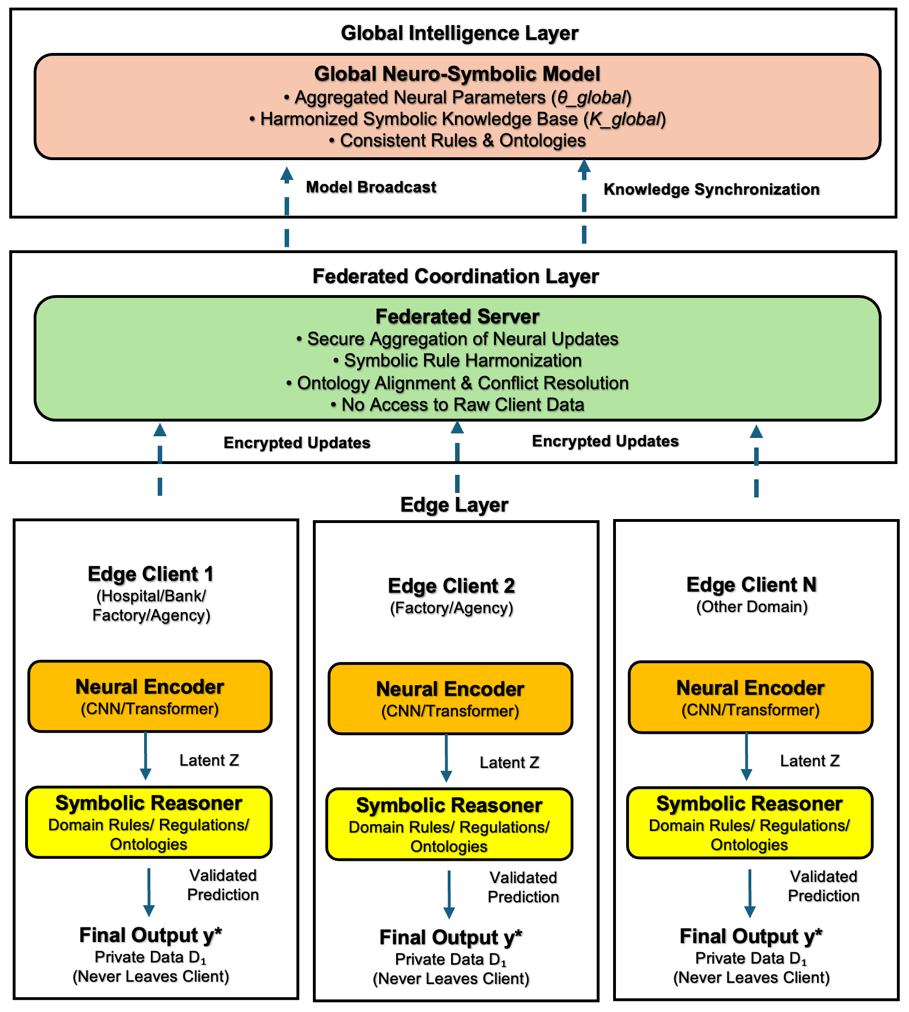
The growth of distributed, institutionally siloed data has created demand for analytics frameworks that ensure privacy, interpretability, and real-time decision support. While federated learning enables decentralized model training without raw data sharing, most existing approaches rely on opaque neural models and lack explicit reasoning capabilities. This paper proposes a Federated Neuro-Symbolic Intelligence (FNSI) framework that integrates federated learning with symbolic reasoning to address these limitations. The architecture combines local neural learning with symbolic constraint enforcement at the client level and a privacy-preserving coordination layer that aggregates encrypted updates and harmonizes distributed knowledge. Formal algorithms and theoretical analysis establish convergence, logical soundness, and data non-mobility. Experimental results under heterogeneous and non-IID data demonstrate that FNSI achieves accuracy comparable to centralized learning, improved robustness over standard federated averaging, and a substantial reduction in logical constraint violations. Visualization-based analyses further show how symbolic projection corrects infeasible neural outputs while preserving predictive fidelity. Overall, FNSI provides a balanced solution for trustworthy, cross-industry analytics in regulated environments.

Graphical Abstract
Federated Neuro-Symbolic Intelligence for Privacy-Preserving Data Analytics: A Next-Generation Framework for Real-Time and Industry Applications

Keywords
federated learning
neuro-symbolic artificial intelligence
privacy-preserving analytics
explainable AI
distributed intelligence
real-time systems

Data Availability Statement
Data will be made available on request.

Funding
This work was supported without any funding.

Conflicts of Interest
The authors declare no conflicts of interest.

AI Use Statement
The authors declare that no generative AI was used in the preparation of this manuscript.

Ethical Approval and Consent to Participate
Not applicable.

References
  1. Singh, B., & Nayyar, A. (2024). Navigating deep learning models and health monitoring infrastructure financing in smart cities: Review from legal perceptions and future innovations. Deep Learning in Engineering, Energy and Finance, 80-114.
    [Google Scholar]
  2. Moreira, M. W., Rodrigues, J. J., Korotaev, V., Al-Muhtadi, J., & Kumar, N. (2019). A comprehensive review on smart decision support systems for health care. IEEE Systems Journal, 13(3), 3536-3545.
    [CrossRef]   [Google Scholar]
  3. Xing, P., Lu, S., & Yu, H. (2023). Federated neuro-symbolic learning. arXiv preprint arXiv:2308.15324.
    [CrossRef]   [Google Scholar]
  4. Colelough, B. C., & Regli, W. (2025). Neuro-symbolic AI in 2024: A systematic review. arXiv preprint arXiv:2501.05435.
    [CrossRef]   [Google Scholar]
  5. Pandharipande, A., Cheng, C. H., Dauwels, J., Gurbuz, S. Z., Ibanez-Guzman, J., Li, G., ... & Santra, A. (2023). Sensing and machine learning for automotive perception: A review. IEEE Sensors Journal, 23(11), 11097-11115.
    [CrossRef]   [Google Scholar]
  6. Elgarhy, I., Badr, M. M., Mahmoud, M., Ni, J., Alsabaan, M., & Alshawi, T. (2025). Investigation of the robustness of XAI-based federated learning against adversarial attacks for smart grid false data detection. IEEE Internet of Things Journal, 12(15), 32179-32192.
    [CrossRef]   [Google Scholar]
  7. Delvecchio, G. P., Molfetta, L., & Moro, G. (2025). Neuro-Symbolic Artificial Intelligence: A Task-Directed Survey in the Black-Box Models Era. In Proceedings of the Thirty-Fourth International Joint Conference on Artificial Intelligence (pp. 10418-10426).
    [Google Scholar]
  8. Acharya, K., & Song, H. (2025). A Comprehensive Review of Neuro-symbolic AI for Robustness, Uncertainty Quantification, and Intervenability. Arabian Journal for Science and Engineering, 1-33.
    [CrossRef]   [Google Scholar]
  9. Wang, W., Yang, Y., & Wu, F. (2024). Towards data-and knowledge-driven AI: a survey on neuro-symbolic computing. IEEE transactions on pattern analysis and machine intelligence, 47(2), 878-899.
    [CrossRef]   [Google Scholar]
  10. Liang, B., Wang, Y., & Tong, C. (2025). AI reasoning in deep learning era: From symbolic AI to neural–symbolic AI. Mathematics, 13(11), 1707.
    [CrossRef]   [Google Scholar]
  11. Bhuyan, B. P., Ramdane-Cherif, A., Tomar, R., & Singh, T. P. (2024). Neuro-symbolic artificial intelligence: A survey. Neural Computing and Applications, 36(21), 12809-12844.
    [CrossRef]   [Google Scholar]
  12. Dasig Jr, D. (2025). A fuzzy set-based context-aware decision framework for histopathological image classification in tumor microarrays. Soft Computing Fusion with Applications, 2(2), 105-119.
    [CrossRef]   [Google Scholar]
  13. Ma, C., Li, J., Shi, L., Ding, M., Wang, T., Han, Z., & Poor, H. V. (2022). When federated learning meets blockchain: A new distributed learning paradigm. IEEE Computational Intelligence Magazine, 17(3), 26-33.
    [CrossRef]   [Google Scholar]
  14. Korkmaz, C., Kocas, H. E., Uysal, A., Masry, A., Ozkasap, O., & Akgun, B. (2020, November). Chain fl: Decentralized federated machine learning via blockchain. In 2020 Second international conference on blockchain computing and applications (BCCA) (pp. 140-146). IEEE.
    [CrossRef]   [Google Scholar]
  15. Ferrag, M. A., Friha, O., Maglaras, L., Janicke, H., & Shu, L. (2021). Federated deep learning for cyber security in the internet of things: Concepts, applications, and experimental analysis. IEEE Access, 9, 138509-138542.
    [CrossRef]   [Google Scholar]
  16. Tariq, A., Serhani, M. A., Sallabi, F. M., Barka, E. S., Qayyum, T., Khater, H. M., & Shuaib, K. A. (2024). Trustworthy federated learning: A comprehensive review, architecture, key challenges, and future research prospects. IEEE Open Journal of the Communications Society, 5, 4920-4998.
    [CrossRef]   [Google Scholar]
  17. Fitas, R. (2025). Neuro-symbolic AI for advanced signal and image processing: A review of recent trends and future directions. IEEE Access, 13, 143360-143376.
    [CrossRef]   [Google Scholar]
  18. Chen, C., Liu, J., Tan, H., Li, X., Wang, K. I. K., Li, P., ... & Dou, D. (2025). Trustworthy federated learning: Privacy, security, and beyond. Knowledge and Information Systems, 67(3), 2321-2356.
    [CrossRef]   [Google Scholar]
  19. Lyu, L., Yu, H., Ma, X., Chen, C., Sun, L., Zhao, J., ... & Yu, P. S. (2022). Privacy and robustness in federated learning: Attacks and defenses. IEEE Transactions on Neural Networks and Learning Systems, 35(7), 8726-8746.
    [CrossRef]   [Google Scholar]
  20. Bai, L., Hu, H., Ye, Q., Li, H., Wang, L., & Xu, J. (2024). Membership inference attacks and defenses in federated learning: A survey. ACM Computing Surveys, 57(4), 1-35.
    [CrossRef]   [Google Scholar]
  21. Cheng, K., Ahmed, N. K., Rossi, R. A., Willke, T., & Sun, Y. (2025). Neural-symbolic methods for knowledge graph reasoning: A survey. ACM Transactions on Knowledge Discovery from Data, 18(9), 1-44.
    [CrossRef]   [Google Scholar]
  22. Rimi, H. A., Asaduzzaman, M., Bhuiyan, M. J. U., Shoaib, H. A., Fuad, K. N. R., & Rahman, M. A. (2025). Advancements and Challenges in Federated Learning for Privacy-Preserving Smart Healthcare: A Review. Federated Learning in Health Care Technology, 213-234.
    [CrossRef]   [Google Scholar]
  23. Bouacida, N., & Mohapatra, P. (2021). Vulnerabilities in federated learning. IEEE Access, 9, 63229-63249.
    [CrossRef]   [Google Scholar]

Cite This Article
APA Style
Dasig Jr, D., Dhar, B. K., Pascua, S. M., & Austria, M. (2026). Federated Neuro-Symbolic Intelligence for Privacy-Preserving Data Analytics: A Next-Generation Framework for Real-Time and Industry Applications. PWU Journal of Research, Innovation, and Transformation, 1(1), 28–38. https://doi.org/10.62762/JRIT.2026.408887
Export Citation
RIS Format
Compatible with EndNote, Zotero, Mendeley, and other reference managers
RIS format data for reference managers
TY  - JOUR
AU  - Jr, Daniel Dasig
AU  - Dhar, Bablu Kumar
AU  - Pascua, Sonia M.
AU  - Austria, Milani
PY  - 2026
DA  - 2026/03/03
TI  - Federated Neuro-Symbolic Intelligence for Privacy-Preserving Data Analytics: A Next-Generation Framework for Real-Time and Industry Applications
JO  - PWU Journal of Research, Innovation, and Transformation
T2  - PWU Journal of Research, Innovation, and Transformation
JF  - PWU Journal of Research, Innovation, and Transformation
VL  - 1
IS  - 1
SP  - 28
EP  - 38
DO  - 10.62762/JRIT.2026.408887
UR  - https://www.icck.org/article/abs/JRIT.2026.408887
KW  - federated learning
KW  - neuro-symbolic artificial intelligence
KW  - privacy-preserving analytics
KW  - explainable AI
KW  - distributed intelligence
KW  - real-time systems
AB  - The growth of distributed, institutionally siloed data has created demand for analytics frameworks that ensure privacy, interpretability, and real-time decision support. While federated learning enables decentralized model training without raw data sharing, most existing approaches rely on opaque neural models and lack explicit reasoning capabilities. This paper proposes a Federated Neuro-Symbolic Intelligence (FNSI) framework that integrates federated learning with symbolic reasoning to address these limitations. The architecture combines local neural learning with symbolic constraint enforcement at the client level and a privacy-preserving coordination layer that aggregates encrypted updates and harmonizes distributed knowledge. Formal algorithms and theoretical analysis establish convergence, logical soundness, and data non-mobility. Experimental results under heterogeneous and non-IID data demonstrate that FNSI achieves accuracy comparable to centralized learning, improved robustness over standard federated averaging, and a substantial reduction in logical constraint violations. Visualization-based analyses further show how symbolic projection corrects infeasible neural outputs while preserving predictive fidelity. Overall, FNSI provides a balanced solution for trustworthy, cross-industry analytics in regulated environments.
SN  - pending
PB  - Institute of Central Computation and Knowledge
LA  - English
ER  - 
BibTeX Format
Compatible with LaTeX, BibTeX, and other reference managers
BibTeX format data for LaTeX and reference managers
@article{Jr2026Federated,
  author = {Daniel Dasig Jr and Bablu Kumar Dhar and Sonia M. Pascua and Milani Austria},
  title = {Federated Neuro-Symbolic Intelligence for Privacy-Preserving Data Analytics: A Next-Generation Framework for Real-Time and Industry Applications},
  journal = {PWU Journal of Research, Innovation, and Transformation},
  year = {2026},
  volume = {1},
  number = {1},
  pages = {28-38},
  doi = {10.62762/JRIT.2026.408887},
  url = {https://www.icck.org/article/abs/JRIT.2026.408887},
  abstract = {The growth of distributed, institutionally siloed data has created demand for analytics frameworks that ensure privacy, interpretability, and real-time decision support. While federated learning enables decentralized model training without raw data sharing, most existing approaches rely on opaque neural models and lack explicit reasoning capabilities. This paper proposes a Federated Neuro-Symbolic Intelligence (FNSI) framework that integrates federated learning with symbolic reasoning to address these limitations. The architecture combines local neural learning with symbolic constraint enforcement at the client level and a privacy-preserving coordination layer that aggregates encrypted updates and harmonizes distributed knowledge. Formal algorithms and theoretical analysis establish convergence, logical soundness, and data non-mobility. Experimental results under heterogeneous and non-IID data demonstrate that FNSI achieves accuracy comparable to centralized learning, improved robustness over standard federated averaging, and a substantial reduction in logical constraint violations. Visualization-based analyses further show how symbolic projection corrects infeasible neural outputs while preserving predictive fidelity. Overall, FNSI provides a balanced solution for trustworthy, cross-industry analytics in regulated environments.},
  keywords = {federated learning, neuro-symbolic artificial intelligence, privacy-preserving analytics, explainable AI, distributed intelligence, real-time systems},
  issn = {pending},
  publisher = {Institute of Central Computation and Knowledge}
}

Article Metrics
Citations:

Crossref

0

Scopus

0

Web of Science

0
Article Access Statistics:
Views: 15
PDF Downloads: 5

Publisher's Note
ICCK stays neutral with regard to jurisdictional claims in published maps and institutional affiliations.

Rights and Permissions
CC BY Copyright © 2026 by the Author(s). Published by Institute of Central Computation and Knowledge. This article is an open access article distributed under the terms and conditions of the Creative Commons Attribution (CC BY) license (https://creativecommons.org/licenses/by/4.0/), which permits use, sharing, adaptation, distribution and reproduction in any medium or format, as long as you give appropriate credit to the original author(s) and the source, provide a link to the Creative Commons licence, and indicate if changes were made.
PWU Journal of Research, Innovation, and Transformation

PWU Journal of Research, Innovation, and Transformation

ISSN: pending (Online)

Email: [email protected]

Portico

Portico

All published articles are preserved here permanently:
https://www.portico.org/publishers/icck/