

The Influence of Government Regulation on Tourist Motivation in Indonesia's Religious Tourism: The Mediating Role of Marketing Communication Strategies



Article Information
Abstract
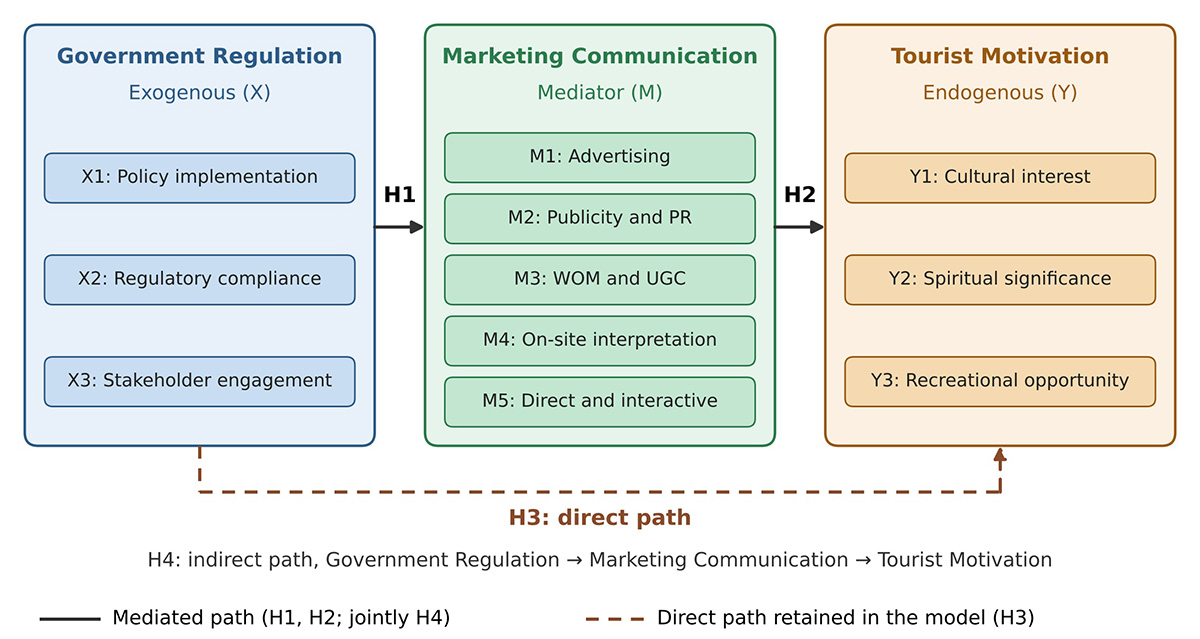
Religious tourism is a significant economic sector in Indonesia, yet how government regulation and marketing communication jointly shape tourist motivation remains underexplored. Grounded in the Theory of Planned Behavior, this study treats government regulation as an exogenous antecedent linked to perceived behavioral control and institutional credibility, and marketing communication as the proximal lever acting on attitudes and subjective norms. Government regulation was operationalized through policy implementation, regulatory compliance, and stakeholder engagement; marketing communication through advertising, publicity, word-of-mouth, on-site interpretation, and direct and interactive marketing; and tourist motivation through cultural interest, spiritual significance, and recreational opportunity. An online survey was completed by 402 non-pilgrim visitors who had visited an Indonesian religious heritage site in the previous 12 months; 81.9% reported one of five focal sites (Borobudur Temple, Istiqlal Mosque, Tanah Lot Temple, Uluwatu Temple, and Jakarta Cathedral). Ordinary least squares regression showed that government regulation predicted marketing communication ($\beta = 0.676$, $p < .001$), while marketing communication ($\beta = 0.385$) and government regulation ($\beta = 0.355$) both predicted tourist motivation, together explaining 45.8% of its variance. The Sobel test ($z = 7.02$, $p < .001$) and a 5,000-resample bootstrap (95% CI [0.183, 0.344]) indicated a significant indirect effect, with 42.3% of the total effect transmitted through marketing communication (partial mediation). Regulation is therefore associated with motivation along two routes: directly, through credible site conditions, and indirectly, through the communication environment. The study offers a TPB-informed account of sacred-heritage visitation and a replicable framework for multi-religious tourism destinations.
Graphical Abstract
Keywords
Data Availability Statement
Funding
Conflicts of Interest
AI Use Statement
Ethical Approval and Consent to Participate
References
- Grand View Research. (2024, September). Religious tourism market to reach \$671.93 billion by 2030 [Press release]. Retrieved November 3, 2026, from https://www.grandviewresearch.com/press-release/global-religious-tourism-market
[Google Scholar] - Kementerian Pariwisata Republik Indonesia. (2025, July 1). Statistik kunjungan wisatawan mancanegara bulan Mei 2025 [Foreign tourist arrival statistics, May 2025]. Retrieved November 3, 2026, from https://www.kemenpar.go.id/statistik-wisatawan-mancanegara/statistik-kunjungan-wisatawan-mancanegara-bulan-mei-2025
[Google Scholar] - Samarathunga, W. H. M. S., Schänzel, H., & Perera, J. A. D. R. (2025). Spiritual tourism, spiritual tourists and religions: The nexus between authenticity and commodification. Tourism Planning & Development, 22(6), 848-870.
[CrossRef] [Google Scholar] - Maharani, A. P., & Rohimi, P. (2025). Communication strategy of Kudus culture and tourism in introducing religious tourism to foreign tourists. Ilomata International Journal of Social Science, 6(2), 358-370.
[CrossRef] [Google Scholar] - Pedersen, D., Engel, S., & Sheridan, L. (2024). The impact of neoliberalism on crisis management in Bali's tourism sector. Tourism Planning & Development, 21(6), 862-880.
[CrossRef] [Google Scholar] - Mujiatun, S., Trianto, B., Cahyono, E. F., & Rahmayati. (2023). The impact of marketing communication and Islamic financial literacy on Islamic financial inclusion and MSMEs performance: Evidence from halal tourism in Indonesia. Sustainability, 15(13), 9868.
[CrossRef] [Google Scholar] - Amin, M. A. S., & Priansah, P. (2019). Marketing communication strategy to improve tourism potential. Budapest International Research and Critics Institute-Journal (BIRCI-Journal), 2(4), 160-166.
[CrossRef] [Google Scholar] - Taylor, L. (2021). Public actors without public values: Legitimacy, domination and the regulation of the technology sector. Philosophy & Technology, 34(4), 897-922.
[CrossRef] [Google Scholar] - Saarinen, J. (2020). Tourism and sustainable development goals: Research on sustainable tourism geographies. In J. Saarinen (Ed.), Tourism and Sustainable Development Goals: Research on Sustainable Tourism Geographies. Routledge.
[CrossRef] [Google Scholar] - Bramwell, B., & Lane, B. (2010). Sustainable tourism and the evolving roles of government planning. Journal of Sustainable Tourism, 18(1), 1-5.
[CrossRef] [Google Scholar] - Datta-Chaudhuri, M. (1990). Market failure and government failure. Journal of Economic Perspectives, 4(3), 25-39.
[CrossRef] [Google Scholar] - Zerbe Jr, R. O., & McCurdy, H. E. (1999). The failure of market failure. Journal of Policy Analysis and Management: The Journal of the Association for Public Policy Analysis and Management, 18(4), 558-578.
[CrossRef] [Google Scholar] - Goktepe, S., Cetin, G., Antonovica, A., & de Esteban Curiel, J. (2024). The impact of government legitimacy on the tourism industry during crises. European Research on Management and Business Economics, 30(3), 100259.
[CrossRef] [Google Scholar] - Logar, I. (2010). Sustainable tourism management in Crikvenica, Croatia: An assessment of policy instruments. Tourism Management, 31(1), 125-135.
[CrossRef] [Google Scholar] - Mugarura, J. T., Turyakira, P. K., Kakumba, U., Mwesigwa, R., Mugabe, N., & Alioni, C. (2025). Optimizing public–private partnerships in Uganda’s tourism sector: critical success factors and best practices for sustainable project outcomes. IIMBG Journal of Sustainable Business and Innovation, 3(2), 213-237.
[CrossRef] [Google Scholar] - Hall, C. M. (2011). Policy learning and policy failure in sustainable tourism governance: From first- and second-order to third-order change? Journal of Sustainable Tourism, 19(4-5), 649-671.
[CrossRef] [Google Scholar] - Dodds, R. (2007). Sustainable tourism and policy implementation: Lessons from the case of Calviá, Spain. Current issues in tourism, 10(4), 296-322.
[CrossRef] [Google Scholar] - Donadelli, F., & van der Heijden, J. (2024). The regulatory state in developing countries: Redistribution and regulatory failure in Brazil. Regulation & Governance, 18(2), 348-370.
[CrossRef] [Google Scholar] - El Haddad, A. F. (2024). Beyond regulatory capture: Policy entrepreneurs' strategies in regulatory policies under authoritarianism. Review of Policy Research, 41(6), 961-984.
[CrossRef] [Google Scholar] - Sharma, V., & Bhat, D. A. R. (2023). The role of community involvement in sustainable tourism strategies: A social and environmental innovation perspective. Business Strategy & Development, 6(2), 119-127.
[CrossRef] [Google Scholar] - Markatos, G., Efthymiou, L., & Morphitis, A. (2024). Collaborative government initiatives for implementing tourism carrying capacity in the context of sustainable development. In Non-profit organisations, Volume III: Society, sustainability and accountability (pp. 233-260). Cham: Springer Nature Switzerland.
[CrossRef] [Google Scholar] - Zhang, F., Lv, Y., & Sarker, M. N. I. (2024). Resilience and recovery: A systematic review of tourism governance strategies in disaster-affected regions. International Journal of Disaster Risk Reduction, 103, 104350.
[CrossRef] [Google Scholar] - Jamal, T. B., & Getz, D. (1995). Collaboration theory and community tourism planning. Annals of Tourism Research, 22(1), 186-204.
[CrossRef] [Google Scholar] - Kotler, P., Keller, K. L., & Chernev, A. (2022). Marketing Management (16th ed.). Pearson. https://www.scirp.org/reference/referencespapers?referenceid=4312531
[Google Scholar] - Xiang, Z., & Gretzel, U. (2010). Role of social media in online travel information search. Tourism management, 31(2), 179-188.
[CrossRef] [Google Scholar] - Varadarajan, R., Welden, R. B., Arunachalam, S., Haenlein, M., & Gupta, S. (2022). Digital product innovations for the greater good and digital marketing innovations in communications and channels: Evolution, emerging issues, and future research directions. International Journal of Research in Marketing, 39(2), 482-501.
[CrossRef] [Google Scholar] - Correia, R., Aksionova, E., Venciute, D., Sousa, J., & Fontes, R. (2025). User-generated content’s influence on tourist destination image: A generational perspective. Consumer Behavior in Tourism and Hospitality, 20(2), 167-185.
[CrossRef] [Google Scholar] - Nguyen, T. T. T., & Tong, S. (2023). The impact of user-generated content on intention to select a travel destination. Journal of Marketing Analytics, 11(3), 443-457.
[CrossRef] [Google Scholar] - Yang, P., Liu, Y., Xiong, R., Run, P., & Junaidi, J. (2026). The emotional impact of cultural tourism: Tourist cultural attributes and delight. Tourism Recreation Research, 51(2), 387-401.
[CrossRef] [Google Scholar] - Buhalis, D., Leung, D., & Lin, M. (2023). Metaverse as a disruptive technology revolutionising tourism management and marketing. Tourism management, 97, 104724.
[CrossRef] [Google Scholar] - Crompton, J. L., & Petrick, J. F. (2024). A half-century reflection on pleasure vacation motives. Annals of Tourism Research, 104, 103692.
[CrossRef] [Google Scholar] - Soldatenko, D., & Backer, E. (2019). A content analysis of cross-cultural motivational studies in tourism relating to nationalities. Journal of Hospitality and Tourism Management, 38, 122-139.
[CrossRef] [Google Scholar] - Dann, G. M. S. (1977). Anomie, ego-enhancement and tourism. Annals of tourism research, 4(4), 184-194.
[CrossRef] [Google Scholar] - Crompton, J. L. (1979). Motivations for pleasure vacation. Annals of Tourism Research, 6(4), 408-424.
[CrossRef] [Google Scholar] - Luekveerawattana, R. (2025). Enhancing visitor experiences: A quantitative analysis of marketing strategies at historical and cultural national parks. Cogent Social Sciences, 11(1), 2458066.
[CrossRef] [Google Scholar] - Rasoolimanesh, S. M., Seyfi, S., Hall, C. M., & Hatamifar, P. (2021). Understanding memorable tourism experiences and behavioural intentions of heritage tourists. Journal of Destination Marketing & Management, 21, 100621.
[CrossRef] [Google Scholar] - Ajzen, I. (1991). The theory of planned behavior. Organizational Behavior and Human Decision Processes, 50(2), 179-211.
[CrossRef] [Google Scholar] - Fishbein, M., & Ajzen, I. (2010). Predicting and Changing Behavior: The Reasoned Action Approach. Psychology Press.
[CrossRef] [Google Scholar] - Esfandiar, K., & Hadinejad, A. (2026). A critical review of the theory of planned behaviour in tourism research. Current Issues in Tourism, 29(8), 1629-1643.
[CrossRef] [Google Scholar] - Ulker-Demirel, E., & Ciftci, G. (2020). A systematic literature review of the theory of planned behavior in tourism, leisure and hospitality management research. Journal of Hospitality and Tourism Management, 43, 209-219.
[CrossRef] [Google Scholar] - Pahrudin, P., Chen, C. T., & Liu, L. W. (2021). A modified theory of planned behavioral: A case of tourist intention to visit a destination post pandemic Covid-19 in Indonesia. Heliyon, 7(10), e08230.
[CrossRef] [Google Scholar] - Tajeddini, K., Rasoolimanesh, S. M., Gamage, T. C., & Martin, E. (2021). Exploring the visitors' decision-making process for Airbnb and hotel accommodations using value-attitude-behavior and theory of planned behavior. International Journal of Hospitality Management, 96, 102950.
[CrossRef] [Google Scholar] - Quintal, V. A., Lee, J. A., & Soutar, G. N. (2010). Risk, uncertainty and the theory of planned behavior: A tourism example. Tourism management, 31(6), 797-805.
[CrossRef] [Google Scholar] - Khan, M. R., Khan, H. U. R., Lim, C. K., Tan, K. L., & Ahmed, M. F. (2021). Sustainable tourism policy, destination management and sustainable tourism development: A moderated-mediation model. Sustainability, 13(21), 12156.
[CrossRef] [Google Scholar] - Liro, J., & Meneghello, S. (2025). Understanding contemporary religious tourism through the lens of the experience economy approach. In D. Liutikas (Ed.), Creating the Sacred Landscape: Pilgrimages and Ritual Practices (pp. 89–108). (pp. 89-108). Cham: Springer Nature Switzerland.
[CrossRef] [Google Scholar] - Mishra, S., Mishra, J. M., Tamta, A. K., & Sahu, S. K. (2025). Smart technology integration in religious tourism destinations: Enhancing visitor experiences and destination management. Technology and Religious Tourism: Emerging Trends, Cases and Futuristic Perspectives (pp. 89-105). Emerald Publishing.
[CrossRef] [Google Scholar] - Torres, S. Y., & Yturralde, C. C. (2025). Religious tourism visitors' motivational factors and experiences in the Philippines. International Journal for Multidisciplinary Research, 7(3).
[CrossRef] [Google Scholar] - Podsakoff, P. M., MacKenzie, S. B., Lee, J. Y., & Podsakoff, N. P. (2003). Common method biases in behavioral research: A critical review of the literature and recommended remedies. Journal of Applied Psychology, 88(5), 879-903.
[CrossRef] [Google Scholar] - Kock, N. (2015). Common method bias in PLS-SEM: A full collinearity assessment approach. International Journal of e-Collaboration, 11(4), 1-10.
[CrossRef] [Google Scholar] - Koop, C., & Lodge, M. (2017). What is regulation? An interdisciplinary concept analysis. Regulation & Governance, 11(1), 95-108.
[CrossRef] [Google Scholar] - Dinas Pariwisata Provinsi Bali. (2025, April 8). Bali cracks down on unruly tourists: Governor Koster issues new regulations [Governor of Bali Circular Letter No. 7 of 2025]. Retrieved November 3, 2026, from https://disparda.baliprov.go.id/bali-cracks-down-on-unruly-tourists-governor-koster-issues-new-regulations/
[Google Scholar]
Cite This Article
TY  - JOUR
AU  - Manurung, Siska Purnama
AU  - Young, Felina C.
PY  - 2026
DA  - 2026/11/07
TI  - The Influence of Government Regulation on Tourist Motivation in Indonesia's Religious Tourism: The Mediating Role of Marketing Communication Strategies
JO  - PWU Journal of Research, Innovation, and Transformation
T2  - PWU Journal of Research, Innovation, and Transformation
JF  - PWU Journal of Research, Innovation, and Transformation
VL  - 1
IS  - 2
SP  - 92
EP  - 103
DO  - 10.62762/JRIT.2026.890558
UR  - https://www.icck.org/article/abs/jrit.2026.890558
KW  - Government regulation
KW  - marketing communication
KW  - tourist motivation
KW  - religious tourism
KW  - Indonesia
AB  - Religious tourism is a significant economic sector in Indonesia, yet how government regulation and marketing communication jointly shape tourist motivation remains underexplored. Grounded in the Theory of Planned Behavior, this study treats government regulation as an exogenous antecedent linked to perceived behavioral control and institutional credibility, and marketing communication as the proximal lever acting on attitudes and subjective norms. Government regulation was operationalized through policy implementation, regulatory compliance, and stakeholder engagement; marketing communication through advertising, publicity, word-of-mouth, on-site interpretation, and direct and interactive marketing; and tourist motivation through cultural interest, spiritual significance, and recreational opportunity. An online survey was completed by 402 non-pilgrim visitors who had visited an Indonesian religious heritage site in the previous 12 months; 81.9% reported one of five focal sites (Borobudur Temple, Istiqlal Mosque, Tanah Lot Temple, Uluwatu Temple, and Jakarta Cathedral). Ordinary least squares regression showed that government regulation predicted marketing communication ($\beta = 0.676$, $p < .001$), while marketing communication ($\beta = 0.385$) and government regulation ($\beta = 0.355$) both predicted tourist motivation, together explaining 45.8% of its variance. The Sobel test ($z = 7.02$, $p < .001$) and a 5,000-resample bootstrap (95% CI [0.183, 0.344]) indicated a significant indirect effect, with 42.3% of the total effect transmitted through marketing communication (partial mediation). Regulation is therefore associated with motivation along two routes: directly, through credible site conditions, and indirectly, through the communication environment. The study offers a TPB-informed account of sacred-heritage visitation and a replicable framework for multi-religious tourism destinations.
SN  - 3071-4001
PB  - Institute of Central Computation and Knowledge
LA  - English
ER  -
@article{Manurung2026The,
  author = {Siska Purnama Manurung and Felina C. Young},
  title = {The Influence of Government Regulation on Tourist Motivation in Indonesia's Religious Tourism: The Mediating Role of Marketing Communication Strategies},
  journal = {PWU Journal of Research, Innovation, and Transformation},
  year = {2026},
  volume = {1},
  number = {2},
  pages = {92-103},
  doi = {10.62762/JRIT.2026.890558},
  url = {https://www.icck.org/article/abs/jrit.2026.890558},
  abstract = {Religious tourism is a significant economic sector in Indonesia, yet how government regulation and marketing communication jointly shape tourist motivation remains underexplored. Grounded in the Theory of Planned Behavior, this study treats government regulation as an exogenous antecedent linked to perceived behavioral control and institutional credibility, and marketing communication as the proximal lever acting on attitudes and subjective norms. Government regulation was operationalized through policy implementation, regulatory compliance, and stakeholder engagement; marketing communication through advertising, publicity, word-of-mouth, on-site interpretation, and direct and interactive marketing; and tourist motivation through cultural interest, spiritual significance, and recreational opportunity. An online survey was completed by 402 non-pilgrim visitors who had visited an Indonesian religious heritage site in the previous 12 months; 81.9\% reported one of five focal sites (Borobudur Temple, Istiqlal Mosque, Tanah Lot Temple, Uluwatu Temple, and Jakarta Cathedral). Ordinary least squares regression showed that government regulation predicted marketing communication (\$\beta = 0.676\$, \$p < .001\$), while marketing communication (\$\beta = 0.385\$) and government regulation (\$\beta = 0.355\$) both predicted tourist motivation, together explaining 45.8\% of its variance. The Sobel test (\$z = 7.02\$, \$p < .001\$) and a 5,000-resample bootstrap (95\% CI [0.183, 0.344]) indicated a significant indirect effect, with 42.3\% of the total effect transmitted through marketing communication (partial mediation). Regulation is therefore associated with motivation along two routes: directly, through credible site conditions, and indirectly, through the communication environment. The study offers a TPB-informed account of sacred-heritage visitation and a replicable framework for multi-religious tourism destinations.},
  keywords = {Government regulation, marketing communication, tourist motivation, religious tourism, Indonesia},
  issn = {3071-4001},
  publisher = {Institute of Central Computation and Knowledge}
}
Article Metrics
Publisher's Note
ICCK stays neutral with regard to jurisdictional claims in published maps and institutional affiliations.
Rights and Permissions
 Copyright © 2026 by the Author(s). Published by Institute of Central Computation and Knowledge. This article is an open access article distributed under the terms and conditions of the Creative Commons Attribution (CC BY) license (https://creativecommons.org/licenses/by/4.0/), which permits use, sharing, adaptation, distribution and reproduction in any medium or format, as long as you give appropriate credit to the original author(s) and the source, provide a link to the Creative Commons licence, and indicate if changes were made.


Portico
