Volume 3, Issue 1, Journal of Social Systems and Policy Analysis
Volume 3, Issue 1, 2026
Submit Manuscript Edit a Special Issue
Article QR Code
Article QR Code
Scan the QR code for reading
Popular articles
Journal of Social Systems and Policy Analysis, Volume 3, Issue 1, 2026: 1-14

Open Access | Research Article | 30 January 2026
The Nonlinear Impact of FDI on Economic Growth and Carbon Emissions: Evidence from RCEP Countries
1 China–ASEAN School of Economics, Guangxi University, Nanning 530004, China
* Corresponding Author: Fang Chen, [email protected]
ARK: ark:/57805/jsspa.2025.514568
Received: 15 September 2025, Accepted: 29 September 2025, Published: 30 January 2026  
Abstract
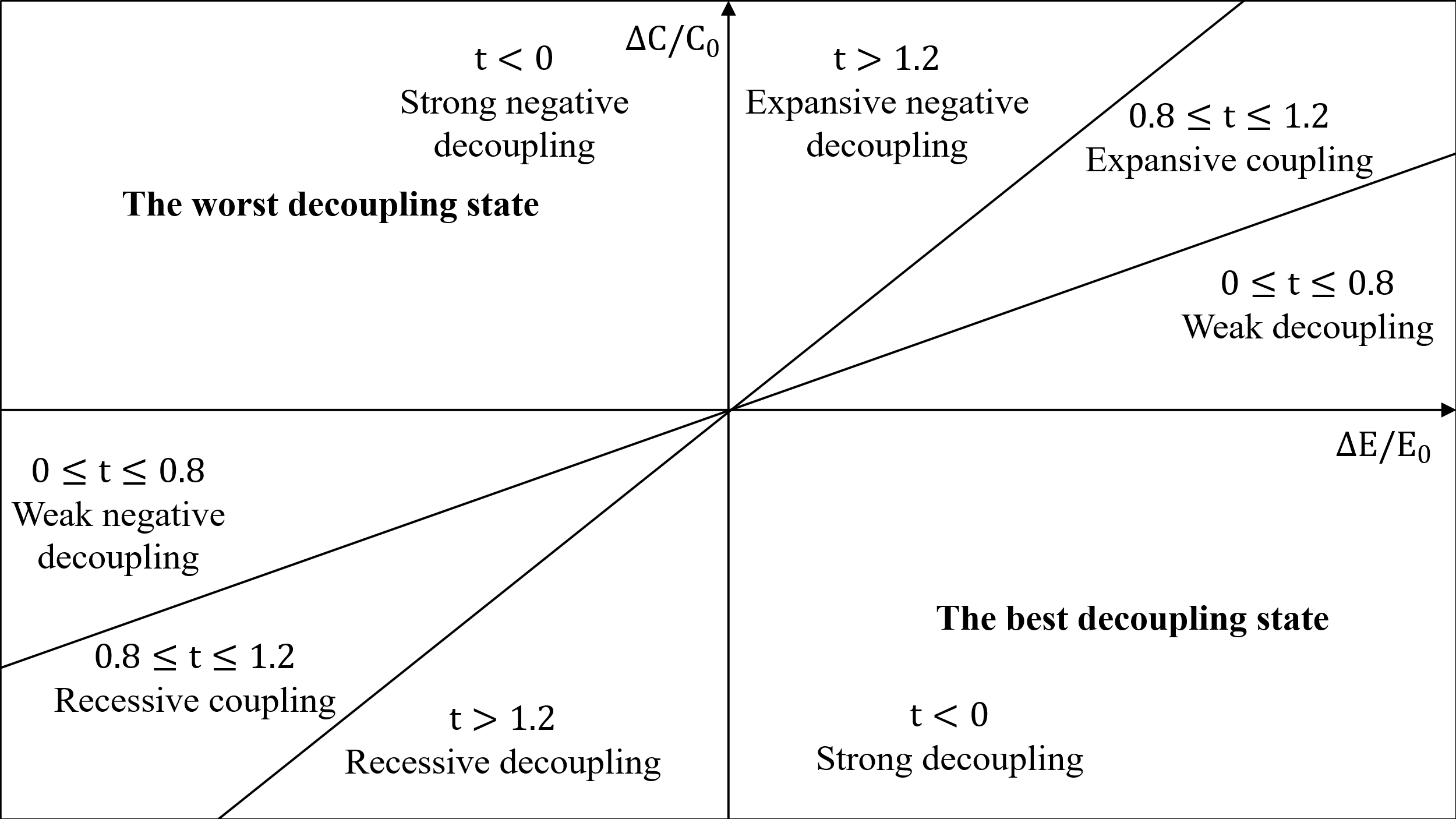
To investigate the decoupling effect of Foreign Direct Investment (FDI) on carbon emissions, this study employs nonlinear panel models and threshold regression models to analyze the impact of FDI on economic growth and carbon emissions in RCEP member countries from 2000 to 2023. First, the Tapio decoupling model reveals that since 2012, the relationship between economic growth and carbon emissions has predominantly exhibited a weak decoupling state. Second, the results from the nonlinear panel models and threshold models indicate that FDI has a significant "U-shaped" nonlinear relationship with both economic growth and carbon emissions. Specifically, in terms of economic effects, FDI may initially suppress economic growth, but ultimately contribute to it. In terms of environmental effects, FDI initially shows emission reduction benefits, but may eventually intensify carbon emissions. The moderating effect model shows that digital infrastructure significantly weakens these "U-shaped" relationships, reducing the steepness of the original curves. Finally, based on this "U-shaped" relationship and the moderating role of digital infrastructure, policy suggestions are put forward to enhance the synergistic benefits of FDI for both economic development and environmental sustainability. The findings of this study shed new light on the classic debate concerning foreign direct investment (FDI), economic development, and environmental sustainability within the RCEP context.

Graphical Abstract
The Nonlinear Impact of FDI on Economic Growth and Carbon Emissions: Evidence from RCEP Countries

Keywords
FDI
economic growth
carbon emissions
nonlinearity
RCEP

Data Availability Statement
Data will be made available on request.

Funding
This work was supported without any funding.

Conflicts of Interest
The author declares no conflicts of interest.

AI Use Statement
The author declares that no generative AI was used in the preparation of this manuscript.

Ethical Approval and Consent to Participate
Not applicable.

References
  1. Li, L., Awada, T., Zhang, Y., & Paustian, K. (2024). Global land use change and its impact on greenhouse gas emissions. Global Change Biology, 30(12), e17604.
    [CrossRef]   [Google Scholar]
  2. Cook, J., Oreskes, N., Doran, P. T., Anderegg, W. R., Verheggen, B., Maibach, E. W., ... & Rice, K. (2016). Consensus on consensus: a synthesis of consensus estimates on human-caused global warming. Environmental research letters, 11(4), 048002.
    [CrossRef]   [Google Scholar]
  3. Feng, W., Min, W., & Wen, Z. (2023). What are the impacts of the carbon peaking and carbon neutrality target constraints on China's economy? Environmental Impact Assessment Review, 101, 107107.
    [CrossRef]   [Google Scholar]
  4. Zhou, S., & Xu, Z. (2022). Energy efficiency assessment of RCEP member states: A three-stage slack based measurement DEA with undesirable outputs. Energy, 253, 124170.
    [CrossRef]   [Google Scholar]
  5. Solow, R. M. (1956). A contribution to the theory of economic growth. The quarterly journal of economics, 70(1), 65-94.
    [CrossRef]   [Google Scholar]
  6. Romer, P. M. (1986). Increasing returns and long-run growth. Journal of political economy, 94(5), 1002-1037.
    [CrossRef]   [Google Scholar]
  7. Borensztein, E., De Gregorio, J., & Lee, J. W. (1998). How does foreign direct investment affect economic growth?. Journal of international Economics, 45(1), 115-135.
    [CrossRef]   [Google Scholar]
  8. Latif, Z., Latif, S., Ximei, L., Pathan, Z. H., Salam, S., & Jianqiu, Z. (2018). The dynamics of ICT, foreign direct investment, globalization and economic growth: Panel estimation robust to heterogeneity and cross-sectional dependence. Telematics and informatics, 35(2), 318-328.
    [CrossRef]   [Google Scholar]
  9. Qamri, G. M., Sheng, B., Adeel-Farooq, R. M., & Alam, G. M. (2022). The criticality of FDI in Environmental Degradation through financial development and economic growth: Implications for promoting the green sector. Resources Policy, 78, 102765.
    [CrossRef]   [Google Scholar]
  10. Brecher, R. A., & Alejandro, C. F. D. (1977). Tariffs, foreign capital and immiserizing growth. Journal of International Economics, 7(4), 317–322.
    [CrossRef]   [Google Scholar]
  11. Doytch, N., & Uctum, M. (2011). Does the worldwide shift of FDI from manufacturing to services accelerate economic growth? A GMM estimation study. Journal of International Money and Finance, 30(3), 410–427.
    [CrossRef]   [Google Scholar]
  12. Seyoum, M., Wu, R., & Lin, J. (2015). Foreign direct investment and economic growth: The case of developing African economies. Social Indicators Research, 122(1), 45–64.
    [CrossRef]   [Google Scholar]
  13. Wang, Q., Wang, L., & Li, R. (2024). Trade openness helps move towards carbon neutrality—Insight from 114 countries. Sustainable Development, 32(1), 1081–1095.
    [CrossRef]   [Google Scholar]
  14. Behera, S. R., & Dash, D. P. (2017). The effect of urbanization, energy consumption, and foreign direct investment on the carbon dioxide emission in the SSEA (South and Southeast Asian) region. Renewable and Sustainable Energy Reviews, 70, 96–106.
    [CrossRef]   [Google Scholar]
  15. Khan, M. T. I., Yaseen, M. R., & Ali, Q. (2017). Dynamic relationship between financial development, energy consumption, trade and greenhouse gas: Comparison of upper middle income countries from Asia, Europe, Africa and America. Journal of Cleaner Production, 161, 567–580.
    [CrossRef]   [Google Scholar]
  16. Bakhsh, K., Rose, S., Ali, M. F., Ahmad, N., & Shahbaz, M. (2017). Economic growth, CO2 emissions, renewable waste and FDI relation in Pakistan: New evidences from 3SLS. Journal of Environmental Management, 196, 627–632.
    [CrossRef]   [Google Scholar]
  17. Walter, I., & Ugelow, J. L. (1979). Environmental policies in developing countries. Ambio, 8(2/3), 102–109.
    [Google Scholar]
  18. Copeland, B. R., & Taylor, M. S. (2017). North-South trade and the environment. In International trade and the environment (pp. 205–238). Routledge.
    [Google Scholar]
  19. Sapkota, P., & Bastola, U. (2017). Foreign direct investment, income, and environmental pollution in developing countries: Panel data analysis of Latin America. Energy Economics, 64, 206–212.
    [CrossRef]   [Google Scholar]
  20. Wu, H., Hao, Y., & Weng, J. H. (2019). How does energy consumption affect China's urbanization? New evidence from dynamic threshold panel models. Energy policy, 127, 24-38.
    [CrossRef]   [Google Scholar]
  21. Sarkodie, S. A., & Strezov, V. (2019). Effect of foreign direct investments, economic development and energy consumption on greenhouse gas emissions in developing countries. Science of the Total Environment, 646, 862–871.
    [CrossRef]   [Google Scholar]
  22. Opoku, E. E. O., & Boachie, M. K. (2020). The environmental impact of industrialization and foreign direct investment. Energy Policy, 137, 111178.
    [CrossRef]   [Google Scholar]
  23. Zarsky, L. (1999). Havens, halos and spaghetti: Untangling the evidence about foreign direct investment and the environment. Foreign Direct Investment and the Environment, 13(8), 47–74.
    [Google Scholar]
  24. Zugravu-Soilita, N. (2017). How does foreign direct investment affect pollution? Toward a better understanding of the direct and conditional effects. Environmental and Resource Economics, 66(2), 293–338.
    [CrossRef]   [Google Scholar]
  25. Demena, B. A., & Afesorgbor, S. K. (2020). The effect of FDI on environmental emissions: Evidence from a meta-analysis. Energy Policy, 138, 111192.
    [CrossRef]   [Google Scholar]
  26. Opoku, E. E. O., Adams, S., & Aluko, O. A. (2021). The foreign direct investment-environment nexus: Does emission disaggregation matter? Energy Reports, 7, 778–787.
    [CrossRef]   [Google Scholar]
  27. Stavropoulos, S., Wall, R., & Xu, Y. (2018). Environmental regulations and industrial competitiveness: Evidence from China. Applied Economics, 50(12), 1378–1394.
    [CrossRef]   [Google Scholar]
  28. Zhang, Y., & Zhang, S. (2018). The impacts of GDP, trade structure, exchange rate and FDI inflows on China's carbon emissions. Energy Policy, 120, 347–353.
    [CrossRef]   [Google Scholar]
  29. Nasir, M. A., Huynh, T. L. D., & Tram, H. T. X. (2019). Role of financial development, economic growth & foreign direct investment in driving climate change: A case of emerging ASEAN. Journal of environmental management, 242, 131-141.
    [CrossRef]   [Google Scholar]
  30. Gyamfi, B. A., Agozie, D. Q., & Bekun, F. V. (2022). Can technological innovation, foreign direct investment and natural resources ease some burden for the BRICS economies within current industrial era? Technology in Society, 70, 102037.
    [CrossRef]   [Google Scholar]
  31. Petrović, P., Filipović, S., & Radovanović, M. (2018). Underlying causal factors of the European Union energy intensity: Econometric evidence. Renewable and Sustainable Energy Reviews, 89, 216–227.
    [CrossRef]   [Google Scholar]
  32. Doytch, N., & Uctum, M. (2016). Globalization and the environmental impact of sectoral FDI. Economic Systems, 40(4), 582–594.
    [CrossRef]   [Google Scholar]
  33. Shahbaz, M., Nasreen, S., Abbas, F., & Anis, O. (2015). Does foreign direct investment impede environmental quality in high-, middle-, and low-income countries? Energy Economics, 51, 275–287.
    [CrossRef]   [Google Scholar]
  34. Adeel-Farooq, R. M., Riaz, M. F., & Ali, T. (2021). Improving the environment begins at home: Revisiting the links between FDI and environment. Energy, 215, 119150.
    [CrossRef]   [Google Scholar]
  35. Acheampong, A. O. (2019). Modelling for insight: does financial development improve environmental quality?. Energy Economics, 83, 156-179.
    [CrossRef]   [Google Scholar]
  36. Wang, Y., Liao, M., Xu, L., & Malik, A. (2021). The impact of foreign direct investment on China's carbon emissions through energy intensity and emissions trading system. Energy Economics, 97, 105212.
    [CrossRef]   [Google Scholar]
  37. Nie, Y., Liu, Q., Liu, R., Ren, D., Zhong, Y., & Yu, F. (2022). The threshold effect of FDI on CO2 emission in Belt and Road countries. International Journal of Environmental Research and Public Health, 19(6), 3523.
    [CrossRef]   [Google Scholar]
  38. Haug, A. A., & Ucal, M. (2019). The role of trade and FDI for CO2 emissions in Turkey: Nonlinear relationships. Energy Economics, 81, 297–307.
    [CrossRef]   [Google Scholar]
  39. Zhang, H., Gao, S., & Zhou, P. (2023). Role of digitalization in energy storage technological innovation: Evidence from China. Renewable and Sustainable Energy Reviews, 171, 113014.
    [CrossRef]   [Google Scholar]
  40. Ahn, S. J. (2020). Three characteristics of technology competition by IoT-driven digitization. Technological Forecasting and Social Change, 157, 120062.
    [CrossRef]   [Google Scholar]
  41. Ma, D., Hu, J., & Yao, F. (2021). Big data empowering low-carbon smart tourism study on low-carbon tourism O2O supply chain considering consumer behaviors and corporate altruistic preferences. Computers & Industrial Engineering, 153, 107061.
    [CrossRef]   [Google Scholar]
  42. Tapio, P. (2005). Towards a theory of decoupling: Degrees of decoupling in the EU and the case of road traffic in Finland between 1970 and 2001. Transport Policy, 12(2), 137–151.
    [CrossRef]   [Google Scholar]
  43. Li, R., Wang, X., & Wang, Q. (2022). Does renewable energy reduce ecological footprint at the expense of economic growth? An empirical analysis of 120 countries. Journal of Cleaner Production, 346, 131207.
    [CrossRef]   [Google Scholar]
  44. Ndubuisi, G., Otioma, C., & Tetteh, G. K. (2021). Digital infrastructure and employment in services: Evidence from Sub-Saharan African countries. Telecommunications Policy, 45(8), 102153.
    [CrossRef]   [Google Scholar]
  45. Danakol, S. H., Estrin, S., Reynolds, P., & Weitzel, U. (2017). Foreign direct investment via M&A and domestic entrepreneurship: Blessing or curse? Small Business Economics, 48(3), 599–612.
    [CrossRef]   [Google Scholar]
  46. Herzer, D. (2025). The impact of FDI-and import-related technology spillovers from government-funded green energy R&D in developed countries on CO2 emissions in developing countries. Energy Policy, 203, 114635.
    [CrossRef]   [Google Scholar]
  47. Hansen, B. E. (2000). Sample splitting and threshold estimation. Econometrica, 68(3), 575–603.
    [CrossRef]   [Google Scholar]
  48. Haans, R. F., Pieters, C., & He, Z. L. (2016). Thinking about U: Theorizing and testing U‐and inverted U‐shaped relationships in strategy research. Strategic Management Journal, 37(7), 1177–1195.
    [CrossRef]   [Google Scholar]

Cite This Article
APA Style
Chen, F. (2026). The Nonlinear Impact of FDI on Economic Growth and Carbon Emissions: Evidence from RCEP Countries. Journal of Social Systems and Policy Analysis, 3(1), 1–14. https://doi.org/10.62762/JSSPA.2025.514568
Export Citation
RIS Format
Compatible with EndNote, Zotero, Mendeley, and other reference managers
RIS format data for reference managers
TY  - JOUR
AU  - Chen, Fang
PY  - 2026
DA  - 2026/01/30
TI  - The Nonlinear Impact of FDI on Economic Growth and Carbon Emissions: Evidence from RCEP Countries
JO  - Journal of Social Systems and Policy Analysis
T2  - Journal of Social Systems and Policy Analysis
JF  - Journal of Social Systems and Policy Analysis
VL  - 3
IS  - 1
SP  - 1
EP  - 14
DO  - 10.62762/JSSPA.2025.514568
UR  - https://www.icck.org/article/abs/JSSPA.2025.514568
KW  - FDI
KW  - economic growth
KW  - carbon emissions
KW  - nonlinearity
KW  - RCEP
AB  - To investigate the decoupling effect of Foreign Direct Investment (FDI) on carbon emissions, this study employs nonlinear panel models and threshold regression models to analyze the impact of FDI on economic growth and carbon emissions in RCEP member countries from 2000 to 2023. First, the Tapio decoupling model reveals that since 2012, the relationship between economic growth and carbon emissions has predominantly exhibited a weak decoupling state. Second, the results from the nonlinear panel models and threshold models indicate that FDI has a significant "U-shaped" nonlinear relationship with both economic growth and carbon emissions. Specifically, in terms of economic effects, FDI may initially suppress economic growth, but ultimately contribute to it. In terms of environmental effects, FDI initially shows emission reduction benefits, but may eventually intensify carbon emissions. The moderating effect model shows that digital infrastructure significantly weakens these "U-shaped" relationships, reducing the steepness of the original curves. Finally, based on this "U-shaped" relationship and the moderating role of digital infrastructure, policy suggestions are put forward to enhance the synergistic benefits of FDI for both economic development and environmental sustainability. The findings of this study shed new light on the classic debate concerning foreign direct investment (FDI), economic development, and environmental sustainability within the RCEP context.
SN  - 3068-5540
PB  - Institute of Central Computation and Knowledge
LA  - English
ER  - 
BibTeX Format
Compatible with LaTeX, BibTeX, and other reference managers
BibTeX format data for LaTeX and reference managers
@article{Chen2026The,
  author = {Fang Chen},
  title = {The Nonlinear Impact of FDI on Economic Growth and Carbon Emissions: Evidence from RCEP Countries},
  journal = {Journal of Social Systems and Policy Analysis},
  year = {2026},
  volume = {3},
  number = {1},
  pages = {1-14},
  doi = {10.62762/JSSPA.2025.514568},
  url = {https://www.icck.org/article/abs/JSSPA.2025.514568},
  abstract = {To investigate the decoupling effect of Foreign Direct Investment (FDI) on carbon emissions, this study employs nonlinear panel models and threshold regression models to analyze the impact of FDI on economic growth and carbon emissions in RCEP member countries from 2000 to 2023. First, the Tapio decoupling model reveals that since 2012, the relationship between economic growth and carbon emissions has predominantly exhibited a weak decoupling state. Second, the results from the nonlinear panel models and threshold models indicate that FDI has a significant "U-shaped" nonlinear relationship with both economic growth and carbon emissions. Specifically, in terms of economic effects, FDI may initially suppress economic growth, but ultimately contribute to it. In terms of environmental effects, FDI initially shows emission reduction benefits, but may eventually intensify carbon emissions. The moderating effect model shows that digital infrastructure significantly weakens these "U-shaped" relationships, reducing the steepness of the original curves. Finally, based on this "U-shaped" relationship and the moderating role of digital infrastructure, policy suggestions are put forward to enhance the synergistic benefits of FDI for both economic development and environmental sustainability. The findings of this study shed new light on the classic debate concerning foreign direct investment (FDI), economic development, and environmental sustainability within the RCEP context.},
  keywords = {FDI, economic growth, carbon emissions, nonlinearity, RCEP},
  issn = {3068-5540},
  publisher = {Institute of Central Computation and Knowledge}
}

Article Metrics
Citations:

Crossref

0

Scopus

0

Web of Science

0
Article Access Statistics:
Views: 17
PDF Downloads: 4

Publisher's Note
ICCK stays neutral with regard to jurisdictional claims in published maps and institutional affiliations.

Rights and Permissions
CC BY Copyright © 2026 by the Author(s). Published by Institute of Central Computation and Knowledge. This article is an open access article distributed under the terms and conditions of the Creative Commons Attribution (CC BY) license (https://creativecommons.org/licenses/by/4.0/), which permits use, sharing, adaptation, distribution and reproduction in any medium or format, as long as you give appropriate credit to the original author(s) and the source, provide a link to the Creative Commons licence, and indicate if changes were made.
Journal of Social Systems and Policy Analysis

Journal of Social Systems and Policy Analysis

ISSN: 3068-5540 (Online)

Email: [email protected]

Portico

Portico

All published articles are preserved here permanently:
https://www.portico.org/publishers/icck/