
Perspective
Open Access
Integrating AI and Education: A Multidimensional Perspective on Opportunities, Risks, and Future Development


1
School of Teacher Education, Fujian Normal University, Fuzhou 350007, China
* Corresponding Author:
Chuyun Liu,
[email protected]
Volume 2, Issue 1
2025
Received: 28 March 2025
Accepted: 30 March 2025
Published: 31 March 2025

You have full access to this open access article
·
CC BY 4.0 License
Article Information
Published in
Journal of Social Systems and Policy Analysis
Volume/Issue
Volume 2, Issue 1, 2025
Pages
29-33
Cited by
2 (Crossref)
Abstract
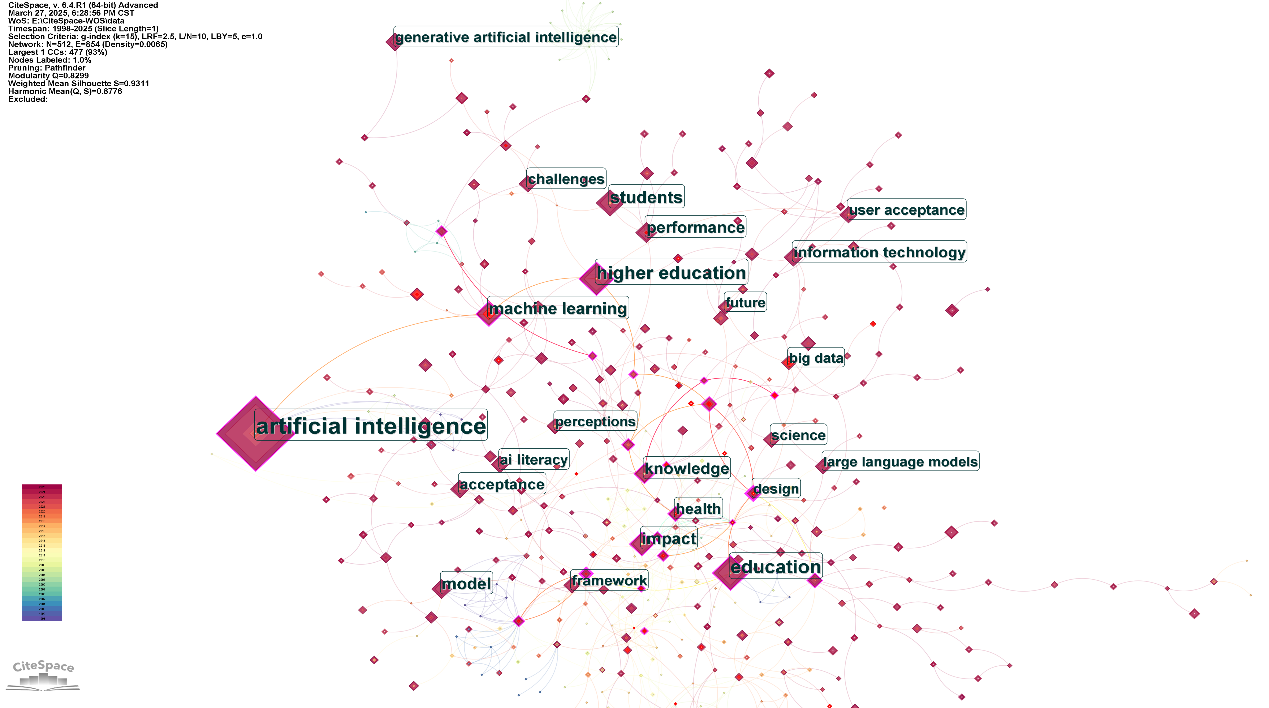
The rapid development of artificial intelligence has profoundly impacted the field of education, influencing teaching models, learning methods, and assessment techniques. This study analyzes the current state of AI in education using the CiteSpace visualization tool, revealing key challenges such as the lack of assurance in information authenticity, the exacerbation of educational inequality, and the potential decline in essential skills. Based on these findings, the paper explores future directions for AI development in education.
Graphical Abstract
Keywords
artificial intelligence
education
personalized assessment
generative AI
Data Availability Statement
Data will be made available on request.
Funding
This work was supported without any funding.
Conflicts of Interest
The author declares no conflicts of interest.
Ethical Approval and Consent to Participate
Not applicable.
References
- Yu, H., & Guo, Y. (2023, June). Generative artificial intelligence empowers educational reform: current status, issues, and prospects. In Frontiers in Education (Vol. 8, p. 1183162). Frontiers Media SA.
[CrossRef] [Google Scholar] - Darics, E., & van Poppel, L. (2023, Feb 20). Debate: ChatGPT offers unseen opportunities to sharpen students’ critical skills. The Conversation. Retrieved from https://theconversation.com/debate-chatgpt-offers-unseen-opportunities-to-sharpen-students-critical-skills-199264
[Google Scholar] - Cooper, G. (2023). Examining science education in ChatGPT: An exploratory study of generative artificial intelligence. Journal of science education and technology, 32(3), 444-452.
[CrossRef] [Google Scholar] - Kim, J., Merrill, K., Xu, K., & Sellnow, D. D. (2020). My teacher is a machine: Understanding students’ perceptions of AI teaching assistants in online education. International Journal of Human–Computer Interaction, 36(20), 1902-1911.
[CrossRef] [Google Scholar] - Jeon, J., & Lee, S. (2023). Large language models in education: A focus on the complementary relationship between human teachers and ChatGPT. Education and Information Technologies, 28(12), 15873-15892.
[CrossRef] [Google Scholar]
Cited By (2)
-
Joe Mutebi, Brian Mugisha, Ibrahim Adabara, Tukur Muhammad. Empowering the AI-Literate Learners: Evaluating the Intersection of Digital Governance and Academic Integrity.
F1000Research, 2026 , 15 .
[CrossRef] -
Josue David Chuqui Sulca, Estelita Janett Romero Carhuancho, Mercedes Dora Izaguirre Tapia, Vivian Collahua Rupaylla, Claudia Regina Nuñez Velarde. Inteligencia artificial en la educación inclusiva: Un análisis bibliométrico de la producción científica (2023–2026).
Revista Tribunal, 2026 , 6 (16).
[CrossRef]
* Citation data provided by Crossref Cited-by.
Cite This Article
APA Style
Liu, C. (2025). Integrating AI and Education: A Multidimensional Perspective on Opportunities, Risks, and Future Development. Journal of Social Systems and Policy Analysis, 2(1), 29–33. https://doi.org/10.62762/JSSPA.2025.594321
Export Citation
RIS Format
Compatible with EndNote, Zotero, Mendeley, and other reference managers
TY  - JOUR
AU  - Liu, Chuyun
PY  - 2025
DA  - 2025/03/31
TI  - Integrating AI and Education: A Multidimensional Perspective on Opportunities, Risks, and Future Development
JO  - Journal of Social Systems and Policy Analysis
T2  - Journal of Social Systems and Policy Analysis
JF  - Journal of Social Systems and Policy Analysis
VL  - 2
IS  - 1
SP  - 29
EP  - 33
DO  - 10.62762/JSSPA.2025.594321
UR  - https://www.icck.org/article/abs/jsspa.2025.594321
KW  - artificial intelligence
KW  - education
KW  - personalized assessment
KW  - generative AI
AB  - The rapid development of artificial intelligence has profoundly impacted the field of education, influencing teaching models, learning methods, and assessment techniques. This study analyzes the current state of AI in education using the CiteSpace visualization tool, revealing key challenges such as the lack of assurance in information authenticity, the exacerbation of educational inequality, and the potential decline in essential skills. Based on these findings, the paper explores future directions for AI development in education.
SN  - 3068-5540
PB  - Institute of Central Computation and Knowledge
LA  - English
ER  -
BibTeX Format
Compatible with LaTeX, BibTeX, and other reference managers
@article{Liu2025Integratin,
  author = {Chuyun Liu},
  title = {Integrating AI and Education: A Multidimensional Perspective on Opportunities, Risks, and Future Development},
  journal = {Journal of Social Systems and Policy Analysis},
  year = {2025},
  volume = {2},
  number = {1},
  pages = {29-33},
  doi = {10.62762/JSSPA.2025.594321},
  url = {https://www.icck.org/article/abs/jsspa.2025.594321},
  abstract = {The rapid development of artificial intelligence has profoundly impacted the field of education, influencing teaching models, learning methods, and assessment techniques. This study analyzes the current state of AI in education using the CiteSpace visualization tool, revealing key challenges such as the lack of assurance in information authenticity, the exacerbation of educational inequality, and the potential decline in essential skills. Based on these findings, the paper explores future directions for AI development in education.},
  keywords = {artificial intelligence, education, personalized assessment, generative AI},
  issn = {3068-5540},
  publisher = {Institute of Central Computation and Knowledge}
}
Article Metrics
Publisher's Note
ICCK stays neutral with regard to jurisdictional claims in published maps and institutional affiliations.
Rights and Permissions
 Copyright © 2025 by the Author(s). Published by Institute of Central Computation and Knowledge. This article is an open access article distributed under the terms and conditions of the Creative Commons Attribution (CC BY) license (https://creativecommons.org/licenses/by/4.0/), which permits use, sharing, adaptation, distribution and reproduction in any medium or format, as long as you give appropriate credit to the original author(s) and the source, provide a link to the Creative Commons licence, and indicate if changes were made.


Preserved at
Portico
Portico

Scan to read this article