
Historical Mission and Life Initiatives of College Students in the New Era: Employment Choices and Employment Psychology - Based on Questionnaires and Interviews from 31 Universities Nationwide



Article Information
Abstract
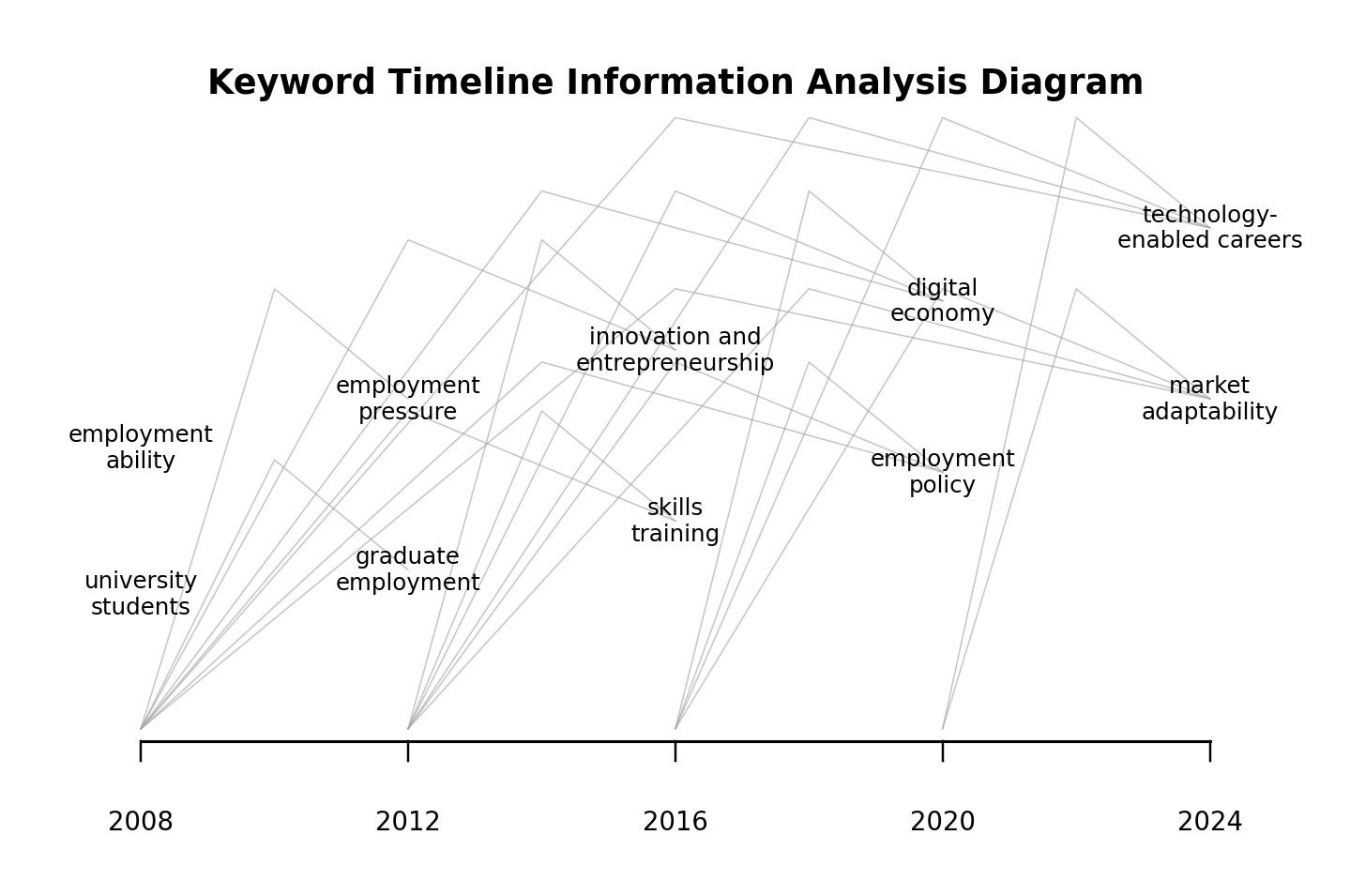
Against the background of digital transformation, industrial upgrading, and increasingly uncertain labor-market conditions, university students are expected to make career decisions that require both technological competence and market adaptability. This study examines university students' employment choices and employment psychology by combining bibliometric analysis, questionnaires, and semi-structured interviews from 31 universities. CiteSpace was used to identify research trends related to university employment, while interview materials from 150 students were analyzed with NVivo to identify recurring psychological patterns in career decision-making. The findings show that students attach strong importance to employment stability, income security, urban development opportunities, and work-life balance. At the same time, students with stronger digital skills, foreign-language ability, and practical experience appear more open to market-oriented sectors, technology-intensive jobs, flexible employment, and entrepreneurship. The study further identifies several psychological tensions, including the gap between ideal expectations and labor-market reality, dependence on family or university resources, hesitation in the face of uncertain career options, and anxiety after job-search setbacks. Based on these findings, the study proposes a multi-level support framework involving public policy, universities, enterprises, families, and students. The framework emphasizes technology-enabled career guidance, university-enterprise collaboration, accurate labor-market information, psychological resilience, and social responsibility in order to improve graduate employability and career quality.
Graphical Abstract
Keywords
Data Availability Statement
Funding
Conflicts of Interest
Ethical Approval and Consent to Participate
References
- Bai, L. (2006). Graduate unemployment: Dilemmas and challenges in China's move to mass higher education. The China Quarterly, 185, 128-144.
[CrossRef] [Google Scholar] - Bridgstock, R. (2009). The graduate attributes we've overlooked: Enhancing graduate employability through career management skills. Higher Education Research & Development, 28(1), 31-44.
[CrossRef] [Google Scholar] - Chen, C. (2006). CiteSpace II: Detecting and visualizing emerging trends and transient patterns in scientific literature. Journal of the American Society for Information Science and Technology, 57(3), 359-377.
[CrossRef] [Google Scholar] - \bibitem{cheng2025 Cheng, S., Cao, R., & Md Rashid, S. (2025). The influence of employability skills on quality of employment in AI-driven labour market transformations: The roles of academic achievement and motivation. Humanities and Social Sciences Communications, 12(1), 1599.
[CrossRef] [Google Scholar] - Clarke, M. (2018). Rethinking graduate employability: The role of capital, individual attributes and context. Studies in Higher Education, 43(11), 1923-1937.
[CrossRef] [Google Scholar] - Donald, W. E., Baruch, Y., & Ashleigh, M. (2019). The undergraduate self-perception of employability: Human capital, careers advice, and career ownership. Studies in Higher Education, 44(4), 599-614.
[CrossRef] [Google Scholar] - Fugate, M., Kinicki, A. J., & Ashforth, B. E. (2004). Employability: A psycho-social construct, its dimensions, and applications. Journal of Vocational Behavior, 65(1), 14-38.
[CrossRef] [Google Scholar] - Guan, Y., Wang, F., Liu, H., Ji, Y., Jia, X., Fang, Z., Li, Y., Hua, H., & Li, C. (2015). Career-specific parental behaviors, career exploration and career adaptability: A three-wave investigation among Chinese undergraduates. Journal of Vocational Behavior, 86, 95-103.
[CrossRef] [Google Scholar] - Holmes, L. (2013). Competing perspectives on graduate employability: Possession, position or process? Studies in Higher Education, 38(4), 538-554.
[CrossRef] [Google Scholar] - Ilom\"{aki, L., Paavola, S., Lakkala, M., & Kantosalo, A. (2016). Digital competence: An emergent boundary concept for policy and educational research. Education and Information Technologies, 21(3), 655-679.
[CrossRef] [Google Scholar] - Jackson, D. (2014). Testing a model of undergraduate competence in employability skills and its implications for stakeholders. Journal of Education and Work, 27(2), 220-242.
[CrossRef] [Google Scholar] - Jackson, D. (2016). Re-conceptualising graduate employability: The importance of pre-professional identity. Higher Education Research & Development, 35(5), 925-939.
[CrossRef] [Google Scholar] - Jackson, D., Lambert, C., Sibson, R., Bridgstock, R., & Tofa, M. (2024). Student employability-building activities: Participation and contribution to graduate outcomes. Higher Education Research & Development, 43(6), 1308-1324.
[CrossRef] [Google Scholar] - Koen, J., Klehe, U.-C., & Van Vianen, A. E. M. (2012). Training career adaptability to facilitate a successful school-to-work transition. Journal of Vocational Behavior, 81(3), 395-408.
[CrossRef] [Google Scholar] - Lent, R. W., Brown, S. D., & Hackett, G. (1994). Toward a unifying social cognitive theory of career and academic interest, choice, and performance. Journal of Vocational Behavior, 45(1), 79-122.
[CrossRef] [Google Scholar] - Lent, R. W., Brown, S. D., & Hackett, G. (2000). Contextual supports and barriers to career choice: A social cognitive analysis. Journal of Counseling Psychology, 47(1), 36-49.
[CrossRef] [Google Scholar] - Ou, L., Ni, J., Qiu, X., & Li, D. (2023). Research on the relationship between rural volunteering and career expectations of college students: The mediating effect of role identity. SAGE Open, 13(2), 21582440231180664.
[CrossRef] [Google Scholar] - Zheng, S., & Yan, Y. (2024). Changes in employment psychology of Chinese university students during the two stages of COVID-19 control and their impacts on their employment intentions. Frontiers in Psychology, 15, 1447103.
[CrossRef] [Google Scholar] - McQuaid, R. W., & Lindsay, C. (2005). The concept of employability. Urban Studies, 42(2), 197-219.
[CrossRef] [Google Scholar] - Mok, K. H., Wen, Z. V., & Dale, R. (2016). Employability and mobility in the valorisation of higher education qualifications: The experiences and reflections of Chinese students and graduates. Journal of Higher Education Policy and Management, 38(3), 264-281.
[CrossRef] [Google Scholar] - Ngoc Ha, N. T., Van Dyke, N., & Spittle, M. (2026). Micro-credentials in higher education: perceived benefits for graduate employability and interest levels in micro-credentials for training employability skills. Studies in Higher Education, 51(7), 1447-1459.
[CrossRef] [Google Scholar] - Phusavat, K., Ongkunaruk, P., & Anussornnitisarn, P. (2025). Gaining insights into the employability of university graduates: Implications from the students' inputs. Studies in Higher Education. Advance online publication.
[CrossRef] [Google Scholar] - Ng, D. T. K., Leung, J. K. L., Chu, S. K. W., & Qiao, M. S. (2021). Conceptualizing AI literacy: An exploratory review. Computers and education: Artificial intelligence, 2, 100041.
[CrossRef] [Google Scholar] - Rothwell, A., Herbert, I., & Rothwell, F. (2008). Self-perceived employability: Construction and initial validation of a scale for university students. Journal of Vocational Behavior, 73(1), 1-12.
[CrossRef] [Google Scholar] - Savickas, M. L., & Porfeli, E. J. (2012). Career Adapt-Abilities Scale: Construction, reliability, and measurement equivalence across 13 countries. Journal of Vocational Behavior, 80(3), 661-673.
[CrossRef] [Google Scholar] - Scandurra, R., Kelly, D., Fusaro, S., Cefalo, R., & Hermannsson, K. (2024). Do employability programmes in higher education improve skills and labour market outcomes? A systematic review of academic literature. Studies in Higher Education, 49(8), 1381-1396.
[CrossRef] [Google Scholar] - Sozon, M., Roengtam, S., & Yin, Y. (2026). Graduate employability in the AI and globalisation era: implications for higher education institutions. Journal of Applied Research in Higher Education, 1-21.
[CrossRef] [Google Scholar] - Tomlinson, M. (2012). Graduate employability: A review of conceptual and empirical themes. Higher Education Policy, 25(4), 407-431.
[CrossRef] [Google Scholar] - van Laar, E., van Deursen, A. J. A. M., van Dijk, J. A. G. M., & de Haan, J. (2017). The relation between 21st-century skills and digital skills: A systematic literature review. Computers in Human Behavior, 72, 577-588.
[CrossRef] [Google Scholar] - Zahn, E.-M., Sch\"{obel, S., Saqr, M., & S\"{ollner, M. (2025). Mapping soft skills and further research directions for higher education: A bibliometric approach with structural topic modelling. Studies in Higher Education, 50(6), 1055-1075.
[CrossRef] [Google Scholar] - Landis, J. R., & Koch, G. G. (1977). The measurement of observer agreement for categorical data. Biometrics, 33(1), 159-174.
[CrossRef] [Google Scholar]
Cite This Article
TY  - JOUR
AU  - Lu, Xinyong
PY  - 2025
DA  - 2025/03/31
TI  - Historical Mission and Life Initiatives of College Students in the New Era: Employment Choices and Employment Psychology - Based on Questionnaires and Interviews from 31 Universities Nationwide
JO  - Journal of Social Systems and Policy Analysis
T2  - Journal of Social Systems and Policy Analysis
JF  - Journal of Social Systems and Policy Analysis
VL  - 2
IS  - 1
SP  - 34
EP  - 46
DO  - 10.62762/JSSPA.2025.814082
UR  - https://www.icck.org/article/abs/jsspa.2025.814082
KW  - University students
KW  - technological literacy
KW  - market adaptability
KW  - employment psychology
KW  - social responsibility
AB  - Against the background of digital transformation, industrial upgrading, and increasingly uncertain labor-market conditions, university students are expected to make career decisions that require both technological competence and market adaptability. This study examines university students' employment choices and employment psychology by combining bibliometric analysis, questionnaires, and semi-structured interviews from 31 universities. CiteSpace was used to identify research trends related to university employment, while interview materials from 150 students were analyzed with NVivo to identify recurring psychological patterns in career decision-making. The findings show that students attach strong importance to employment stability, income security, urban development opportunities, and work-life balance. At the same time, students with stronger digital skills, foreign-language ability, and practical experience appear more open to market-oriented sectors, technology-intensive jobs, flexible employment, and entrepreneurship. The study further identifies several psychological tensions, including the gap between ideal expectations and labor-market reality, dependence on family or university resources, hesitation in the face of uncertain career options, and anxiety after job-search setbacks. Based on these findings, the study proposes a multi-level support framework involving public policy, universities, enterprises, families, and students. The framework emphasizes technology-enabled career guidance, university-enterprise collaboration, accurate labor-market information, psychological resilience, and social responsibility in order to improve graduate employability and career quality.
SN  - 3068-5540
PB  - Institute of Central Computation and Knowledge
LA  - English
ER  -
@article{Lu2025Historical,
  author = {Xinyong Lu},
  title = {Historical Mission and Life Initiatives of College Students in the New Era: Employment Choices and Employment Psychology - Based on Questionnaires and Interviews from 31 Universities Nationwide},
  journal = {Journal of Social Systems and Policy Analysis},
  year = {2025},
  volume = {2},
  number = {1},
  pages = {34-46},
  doi = {10.62762/JSSPA.2025.814082},
  url = {https://www.icck.org/article/abs/jsspa.2025.814082},
  abstract = {Against the background of digital transformation, industrial upgrading, and increasingly uncertain labor-market conditions, university students are expected to make career decisions that require both technological competence and market adaptability. This study examines university students' employment choices and employment psychology by combining bibliometric analysis, questionnaires, and semi-structured interviews from 31 universities. CiteSpace was used to identify research trends related to university employment, while interview materials from 150 students were analyzed with NVivo to identify recurring psychological patterns in career decision-making. The findings show that students attach strong importance to employment stability, income security, urban development opportunities, and work-life balance. At the same time, students with stronger digital skills, foreign-language ability, and practical experience appear more open to market-oriented sectors, technology-intensive jobs, flexible employment, and entrepreneurship. The study further identifies several psychological tensions, including the gap between ideal expectations and labor-market reality, dependence on family or university resources, hesitation in the face of uncertain career options, and anxiety after job-search setbacks. Based on these findings, the study proposes a multi-level support framework involving public policy, universities, enterprises, families, and students. The framework emphasizes technology-enabled career guidance, university-enterprise collaboration, accurate labor-market information, psychological resilience, and social responsibility in order to improve graduate employability and career quality.},
  keywords = {University students, technological literacy, market adaptability, employment psychology, social responsibility},
  issn = {3068-5540},
  publisher = {Institute of Central Computation and Knowledge}
}
Article Metrics
Publisher's Note
ICCK stays neutral with regard to jurisdictional claims in published maps and institutional affiliations.
Rights and Permissions
 Copyright © 2025 by the Author(s). Published by Institute of Central Computation and Knowledge. This article is an open access article distributed under the terms and conditions of the Creative Commons Attribution (CC BY) license (https://creativecommons.org/licenses/by/4.0/), which permits use, sharing, adaptation, distribution and reproduction in any medium or format, as long as you give appropriate credit to the original author(s) and the source, provide a link to the Creative Commons licence, and indicate if changes were made.

Portico
