
-
CiteScore
-
Impact Factor
Volume 2, Issue 1, Reservoir Science
Volume 2, Issue 1, 2026
Submit Manuscript Edit a Special Issue
Article QR Code
Article QR Code
Scan the QR code for reading
Popular articles
Reservoir Science, Volume 2, Issue 1, 2026: 1-15

Open Access | Research Article | 06 January 2026
Effect of Nanomaterials on Improving the Apparent Viscosity of Heavy Oil and the Environmental Evaluation of Reservoir Environment
1 School of Petroleum Engineering, China University of Petroleum (East China), Qingdao 266580, China
* Corresponding Author: Yanling Wang, [email protected]
ARK: ark:/57805/rs.2025.277961
Received: 24 October 2025, Accepted: 17 December 2025, Published: 06 January 2026  
Abstract
Heavy oil reservoirs have become an important potential for alleviating energy shortages and supporting economic development. This investigation aims to explore the influence of a nano heavy oil viscosity reducer and reservoir characteristics on crude oil viscosity and flow rate during the underground extraction process, and to reveal the viscosity reduction mechanism of reservoir crude oil. The results indicate that the prepared nano viscosity reducer can significantly weaken oil viscosity compared with the commercial viscosity reducer. Moreover, the nano viscosity reducer NVR (acting as a catalyst) achieves a much higher viscosity reduction performance than the commercial viscosity reducer CVR under the same conditions. Meanwhile, the dosage of nano viscosity reducer NVR shows the greatest impact on the viscosity reduction rate among the investigated factors, whereas the pyrolysis time exhibits the smallest influence. This investigation provides basic data for improving the flowability, mobility, and recovery of reservoir crude oil.

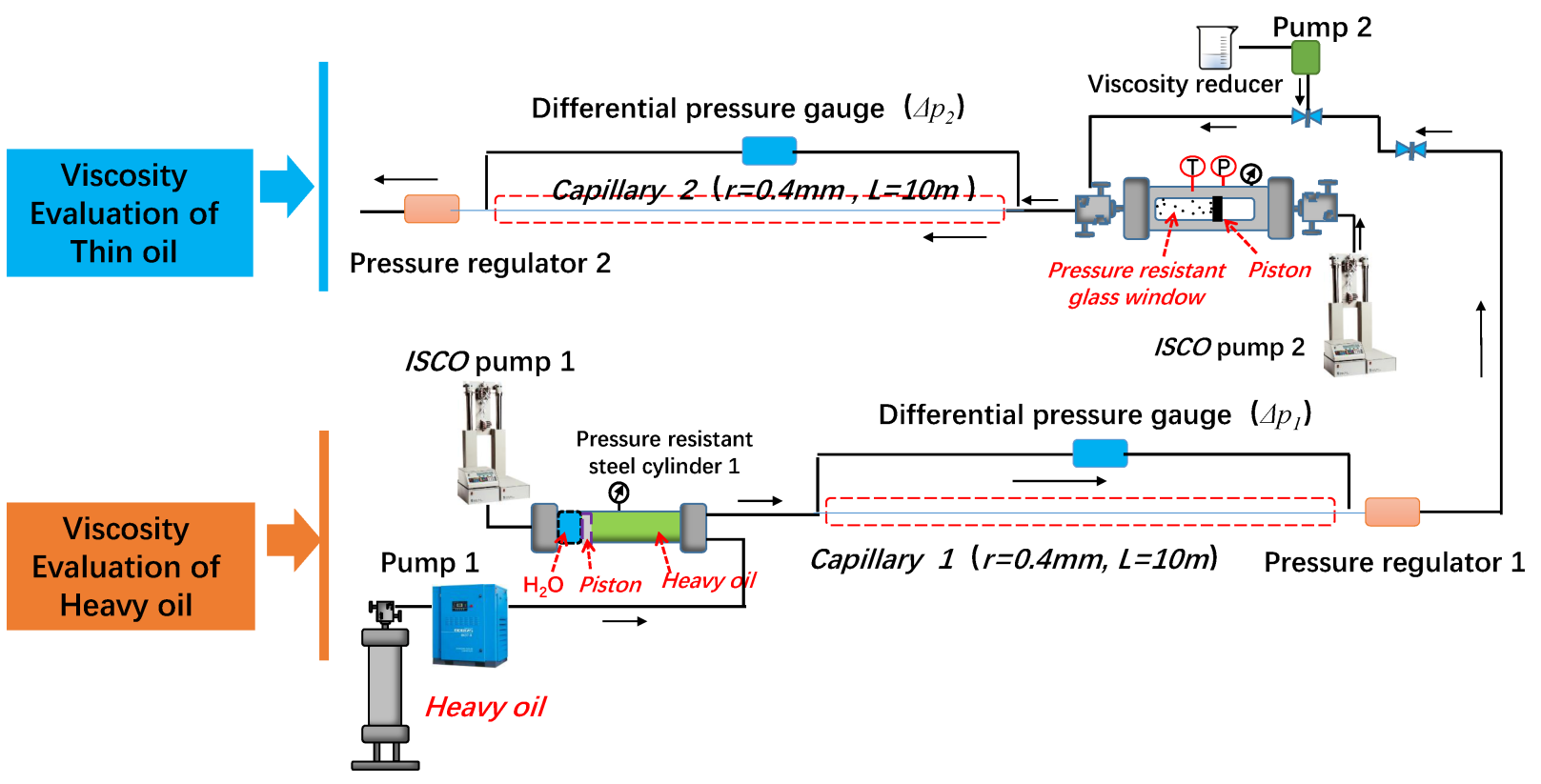
Graphical Abstract
Effect of Nanomaterials on Improving the Apparent Viscosity of Heavy Oil and the Environmental Evaluation of Reservoir Environment

Keywords
geological energy
geological reservoir
heavy oil viscosity reduction
reservoir stimulation
petroleum engineering

Data Availability Statement
Data will be made available on request.

Funding
This work was supported without any funding.

Conflicts of Interest
The authors declare no conflicts of interest.

Ethical Approval and Consent to Participate
Not applicable.

References
  1. Montes, D., Orozco, W., Taborda, E. A., Franco, C. A., & Cortés, F. B. (2019). Development of nanofluids for perdurability in viscosity reduction of extra-heavy oils. Energies, 12(6), 1068.
    [CrossRef]   [Google Scholar]
  2. Ansari, U., Cheng, Y., Memon, M. K., Nabi, A., & WanQing, T. (2023). Predicting the Presence of Natural Gas Hydrates Potential in the Maritime Regions of Pakistan by Correlating Experimental Study and Pre Available Seismic Surveys. Energy Sources, Part A: Recovery, Utilization, and Environmental Effects, 45(3), 7461-7472.
    [CrossRef]   [Google Scholar]
  3. Fan, H., Li, Z., & Liang, T. (2007). Experimental study on using ionic liquids to upgrade heavy oil. Journal of Fuel Chemistry and Technology, 35(1), 32–35.
    [CrossRef]   [Google Scholar]
  4. Chen, Y., Yang, C., & Wang, Y. (2010). Gemini catalyst for catalytic aquathermolysis of heavy oil. Journal of Analytical and Applied Pyrolysis, 89(2), 159-165.
    [CrossRef]   [Google Scholar]
  5. Chen, L., Zhang, G., & Ge, J. (2013). Research of the heavy oil displacement mechanism by using alkaline/surfactant flooding system. Colloids and Surfaces A: Physicochemical and Engineering Aspects, 434, 63–71.
    [CrossRef]   [Google Scholar]
  6. Ma, X., Sun, Y., Liu, B., Guo, W., Jia, R., Li, B., & Li, S. (2020). Numerical study of depressurization and hot water injection for gas hydrate production in China's first offshore test site. Journal of Natural Gas Science and Engineering, 83, 103530.
    [CrossRef]   [Google Scholar]
  7. Hasan, S. W., Ghannam, M. T., & Esmail, N. (2010). Heavy crude oil viscosity reduction and rheology for pipeline transportation. Fuel, 89(5), 1095–1100.
    [CrossRef]   [Google Scholar]
  8. Ke, H., Yuan, M., & Xia, S. (2022). A review of nanomaterials as viscosity reducer for heavy oil. Journal of Dispersion Science and Technology, 43(9), 1271-1282.
    [CrossRef]   [Google Scholar]
  9. Li, Q., Wang, F., Forson, K., Zhang, J., Zhang, C., Chen, J., ... & Wang, Y. (2022). Affecting analysis of the rheological characteristic and reservoir damage of CO2 fracturing fluid in low permeability shale reservoir. Environmental Science and Pollution Research, 29(25), 37815-37826.
    [CrossRef]   [Google Scholar]
  10. Ma, X., Jiang, D., Sun, Y., & Li, S. (2022). Experimental study on hydraulic fracturing behavior of frozen clayey silt and hydrate-bearing clayey silt. Fuel, 322, 124366.
    [CrossRef]   [Google Scholar]
  11. Botella, L., Stankovikj, F., Sánchez, J. L., Gonzalo, A., Arauzo, J., & Garcia-Pérez, M. (2018). Bio-oil hydrotreatment for enhancing solubility in biodiesel and the oxydation stability of resulting blends. Frontiers in Chemistry, 6, 83.
    [CrossRef]   [Google Scholar]
  12. Tang, X., Duan, W., Xu, K., & Zheng, C. (2022). Three-dimensional network gel structure and viscosity reduction mechanism of heavy oil. Colloids and Surfaces A: Physicochemical and Engineering Aspects, 653, 130060.
    [CrossRef]   [Google Scholar]
  13. Xu, J., Wang, N., Xue, S., Zhang, H., Zhang, J., Xia, S., & Han, Y. (2022). Insights into the mechanism during viscosity reduction process of heavy oil through molecule simulation. Fuel, 310, 122270.
    [CrossRef]   [Google Scholar]
  14. Chen, Q., Wang, Y., Lu, Z., & Feng, Y. (2013). Thermoviscosifying polymer used for enhanced oil recovery: rheological behaviors and core flooding test. Polymer bulletin, 70(2), 391-401.
    [CrossRef]   [Google Scholar]
  15. Li, X., Zhang, F., & Liu, G. (2022, February). Review on new heavy oil viscosity reduction technologies. In IOP Conference Series: Earth and Environmental Science (Vol. 983, No. 1, p. 012059). IOP Publishing.
    [CrossRef]   [Google Scholar]
  16. Jang, H. Y., Zhang, K., Chon, B. H., & Choi, H. (2015). Enhanced oil recovery performance and viscosity characteristics of polysaccharide xanthan gum solution. Journal of Industrial and Engineering Chemistry, 21, 741–745.
    [CrossRef]   [Google Scholar]
  17. Nian, Y. L., & Cheng, W. L. (2017). Insights into heat transport for thermal oil recovery. Journal of Petroleum Science and Engineering, 151, 507–521.
    [CrossRef]   [Google Scholar]
  18. Patel, H., Shah, S., Ahmed, R., & Ucan, S. (2018). Effects of nanoparticles and temperature on heavy oil viscosity. Journal of Petroleum Science and Engineering, 167, 819–828.
    [CrossRef]   [Google Scholar]
  19. Cross, M. M. (1970). Viscosity, molecular weight and chain entanglement. Polymer, 11(5), 238-244.
    [CrossRef]   [Google Scholar]
  20. Tan, J., Wang, Z., Chen, S., & Hu, H. (2023). Progress and outlook of supercritical CO2–heavy oil viscosity reduction technology: a minireview. Energy & Fuels, 37(16), 11567-11583.
    [CrossRef]   [Google Scholar]
  21. Shao, M., Shao, Y., Wang, Y., Fu, L., Liao, K., Zhu, T., & Yang, Z. (2025). A review and perspective on viscosity reduction development technologies for heavy oil. Petroleum Science and Technology, 1–17.
    [CrossRef]   [Google Scholar]
  22. Shi, C., Yang, W., Chen, J., Sun, X., Chen, W., An, H., ... & Pei, M. (2017). Application and mechanism of ultrasonic static mixer in heavy oil viscosity reduction. Ultrasonics sonochemistry, 37, 648-653.
    [CrossRef]   [Google Scholar]
  23. Pérez-Madrid, A., Rubi, J. M., & Mazur, P. (1994). Brownian motion in the presence of a temperature gradient. Physica A: Statistical Mechanics and its Applications, 212(3–4), 231–238.
    [CrossRef]   [Google Scholar]
  24. Vyazovkin, S. (2020). Activation energies and temperature dependencies of the rates of crystallization and melting of polymers. Polymers, 12(5), 1070.
    [CrossRef]   [Google Scholar]
  25. Wang, C., Gao, L., Liu, M., Nian, Y., Shu, Q., Xia, S., & Han, Y. (2024). Viscosity reduction mechanism of surface-functionalized Fe3O4 nanoparticles in different types of heavy oil. Fuel, 360, 130535.
    [CrossRef]   [Google Scholar]
  26. Sun, X., Liang, X., Wang, S., & Lu, Y. (2014). Experimental study on the rheology of CO2 viscoelastic surfactant foam fracturing fluid. Journal of Petroleum Science and Engineering, 119(1), 104–111.
    [CrossRef]   [Google Scholar]
  27. Wang, C., Zhong, L., Cao, Z., Liu, Y., Zou, J., & Wang, Q. (2019). Synergistic collaboration between a viscosity reducer and a surfactant for in situ emulsion formation to enhance heavy-oil recovery. Energy & Fuels, 34(1), 95-102.
    [CrossRef]   [Google Scholar]
  28. Xu, Y., Heck, K. N., Ayala-Orozco, C., Arredondo, J. H., Zenor, W., Shammai, M., & Wong, M. S. (2021). Heavy oil viscosity reduction at mild temperatures using palladium acetylacetonate. Fuel, 294, 120546.
    [CrossRef]   [Google Scholar]
  29. Wang, F., Liu, X., Jiang, B., Zhuo, H., Chen, W., Chen, Y., & Li, X. (2023). Low-loading Pt nanoparticles combined with the atomically dispersed FeN4 sites supported by FeSA-NC for improved activity and stability towards oxygen reduction reaction/hydrogen evolution reaction in acid and alkaline media. Journal of Colloid and Interface Science, 635, 514-523.
    [CrossRef]   [Google Scholar]
  30. Zhang, S., Huo, J., Sun, X., Yang, F., Wang, P., Wu, J., ... & Shi, Q. (2020). Molecular composition reveals unique rheological property of Karamay heavy crude oil. Energy & Fuels, 35(1), 473-478.
    [CrossRef]   [Google Scholar]
  31. Wang, J., & Dong, M. (2009). Optimum effective viscosity of polymer solution for improving heavy oil recovery. Journal of Petroleum Science and Engineering, 67(3–4), 155–158.
    [CrossRef]   [Google Scholar]
  32. Wang, J., Tang, X., Li, J., Dai, L., & Deng, G. (2023). Synergistic effect and viscosity reduction mechanism of different biomass and extra-heavy oil in aquathermolysis. Fuel, 333, 126528.
    [CrossRef]   [Google Scholar]
  33. Zhong, X., Chen, J., An, R., Li, K., & Chen, M. (2021). A state-of-the-art review of nanoparticle applications with a focus on heavy oil viscosity reduction. Journal of Molecular Liquids, 344, 117845.
    [CrossRef]   [Google Scholar]
  34. Zheng, C., Fu, H., Wang, Y., Zhang, T., & Duan, W. (2021). Preparation and mechanism of hyperbranched heavy oil viscosity reducer. Journal of Petroleum Science and Engineering, 196, 107941.
    [CrossRef]   [Google Scholar]
  35. Maity, S. K., Ancheyta, J., & Marroquín, G. (2010). Catalytic aquathermolysis used for viscosity reduction of heavy crude oils: A review. Energy & Fuels, 24(5), 2809–2816.
    [CrossRef]   [Google Scholar]
  36. Guo, J., Wang, H., Chen, C., Chen, Y., & Xie, X. (2010). Synthesis and evaluation of an oil-soluble viscosity reducer for heavy oil. Petroleum Science, 7(4), 536–540.
    [CrossRef]   [Google Scholar]
  37. Wu, B., & Gao, J. (2010). A viscosity reduction study on Chinese extra heavy oil by the addition of synthesized novel oil-soluble viscosity-reducing agents. Petroleum Science and Technology, 28(18), 1919–1935.
    [CrossRef]   [Google Scholar]
  38. Hu, J., Yang, J., Wang, P., Gu, X., & Chen, G. (2025). Improvement of the fluidity of heavy oil using a composite viscosity reducer. Processes, 13(11), 3547.
    [CrossRef]   [Google Scholar]
  39. Liu, Z., Wu, G., & Wei, C. (2020). Physical experiments and numerical simulations of viscosity reducer flooding for ordinary heavy oil. Journal of Petroleum Science and Engineering, 192, 107194.
    [CrossRef]   [Google Scholar]
  40. Wang, Q., Zhang, W., Wang, C., Han, X., Wang, H., & Zhang, H. (2023). Microstructure of heavy oil components and mechanism of influence on viscosity of heavy oil. ACS Omega, 8(12), 10980–10990.
    [CrossRef]   [Google Scholar]
  41. Shi, H., Mao, Z., Ran, L., Ru, C., Guo, S., & Dong, H. (2023). Heavy oil viscosity reduction through aquathermolysis catalyzed by Ni20 (NiO) 80 nanocatalyst. Fuel Processing Technology, 250, 107911.
    [CrossRef]   [Google Scholar]

Cite This Article
APA Style
Xu, N., & Wang, Y. (2026). Effect of Nanomaterials on Improving the Apparent Viscosity of Heavy Oil and the Environmental Evaluation of Reservoir Environment. Reservoir Science, 2(1), 1–15. https://doi.org/10.62762/RS.2025.277961
Export Citation
RIS Format
Compatible with EndNote, Zotero, Mendeley, and other reference managers
RIS format data for reference managers
TY  - JOUR
AU  - Xu, Ning
AU  - Wang, Yanling
PY  - 2026
DA  - 2026/01/06
TI  - Effect of Nanomaterials on Improving the Apparent Viscosity of Heavy Oil and the Environmental Evaluation of Reservoir Environment
JO  - Reservoir Science
T2  - Reservoir Science
JF  - Reservoir Science
VL  - 2
IS  - 1
SP  - 1
EP  - 15
DO  - 10.62762/RS.2025.277961
UR  - https://www.icck.org/article/abs/RS.2025.277961
KW  - geological energy
KW  - geological reservoir
KW  - heavy oil viscosity reduction
KW  - reservoir stimulation
KW  - petroleum engineering
AB  - Heavy oil reservoirs have become an important potential for alleviating energy shortages and supporting economic development. This investigation aims to explore the influence of a nano heavy oil viscosity reducer and reservoir characteristics on crude oil viscosity and flow rate during the underground extraction process, and to reveal the viscosity reduction mechanism of reservoir crude oil. The results indicate that the prepared nano viscosity reducer can significantly weaken oil viscosity compared with the commercial viscosity reducer. Moreover, the nano viscosity reducer NVR (acting as a catalyst) achieves a much higher viscosity reduction performance than the commercial viscosity reducer CVR under the same conditions. Meanwhile, the dosage of nano viscosity reducer NVR shows the greatest impact on the viscosity reduction rate among the investigated factors, whereas the pyrolysis time exhibits the smallest influence. This investigation provides basic data for improving the flowability, mobility, and recovery of reservoir crude oil.
SN  - 3070-2356
PB  - Institute of Central Computation and Knowledge
LA  - English
ER  - 
BibTeX Format
Compatible with LaTeX, BibTeX, and other reference managers
BibTeX format data for LaTeX and reference managers
@article{Xu2026Effect,
  author = {Ning Xu and Yanling Wang},
  title = {Effect of Nanomaterials on Improving the Apparent Viscosity of Heavy Oil and the Environmental Evaluation of Reservoir Environment},
  journal = {Reservoir Science},
  year = {2026},
  volume = {2},
  number = {1},
  pages = {1-15},
  doi = {10.62762/RS.2025.277961},
  url = {https://www.icck.org/article/abs/RS.2025.277961},
  abstract = {Heavy oil reservoirs have become an important potential for alleviating energy shortages and supporting economic development. This investigation aims to explore the influence of a nano heavy oil viscosity reducer and reservoir characteristics on crude oil viscosity and flow rate during the underground extraction process, and to reveal the viscosity reduction mechanism of reservoir crude oil. The results indicate that the prepared nano viscosity reducer can significantly weaken oil viscosity compared with the commercial viscosity reducer. Moreover, the nano viscosity reducer NVR (acting as a catalyst) achieves a much higher viscosity reduction performance than the commercial viscosity reducer CVR under the same conditions. Meanwhile, the dosage of nano viscosity reducer NVR shows the greatest impact on the viscosity reduction rate among the investigated factors, whereas the pyrolysis time exhibits the smallest influence. This investigation provides basic data for improving the flowability, mobility, and recovery of reservoir crude oil.},
  keywords = {geological energy, geological reservoir, heavy oil viscosity reduction, reservoir stimulation, petroleum engineering},
  issn = {3070-2356},
  publisher = {Institute of Central Computation and Knowledge}
}

Article Metrics
Citations:

Crossref

0

Scopus

0

Web of Science

0
Article Access Statistics:
Views: 176
PDF Downloads: 36

Publisher's Note
ICCK stays neutral with regard to jurisdictional claims in published maps and institutional affiliations.

Rights and Permissions
CC BY Copyright © 2026 by the Author(s). Published by Institute of Central Computation and Knowledge. This article is an open access article distributed under the terms and conditions of the Creative Commons Attribution (CC BY) license (https://creativecommons.org/licenses/by/4.0/), which permits use, sharing, adaptation, distribution and reproduction in any medium or format, as long as you give appropriate credit to the original author(s) and the source, provide a link to the Creative Commons licence, and indicate if changes were made.
Reservoir Science

Reservoir Science

ISSN: 3070-2356 (Online)

Email: [email protected]

Portico

Portico

All published articles are preserved here permanently:
https://www.portico.org/publishers/icck/