Volume 2, Issue 1, ICCK Transactions on Advanced Computing and Systems
Volume 2, Issue 1, 2026
Submit Manuscript Edit a Special Issue
Article QR Code
Article QR Code
Scan the QR code for reading
Popular articles
ICCK Transactions on Advanced Computing and Systems, Volume 2, Issue 1, 2026: 61-73

Open Access | Research Article | 14 January 2026
Pairwise Frank-Wolfe for Maximum Inscribed Balls: Enabling Real-Time Geometric Optimization
by
1 The Grainger College of Engineering, University of Illinois Urbana-Champaign, Urbana 61801, United States
* Corresponding Author: Yuqi Lin, [email protected]
ARK: ark:/57805/tacs.2025.318429
Received: 15 July 2025, Accepted: 22 December 2025, Published: 14 January 2026  
Abstract
As a classical convex optimization problem in geometry, computing the maximum inscribed ball (MaxIB) in ultra-high-dimensional polytopes is critical for enabling real-time IoT applications, such as optimal deployment of sensor networks, where polytopes model physical constraints arising from obstacles or coverage boundaries. However, existing methods suffer from the curse of dimensionality, leading to prohibitive computational costs. This paper develops a more efficient approach for computing the (1-\(\epsilon\))-approximate MaxIB in high-dimensional polytopes. To address these challenges, the problem is reformulated with adaptive penalty parameters to enforce strong convexity, enabling linear convergence under the Pairwise Frank–Wolfe (PFW) algorithm. Furthermore, expensive exact line searches are replaced with a backtracking strategy, significantly reducing the per-iteration computational cost. Simulation results demonstrate more than a 12-fold acceleration over existing approximate MaxIB methods without sacrificing accuracy.

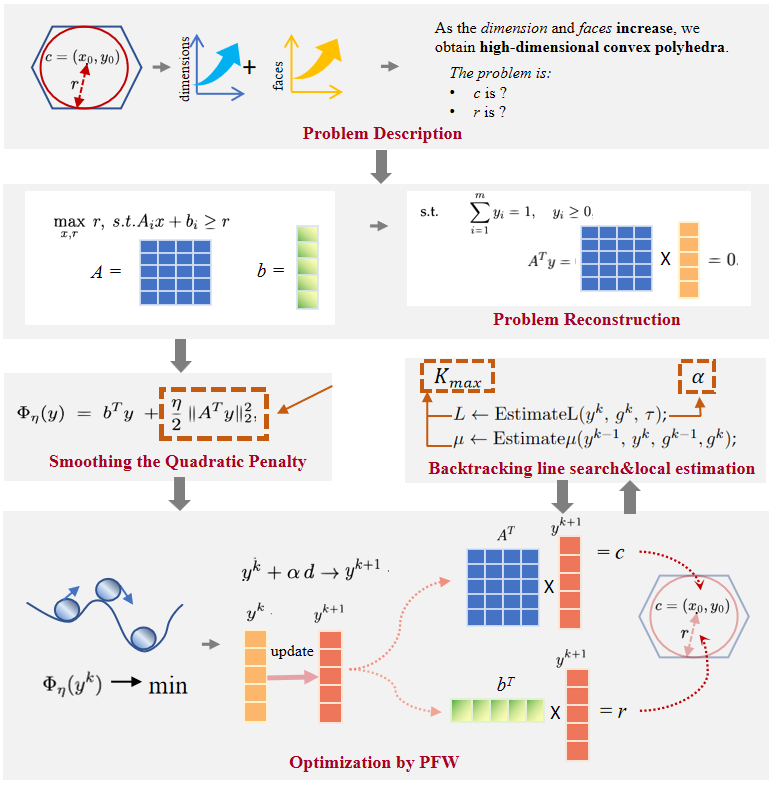
Graphical Abstract
Pairwise Frank-Wolfe for Maximum Inscribed Balls: Enabling Real-Time Geometric Optimization

Keywords
convex optimization
maximum inscribed ball
gradient optimization
Frank-Wolfe's Method

Data Availability Statement
The program used to test the methods is available at Github: https://github.com/Linyuqi2/MaxIB-Calculation-Methods-Evaluation.

Funding
This work was supported without any funding.

Conflicts of Interest
The author declares no conflicts of interest.

Ethical Approval and Consent to Participate
Not applicable.

References
  1. Yildirim, E. A., & Wright, S. J. (2002). Warm-start strategies in interior-point methods for linear programming. SIAM Journal on Optimization, 12(3), 782–810.
    [CrossRef]   [Google Scholar]
  2. Belykh, T. I., Bulatov, V. P., & Yaskova, E. N. (2008). Methods of Chebyshev points of convex sets and their applications. Computational Mathematics and Mathematical Physics, 48(1), 16–29.
    [CrossRef]   [Google Scholar]
  3. Oxley, T. J., Opie, N. L., John, S. E., Rind, G. S., Ronayne, S. M., Wheeler, T. L., … & O’Brien, T. J. (2016). Minimally invasive endovascular stent-electrode array for high-fidelity, chronic recordings of cortical neural activity. Nature Biotechnology, 34(3), 320–327.
    [CrossRef]   [Google Scholar]
  4. Sra, S., Nowozin, S., & Wright, S. J. (Eds.). (2012). Optimization for machine learning. MIT Press.
    [CrossRef]   [Google Scholar]
  5. Norris, B. R., Martinod, M. A., Tuthill, P., Gross, S., Cvetojevic, N., Jovanovic, N., ... & Withford, M. J. (2023). Machine-learning approach for optimal self-calibration and fringe tracking in photonic nulling interferometry. Journal of Astronomical Telescopes, Instruments, and Systems, 9(4), 048005-048005.
    [CrossRef]   [Google Scholar]
  6. Baena, D., & Castro, J. (2023). The Chebyshev center as an alternative to the analytic center in the feasibility pump. Optimization Letters, 17(8), 1757–1790.
    [CrossRef]   [Google Scholar]
  7. Dantzig, G. (1963). Linear Programming and Extensions. Linear Programming and Extensions Princeton.
    [CrossRef]   [Google Scholar]
  8. Karmarkar, N. (1984, December). A new polynomial-time algorithm for linear programming. In Proceedings of the sixteenth annual ACM symposium on Theory of computing (pp. 302-311).
    [CrossRef]   [Google Scholar]
  9. Ye, Y. (1997). Interior point algorithms: Theory and analysis. John Wiley & Sons.
    [CrossRef]   [Google Scholar]
  10. Xie, Y., Snoeyink, J., & Xu, J. (2006, June). Efficient algorithm for approximating maximum inscribed sphere in high dimensional polytope. In Proceedings of the twenty-second annual symposium on Computational Geometry (pp. 21-29).
    [CrossRef]   [Google Scholar]
  11. Allen-Zhu, Z., Liao, Z., Orecchia, L., & Math, M. I. T. (2014). Using optimization to find maximum inscribed balls and minimum enclosing balls. arXiv preprint arXiv:1412.1001.
    [Google Scholar]
  12. Klee, V., & Minty, G. J. (1972). How good is the simplex algorithm. Inequalities, 3(3), 159-175.
    [Google Scholar]
  13. Wright, S. J. (1997). Primal-Dual Interior-Point Methods. Primal-Dual Interior-Point Methods. SIAM.
    [CrossRef]   [Google Scholar]
  14. Frank, M., & Wolfe, P. (1956). An algorithm for quadratic programming. Naval Research Logistics Quarterly, 3(1–2), 95–110.
    [CrossRef]   [Google Scholar]
  15. Jaggi, M. (2013, February). Revisiting Frank-Wolfe: Projection-free sparse convex optimization. In International conference on machine learning (pp. 427-435). PMLR.
    [Google Scholar]
  16. Beck, A., & Shtern, S. (2017). Linearly convergent away-step conditional gradient for non-strongly convex functions. Mathematical Programming, 164(1), 1-27.
    [CrossRef]   [Google Scholar]
  17. Lacoste-Julien, S., & Jaggi, M. (2015). On the global linear convergence of Frank-Wolfe optimization variants. Advances in neural information processing systems, 28.
    [Google Scholar]
  18. Bertsekas, D. P. (2014). Constrained optimization and Lagrange multiplier methods (2nd ed.). Athena Scientific.
    [Google Scholar]
  19. Chapaneri, S. V., & Jayaswal, D. J. (2019). Covariate shift adaptation for structured regression with Frank–Wolfe algorithms. IEEE Access, 7, 73804–73818.
    [CrossRef]   [Google Scholar]
  20. Chambolle, A., & Pock, T. (2011). A first-order primal-dual algorithm for convex problems with applications to imaging. Journal of mathematical imaging and vision, 40(1), 120-145.
    [CrossRef]   [Google Scholar]
  21. Golub, G. H., & Van Loan, C. F. (2013). Matrix computations (4th ed.). Johns Hopkins University Press.
    [Google Scholar]
  22. Armijo, L. (1966). Minimization of functions having Lipschitz continuous first partial derivatives. Pacific Journal of Mathematics, 16(1), 1–3.
    [CrossRef]   [Google Scholar]
  23. Pedregosa, F., Negiar, G., Askari, A., & Jaggi, M. (2020, June). Linearly convergent Frank-Wolfe with backtracking line-search. In International conference on artificial intelligence and statistics (pp. 1-10). PMLR.
    [Google Scholar]
  24. Ziegler, G. M. (2012). Lectures on polytopes. Springer Science & Business Media.
    [Google Scholar]
  25. lpSolve Team. (n.d.). lpSolve: Interface to ‘lpsolve’ v5.5 for solving linear/integer programs [Computer software]. CRAN. Retrieved from https://cran.r-project.org/web/packages/lpSolve/index.html
    [Google Scholar]
  26. Free Software Foundation. (n.d.). GNU Linear Programming Kit (GLPK) [Computer software]. Retrieved from https://www.gnu.org/software/glpk/
    [Google Scholar]
  27. Mosek ApS. (n.d.). MOSEK Optimization Suite [Computer software]. Retrieved from https://www.mosek.com/
    [Google Scholar]

Cite This Article
APA Style
Lin, Y. (2026). Pairwise Frank-Wolfe for Maximum Inscribed Balls: Enabling Real-Time Geometric Optimization. ICCK Transactions on Advanced Computing and Systems, 2(1), 61–73. https://doi.org/10.62762/TACS.2025.318429
Export Citation
RIS Format
Compatible with EndNote, Zotero, Mendeley, and other reference managers
RIS format data for reference managers
TY  - JOUR
AU  - Lin, Yuqi
PY  - 2026
DA  - 2026/01/14
TI  - Pairwise Frank-Wolfe for Maximum Inscribed Balls: Enabling Real-Time Geometric Optimization
JO  - ICCK Transactions on Advanced Computing and Systems
T2  - ICCK Transactions on Advanced Computing and Systems
JF  - ICCK Transactions on Advanced Computing and Systems
VL  - 2
IS  - 1
SP  - 61
EP  - 73
DO  - 10.62762/TACS.2025.318429
UR  - https://www.icck.org/article/abs/TACS.2025.318429
KW  - convex optimization
KW  - maximum inscribed ball
KW  - gradient optimization
KW  - Frank-Wolfe's Method
AB  - As a classical convex optimization problem in geometry, computing the maximum inscribed ball (MaxIB) in ultra-high-dimensional polytopes is critical for enabling real-time IoT applications, such as optimal deployment of sensor networks, where polytopes model physical constraints arising from obstacles or coverage boundaries. However, existing methods suffer from the curse of dimensionality, leading to prohibitive computational costs. This paper develops a more efficient approach for computing the (1-\(\epsilon\))-approximate MaxIB in high-dimensional polytopes. To address these challenges, the problem is reformulated with adaptive penalty parameters to enforce strong convexity, enabling linear convergence under the Pairwise Frank–Wolfe (PFW) algorithm. Furthermore, expensive exact line searches are replaced with a backtracking strategy, significantly reducing the per-iteration computational cost. Simulation results demonstrate more than a 12-fold acceleration over existing approximate MaxIB methods without sacrificing accuracy.
SN  - 3068-7969
PB  - Institute of Central Computation and Knowledge
LA  - English
ER  - 
BibTeX Format
Compatible with LaTeX, BibTeX, and other reference managers
BibTeX format data for LaTeX and reference managers
@article{Lin2026Pairwise,
  author = {Yuqi Lin},
  title = {Pairwise Frank-Wolfe for Maximum Inscribed Balls: Enabling Real-Time Geometric Optimization},
  journal = {ICCK Transactions on Advanced Computing and Systems},
  year = {2026},
  volume = {2},
  number = {1},
  pages = {61-73},
  doi = {10.62762/TACS.2025.318429},
  url = {https://www.icck.org/article/abs/TACS.2025.318429},
  abstract = {As a classical convex optimization problem in geometry, computing the maximum inscribed ball (MaxIB) in ultra-high-dimensional polytopes is critical for enabling real-time IoT applications, such as optimal deployment of sensor networks, where polytopes model physical constraints arising from obstacles or coverage boundaries. However, existing methods suffer from the curse of dimensionality, leading to prohibitive computational costs. This paper develops a more efficient approach for computing the (1-\(\epsilon\))-approximate MaxIB in high-dimensional polytopes. To address these challenges, the problem is reformulated with adaptive penalty parameters to enforce strong convexity, enabling linear convergence under the Pairwise Frank–Wolfe (PFW) algorithm. Furthermore, expensive exact line searches are replaced with a backtracking strategy, significantly reducing the per-iteration computational cost. Simulation results demonstrate more than a 12-fold acceleration over existing approximate MaxIB methods without sacrificing accuracy.},
  keywords = {convex optimization, maximum inscribed ball, gradient optimization, Frank-Wolfe's Method},
  issn = {3068-7969},
  publisher = {Institute of Central Computation and Knowledge}
}

Article Metrics
Citations:

Crossref

0

Scopus

0

Web of Science

0
Article Access Statistics:
Views: 99
PDF Downloads: 19

Publisher's Note
ICCK stays neutral with regard to jurisdictional claims in published maps and institutional affiliations.

Rights and Permissions
CC BY Copyright © 2026 by the Author(s). Published by Institute of Central Computation and Knowledge. This article is an open access article distributed under the terms and conditions of the Creative Commons Attribution (CC BY) license (https://creativecommons.org/licenses/by/4.0/), which permits use, sharing, adaptation, distribution and reproduction in any medium or format, as long as you give appropriate credit to the original author(s) and the source, provide a link to the Creative Commons licence, and indicate if changes were made.
ICCK Transactions on Advanced Computing and Systems

ICCK Transactions on Advanced Computing and Systems

ISSN: 3068-7969 (Online)

Email: [email protected]

Portico

Portico

All published articles are preserved here permanently:
https://www.portico.org/publishers/icck/