


Volume 2, Issue 2, ICCK Transactions on Advanced Computing and Systems
Volume 2, Issue 2, 2026
Submit Manuscript Edit a Special Issue
Article QR Code
Article QR Code
Scan the QR code for reading
Popular articles
ICCK Transactions on Advanced Computing and Systems, Volume 2, Issue 2, 2026: 85-106

Open Access | Research Article | 10 February 2026
Denoising Telerik RadCaptcha: A Comparative Evaluation of the Effectiveness of Pre-Processing Techniques and Deep Learning Methods Using a Novel Dataset
1 Department of Creative Technologies, Air University, Islamabad 44000, Pakistan
2 Department of Artificial Intelligence, Korea University, Seoul 02842, Republic of Korea
3 Human Data Convergence Institute, Jeonju University, Jeonju 55069, Republic of Korea
† These authors contributed equally to this work
* Corresponding Author: Abdul Rehman, [email protected]
ARK: ark:/57805/tacs.2025.469136
Received: 18 May 2025, Accepted: 10 September 2025, Published: 10 February 2026  
Abstract
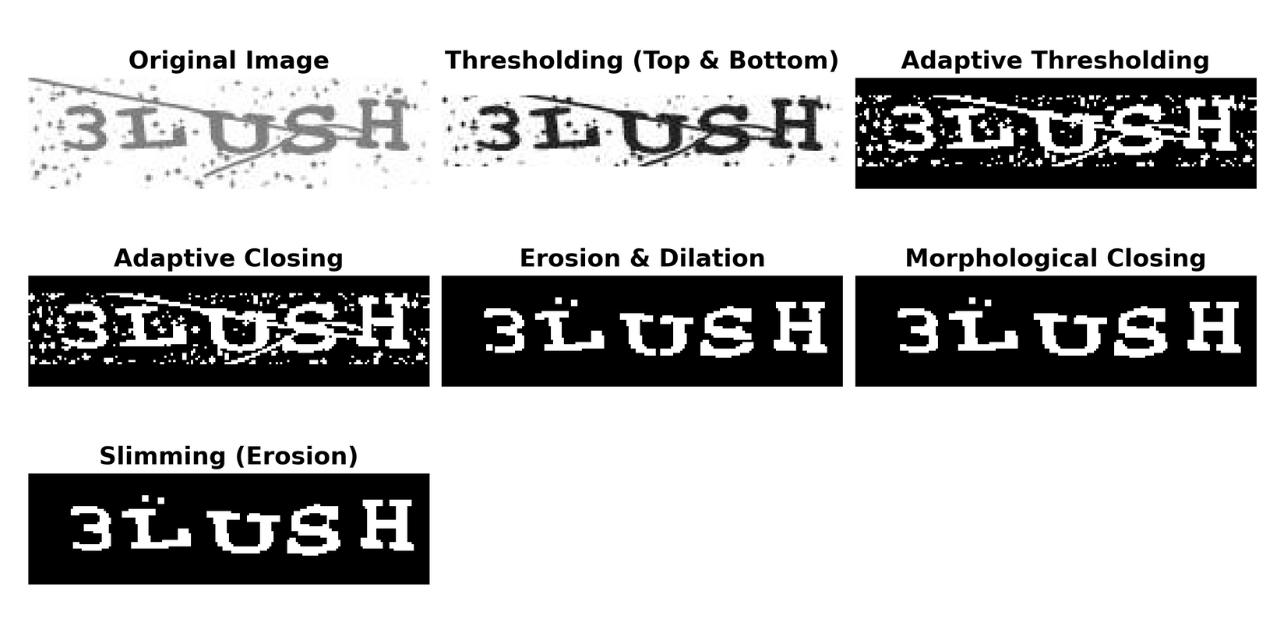
Text-based CAPTCHAs remain a widely deployed mechanism to distinguish humans from automated bots. The Telerik RadCaptcha, a component of the ASP.NET AJAX suite, generates distorted alphanumeric images with character overlap, intersecting lines, and dynamic background noise. This study introduces a novel, real-world dataset of 3,000 labeled Telerik RadCaptcha images and proposes a specialized multi-stage preprocessing pipeline featuring adaptive binarization and contour-based segmentation to robustly isolate overlapping and noisy characters—challenges where conventional methods frequently fail. The segmented characters are then classified using a lightweight Convolutional Neural Network (CNN). Experimental results demonstrate 99.26% training accuracy, 97.60% character-level test accuracy, and 92.08% full-sequence accuracy on unseen 5-character CAPTCHAs, with stable learning curves indicating effective generalization and minimal overfitting. These findings reveal critical vulnerabilities in traditional text-based CAPTCHA designs and provide empirical insights to guide the development of more resilient verification mechanisms.

Graphical Abstract
Denoising Telerik RadCaptcha: A Comparative Evaluation of the Effectiveness of Pre-Processing Techniques and Deep Learning Methods Using a Novel Dataset

Keywords
Convolutional neural network
deep learning
Telerik RadCaptcha

Data Availability Statement
Data will be made available on request.

Funding
This work was supported without any funding.

Conflicts of Interest
The authors declare no conflicts of interest.

AI Use Statement
The authors declare that no generative AI was used in the preparation of this manuscript.

Ethical Approval and Consent to Participate
Not applicable.

References
  1. Von Ahn, L., Blum, M., & Langford, J. (2004). Telling humans and computers apart automatically. Communications of the ACM, 47(2), 56-60.
    [CrossRef]   [Google Scholar]
  2. Reddy, A., & Cheng, Y. (2024). User Perception of CAPTCHAs: A Comparative Study between University and Internet Users. arXiv preprint arXiv:2405.18547.
    [Google Scholar]
  3. Turing, A. M. (2007). Computing machinery and intelligence. In Parsing the Turing test: Philosophical and methodological issues in the quest for the thinking computer (pp. 23-65). Dordrecht: Springer Netherlands.
    [CrossRef]   [Google Scholar]
  4. Singh, T., Kumar, A., & Goel, P. (2024, September). Analysis of Text-CAPTCHA Using Machine Learning. In 2024 International Conference on Communication, Computing and Energy Efficient Technologies (I3CEET) (pp. 238-243). IEEE.
    [CrossRef]   [Google Scholar]
  5. Guerar, M., Verderame, L., Migliardi, M., Palmieri, F., & Merlo, A. (2021). Gotta CAPTCHA’Em all: a survey of 20 Years of the human-or-computer Dilemma. ACM Computing Surveys (CSUR), 54(9), 1-33.
    [CrossRef]   [Google Scholar]
  6. Udoidiok, I., & Zhang, J. (2024, October). When XAI Meets CAPTCHA: A Case Study. In 2024 Cyber Awareness and Research Symposium (CARS) (pp. 1-6). IEEE.
    [CrossRef]   [Google Scholar]
  7. Kumar, M., Jindal, M. K., & Kumar, M. (2022). A systematic survey on CAPTCHA recognition: types, creation and breaking techniques. Archives of Computational Methods in Engineering, 29(2), 1107-1136.
    [CrossRef]   [Google Scholar]
  8. Sharma, S., & Singh, D. (2024, March). Captcha in web security and deep-captcha configuration based on machine learning. In 2024 3rd International Conference for Innovation in Technology (INOCON) (pp. 1-6). IEEE.
    [CrossRef]   [Google Scholar]
  9. Bursztein, E., Martin, M., & Mitchell, J. (2011, October). Text-based CAPTCHA strengths and weaknesses. In Proceedings of the 18th ACM conference on Computer and communications security (pp. 125-138).
    [CrossRef]   [Google Scholar]
  10. Chellapilla, K., & Simard, P. (2004). Using machine learning to break visual human interaction proofs (HIPs). Advances in neural information processing systems, 17.
    [Google Scholar]
  11. Sivakorn, S., Polakis, J., & Keromytis, A. D. (2016). I’m not a human: Breaking the Google reCAPTCHA. Black Hat, 14, 1-12.
    [Google Scholar]
  12. Bursztein, E., Beauxis, R., Paskov, H., Perito, D., Fabry, C., & Mitchell, J. (2011, May). The failure of noise-based non-continuous audio captchas. In 2011 IEEE symposium on security and privacy (pp. 19-31). IEEE.
    [CrossRef]   [Google Scholar]
  13. ASP.NET AJAX Captcha - RadControls for web forms | Telerik UI for ASP.NET AJAX. (n.d.). Telerik.com. Retrieved from https://www.telerik.com/products/aspnet-ajax/captcha.aspx
    [Google Scholar]
  14. Holman, J., Lazar, J., Feng, J. H., & D'Arcy, J. (2007, October). Developing usable CAPTCHAs for blind users. In Proceedings of the 9th international ACM SIGACCESS conference on Computers and accessibility (pp. 245-246).
    [CrossRef]   [Google Scholar]
  15. Xing, W., Mohd, M. R. S., Johari, J., & Ruslan, F. A. (2023, June). A Review on Text-based CAPTCHA Breaking Based on Deep Learning Methods. In 2023 International Conference on Computer Engineering and Distance Learning (CEDL) (pp. 171-175). IEEE.
    [CrossRef]   [Google Scholar]
  16. Deng, X., Zhao, R., Xue, Z., Liu, M., Chen, L., & Wang, Y. (2021, October). A Semi-supervised Deep Learning-Based Solver for Breaking Text-Based CAPTCHAs. In 2021 IEEE 20th International Conference on Trust, Security and Privacy in Computing and Communications (TrustCom) (pp. 614-619). IEEE.
    [CrossRef]   [Google Scholar]
  17. Mistry, R., Thatte, G., Waghela, A., Srinivasan, G., & Mali, S. (2021, October). DeCaptcha: Cracking captcha using Deep Learning Techniques. In 2021 5th International Conference on Information Systems and Computer Networks (ISCON) (pp. 1-6). IEEE.
    [CrossRef]   [Google Scholar]
  18. Aiken, W., & Kim, H. (2018, May). POSTER: DeepCRACk: Using deep learning to automatically crack audio CAPTCHAs. In Proceedings of the 2018 on Asia conference on computer and communications security (pp. 797-799).
    [CrossRef]   [Google Scholar]
  19. Sivakorn, S., Polakis, I., & Keromytis, A. D. (2016, March). I am robot:(deep) learning to break semantic image captchas. In 2016 IEEE European Symposium on Security and Privacy (EuroS&P) (pp. 388-403). IEEE.
    [CrossRef]   [Google Scholar]
  20. Dou, Z. (2021, June). The text captcha solver: A convolutional recurrent neural network-based approach. In 2021 International Conference on Big Data Analysis and Computer Science (BDACS) (pp. 273-283). IEEE.
    [CrossRef]   [Google Scholar]
  21. Pattabiraman, V., & Maheswari, R. (2022). Image to Text Processing Using Convolution Neural Networks. In Recurrent Neural Networks (pp. 43-52). CRC Press.
    [Google Scholar]
  22. Goodfellow, I. J., Bulatov, Y., Ibarz, J., Arnoud, S., & Shet, V. (2013). Multi-digit number recognition from street view imagery using deep convolutional neural networks. arXiv preprint arXiv:1312.6082.
    [Google Scholar]
  23. Telerik web forms Captcha overview - Telerik UI for ASP.NET AJAX. (n.d.). Telerik & Kendo UI - .NET Components Suites & JavaScript UI Libraries. Retrieved from https://www.telerik.com/products/aspnet-ajax/documentation/controls/captcha/overview
    [Google Scholar]
  24. Jähne, B. (2005). Digital image processing. Berlin, Heidelberg: Springer Berlin Heidelberg.
    [Google Scholar]
  25. Gao, H., Wang, W., Qi, J., Wang, X., Liu, X., & Yan, J. (2013, November). The robustness of hollow CAPTCHAs. In Proceedings of the 2013 ACM SIGSAC conference on Computer & communications security (pp. 1075-1086).
    [CrossRef]   [Google Scholar]
  26. Cireşan, D. C., Meier, U., Gambardella, L. M., & Schmidhuber, J. (2010). Deep, big, simple neural nets for handwritten digit recognition. Neural computation, 22(12), 3207-3220.
    [CrossRef]   [Google Scholar]
  27. Shirali-Shahreza, M., & Shirali-Shahreza, S. (2007, December). CAPTCHA for blind people. In 2007 IEEE international symposium on signal processing and information technology (pp. 995-998). IEEE.
    [CrossRef]   [Google Scholar]
  28. Wang, T., Wu, D. J., Coates, A., & Ng, A. Y. (2012, November). End-to-end text recognition with convolutional neural networks. In Proceedings of the 21st international conference on pattern recognition (ICPR2012) (pp. 3304-3308). IEEE.
    [Google Scholar]
  29. Zhu, B. B., Yan, J., Li, Q., Yang, C., Liu, J., Xu, N., ... & Cai, K. (2010, October). Attacks and design of image recognition CAPTCHAs. In Proceedings of the 17th ACM conference on Computer and communications security (pp. 187-200).
    [CrossRef]   [Google Scholar]
  30. Aguilar, D., Riofrío, D., Benítez, D., Pérez, N., & Moyano, R. F. (2021, October). Text-based CAPTCHA vulnerability assessment using a deep learning-based solver. In 2021 IEEE Fifth Ecuador Technical Chapters Meeting (ETCM) (pp. 1-6). IEEE.
    [CrossRef]   [Google Scholar]
  31. Noury, Z., & Rezaei, M. (2020). Deep-CAPTCHA: a deep learning based CAPTCHA solver for vulnerability assessment. arXiv preprint arXiv:2006.08296.
    [Google Scholar]
  32. Kumar, M., Jindal, M. K., & Kumar, M. (2023). An efficient technique for breaking of coloured Hindi CAPTCHA. Soft Computing, 27(16), 11661-11686.
    [CrossRef]   [Google Scholar]
  33. Wei, L., Li, X., Cao, T., Zhang, Q., Zhou, L., & Wang, W. (2019, February). Research on optimization of CAPTCHA recognition algorithm based on SVM. In Proceedings of the 2019 11th International Conference on Machine Learning and Computing (pp. 236-240).
    [CrossRef]   [Google Scholar]
  34. Lu, S., Huang, K., Meraj, T., & Rauf, H. T. (2022). A novel CAPTCHA solver framework using deep skipping Convolutional Neural Networks. PeerJ Computer Science, 8, e879.
    [CrossRef]   [Google Scholar]
  35. Derea, Z., Zou, B., Kui, X., Thobhani, A., & Abdussalam, A. (2025). A Dual-Layer Attention Based CAPTCHA Recognition Approach with Guided Visual Attention. Computer Modeling in Engineering & Sciences (CMES), 142(3).
    [CrossRef]   [Google Scholar]
  36. Zhang, N., Ebrahimi, M., Li, W., & Chen, H. (2020, November). A generative adversarial learning framework for breaking text-based captcha in the dark web. In 2020 IEEE International conference on intelligence and security informatics (ISI) (pp. 1-6). IEEE.
    [CrossRef]   [Google Scholar]
  37. Kumar, D., Singh, R., & Bamber, S. S. (2022). Your CAPTCHA Recognition Method Based on DEEP Learning Using MSER Descriptor. Computers, Materials & Continua, 72(2).
    [CrossRef]   [Google Scholar]
  38. Derea, Z., Zou, B., Al-Shargabi, A. A., Thobhani, A., & Abdussalam, A. (2023). Deep Learning Based CAPTCHA Recognition Network with Grouping Strategy. Sensors, 23(23), 9487.
    [CrossRef]   [Google Scholar]
  39. Wan, X., Johari, J., & Ruslan, F. A. (2024). Adaptive captcha: a CRNN-based text captcha solver with adaptive fusion filter networks. Applied Sciences, 14(12), 5016.
    [CrossRef]   [Google Scholar]
  40. Dankwa, S., & Yang, L. (2021). An efficient and accurate depth-wise separable convolutional neural network for cybersecurity vulnerability assessment based on CAPTCHA breaking. Electronics, 10(4), 480.
    [CrossRef]   [Google Scholar]
  41. Bhowmick, R. S., Indra, R., Ganguli, I., Paul, J., & Sil, J. (2023). Breaking CAPTCHA system with minimal exertion through deep learning: Real-time risk assessment on Indian government websites. Digital Threats: Research and Practice, 4(2), 1-24.
    [CrossRef]   [Google Scholar]
  42. Yu, N., & Darling, K. (2019). A low-cost approach to crack python CAPTCHAs using AI-based chosen-plaintext attack. Applied sciences, 9(10), 2010.
    [CrossRef]   [Google Scholar]
  43. Bostik, O., Horak, K., Kratochvila, L., Zemcik, T., & Bilik, S. (2021). Semi-supervised deep learning approach to break common CAPTCHAs. Neural Computing and Applications, 33(20), 13333-13343.
    [CrossRef]   [Google Scholar]
  44. Tian, S., & Xiong, T. (2020, April). A generic solver combining unsupervised learning and representation learning for breaking text-based captchas. In Proceedings of The Web Conference 2020 (pp. 860-871).
    [CrossRef]   [Google Scholar]
  45. Kovács, Á., & Tajti, T. CAPTCHA recognition using machine learning algorithms with various techniques. In Annales Mathematicae et Informaticae (pp. 81-91).
    [CrossRef]   [Google Scholar]
  46. Derea, Z., Zou, B., Kui, X., Abdullah, M., Thobhani, A., & Abdussalam, A. (2025). A Novel CAPTCHA Recognition System Based on Refined Visual Attention. Computers, Materials & Continua, 83(1).
    [CrossRef]   [Google Scholar]
  47. Lin, G., Liang, Y., Chen, Y., & Pan, W. (2022, May). Configurable image recognition framework design based on KNN and bit-based similarity model. In International Conference on Computer Application and Information Security (ICCAIS 2021) (Vol. 12260, pp. 396-402). SPIE.
    [CrossRef]   [Google Scholar]
  48. UmaMaheswari, P., Ezhilarasi, S., Harish, P., Gowrishankar, B., & Sanjiv, S. (2020, December). Designing a text-based CAPTCHA breaker and solver by using deep learning techniques. In 2020 IEEE international conference on advances and developments in electrical and electronics engineering (ICADEE) (pp. 1-6). IEEE.
    [CrossRef]   [Google Scholar]
  49. Dietterich, T. G. (2000, June). Ensemble methods in machine learning. In International workshop on multiple classifier systems (pp. 1-15). Berlin, Heidelberg: Springer Berlin Heidelberg.
    [CrossRef]   [Google Scholar]
  50. Srivastava, N., Hinton, G., Krizhevsky, A., Sutskever, I., & Salakhutdinov, R. (2014). Dropout: a simple way to prevent neural networks from overfitting. The journal of machine learning research, 15(1), 1929-1958.
    [Google Scholar]
  51. National University of Sciences and Technology (NUST). (2024). Merit Search. Retrieved from https://ugadmissions.nust.edu.pk/result/meritsearch.aspx
    [Google Scholar]
  52. Tbogamer22. (2024). 5-Characters CAPTCHA Labeled Dataset. Retrieved from https://www.kaggle.com/datasets/tbogamer22/5characters-captcha-labeled-dataset
    [Google Scholar]
  53. Brweb. (n.d.). BT.601 : Studio encoding parameters of digital television for standard 4:3 and wide screen 16:9 aspect ratios. Retrieved from https://www.itu.int/rec/R-REC-BT.601
    [Google Scholar]
  54. LeCun, Y., Bottou, L., Bengio, Y., & Haffner, P. (2002). Gradient-based learning applied to document recognition. Proceedings of the IEEE, 86(11), 2278-2324.
    [CrossRef]   [Google Scholar]
  55. Yamashita, R., Nishio, M., Do, R. K. G., & Togashi, K. (2018). Convolutional neural networks: an overview and application in radiology. Insights into imaging, 9(4), 611-629.
    [CrossRef]   [Google Scholar]

Cite This Article
APA Style
Omar, T. B., Sher, T., Rehman, A., & Khan, M. H. (2026). Denoising Telerik RadCaptcha: A Comparative Evaluation of the Effectiveness of Pre-Processing Techniques and Deep Learning Methods Using a Novel Dataset. ICCK Transactions on Advanced Computing and Systems, 2(2), 85–106. https://doi.org/10.62762/TACS.2025.469136
Export Citation
RIS Format
Compatible with EndNote, Zotero, Mendeley, and other reference managers
RIS format data for reference managers
TY  - JOUR
AU  - Omar, Talha Bin
AU  - Sher, Tahir
AU  - Rehman, Abdul
AU  - Khan, M. Haroon
PY  - 2026
DA  - 2026/02/10
TI  - Denoising Telerik RadCaptcha: A Comparative Evaluation of the Effectiveness of Pre-Processing Techniques and Deep Learning Methods Using a Novel Dataset
JO  - ICCK Transactions on Advanced Computing and Systems
T2  - ICCK Transactions on Advanced Computing and Systems
JF  - ICCK Transactions on Advanced Computing and Systems
VL  - 2
IS  - 2
SP  - 85
EP  - 106
DO  - 10.62762/TACS.2025.469136
UR  - https://www.icck.org/article/abs/TACS.2025.469136
KW  - Convolutional neural network
KW  - deep learning
KW  - Telerik RadCaptcha
AB  - Text-based CAPTCHAs remain a widely deployed mechanism to distinguish humans from automated bots. The Telerik RadCaptcha, a component of the ASP.NET AJAX suite, generates distorted alphanumeric images with character overlap, intersecting lines, and dynamic background noise. This study introduces a novel, real-world dataset of 3,000 labeled Telerik RadCaptcha images and proposes a specialized multi-stage preprocessing pipeline featuring adaptive binarization and contour-based segmentation to robustly isolate overlapping and noisy characters—challenges where conventional methods frequently fail. The segmented characters are then classified using a lightweight Convolutional Neural Network (CNN). Experimental results demonstrate 99.26% training accuracy, 97.60% character-level test accuracy, and 92.08% full-sequence accuracy on unseen 5-character CAPTCHAs, with stable learning curves indicating effective generalization and minimal overfitting. These findings reveal critical vulnerabilities in traditional text-based CAPTCHA designs and provide empirical insights to guide the development of more resilient verification mechanisms.
SN  - 3068-7969
PB  - Institute of Central Computation and Knowledge
LA  - English
ER  - 
BibTeX Format
Compatible with LaTeX, BibTeX, and other reference managers
BibTeX format data for LaTeX and reference managers
@article{Omar2026Denoising,
  author = {Talha Bin Omar and Tahir Sher and Abdul Rehman and M. Haroon Khan},
  title = {Denoising Telerik RadCaptcha: A Comparative Evaluation of the Effectiveness of Pre-Processing Techniques and Deep Learning Methods Using a Novel Dataset},
  journal = {ICCK Transactions on Advanced Computing and Systems},
  year = {2026},
  volume = {2},
  number = {2},
  pages = {85-106},
  doi = {10.62762/TACS.2025.469136},
  url = {https://www.icck.org/article/abs/TACS.2025.469136},
  abstract = {Text-based CAPTCHAs remain a widely deployed mechanism to distinguish humans from automated bots. The Telerik RadCaptcha, a component of the ASP.NET AJAX suite, generates distorted alphanumeric images with character overlap, intersecting lines, and dynamic background noise. This study introduces a novel, real-world dataset of 3,000 labeled Telerik RadCaptcha images and proposes a specialized multi-stage preprocessing pipeline featuring adaptive binarization and contour-based segmentation to robustly isolate overlapping and noisy characters—challenges where conventional methods frequently fail. The segmented characters are then classified using a lightweight Convolutional Neural Network (CNN). Experimental results demonstrate 99.26\% training accuracy, 97.60\% character-level test accuracy, and 92.08\% full-sequence accuracy on unseen 5-character CAPTCHAs, with stable learning curves indicating effective generalization and minimal overfitting. These findings reveal critical vulnerabilities in traditional text-based CAPTCHA designs and provide empirical insights to guide the development of more resilient verification mechanisms.},
  keywords = {Convolutional neural network, deep learning, Telerik RadCaptcha},
  issn = {3068-7969},
  publisher = {Institute of Central Computation and Knowledge}
}

Article Metrics
Citations:

Crossref

0

Scopus

0

Web of Science

0
Article Access Statistics:
Views: 27
PDF Downloads: 8

Publisher's Note
ICCK stays neutral with regard to jurisdictional claims in published maps and institutional affiliations.

Rights and Permissions
CC BY Copyright © 2026 by the Author(s). Published by Institute of Central Computation and Knowledge. This article is an open access article distributed under the terms and conditions of the Creative Commons Attribution (CC BY) license (https://creativecommons.org/licenses/by/4.0/), which permits use, sharing, adaptation, distribution and reproduction in any medium or format, as long as you give appropriate credit to the original author(s) and the source, provide a link to the Creative Commons licence, and indicate if changes were made.
ICCK Transactions on Advanced Computing and Systems

ICCK Transactions on Advanced Computing and Systems

ISSN: 3068-7969 (Online)

Email: [email protected]

Portico

Portico

All published articles are preserved here permanently:
https://www.portico.org/publishers/icck/