
Volume 2, Issue 2, ICCK Transactions on Advanced Computing and Systems
Volume 2, Issue 2, 2026
Submit Manuscript Edit a Special Issue
Article QR Code
Article QR Code
Scan the QR code for reading
Popular articles
ICCK Transactions on Advanced Computing and Systems, Volume 2, Issue 2, 2026: 137-157

Open Access | Research Article | 14 February 2026
Performance Evaluation of Collaborative Filtering Recommender System on MovieLens Dataset
1 Department of Creative Technologies, Air University, Islamabad 44000, Pakistan
2 Department of Artificial Intelligence, Korea University, Seoul 02842, Republic of Korea
3 Convergence Institute of Human Data Technology, Jeonju University, Jeonju 55069, Republic of Korea
† These authors contributed equally to this work
* Corresponding Author: Abdul Rehman, [email protected]
ARK: ark:/57805/tacs.2025.714333
Received: 18 July 2025, Accepted: 12 August 2025, Published: 14 February 2026  
Abstract
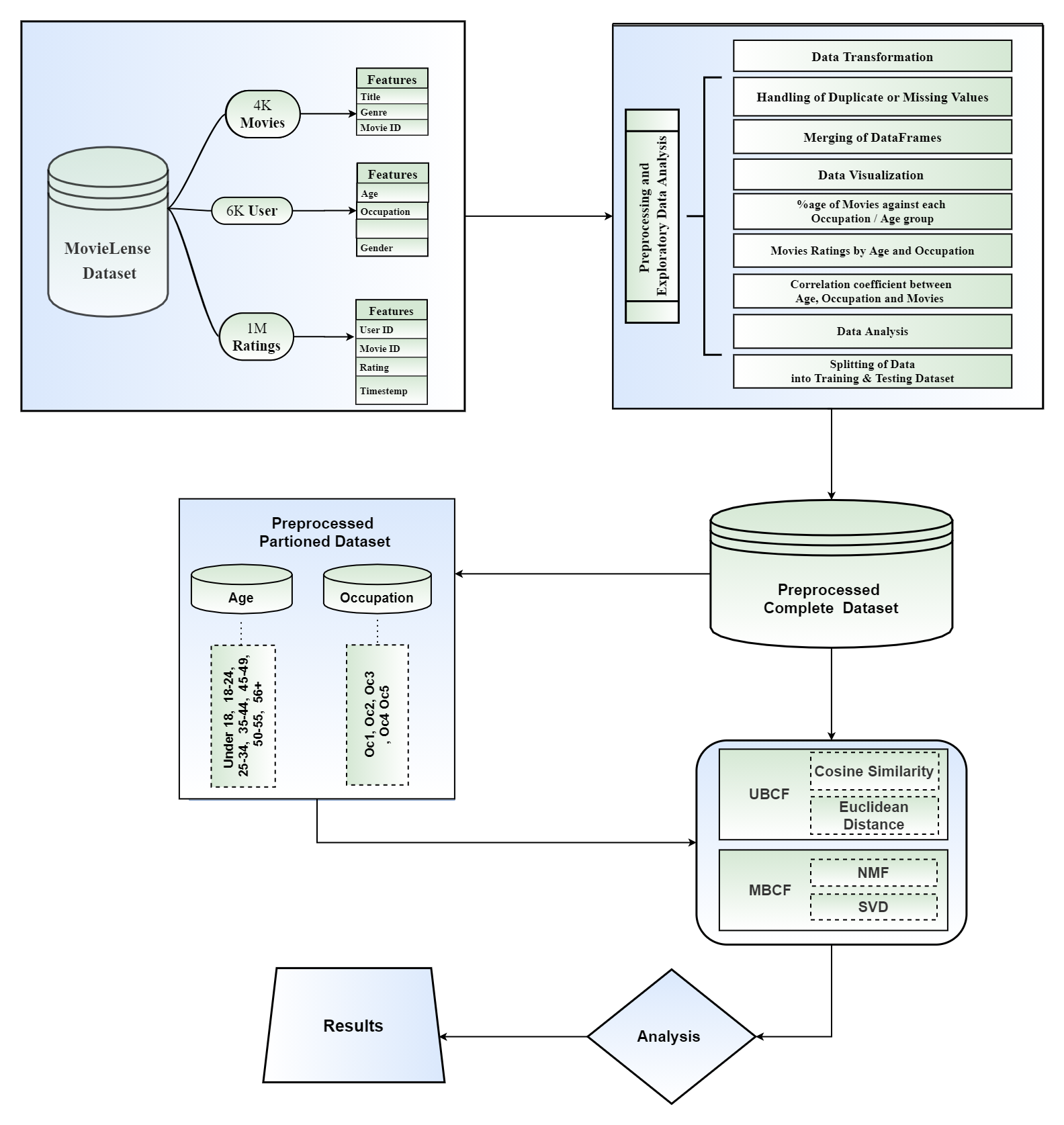
In today's technological landscape, recommender systems provide essential personalized suggestions by leveraging user preferences. This study evaluates User-Based (UBCF) and Model-Based Collaborative Filtering (MBCF) on the MovieLens 1M dataset, comparing performance on complete data versus partitions based on age and occupation. Using MAE and RMSE metrics, we assessed UBCF with Euclidean/Cosine similarity and MBCF with NMF/SVD. Results show MBCF with SVD achieved the best performance (MAE: 0.6909, RMSE: 0.8761), outperforming UBCF by approximately 5.2% in MAE and 5.4% in RMSE. This confirms model-based approaches, particularly SVD, excel with complete datasets, while demographic partitioning reduces accuracy due to data sparsity. Future work will explore hybrid models combining global and partition-based analysis with deep learning for enhanced personalization.

Graphical Abstract
Performance Evaluation of Collaborative Filtering Recommender System on MovieLens Dataset

Keywords
recommender system
user-based & model-based collaborative filtering
cosine similarity
euclidean similarity
non-negative matrix factorization
singular value decomposition
mean absolute error
root mean squared error

Data Availability Statement
Data will be made available on request.

Funding
This work was supported without any funding.

Conflicts of Interest
The authors declare no conflicts of interest.

AI Use Statement
The authors declare that no generative AI was used in the preparation of this manuscript.

Ethical Approval and Consent to Participate
Not applicable.

References
  1. Bhatnagar, V. (2016). Collaborative filtering using data mining and analysis. IGI Global.
    [Google Scholar]
  2. Adomavicius, G., & Tuzhilin, A. (2005). Toward the next generation of recommender systems: A survey of the state-of-the-art and possible extensions. IEEE Transactions on Knowledge and Data Engineering, 17(6), 734–749.
    [CrossRef]   [Google Scholar]
  3. Fields, B., Rhodes, C., & d'Inverno, M. (2010). Using song social tags and topic models to describe and compare playlists. In 1st Workshop On Music Recommendation And Discovery (WOMRAD), ACM RecSys, 2010, Barcelona, Spain.
    [Google Scholar]
  4. Yang, X., Guo, Y., Liu, Y., & Steck, H. (2014). A survey of collaborative filtering based social recommender systems. Computer Communications, 41, 1–10.
    [CrossRef]   [Google Scholar]
  5. Lü, L., Medo, M., Yeung, C. H., Zhang, Y. C., Zhang, Z. K., & Zhou, T. (2012). Recommender systems. Physics Reports, 519(1), 1–49.
    [CrossRef]   [Google Scholar]
  6. Koren, Y., Rendle, S., & Bell, R. (2021). Advances in collaborative filtering. Recommender systems handbook, 91-142.
    [CrossRef]   [Google Scholar]
  7. Rajaraman, A., & Ullman, J. D. (2011). Mining of massive datasets. Autoedicion.
    [Google Scholar]
  8. He, X., Liao, L., Zhang, H., Nie, L., Hu, X., & Chua, T. S. (2017, April). Neural collaborative filtering. In Proceedings of the 26th international conference on world wide web (pp. 173-182).
    [CrossRef]   [Google Scholar]
  9. Yuan, T., Cheng, J., Zhang, X., Qiu, S., & Lu, H. (2014, June). Recommendation by mining multiple user behaviors with group sparsity. In Proceedings of the AAAI Conference on Artificial Intelligence (Vol. 28, No. 1).
    [CrossRef]   [Google Scholar]
  10. Bobadilla, J., Ortega, F., Hernando, A., & Gutiérrez, A. (2013). Recommender systems survey. Knowledge-Based Systems, 46, 109–132.
    [CrossRef]   [Google Scholar]
  11. Jannach, D., Zanker, M., Felfernig, A., & Friedrich, G. (2010). Recommender systems: an introduction. Cambridge University Press.
    [Google Scholar]
  12. Rendle, S. (2010, December). Factorization machines. In 2010 IEEE International conference on data mining (pp. 995-1000). IEEE.
    [CrossRef]   [Google Scholar]
  13. Goodfellow, I., Bengio, Y., Courville, A., & Bengio, Y. (2016). Deep learning (Vol. 1, No. 2). Cambridge: MIT press.
    [Google Scholar]
  14. Núñez-Valdéz, E. R., Lovelle, J. M. C., Martínez, O. S., García-Díaz, V., De Pablos, P. O., & Marín, C. E. M. (2012). Implicit feedback techniques on recommender systems applied to electronic books. Computers in Human Behavior, 28(4), 1186–1193.
    [CrossRef]   [Google Scholar]
  15. Bell, R. M., Koren, Y., & Volinsky, C. (2007). Modeling relationships at multiple scales to improve accuracy of large recommender systems. In Proceedings of the 13th ACM SIGKDD international conference on Knowledge discovery and data mining (pp. 95-104).
    [CrossRef]   [Google Scholar]
  16. Schafer, J. B., Frankowski, D., Herlocker, J., & Sen, S. (2007). Collaborative filtering recommender systems. In The adaptive web: methods and strategies of web personalization (pp. 291-324). Berlin, Heidelberg: Springer Berlin Heidelberg.
    [CrossRef]   [Google Scholar]
  17. Robillard, M., Walker, R., & Zimmermann, T. (2009). Recommendation systems for software engineering. IEEE Software, 27(4), 80–86.
    [CrossRef]   [Google Scholar]
  18. Lokesh, A. (2019). A Comparative Study of Recommendation Systems. Masters Theses & Specialist Projects. Paper 3166.
    [Google Scholar]
  19. Desrosiers, C., & Karypis, G. (2010). A comprehensive survey of neighborhood-based recommendation methods. Recommender systems handbook, 107-144.
    [CrossRef]   [Google Scholar]
  20. Aggarwal, C. C., & Aggarwal, C. C. (2016). Model-based collaborative filtering. In Recommender Systems: The Textbook (pp. 71–138). Springer.
    [CrossRef]   [Google Scholar]
  21. Luo, X., Zhou, M., Xia, Y., & Zhu, Q. (2014). An efficient non-negative matrix-factorization-based approach to collaborative filtering for recommender systems. IEEE Transactions on Industrial Informatics, 10(2), 1273–1284.
    [CrossRef]   [Google Scholar]
  22. Ungar, L., & Foster, D. P. (1998). A formal statistical approach to collaborative filtering. CONALD’98.
    [Google Scholar]
  23. Salton, G., & Buckley, C. (1990). Improving retrieval performance by relevance feedback. Journal of the American Society for Information Science, 41(4), 288–297.
    [CrossRef]   [Google Scholar]
  24. Black, P. E. (2006). Manhattan distance. In Dictionary of Algorithms and Data Structures. Retrieved from https://xlinux.nist.gov/dads/HTML/manhattanDistance.html (accessed on 31 December 2025).
    [Google Scholar]
  25. Casanovas, M., Torres-Martinez, A., & Merigo, J. M. (2016). Decision making in reinsurance with induced OWA operators and Minkowski distances. Cybernetics and Systems, 47(6), 460–477.
    [CrossRef]   [Google Scholar]
  26. Cremonesi, P., Koren, Y., & Turrin, R. (2010). Performance of recommender algorithms on top-n recommendation tasks. In Proceedings of the fourth ACM conference on Recommender systems (pp. 39-46).
    [CrossRef]   [Google Scholar]
  27. Takács, G., Pilászy, I., Németh, B., & Tikk, D. (2009). Scalable Collaborative Filtering Approaches for Large Recommender Systems. The Journal of Machine Learning Research, 10, 623-656.
    [Google Scholar]
  28. Paterek, A. (2007). Improving regularized singular value decomposition for collaborative filtering. In Proceedings of KDD cup and workshop (Vol. 2007, pp. 5-8).
    [Google Scholar]
  29. Koren, Y. (2008). Factorization meets the neighborhood: a multifaceted collaborative filtering model. In Proceedings of the 14th ACM SIGKDD international conference on Knowledge discovery and data mining (pp. 426-434).
    [CrossRef]   [Google Scholar]
  30. Gunawardana, A., Shani, G., & Yogev, S. (2012). Evaluating recommender systems. In Recommender systems handbook (pp. 547-601). New York, NY: Springer US.
    [CrossRef]   [Google Scholar]
  31. Herlocker, J. L., Konstan, J. A., Terveen, L. G., & Riedl, J. T. (2004). Evaluating collaborative filtering recommender systems. ACM Transactions on Information Systems (TOIS), 22(1), 5-53.
    [CrossRef]   [Google Scholar]
  32. Ahuja, R., Solanki, A., & Nayyar, A. (2019). Movie recommender system using k-means clustering and k-nearest neighbor. In 2019 9th International Conference on Cloud Computing, Data Science & Engineering (Confluence) (pp. 263–268). IEEE.
    [CrossRef]   [Google Scholar]
  33. Katarya, R., & Verma, O. P. (2016). A collaborative recommender system enhanced with particle swarm optimization technique. Multimedia Tools and Applications, 75(15), 9225-9239.
    [CrossRef]   [Google Scholar]
  34. Alam, M. T., Ubaid, S., Sohail, S. S., Nadeem, M., Hussain, S., Siddiqui, J., & others. (2021). Comparative analysis of machine learning based filtering techniques using MovieLens dataset. Procedia Computer Science, 194, 210–217.
    [CrossRef]   [Google Scholar]
  35. Singh, P. K., Pramanik, P. K. D., & Choudhury, P. (2019). A comparative study of different similarity metrics in highly sparse rating dataset. In Data Management, Analytics and Innovation: Proceedings of ICDMAI 2018, Volume 2 (pp. 45–60). Springer.
    [CrossRef]   [Google Scholar]
  36. Zhang, J., Wang, Y., Yuan, Z., & Jin, Q. (2019). Personalized real-time movie recommendation system: Practical prototype and evaluation. Tsinghua Science and Technology, 25(2), 180–191.
    [CrossRef]   [Google Scholar]
  37. Zarzour, H., Al-Sharif, Z., Al-Ayyoub, M., & Jararweh, Y. (2018). A new collaborative filtering recommendation algorithm based on dimensionality reduction and clustering techniques. In 2018 9th International Conference on Information and Communication Systems (ICICS) (pp. 102–106). IEEE.
    [CrossRef]   [Google Scholar]
  38. Lund, J., & Ng, Y. K. (2018). Movie recommendations using the deep learning approach. In 2018 IEEE International Conference on Information Reuse and Integration (IRI) (pp. 47–54). IEEE.
    [CrossRef]   [Google Scholar]
  39. Byström, H. (2013). Movie Recommendations from User Ratings. Stanford University.
    [Google Scholar]
  40. Gupta, G., & Katarya, R. (2019). Recommendation analysis on item-based and user-based collaborative filtering. In 2019 International Conference on Smart Systems and Inventive Technology (ICSSIT) (pp. 1–4). IEEE.
    [CrossRef]   [Google Scholar]
  41. Guan, X., Li, C.-T., & Guan, Y. (2017). Matrix factorization with rating completion: An enhanced SVD model for collaborative filtering recommender systems. IEEE Access, 5, 27668–27678.
    [CrossRef]   [Google Scholar]
  42. Ayyaz, S., & Qamar, U. (2017). Improving collaborative filtering by selecting an effective user neighborhood for recommender systems. In 2017 IEEE International Conference on Industrial Technology (ICIT) (pp. 1244–1249). IEEE.
    [CrossRef]   [Google Scholar]
  43. Isma’il, M., Haruna, U., Aliyu, G., Abdulmumin, I., & Adamu, S. (2020). An autonomous courses recommender system for undergraduate using machine learning techniques. In 2020 International Conference in Mathematics, Computer Engineering and Computer Science (ICMCECS) (pp. 1–6). IEEE.
    [CrossRef]   [Google Scholar]
  44. Sallam, R. M., Hussein, M., & Mousa, H. M. (2020). An enhanced collaborative filtering-based approach for recommender systems. International Journal of Computer Applications, 176(41), 9–15.
    [Google Scholar]
  45. Kużelewska, U. (2014). Clustering algorithms in hybrid recommender system on movielens data. Studies in logic, grammar and rhetoric, 37(50), 125-139.
    [CrossRef]   [Google Scholar]
  46. Hsu, S. H., Wen, M. H., Lin, H. C., Lee, C. C., & Lee, C. H. (2007, May). AIMED-A personalized TV recommendation system. In European conference on interactive television (pp. 166-174). Berlin, Heidelberg: Springer Berlin Heidelberg.
    [CrossRef]   [Google Scholar]
  47. Ma, T.-m., Wang, X., Zhou, F.-c., & Wang, S. (2023). Research on diversity and accuracy of the recommendation system based on multi-objective optimization. Neural Computing and Applications, 35(7), 5155–5163.
    [CrossRef]   [Google Scholar]
  48. Pandya, S., Shah, J., Joshi, N., Ghayvat, H., Mukhopadhyay, S. C., & Yap, M. H. (2016, November). A novel hybrid based recommendation system based on clustering and association mining. In 2016 10th international conference on sensing technology (ICST) (pp. 1-6). IEEE.
    [CrossRef]   [Google Scholar]
  49. Agrawal, S., & Jain, P. (2017). An improved approach for movie recommendation system. In 2017 International Conference on I-SMAC (IoT in Social, Mobile, Analytics and Cloud)(I-SMAC) (pp. 336–342). IEEE.
    [CrossRef]   [Google Scholar]
  50. Ponnam, L. T., Punyasamudram, S. D., Nallagulla, S. N., & Yellamati, S. (2016). Movie recommender system using item based collaborative filtering technique. In 2016 International Conference on Emerging Trends in Engineering, Technology and Science (ICETETS) (pp. 1–5). IEEE.
    [CrossRef]   [Google Scholar]
  51. Shah, K. (2019). Book recommendation system using item based collaborative filtering. International Research Journal of Engineering and Technology, 6(5), 5960–5965.
    [Google Scholar]
  52. Ricci, F., Rokach, L., & Shapira, B. (2021). Recommender systems: Techniques, applications, and challenges. Recommender systems handbook, 1-35.
    [CrossRef]   [Google Scholar]
  53. Liu, A. S., & Gao, J. (2019). Book Recommendation Algorithm Based on Deep Learning. International Journal of Science, 152–156.
    [Google Scholar]
  54. Saraswat, M., Dubey, A., Naidu, S., Vashisht, R., & Singh, A. (2020). Web-Based Movie Recommender System. In Ambient Communications and Computer Systems: RACCCS 2019 (pp. 291–301). Springer.
    [CrossRef]   [Google Scholar]
  55. Raghuwanshi, S. K., & Pateriya, R. K. (2021). Accelerated singular value decomposition (asvd) using momentum based gradient descent optimization. Journal of King Saud University-Computer and Information Sciences, 33(4), 447–452.
    [CrossRef]   [Google Scholar]
  56. Harper, F. M., & Konstan, J. A. (2015). The movielens datasets: History and context. ACM Transactions on Interactive Intelligent Systems (TiiS), 5(4), 1–19.
    [CrossRef]   [Google Scholar]

Cite This Article
APA Style
Hafeez, M. A., Sher, T., Rehman, A., & Ihsan, I. (2026). Performance Evaluation of Collaborative Filtering Recommender System on MovieLens Dataset. ICCK Transactions on Advanced Computing and Systems, 2(2), 137–157. https://doi.org/10.62762/TACS.2025.714333
Export Citation
RIS Format
Compatible with EndNote, Zotero, Mendeley, and other reference managers
RIS format data for reference managers
TY  - JOUR
AU  - Hafeez, Muhammad Ahmad
AU  - Sher, Tahir
AU  - Rehman, Abdul
AU  - Ihsan, Imran
PY  - 2026
DA  - 2026/02/14
TI  - Performance Evaluation of Collaborative Filtering Recommender System on MovieLens Dataset
JO  - ICCK Transactions on Advanced Computing and Systems
T2  - ICCK Transactions on Advanced Computing and Systems
JF  - ICCK Transactions on Advanced Computing and Systems
VL  - 2
IS  - 2
SP  - 137
EP  - 157
DO  - 10.62762/TACS.2025.714333
UR  - https://www.icck.org/article/abs/TACS.2025.714333
KW  - recommender system
KW  - user-based & model-based collaborative filtering
KW  - cosine similarity
KW  - euclidean similarity
KW  - non-negative matrix factorization
KW  - singular value decomposition
KW  - mean absolute error
KW  - root mean squared error
AB  - In today's technological landscape, recommender systems provide essential personalized suggestions by leveraging user preferences. This study evaluates User-Based (UBCF) and Model-Based Collaborative Filtering (MBCF) on the MovieLens 1M dataset, comparing performance on complete data versus partitions based on age and occupation. Using MAE and RMSE metrics, we assessed UBCF with Euclidean/Cosine similarity and MBCF with NMF/SVD. Results show MBCF with SVD achieved the best performance (MAE: 0.6909, RMSE: 0.8761), outperforming UBCF by approximately 5.2% in MAE and 5.4% in RMSE. This confirms model-based approaches, particularly SVD, excel with complete datasets, while demographic partitioning reduces accuracy due to data sparsity. Future work will explore hybrid models combining global and partition-based analysis with deep learning for enhanced personalization.
SN  - 3068-7969
PB  - Institute of Central Computation and Knowledge
LA  - English
ER  - 
BibTeX Format
Compatible with LaTeX, BibTeX, and other reference managers
BibTeX format data for LaTeX and reference managers
@article{Hafeez2026Performanc,
  author = {Muhammad Ahmad Hafeez and Tahir Sher and Abdul Rehman and Imran Ihsan},
  title = {Performance Evaluation of Collaborative Filtering Recommender System on MovieLens Dataset},
  journal = {ICCK Transactions on Advanced Computing and Systems},
  year = {2026},
  volume = {2},
  number = {2},
  pages = {137-157},
  doi = {10.62762/TACS.2025.714333},
  url = {https://www.icck.org/article/abs/TACS.2025.714333},
  abstract = {In today's technological landscape, recommender systems provide essential personalized suggestions by leveraging user preferences. This study evaluates User-Based (UBCF) and Model-Based Collaborative Filtering (MBCF) on the MovieLens 1M dataset, comparing performance on complete data versus partitions based on age and occupation. Using MAE and RMSE metrics, we assessed UBCF with Euclidean/Cosine similarity and MBCF with NMF/SVD. Results show MBCF with SVD achieved the best performance (MAE: 0.6909, RMSE: 0.8761), outperforming UBCF by approximately 5.2\% in MAE and 5.4\% in RMSE. This confirms model-based approaches, particularly SVD, excel with complete datasets, while demographic partitioning reduces accuracy due to data sparsity. Future work will explore hybrid models combining global and partition-based analysis with deep learning for enhanced personalization.},
  keywords = {recommender system, user-based \& model-based collaborative filtering, cosine similarity, euclidean similarity, non-negative matrix factorization, singular value decomposition, mean absolute error, root mean squared error},
  issn = {3068-7969},
  publisher = {Institute of Central Computation and Knowledge}
}

Article Metrics
Citations:

Crossref

0

Scopus

0

Web of Science

0
Article Access Statistics:
Views: 28
PDF Downloads: 6

Publisher's Note
ICCK stays neutral with regard to jurisdictional claims in published maps and institutional affiliations.

Rights and Permissions
CC BY Copyright © 2026 by the Author(s). Published by Institute of Central Computation and Knowledge. This article is an open access article distributed under the terms and conditions of the Creative Commons Attribution (CC BY) license (https://creativecommons.org/licenses/by/4.0/), which permits use, sharing, adaptation, distribution and reproduction in any medium or format, as long as you give appropriate credit to the original author(s) and the source, provide a link to the Creative Commons licence, and indicate if changes were made.
ICCK Transactions on Advanced Computing and Systems

ICCK Transactions on Advanced Computing and Systems

ISSN: 3068-7969 (Online)

Email: [email protected]

Portico

Portico

All published articles are preserved here permanently:
https://www.portico.org/publishers/icck/