

Comparative Analysis of Smart Meter Testing According to International Standards with AI-Based Methods for Anomaly Detection

Article Information
Abstract
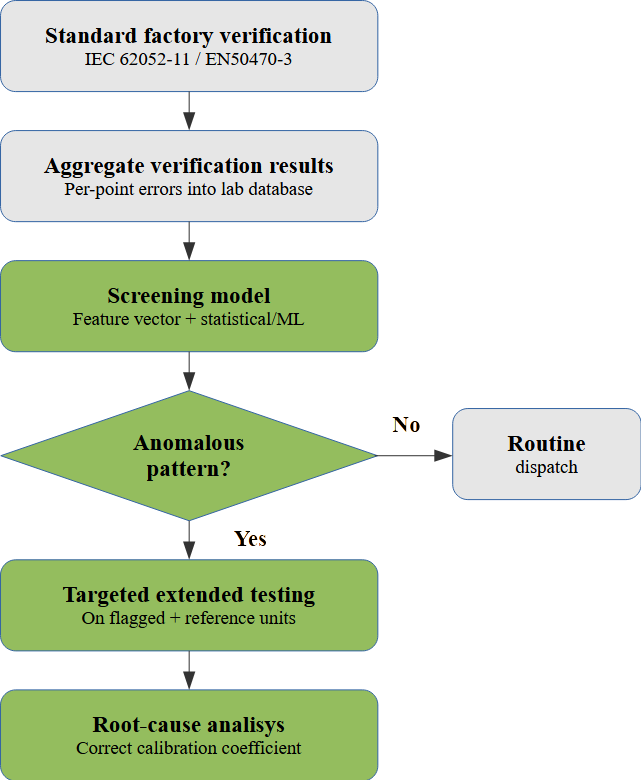
Standard type verification of three-phase smart meters is performed under idealized balanced test conditions that do not fully reproduce the current unbalance, single-phase loading and voltage deviations found on real distribution networks, so that a channel-specific calibration fault can pass undetected. This paper presents a methodology combining standard IEC~62052-11 and EN~50470-3 verification with an extended set of near-real-network test conditions (unbalanced current distribution, single-phase loading, and voltage deviation from nominal), together with a statistical/machine-learning screening step applied to aggregated laboratory verification results and used to flag units for targeted extended validation. Three three-phase static meters were analyzed: two units flagged by the screening procedure and one reference unit. Under standard balanced testing all three units remained within their declared accuracy class, but under extended single-phase loading on one specific current channel the two flagged units exhibited systematic registration errors of up to approximately 4%, traced to an incorrectly recorded calibration coefficient on that channel; the reference unit remained within tolerance throughout. The results show that screening of aggregated verification data can identify meters with hidden channel-specific faults that standard balanced verification alone does not reveal, and support extending routine Type C verification with a small set of unbalanced/single-phase test points. The primary contribution of this work is the extended verification methodology and its validation on a real production case; the AI-assisted screening is employed as a triggering mechanism.
Graphical Abstract
Keywords
Data Availability Statement
Funding
Conflicts of Interest
AI Use Statement
Ethical Approval and Consent to Participate
References
- European Commission. (2021). `Fit for 55': Delivering the EU's 2030 Climate Target on the Way to Climate Neutrality (COM(2021) 550 final). Brussels: European Commission. Retrieved from https://www.eesc.europa.eu/en/our-work/opinions-information-reports/opinions/fit-55-delivering-eus-2030-climate-target-way-climate-neutrality
[Google Scholar] - European Commission. (2022). REPowerEU Plan (COM(2022) 230 final). Brussels: European Commission. Retrieved from https://eur-lex.europa.eu/resource.html?format=PDF&uri=cellar:fc930f14-d7ae-11ec-a95f-01aa75ed71a1.0001.02/DOC_1
[Google Scholar] - International Electrotechnical Commission. (2022). Electricity metering equipment - General requirements, tests and test conditions - Part 11: Metering equipment (IEC 62052-11:2022). Geneva: IEC. Retrieved from https://standards.iteh.ai/catalog/standards/clc/23606e6f-f5a6-4c89-9a42-a1a55b7357af/en-iec-62052-11-2021-a11-2022
[Google Scholar] - International Electrotechnical Commission. (2022). Electricity metering equipment - Particular requirements - Part 22: Static meters for active and reactive energy (IEC 62053-21:2022, IEC 62053-22:2022, IEC 62053-24:2022). Geneva: IEC. Retrieved from https://webstore.iec.ch/en/publication/29987
[Google Scholar] - CENELEC. (2022). Electricity metering equipment (a.c.) - Part 3: Particular requirements - Static meters for active energy (EN 50470-3:2022). Brussels: CENELEC. Retrieved from https://standards.iteh.ai/catalog/standards/clc/d898d898-a575-4387-8b76-e12cddca928f/en-50470-3-2022
[Google Scholar] - Bracale, A., Janowicz, J., Kuwałek, P., & Wiczyński, G. (2026). Challenges in the Proper Metrological Verification of Smart Energy Meters. arXiv preprint arXiv:2601.16612.
[CrossRef] [Google Scholar] - Korakianitis, N. S., Papageorgas, P., Vokas, G. A., Piromalis, D. D., Kaminaris, S. D., Ioannidis, G. C., & Zuazola, A. O. D. (2025). Design and Evaluation of a Research-Oriented Open-Source Platform for Smart Grid Metering: A Comprehensive Review and Experimental Intercomparison of Smart Meter Technologies. Future Internet, 17(9), 425.
[CrossRef] [Google Scholar] - Amirkhanova, G., Aidynuly, A., Adilzhanova, S., Fu, Y., Dina, B., & Alipbeki, O. (2026). A comparative analysis of machine learning models for anomaly detection in industrial smart meter time-series data. Information, 17(2), 131.
[CrossRef] [Google Scholar] - Guato Burgos, M. F., Morato, J., & Vizcaíno Imacaña, F. P. (2024). A review of smart grid anomaly detection approaches pertaining to artificial intelligence. Applied Sciences, 14(3), 1194.
[CrossRef] [Google Scholar] - Zhang, J. E., Wu, D., & Boulet, B. (2021, October). Time series anomaly detection for smart grids: A survey. In 2021 IEEE electrical power and energy conference (EPEC) (pp. 125-130). IEEE.
[CrossRef] [Google Scholar] - Patrizi, G., Garzon Alfonso, C., Calandroni, L., Bartolini, A., Iturrino Garcia, C., Paolucci, L., ... & Ciani, L. (2024). Anomaly detection for power quality analysis using smart metering systems. Sensors, 24(17), 5807.
[CrossRef] [Google Scholar] - Leferink, F., Keyer, C., & Melentjev, A. (2017). Static energy meter errors caused by conducted electromagnetic interference. IEEE electromagnetic compatibility magazine, 5(4), 49-55.
[CrossRef] [Google Scholar] - European Parliament and Council. (2014). Directive 2014/32/EU of 26 February 2014 on the harmonisation of the laws of the Member States relating to the making available on the market of measuring instruments (MID). Official Journal of the European Union. Retrieved from https://eur-lex.europa.eu/eli/dir/2014/32/oj/eng
[Google Scholar] - Ministry of Economy of the Republic of Serbia. (2024).Regulation on the verification of active electrical energy meters of accuracy classes A, B, C, 2, 1 and 0.5\,S (in Serbian). Official Gazette of the Republic of Serbia, No.~14/2024. Retrieved from https://www.dmdm.rs/sr/vesti/pravilnik-o-overavanju-brojila-aktivne-elektricne-energije-klase-tacnosti-a-b-c-2-1-i-0-5-s
[Google Scholar] - International Organization for Standardization. (2012). Conformity assessment - Requirements for the operation of various types of bodies performing inspection (ISO/IEC 17020:2012). Geneva: ISO. Retrieved from https://www.iso.org/standard/52994.html
[Google Scholar] - GFUVE Group. (2026). GF302D - Portable three-phase kWh meter test equipment [Datasheet]. Retrieved from https://www.gfuvegroup.com/pdf/GF302D.pdf
[Google Scholar] - Cataliotti, A., Cosentino, V., Lipari, A., & Nuccio, S. (2008). Metrological characterization and operating principle identification of static meters for reactive energy: an experimental approach under nonsinusoidal test conditions. IEEE Transactions on Instrumentation and Measurement, 58(5), 1427-1435.
[CrossRef] [Google Scholar]
Cite This Article
TY  - JOUR
AU  - Aleksandrov, Saša
PY  - 2026
DA  - 2026/09/12
TI  - Comparative Analysis of Smart Meter Testing According to International Standards with AI-Based Methods for Anomaly Detection
JO  - ICCK Transactions on Electric Power Networks and Systems
T2  - ICCK Transactions on Electric Power Networks and Systems
JF  - ICCK Transactions on Electric Power Networks and Systems
VL  - 2
IS  - 3
SP  - 149
EP  - 160
DO  - 10.62762/TEPNS.2026.407661
UR  - https://www.icck.org/article/abs/TEPNS.2026.407661
KW  - anomaly detection
KW  - machine learning
KW  - metrological validation
KW  - smart meter
AB  - Standard type verification of three-phase smart meters is performed under idealized balanced test conditions that do not fully reproduce the current unbalance, single-phase loading and voltage deviations found on real distribution networks, so that a channel-specific calibration fault can pass undetected. This paper presents a methodology combining standard IEC~62052-11 and EN~50470-3 verification with an extended set of near-real-network test conditions (unbalanced current distribution, single-phase loading, and voltage deviation from nominal), together with a statistical/machine-learning screening step applied to aggregated laboratory verification results and used to flag units for targeted extended validation. Three three-phase static meters were analyzed: two units flagged by the screening procedure and one reference unit. Under standard balanced testing all three units remained within their declared accuracy class, but under extended single-phase loading on one specific current channel the two flagged units exhibited systematic registration errors of up to approximately 4%, traced to an incorrectly recorded calibration coefficient on that channel; the reference unit remained within tolerance throughout. The results show that screening of aggregated verification data can identify meters with hidden channel-specific faults that standard balanced verification alone does not reveal, and support extending routine Type C verification with a small set of unbalanced/single-phase test points. The primary contribution of this work is the extended verification methodology and its validation on a real production case; the AI-assisted screening is employed as a triggering mechanism.
SN  - 3070-2607
PB  - Institute of Central Computation and Knowledge
LA  - English
ER  -
@article{Aleksandrov2026Comparativ,
  author = {Saša Aleksandrov},
  title = {Comparative Analysis of Smart Meter Testing According to International Standards with AI-Based Methods for Anomaly Detection},
  journal = {ICCK Transactions on Electric Power Networks and Systems},
  year = {2026},
  volume = {2},
  number = {3},
  pages = {149-160},
  doi = {10.62762/TEPNS.2026.407661},
  url = {https://www.icck.org/article/abs/TEPNS.2026.407661},
  abstract = {Standard type verification of three-phase smart meters is performed under idealized balanced test conditions that do not fully reproduce the current unbalance, single-phase loading and voltage deviations found on real distribution networks, so that a channel-specific calibration fault can pass undetected. This paper presents a methodology combining standard IEC~62052-11 and EN~50470-3 verification with an extended set of near-real-network test conditions (unbalanced current distribution, single-phase loading, and voltage deviation from nominal), together with a statistical/machine-learning screening step applied to aggregated laboratory verification results and used to flag units for targeted extended validation. Three three-phase static meters were analyzed: two units flagged by the screening procedure and one reference unit. Under standard balanced testing all three units remained within their declared accuracy class, but under extended single-phase loading on one specific current channel the two flagged units exhibited systematic registration errors of up to approximately 4\%, traced to an incorrectly recorded calibration coefficient on that channel; the reference unit remained within tolerance throughout. The results show that screening of aggregated verification data can identify meters with hidden channel-specific faults that standard balanced verification alone does not reveal, and support extending routine Type C verification with a small set of unbalanced/single-phase test points. The primary contribution of this work is the extended verification methodology and its validation on a real production case; the AI-assisted screening is employed as a triggering mechanism.},
  keywords = {anomaly detection, machine learning, metrological validation, smart meter},
  issn = {3070-2607},
  publisher = {Institute of Central Computation and Knowledge}
}
Article Metrics
Publisher's Note
ICCK stays neutral with regard to jurisdictional claims in published maps and institutional affiliations.
Rights and Permissions


Portico
