

Amendments to some IEC TR 62095 Recommendations for Underground Single-Core Power Cables in Trefoil Formation



Article Information
Abstract
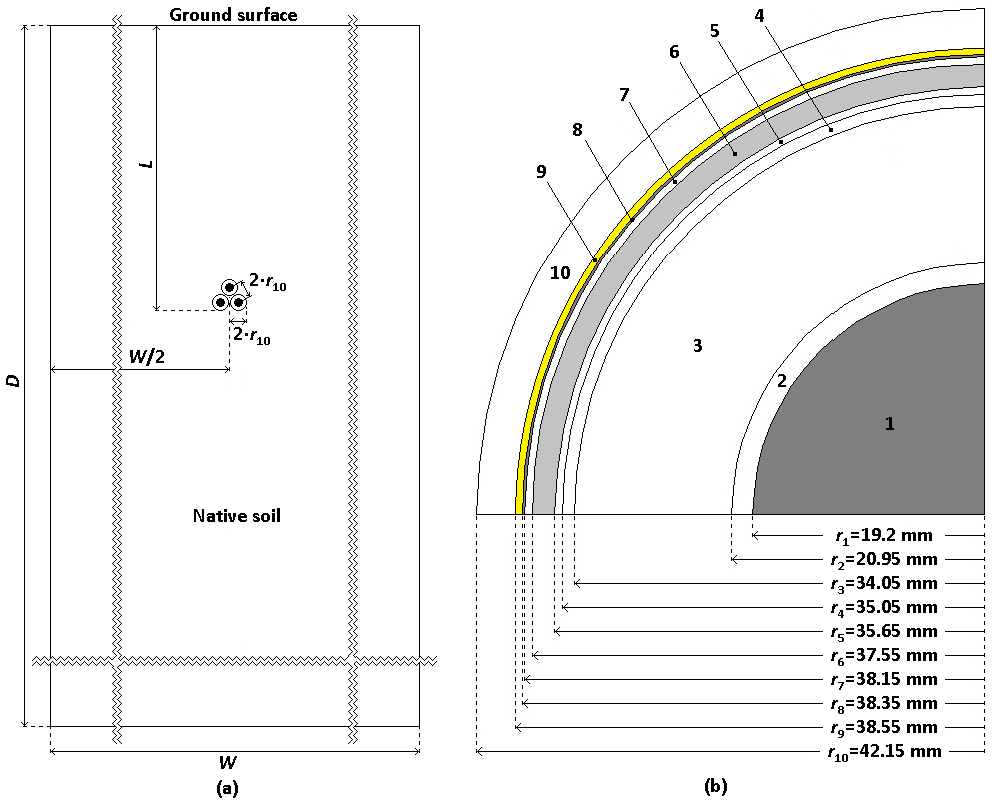
In the last decade, design engineers have been increasingly required to calculate the ampacities of cable lines using the finite element method (FEM) according to IEC TR 62095, especially for cases that cannot be solved analytically based on IEC 60287. In this regard, CIGRE Study Committee B1 noted in 2020 that there are many gaps in the technical report IEC TR 62095 and then published in 2025 a technical brochure. However, a certain number of those gaps still remained unaddressed. This paper proposes concrete solutions for addressing several gaps related to underground single-core power cables in trefoil formations. 110 kV single-core cables with cross-linked polyethylene insulation are considered, and FEM-based modeling is used for their steady-state thermal analysis. FEM-based models utilized here assume that the cables are installed directly in the dried-out soil, without cable bedding, under the most unfavorable ambient conditions. Appropriate analytical IEC-based models are used to verify the correctness of the proposed solutions. The ampacity obtained using the FEM differs from the corresponding IEC 60287-based value by only -0.263%, and the maximum conductor temperature deviations from the continuously permissible temperature are lower than 0.01 °C. The differences guarantee the reliability of FEM-based calculations.
Graphical Abstract
Keywords
Data Availability Statement
Funding
Conflicts of Interest
Ethical Approval and Consent to Participate
References
- Finite element analysis for cable rating calculations. (2025, May 26). Online Library for Electrical Power Systems Publications | eCIGRE. Retrieved from https://www.e-cigre.org/publications/detail/963-finite-element-analysis-for-cable-rating-calculations.html\#pSummary
[Google Scholar] - IEC 60287-1-1:2023 cmv. (n.d.). IEC WebstoreIEC. Retrieved from https://webstore.iec.ch/en/publication/85666
[Google Scholar] - IEC 60287-2-1:2023 cmv. (n.d.). IEC WebstoreIEC. Retrieved from https://webstore.iec.ch/en/publication/85669
[Google Scholar] - IEC 60287-3-1:2017 rlv. (n.d.). IEC WebstoreIEC. Retrieved from https://webstore.iec.ch/en/publication/60845
[Google Scholar] - IEC TR 62095:2003. (n.d.). IEC WebstoreIEC. Retrieved from https://webstore.iec.ch/en/publication/6455
[Google Scholar] - Kim, Y. S., Cong, H. N., Dinh, B. H., & Kim, H. K. (2025). Effect of ambient air and ground temperatures on heat transfer in underground power cable system buried in newly developed cable bedding material. Geothermics, 125, 103151.
[CrossRef] [Google Scholar] - Bustamante, S., Mínguez, R., Arroyo, A., Manana, M., Laso, A., Castro, P., & Martinez, R. (2019). Thermal behaviour of medium-voltage underground cables under high-load operating conditions. Applied Thermal Engineering, 156, 444–452.
[CrossRef] [Google Scholar] - Klimenta, D., Perović, B., Klimenta, J., Jevtić, M., Milovanović, M., & Krstić, I. (2018). Modelling the thermal effect of solar radiation on the ampacity of a low voltage underground cable. International Journal of Thermal Sciences, 134, 507–516.
[CrossRef] [Google Scholar] - Riba, J.-R., & Llauradó, J. (2022). A model to calculate the current–temperature relationship of insulated and jacketed cables. Materials, 15(19), 6814.
[CrossRef] [Google Scholar] - Ainhirn, F., Woschitz, R., & Bolzer, A. (2019, June). Extended approach for calculating thermal stress and ampacity of high voltage cable systems based on experimental data. In Jicable 2019: 10th International Conference On Insulated Cables.
[Google Scholar] - Charerndee, K., Chatthaworn, R., Khunkitti, P., Kruesubthaworn, A., Siritaratiwat, A., & Surawanitkun, C. (2020, July). Investment Cost Analysis with Structural Design of Concrete Duct Bank Power Cables. In IOP Conference Series: Materials Science and Engineering (Vol. 897, No. 1, p. 012007). IOP Publishing.
[CrossRef] [Google Scholar] - Šućurović, M., Klimenta, D., & Tasić, D. (2024). Correction of the Iec Formula for the Eddy-Current Loss Factor: the Case of Single-Core Cables in Trefoil Formation With Metallic Screens Bonded and Earthed At One End. Facta Universitatis, Series: Electronics and Energetics, 37(2), 391-408.
[CrossRef] [Google Scholar] - Aegerter, D. (2023, June 18–22). Calculation of cable thermal rating using a hybrid method based on IEC 60287 and finite element method. In Proceedings of the 11th International Conference on Insulated Power Cables (Jicable’23) (pp. 1–5).
[Google Scholar] - COMSOL. (2012). COMSOL multiphysics user's guide (Version 4.3) [Computer software]. COMSOL Inc.
[Google Scholar] - Klimenta, D. O., Perovic, B. D., Jevtic, M. D., Radosavljevic, J. N., & Arsic, N. B. (2014). Thermal FEM-based procedure for design of energy-efficient underground cable lines. Humanities and Science University Journal Technics, (10), 162-188.
[Google Scholar] - IEC 60228:2023 cmv. (n.d.). IEC WebstoreIEC. Retrieved from https://webstore.iec.ch/en/publication/90329
[Google Scholar] - Heinhold, L. (1991). Power cables and their application — Part 1 (3rd rev. ed.). Siemens Aktiengesellschaft.
[Google Scholar] - Salata, F., De Lieto Vollaro, A., & De Lieto Vollaro, R. (2015). A model for the evaluation of heat loss from underground cables in non-uniform soil to optimize the system design. Thermal Science, 19(2), 461–474.
[CrossRef] [Google Scholar]
Cited By (5)
-
Yuexin Wang, Zhiye Du, Gen Li, Mengda Zhao, Zhichao Chen, Peng Chen, Xingyu Zhou. Arrangement principles for 500 kV cables in compact flexible DC converter stations based on spatial loss-density distribution characteristics.
Electric Power Systems Research, 2027 , 264 .
[CrossRef] -
Zhaoyu Qin, Yan Zhang, Yuli Wang, Ge Wang, Xiaoyi Cheng. Harmonic Resonance Mechanism and Suppression Strategies for High-Voltage Cables with Frequency-Dependent Parameters.
Applied Sciences, 2026 , 16 (9).
[CrossRef] -
Peter Wouters, Peter van der Wielen, Yan Li. Wave‐Velocity‐Based Temperature Monitoring Applied to Underground Power Cables in Medium‐Voltage Networks—Discrimination of Individual Cable Temperatures in a Distribution Grid.
High Voltage, 2026 .
[CrossRef] -
Minquan Ye, Yue Zhang, Huiying Wu, Cong Zeng, Hongyi Chen. Analysis on the thermal performance and economic efficiency of XLPE submarine cable based on electric–thermal–hydraulic coupling simulation.
Scientific Reports, 2026 , 16 (1).
[CrossRef] -
Marko Šućurović, Dardan Klimenta, Nikolay Hinov, Dragan Tasić, Mladen Banjanin, Darius Andriukaitis. FEM-Based Quantification of Eddy-Current Losses for MV Cables in Trefoil Formation With Non-Magnetic Screens.
IEEE Access, 2026 , 14 .
[CrossRef]
Cite This Article
TY  - JOUR
AU  - Klimenta, Dardan
AU  - Sucurovic, Marko
AU  - Tasic, Dragan
PY  - 2025
DA  - 2025/10/23
TI  - Amendments to some IEC TR 62095 Recommendations for Underground Single-Core Power Cables in Trefoil Formation
JO  - ICCK Transactions on Electric Power Networks and Systems
T2  - ICCK Transactions on Electric Power Networks and Systems
JF  - ICCK Transactions on Electric Power Networks and Systems
VL  - 1
IS  - 1
SP  - 38
EP  - 49
DO  - 10.62762/TEPNS.2025.641725
UR  - https://www.icck.org/article/abs/TEPNS.2025.641725
KW  - ampacity
KW  - finite element method (FEM)
KW  - power cable
KW  - steady-state thermal analysis
AB  - In the last decade, design engineers have been increasingly required to calculate the ampacities of cable lines using the finite element method (FEM) according to IEC TR 62095, especially for cases that cannot be solved analytically based on IEC 60287. In this regard, CIGRE Study Committee B1 noted in 2020 that there are many gaps in the technical report IEC TR 62095 and then published in 2025 a technical brochure. However, a certain number of those gaps still remained unaddressed. This paper proposes concrete solutions for addressing several gaps related to underground single-core power cables in trefoil formations. 110 kV single-core cables with cross-linked polyethylene insulation are considered, and FEM-based modeling is used for their steady-state thermal analysis. FEM-based models utilized here assume that the cables are installed directly in the dried-out soil, without cable bedding, under the most unfavorable ambient conditions. Appropriate analytical IEC-based models are used to verify the correctness of the proposed solutions. The ampacity obtained using the FEM differs from the corresponding IEC 60287-based value by only -0.263%, and the maximum conductor temperature deviations from the continuously permissible temperature are lower than 0.01 °C. The differences guarantee the reliability of FEM-based calculations.
SN  - 3070-2607
PB  - Institute of Central Computation and Knowledge
LA  - English
ER  -
@article{Klimenta2025Amendments,
  author = {Dardan Klimenta and Marko Sucurovic and Dragan Tasic},
  title = {Amendments to some IEC TR 62095 Recommendations for Underground Single-Core Power Cables in Trefoil Formation},
  journal = {ICCK Transactions on Electric Power Networks and Systems},
  year = {2025},
  volume = {1},
  number = {1},
  pages = {38-49},
  doi = {10.62762/TEPNS.2025.641725},
  url = {https://www.icck.org/article/abs/TEPNS.2025.641725},
  abstract = {In the last decade, design engineers have been increasingly required to calculate the ampacities of cable lines using the finite element method (FEM) according to IEC TR 62095, especially for cases that cannot be solved analytically based on IEC 60287. In this regard, CIGRE Study Committee B1 noted in 2020 that there are many gaps in the technical report IEC TR 62095 and then published in 2025 a technical brochure. However, a certain number of those gaps still remained unaddressed. This paper proposes concrete solutions for addressing several gaps related to underground single-core power cables in trefoil formations. 110 kV single-core cables with cross-linked polyethylene insulation are considered, and FEM-based modeling is used for their steady-state thermal analysis. FEM-based models utilized here assume that the cables are installed directly in the dried-out soil, without cable bedding, under the most unfavorable ambient conditions. Appropriate analytical IEC-based models are used to verify the correctness of the proposed solutions. The ampacity obtained using the FEM differs from the corresponding IEC 60287-based value by only -0.263\%, and the maximum conductor temperature deviations from the continuously permissible temperature are lower than 0.01 °C. The differences guarantee the reliability of FEM-based calculations.},
  keywords = {ampacity, finite element method (FEM), power cable, steady-state thermal analysis},
  issn = {3070-2607},
  publisher = {Institute of Central Computation and Knowledge}
}
Publisher's Note
ICCK stays neutral with regard to jurisdictional claims in published maps and institutional affiliations.
Rights and Permissions


Portico
