

Simulation of Thermal Operation Modes of XLPE Pulse Cable


Article Information
Abstract
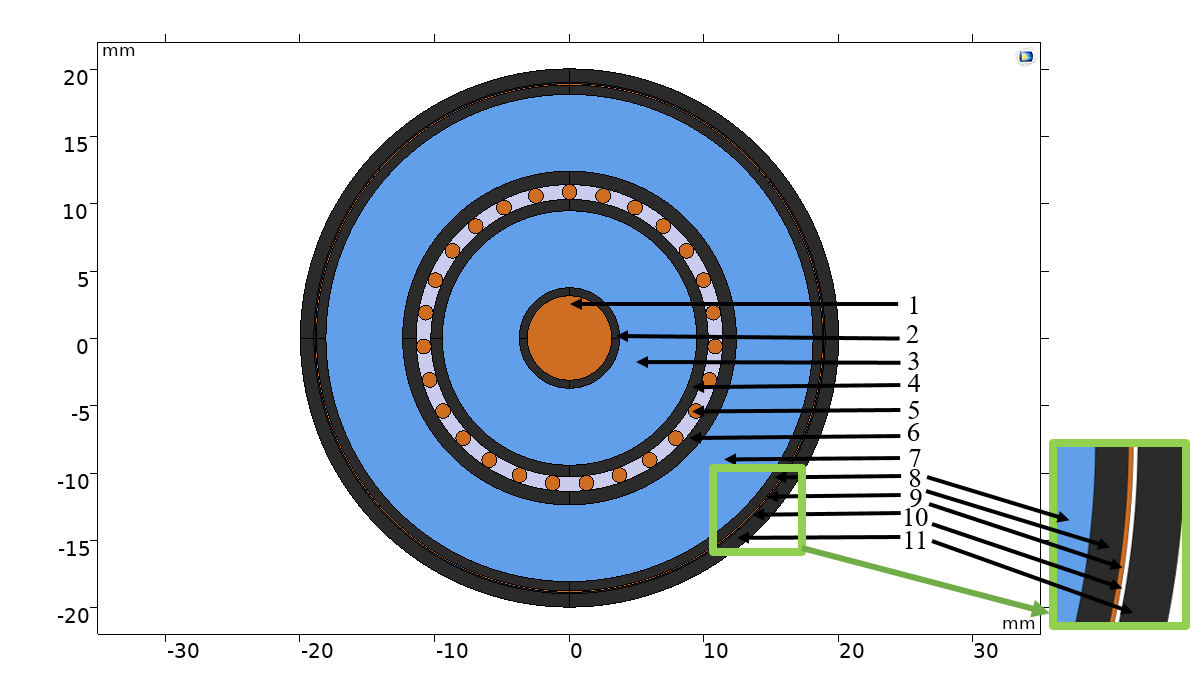
The results of numerical simulation of temperature modes of cross-linked polyethylene (XLPE) cable under transient states for International Thermonuclear Experimental Reactor (ITER) application are presented. The pulsed electric current load in the external circuit rapidly changes with the maximum values of 1.5 kA during tens of seconds decay with a period of 1200 s that corresponds to operation modes of the ITER fusion reactor. The core temperature achieves periodic steady-state at 20000 s, which is consistent with 4-5 cable thermal constant (~ 4500 s). The numerical results obtained reveal that the skin effect plays an insignificant role on core temperature dynamics. Multiphysics model links electric current with heat generation in cables with respect to electromagnetic effects and measured temperature dependencies of electro and thermophysical properties of the cable’s XLPE insulation.
Graphical Abstract
Keywords
Data Availability Statement
Funding
Conflicts of Interest
Ethical Approval and Consent to Participate
References
- Sonara, J., Beltran, D., Pintea, B., Hourtoule, J., Benfatto, I., Kim, S. H., ... & Lee, C. J. (2015). An overview of the ITER cabling network and cable database management. Fusion Engineering and Design, 96, 957-960.
[CrossRef] [Google Scholar] - Gung, C. Y., Ilin, Y., Dolgetta, N., Chen, Y., Bauer, P., Jong, C., \ldots, & Ding, K. (2012). Progress in design, analysis, and manufacturing studies of the ITER feeders. IEEE Transactions on Applied Superconductivity, 22(3), 4800804-4800804.
[CrossRef] [Google Scholar] - Doronin, M., Greshnyakov, G., & Korovkin, N. (2018). Modes of operation and design features of pulse cables for the ITER project. In MATEC Web of Conferences (Vol. 245, p. 13001). EDP Sciences.
[CrossRef] [Google Scholar] - IEEE SA. (n.d.). IEEE Standards Association. IEEE Standards Association. Retrieved from https://standards.ieee.org/ieee/400/7618/
[Google Scholar] - Finite element analysis for cable rating calculations. (2025, May 26). Online Library for Electrical Power Systems Publications | eCIGRE. Retrieved from https://www.e-cigre.org/publications/detail/963-finite-element-analysis-for-cable-rating-calculations.html
[Google Scholar] - IEC 60853-1:1985/Amd2:2008. (n.d.). IEC WebstoreIEC. Retrieved from https://webstore.iec.ch/en/publication/3708
[Google Scholar] - IEC TR 62095:2003. (n.d.). IEC WebstoreIEC. Retrieved from https://webstore.iec.ch/en/publication/6455
[Google Scholar] - IEC 60287-1-1:2023. (n.d.). IEC WebstoreIEC. Retrieved from https://webstore.iec.ch/en/publication/68118
[Google Scholar] - IEC 60287-2-1:2023. (n.d.). IEC WebstoreIEC. Retrieved from https://webstore.iec.ch/en/publication/68134
[Google Scholar] - De Leon, F., & Anders, G. J. (2008). Effects of backfilling on cable ampacity analyzed with the finite element method. IEEE Transactions on Power Delivery, 23(2), 537-543.
[CrossRef] [Google Scholar] - Dubitsky, S., Greshnyakov, G., & Korovkin, N. (2016, April). Comparison of finite element analysis to IEC-60287 for predicting underground cable ampacity. In 2016 IEEE International Energy Conference (ENERGYCON) (pp. 1-6). IEEE.
[CrossRef] [Google Scholar] - Wang, P. Y., Ma, H., Liu, G., Han, Z. Z., Guo, D. M., Xu, T., & Kang, L. Y. (2019). Dynamic thermal analysis of high-voltage power cable insulation for cable dynamic thermal rating. IEEE Access, 7, 56095-56106.
[CrossRef] [Google Scholar] - Osman, G. F., Elsharkawy, T. M., & Salem, W. A. (2021, December). Thermal analysis of underground distribution cables under dynamic loading in the presence of harmonic load currents. In 2021 22nd International Middle East Power Systems Conference (MEPCON) (pp. 319-325). IEEE.
[CrossRef] [Google Scholar] - da Silva, M. V., de Araújo, O. M., de Oliveira, D. F., & Lopes, R. T. (2024). Volumetric power density distribution in low voltage cables with Maxwell equations and FEM simulations. IEEE Transactions on Dielectrics and Electrical Insulation, 31(4), 2235-2241.
[CrossRef] [Google Scholar] - Greshnyakov, G. V., Egupov, A. A., Dubitsky, S. D., & Korovkin, N. V. (2022, January). Coaxial XPLE-Insulated Cable for Current Pulse Application: Design, Sizing, and Parameters. In 2022 Conference of Russian Young Researchers in Electrical and Electronic Engineering (ElConRus) (pp. 1180-1184). IEEE.
[CrossRef] [Google Scholar] - Mamaev, K. M., Greshnyakov, G. V., Dubitsky, S. D., Chesnokov, E. A., & Lebedeva, A. A. (2023, November). Transient thermal analysis of coaxial pulse power cable. In 2023 Seminar on Industrial Electronic Devices and Systems (IEDS) (pp. 167-171). IEEE.
[CrossRef] [Google Scholar] - Morgan, V. T. (2002). The thermal conductivity of crosslinked polyethylene insulation in aerial bundled cables. IEEE Transactions on Electrical Insulation, 26(6), 1153-1158.
[CrossRef] [Google Scholar] - Lee, K. Y., Yang, J. S., Choi, Y. S., & Park, D. H. (2006, June). Specific heat and thermal conductivity measurement of XLPE insulator and semiconducting materials. In 2006 IEEE 8th International Conference on Properties & Applications of Dielectric Materials (pp. 805-809). IEEE.
[CrossRef] [Google Scholar] - Liu, Y., Sun, J., Chen, S., Sha, J., & Yang, J. (2022). Thermophysical properties of cross-linked polyethylene during thermal aging. Thermochimica Acta, 713, 179231.
[CrossRef] [Google Scholar] - IEC 60949:1988. (2028, June 30). IEC WebstoreIEC. Retrieved from https://webstore.iec.ch/en/publication/4016
[Google Scholar]
Cited By (3)
-
Marko Šućurović, Dardan Klimenta, Nikolay Hinov, Dragan Tasić, Mladen Banjanin, Darius Andriukaitis. FEM-Based Quantification of Eddy-Current Losses for MV Cables in Trefoil Formation With Non-Magnetic Screens.
IEEE Access, 2026 , 14 .
[CrossRef] -
Zhaoyu Qin, Yan Zhang, Yuli Wang, Ge Wang, Xiaoyi Cheng. Harmonic Resonance Mechanism and Suppression Strategies for High-Voltage Cables with Frequency-Dependent Parameters.
Applied Sciences, 2026 , 16 (9).
[CrossRef] -
Minquan Ye, Yue Zhang, Huiying Wu, Cong Zeng, Hongyi Chen. Analysis on the thermal performance and economic efficiency of XLPE submarine cable based on electric–thermal–hydraulic coupling simulation.
Scientific Reports, 2026 , 16 (1).
[CrossRef]
Cite This Article
TY  - JOUR
AU  - Chesnokov, Evgenii
AU  - Feklistov, Efrem
AU  - Greshnyakov, George
AU  - Emelyanov, Oleg
PY  - 2025
DA  - 2025/10/19
TI  - Simulation of Thermal Operation Modes of XLPE Pulse Cable
JO  - ICCK Transactions on Electric Power Networks and Systems
T2  - ICCK Transactions on Electric Power Networks and Systems
JF  - ICCK Transactions on Electric Power Networks and Systems
VL  - 1
IS  - 1
SP  - 17
EP  - 25
DO  - 10.62762/TEPNS.2025.127082
UR  - https://www.icck.org/article/abs/TEPNS.2025.127082
KW  - pulse cable
KW  - skin effect
KW  - temperature transient state
KW  - thermophysical property of cross-linked polyethylene (XLPE)
AB  - The results of numerical simulation of temperature modes of cross-linked polyethylene (XLPE) cable under transient states for International Thermonuclear Experimental Reactor (ITER) application are presented. The pulsed electric current load in the external circuit rapidly changes with the maximum values of 1.5 kA during tens of seconds decay with a period of 1200 s that corresponds to operation modes of the ITER fusion reactor. The core temperature achieves periodic steady-state at 20000 s, which is consistent with 4-5 cable thermal constant (~ 4500 s). The numerical results obtained reveal that the skin effect plays an insignificant role on core temperature dynamics. Multiphysics model links electric current with heat generation in cables with respect to electromagnetic effects and measured temperature dependencies of electro and thermophysical properties of the cable’s XLPE insulation.
SN  - 3070-2607
PB  - Institute of Central Computation and Knowledge
LA  - English
ER  -
@article{Chesnokov2025Simulation,
  author = {Evgenii Chesnokov and Efrem Feklistov and George Greshnyakov and Oleg Emelyanov},
  title = {Simulation of Thermal Operation Modes of XLPE Pulse Cable},
  journal = {ICCK Transactions on Electric Power Networks and Systems},
  year = {2025},
  volume = {1},
  number = {1},
  pages = {17-25},
  doi = {10.62762/TEPNS.2025.127082},
  url = {https://www.icck.org/article/abs/TEPNS.2025.127082},
  abstract = {The results of numerical simulation of temperature modes of cross-linked polyethylene (XLPE) cable under transient states for International Thermonuclear Experimental Reactor (ITER) application are presented. The pulsed electric current load in the external circuit rapidly changes with the maximum values of 1.5 kA during tens of seconds decay with a period of 1200 s that corresponds to operation modes of the ITER fusion reactor. The core temperature achieves periodic steady-state at 20000 s, which is consistent with 4-5 cable thermal constant (~ 4500 s). The numerical results obtained reveal that the skin effect plays an insignificant role on core temperature dynamics. Multiphysics model links electric current with heat generation in cables with respect to electromagnetic effects and measured temperature dependencies of electro and thermophysical properties of the cable’s XLPE insulation.},
  keywords = {pulse cable, skin effect, temperature transient state, thermophysical property of cross-linked polyethylene (XLPE)},
  issn = {3070-2607},
  publisher = {Institute of Central Computation and Knowledge}
}
Publisher's Note
ICCK stays neutral with regard to jurisdictional claims in published maps and institutional affiliations.
Rights and Permissions


Portico
