

A Model for Assessing the Degree of Digitalization in Electric Power Networks


Article Information
Abstract
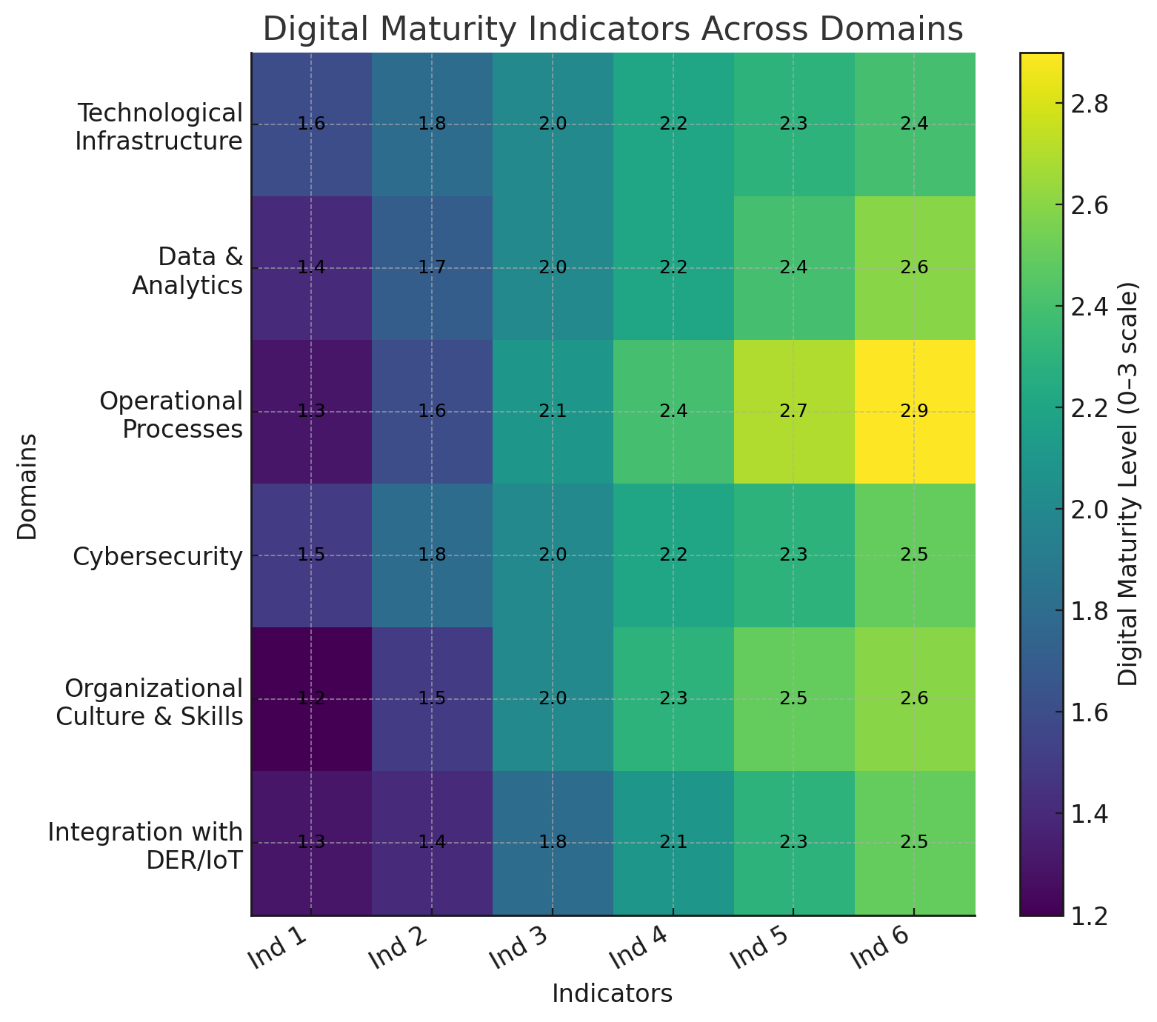
The increasing integration of digital technologies into electric power networks has transformed traditional grids into complex cyber-physical systems. Yet, the level of digital maturity across operators remains uneven, lacking a unified assessment framework. This paper proposes a structured model for evaluating the degree of digitalization in power grids, integrating technological, organizational, and analytical dimensions. The model introduces six core domains, technological infrastructure, data and analytics, operational processes, cybersecurity, organizational culture, and distributed energy integration, each evaluated across four maturity levels. A weighted scoring system is used to compute a Digitalization Score Index (DSI), allowing quantitative comparison and benchmarking. The proposed model is tested through a case study involving a regional grid operator, demonstrating its capability to identify gaps and guide digital transformation strategies. Results show that such an approach enhances transparency, supports investment prioritization, and aligns network modernization with the principles of smart grid development.
Graphical Abstract
Keywords
Data Availability Statement
Funding
Conflicts of Interest
Ethical Approval and Consent to Participate
References
- Aghahadi, M., Bosisio, A., Merlo, M., Berizzi, A., Pegoiani, A., & Forciniti, S. (2024). Digitalization processes in distribution grids: a comprehensive review of strategies and challenges. Applied Sciences, 14(11), 4528.
[CrossRef] [Google Scholar] - Monaco, R., Bergaentzlé, C., Vilaplana, J. A. L., Ackom, E., & Nielsen, P. S. (2024). Digitalization of power distribution grids: Barrier analysis, ranking and policy recommendations. Energy Policy, 188, 114083.
[CrossRef] [Google Scholar] - Kiasari, M., Ghaffari, M., & Aly, H. H. (2024). A comprehensive review of the current status of smart grid technologies for renewable energies integration and future trends: The role of machine learning and energy storage systems. Energies, 17(16), 4128.
[CrossRef] [Google Scholar] - Smart grids task force – EG3. (n.d.). Usef Energy – Universal Smart Energy Framework. Retrieved from https://www.usef.energy/implementations/smart-grids-task-force-eg3/ (accessed on 29 December 2025).
[Google Scholar] - Schirn, A. (2025, May 21). ISO 55000:2024— asset management vocabulary & principles - ANSI blog. The ANSI Blog. Retrieved from https://blog.ansi.org/ansi/iso-55000-2024-asset-management-vocab-principles/ (accessed on 29 December 2025).
[Google Scholar] - Olson, E. (2024). Digital Transformation and AI in Energy Systems: Applications, Challenges, and the Path Forward. In Digital Sustainability: Leveraging Digital Technology to Combat Climate Change (pp. 63-79). Cham: Springer Nature Switzerland.
[CrossRef] [Google Scholar] - Force Digitalisation of the Energy System. (2024, June). Smart grid indicators – The case for observability (Technical Discussion Paper) [Draft]. DSO Entity. Retrieved from https://odoo.eudsoentity.eu/publications/download/113 (accessed on 29 December 2025).
[Google Scholar] - DSO, E. (2022). The value of the digital transformation-Opportunities for distribution system operators (DSOs). Retrieved from https://www.edsoforsmartgrids.eu/edso-publications/the-value-of-the-digital-transformation-opportunities-for-dsos/ (accessed on 29 December 2025).
[Google Scholar] - Digitalization in the power grid: Driving innovation and transformation. (2024, June 24). Energy Central. Retrieved from https://www.energycentral.com/energy-management/post/digitalization-power-grid-driving-innovation-and-transformation-IAtxAfSNgSoS1bu (accessed on 29 December 2025).
[Google Scholar] - International Electrotechnical Commission. (n.d.). IEC 61970:2025 ser.: Energy management system application program interface (EMS-API) [Standard series]. Retrieved from https://webstore.iec.ch/en/publication/61167 (accessed on 29 December 2025).
[Google Scholar] - International Electrotechnical Commission. (2004). Application integration at electric utilities: System interfaces for distribution management. Geneva: International Electrotechnical Commission. Retrieved from https://cdn.standards.iteh.ai/samples/23638/b3d6c39cd2bb4701aedf29431861e4b5/IEC-61968-1-2020.pdf (accessed on 29 December 2025).
[Google Scholar] - Meletiou, A., Vasiljevska, J., Prettico, G., & Vitiello, S. (2023). Distribution system operator observatory 2022. Joint Res. Centre, Publications Office Eur. Union, Luxembourg, Tech. Rep. EUR, 31481.
[CrossRef] [Google Scholar] - Heymann, F., Milojevic, T., Covatariu, A., & Verma, P. (2023). Digitalization in decarbonizing electricity systems–Phenomena, regional aspects, stakeholders, use cases, challenges and policy options. Energy, 262, 125521.
[CrossRef] [Google Scholar] - Vilaplana, J. A. L., Yang, G., Monaco, R., Bergaentzlé, C., Ackom, E., & Morais, H. (2025). Digital versus grid investments in electricity distribution grids: Informed decision-making through system dynamics. Applied Energy, 386, 125536.
[CrossRef] [Google Scholar] - Mahmood, M., Chowdhury, P., Yeassin, R., Hasan, M., Ahmad, T., & Chowdhury, N. U. R. (2024). Impacts of digitalization on smart grids, renewable energy, and demand response: An updated review of current applications. Energy Conversion and Management: X, 24, 100790.
[CrossRef] [Google Scholar] - Chen, J., Yan, J., Kemmeugne, A., Kassouf, M., & Debbabi, M. (2025). Cybersecurity of distributed energy resource systems in the smart grid: A survey. Applied Energy, 383, 125364.
[CrossRef] [Google Scholar] - Paul, B., Sarker, A., Abhi, S. H., Das, S. K., Ali, M. F., Islam, M. M., ... & Saqib, N. (2024). Potential smart grid vulnerabilities to cyber attacks: Current threats and existing mitigation strategies. Heliyon, 10(19).
[CrossRef] [Google Scholar] - Pinto, S. J., Siano, P., & Parente, M. (2023). Review of cybersecurity analysis in smart distribution systems and future directions for using unsupervised learning methods for cyber detection. Energies, 16(4), 1651.
[CrossRef] [Google Scholar] - Fatemi, A., Tischbein, F., Wirtz, F., Schmoger, C., Dorendorf, S., Schurtz, A., ... & Ulbig, A. (2023). On the impact of smartification strategies for the state estimation of low voltage grids. arXiv preprint arXiv:2303.07964.
[Google Scholar] - Cavus, M. (2024). Integration Smart Grids, Distributed Generation, and Cybersecurity: Strategies for Securing and Optimizing Future Energy Systems.
[CrossRef] [Google Scholar] - Okafor, W. O., Edeagu, S. O., Chijindu, V. C., Iloanusi, O. N., & Eze, V. H. U. (2023). A Comprehensive Review on Smart Grid Ecosystem. IDOSR Journal of Applied Science, 8(1), 25-63.
[Google Scholar] - Wargers, A., Kula, J., Ortiz, F., & Rubio, D. (2018). European Distribution System Operators for Smart Grids. Smart Charging: Integrating a Large Widespread of Electric Cars in Electricity Distribution Grids. Available online: https://www.edsoforsmartgrids.eu/wp-content/uploads/EDSO-paper-on-electro-mobility-2.pdf (accessed on 29 December 2025).
[Google Scholar] - International Electrotechnical Commission. (2025). IEC 61850:2025 ser.: Communication networks and systems for power utility automation [Standard series]. Retrieved from https://webstore.iec.ch/en/publication/6028 (accessed on 29 December 2025).
[Google Scholar] - International Organization for Standardization. (2022). ISO/IEC 27001:2022 Information technology — Security techniques — Information security management systems — Requirements (3rd ed.) [International standard]. Retrieved from https://www.iso.org/standard/27001 (accessed on 29 December 2025).
[Google Scholar] - Brown, M. A., & Zhou, S. (2019). Smart‐grid policies: an international review. Advances in Energy Systems: The Large‐scale renewable energy integration challenge, 127-147.
[CrossRef] [Google Scholar] - Zhang, Z., Liu, M., Sun, M., Deng, R., Cheng, P., Niyato, D., ... & Chen, J. (2024). Vulnerability of machine learning approaches applied in iot-based smart grid: A review. IEEE Internet of Things Journal, 11(11), 18951-18975.
[CrossRef] [Google Scholar] - Shahbazi, A., Aghaei, J., Pirouzi, S., Niknam, T., Shafie-khah, M., & Catalão, J. P. (2021). Effects of resilience-oriented design on distribution networks operation planning. Electric Power Systems Research, 191, 106902.
[CrossRef] [Google Scholar] - Siano, P. (2014). Demand response and smart grids—A survey. Renewable and sustainable energy reviews, 30, 461-478.
[CrossRef] [Google Scholar] - Zhi, H., Mao, R., Hao, L., Chang, X., Guo, X., & Ji, L. (2024). Digital Twin for Modern Distribution Networks by Improved State Estimation with Consideration of Bad Date Identification. Electronics, 13(18), 3613.
[CrossRef] [Google Scholar] - Haggi, H., Song, M., & Sun, W. (2019). A review of smart grid restoration to enhance cyber-physical system resilience. 2019 IEEE Innovative Smart Grid Technologies-Asia (ISGT Asia), 4008-4013.
[CrossRef] [Google Scholar] - Jørgensen, B. N., & Ma, Z. G. (2025). Digital Twin of the European Electricity Grid: A Review of Regulatory Barriers, Technological Challenges, and Economic Opportunities. Applied Sciences, 15(12), 6475.
[CrossRef] [Google Scholar] - Kirmani, S., Mazid, A., Khan, I. A., & Abid, M. (2022). A survey on IoT-enabled smart grids: technologies, architectures, applications, and challenges. Sustainability, 15(1), 717.
[CrossRef] [Google Scholar] - Nuruzzaman, M., & Rana, S. (2025). IoT-Enabled Condition Monitoring in Power Distribution Systems: A Review of Scada-Based Automation, Real-Time Data Analytics, and Cyber-Physical Security Challenges. Journal of Sustainable Development and Policy, 1(01), 25-43.
[CrossRef] [Google Scholar]
Cited By (1)
-
Huida Duan, Zhipeng Gao, Song Bai, Yihan Wang, Shihao Zhao, Ying Zhao. Research on Intelligent Diagnosis of DC Magnetic Bias of Power Transformers Based on Vibration Signals and Improved 2DWT-CNN-Transformer Framework.
Electronics, 2026 , 15 (17).
[CrossRef]
Cite This Article
TY  - JOUR
AU  - Stanchev, Plamen
AU  - Hinov, Nikolay
AU  - Zlatev, Zoran
PY  - 2025
DA  - 2025/12/30
TI  - A Model for Assessing the Degree of Digitalization in Electric Power Networks
JO  - ICCK Transactions on Electric Power Networks and Systems
T2  - ICCK Transactions on Electric Power Networks and Systems
JF  - ICCK Transactions on Electric Power Networks and Systems
VL  - 1
IS  - 2
SP  - 93
EP  - 108
DO  - 10.62762/TEPNS.2025.524616
UR  - https://www.icck.org/article/abs/TEPNS.2025.524616
KW  - digitalization
KW  - power grid
KW  - maturity model
KW  - smart grid
KW  - assessment framework
AB  - The increasing integration of digital technologies into electric power networks has transformed traditional grids into complex cyber-physical systems. Yet, the level of digital maturity across operators remains uneven, lacking a unified assessment framework. This paper proposes a structured model for evaluating the degree of digitalization in power grids, integrating technological, organizational, and analytical dimensions. The model introduces six core domains, technological infrastructure, data and analytics, operational processes, cybersecurity, organizational culture, and distributed energy integration, each evaluated across four maturity levels. A weighted scoring system is used to compute a Digitalization Score Index (DSI), allowing quantitative comparison and benchmarking. The proposed model is tested through a case study involving a regional grid operator, demonstrating its capability to identify gaps and guide digital transformation strategies. Results show that such an approach enhances transparency, supports investment prioritization, and aligns network modernization with the principles of smart grid development.
SN  - 3070-2607
PB  - Institute of Central Computation and Knowledge
LA  - English
ER  -
@article{Stanchev2025A,
  author = {Plamen Stanchev and Nikolay Hinov and Zoran Zlatev},
  title = {A Model for Assessing the Degree of Digitalization in Electric Power Networks},
  journal = {ICCK Transactions on Electric Power Networks and Systems},
  year = {2025},
  volume = {1},
  number = {2},
  pages = {93-108},
  doi = {10.62762/TEPNS.2025.524616},
  url = {https://www.icck.org/article/abs/TEPNS.2025.524616},
  abstract = {The increasing integration of digital technologies into electric power networks has transformed traditional grids into complex cyber-physical systems. Yet, the level of digital maturity across operators remains uneven, lacking a unified assessment framework. This paper proposes a structured model for evaluating the degree of digitalization in power grids, integrating technological, organizational, and analytical dimensions. The model introduces six core domains, technological infrastructure, data and analytics, operational processes, cybersecurity, organizational culture, and distributed energy integration, each evaluated across four maturity levels. A weighted scoring system is used to compute a Digitalization Score Index (DSI), allowing quantitative comparison and benchmarking. The proposed model is tested through a case study involving a regional grid operator, demonstrating its capability to identify gaps and guide digital transformation strategies. Results show that such an approach enhances transparency, supports investment prioritization, and aligns network modernization with the principles of smart grid development.},
  keywords = {digitalization, power grid, maturity model, smart grid, assessment framework},
  issn = {3070-2607},
  publisher = {Institute of Central Computation and Knowledge}
}
Publisher's Note
ICCK stays neutral with regard to jurisdictional claims in published maps and institutional affiliations.
Rights and Permissions


Portico
