

Short-Term Load Forecasting with Taguchi-Optimized Single-Layer Feedforward Neural Networks: A MATLAB GUI




Article Information
Abstract
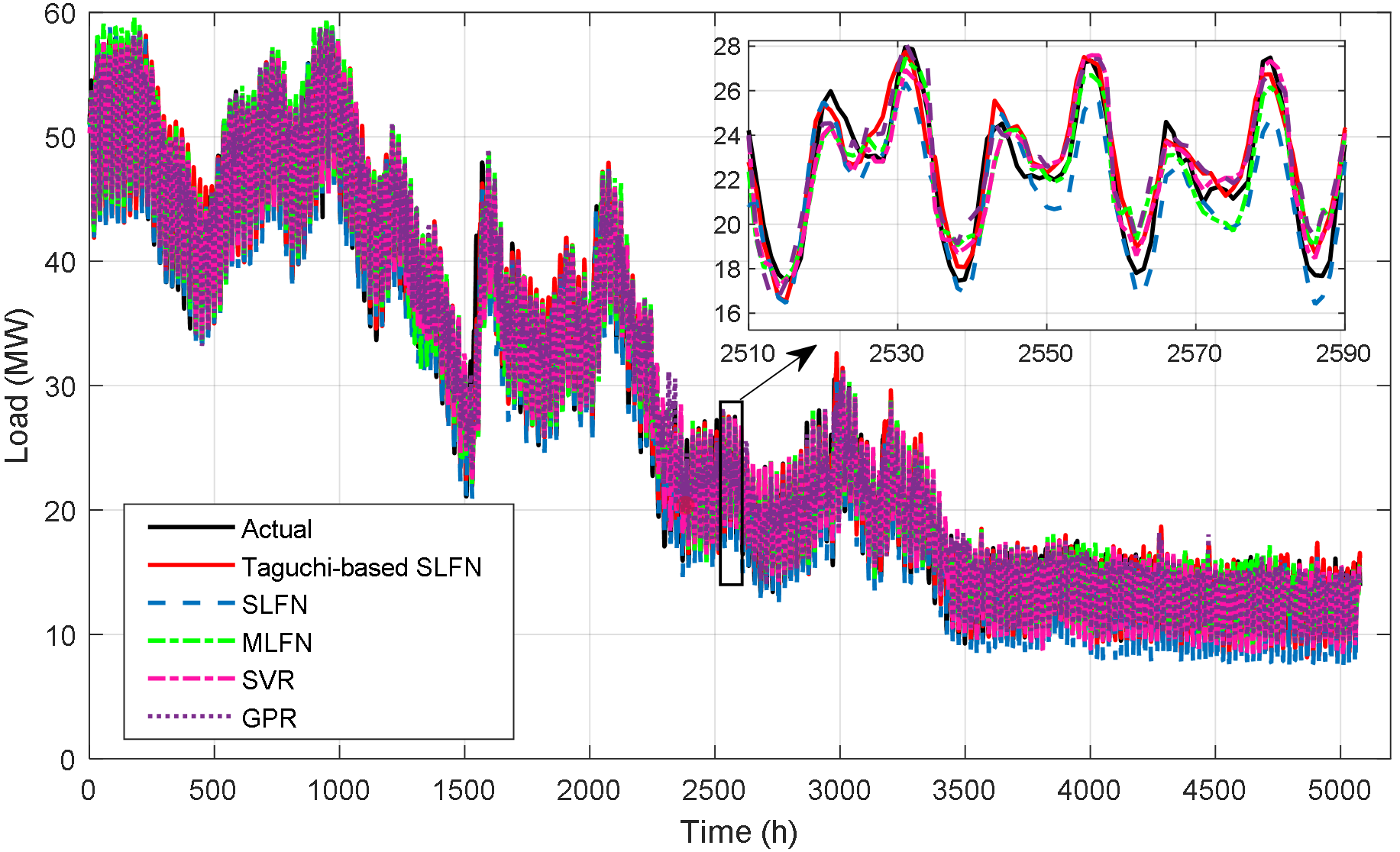
This paper proposes a Taguchi-based optimization framework for short-term load forecasting (STLF) using single-layer feedforward neural networks (SLFNs). Although SLFNs are computationally efficient, their accuracy strongly depends on proper hyperparameter configuration, which is often selected through inefficient trial-and-error procedures. The proposed approach applies orthogonal arrays and signal-to-noise analysis to identify robust and reproducible SLFN settings. A MATLAB-based load forecasting interface is developed to support data preprocessing, model selection, parameter tuning, forecasting, and performance evaluation. The methodology is validated using real historical load and meteorological data from the distribution network supplying the municipalities of Kosovska Mitrovica, Zvečan, Leposavić, and Zubin Potok. The Taguchi-optimized SLFN achieves a mean absolute percentage error of 4.32% and a coefficient of determination of 0.991, outperforming all reference methods. More than one year of operational use confirms that forecasting errors consistently remain in the 3–5% range. These results demonstrate that lightweight neural architectures, when systematically optimized, provide a practical, accurate, and computationally efficient solution for real-world STLF applications.
Graphical Abstract
Keywords
Data Availability Statement
Funding
Conflicts of Interest
Ethical Approval and Consent to Participate
References
- Hong, T., & Fan, S. (2016). Probabilistic electric load forecasting: A tutorial review. International Journal of Forecasting, 32(3), 914–938.
[CrossRef] [Google Scholar] - Weron, R. (2014). Electricity price forecasting: A review of the state-of-the-art with a look into the future. International Journal of Forecasting, 30(4), 1030–1081.
[CrossRef] [Google Scholar] - Ullah, K., Ahsan, M., Hasanat, S. M., Haris, M., Yousaf, H., Raza, S. F., ... & Ullah, Z. (2024). Short-term load forecasting: A comprehensive review and simulation study with CNN-LSTM hybrids approach. IEEE Access, 12, 111858–111881.
[CrossRef] [Google Scholar] - Ke, X., Jiang, A., & Lu, N. (2016). Load profile analysis and short-term building load forecast for a university campus. In Proceedings of the 2016 IEEE Power and Energy Society General Meeting (PESGM) (pp. 1–5). IEEE.
[CrossRef] [Google Scholar] - Box, G. E. P., Jenkins, G. M., Reinsel, G. C., & Ljung, G. M. (2015). Time series analysis: Forecasting and control (5th ed.). John Wiley & Sons.
[Google Scholar] - Chen, B.-J., Chang, M.-W., & Lin, C.-J. (2004). Load forecasting using support vector machines: A study on EUNITE competition 2001. IEEE Transactions on Power Systems, 19(4), 1821–1830.
[CrossRef] [Google Scholar] - Zhang, Z., & Hong, W. C. (2019). Electric load forecasting by complete ensemble empirical mode decomposition adaptive noise and support vector regression with quantum-based dragonfly algorithm. Nonlinear dynamics, 98(2), 1107-1136.
[CrossRef] [Google Scholar] - Chen, R., Liang, C. Y., Hong, W. C., & Gu, D. X. (2015). Forecasting holiday daily tourist flow based on seasonal support vector regression with adaptive genetic algorithm. Applied Soft Computing, 26, 435-443.
[CrossRef] [Google Scholar] - Alamaniotis, M., Bargiotas, D., & Tsoukalas, L. H. (2016). Towards smart energy systems: application of kernel machine regression for medium term electricity load forecasting. SpringerPlus, 5(1), 58.
[CrossRef] [Google Scholar] - Alamaniotis, M., Bargiotas, D., & Tsoukalas, L. H. (2016). Towards smart energy systems: application of kernel machine regression for medium term electricity load forecasting. SpringerPlus, 5(1), 58.
[CrossRef] [Google Scholar] - Bishop, C. M., & Nasrabadi, N. M. (2006). Pattern recognition and machine learning (Vol. 4, No. 4, p. 738). New York: springer.
[Google Scholar] - Haykin, S. (2009). Neural networks and learning machines, 3/E. Pearson Education India. https://dai.fmph.uniba.sk/courses/NN/haykin.neural-networks.3ed.2009.pdf
[Google Scholar] - Kim, J., Moon, J., Hwang, E., & Kang, P. (2019). Recurrent inception convolutional neural network for multi short-term load forecasting. Energy and Buildings, 194, 328–341.
[CrossRef] [Google Scholar] - Kwon, B. S., Park, R. J., & Song, K. B. (2020). Short-term load forecasting based on deep neural networks using LSTM layer. Journal of Electrical Engineering & Technology, 15(4), 1501-1509.
[CrossRef] [Google Scholar] - Kong, W., Dong, Z. Y., Jia, Y., Hill, D. J., Xu, Y., & Zhang, Y. (2019). Short-term residential load forecasting based on LSTM recurrent neural network. IEEE Transactions on Smart Grid, 10(1), 841–851.
[CrossRef] [Google Scholar] - Rafi, S. H., Nahid-Al-Masood, Deeba, S. R., & Hossain, E. (2021). A short-term load forecasting method using integrated CNN and LSTM network. IEEE Access, 9, 32436–32448.
[CrossRef] [Google Scholar] - Qiu, H., Hu, R., Chen, J., & Yuan, Z. (2025). Short-Term Electricity Load Forecasting Based on Complete Ensemble Empirical Mode Decomposition with Adaptive Noise and Improved Sparrow Search Algorithm–Convolutional Neural Network–Bidirectional Long Short-Term Memory Model. Mathematics, 13(5), 813.
[CrossRef] [Google Scholar] - Moradzadeh, A., Zakeri, S., Shoaran, M., Mohammadi-Ivatloo, B., & Mohammadi, F. (2020). Short-Term Load Forecasting of Microgrid via Hybrid Support Vector Regression and Long Short-Term Memory Algorithms. Sustainability, 12(17), 7076.
[CrossRef] [Google Scholar] - Zhang, Z., Zhang, Q., Liang, H., & Gorbani, B. (2024). Optimizing electric load forecasting with support vector regression/LSTM optimized by flexible Gorilla troops algorithm and neural networks a case study. Scientific Reports, 14(1), 22092.
[CrossRef] [Google Scholar] - Salam, A., & El Hibaoui, A. (2018, December). Comparison of machine learning algorithms for the power consumption prediction:-case study of tetouan city–. In 2018 6th international renewable and sustainable energy conference (IRSEC) (pp. 1-5). IEEE.
[CrossRef] [Google Scholar] - Jang, J., Kim, B., & Kim, I. (2024). Comparative Analysis of Deep Learning Techniques for Load Forecasting in Power Systems Using Single‐Layer and Hybrid Models. International Transactions on Electrical Energy Systems, 2024(1), 5587728.
[CrossRef] [Google Scholar] - Dehnad, K. (2012). Quality control, robust design, and the Taguchi method. Springer Science & Business Media.
[Google Scholar] - Diab, A. A. Z., Tulsky, V. N., & Tolba, M. A. (2016, December). Optimal shunt capacitors sittings and sizing in radial distribution systems using a novel hybrid optimization algorithm. In 2016 Eighteenth International Middle East Power Systems Conference (MEPCON) (pp. 445-452). IEEE.
[CrossRef] [Google Scholar] - Sahoo, S., Dalei, R. K., Rath, S. K., & Sahu, U. K. (2023). Selection of PSO parameters based on Taguchi design–ANOVA–ANN methodology for missile gliding trajectory optimization. Cognitive Robotics, 3, 158-172.
[CrossRef] [Google Scholar] - Visual Crossing Corporation. (2025). Weather Query Builder. Visual Crossing. Retrieved from https://www.visualcrossing.com/weather-query-builder (accessed on 23 December 2025).
[Google Scholar] - Minitab Inc. (2007). Minitab Statistical Software (Release 15) [Computer software]. Retrieved from https://www.minitab.com/en-us/support/downloads/ (accessed on 23 December 2025).
[Google Scholar]
Cited By (4)
-
Yangbo Liu, Lisha Peng, Lin Yin, Jingwei Deng, Mingjun Liu, Songling Huang. A non-destructive cable defect localisation method based on instantaneous frequency correlation.
Nondestructive Testing and Evaluation, 2026 .
[CrossRef] -
Jiyong Li, Zhiliang Cheng, Yide Peng, Hao Huang, Chen Ye. Research on Microgrid Resilience in Highway Service Areas Based on Federated Multi-Agent Deep Reinforcement Learning.
Sustainability, 2026 , 18 (2).
[CrossRef] -
Fulin Gong, Ruisheng Diao, Chao Cai, Jun Han. POA-Optimized 1D-CNN with Channel Attention for Power Quality Disturbance Classification Under Strong Noise Conditions.
Energies, 2026 , 19 (15).
[CrossRef] -
Fanghong Zhang, Hongwei Wang, Yongliang Zhang, Weipao Miao, Chengyu Hou. A Review of Mathematical Optimization Methods in Offshore Wind Energy Systems: Design, Layout, and Control.
Journal of Marine Science and Engineering, 2026 , 14 (11).
[CrossRef]
Cite This Article
TY  - JOUR
AU  - Milovanović, Miloš J.
AU  - Dragičević, Milorad M.
AU  - Krečković, Nebojša R.
AU  - Perović, Bojan D.
PY  - 2025
DA  - 2025/12/24
TI  - Short-Term Load Forecasting with Taguchi-Optimized Single-Layer Feedforward Neural Networks: A MATLAB GUI
JO  - ICCK Transactions on Electric Power Networks and Systems
T2  - ICCK Transactions on Electric Power Networks and Systems
JF  - ICCK Transactions on Electric Power Networks and Systems
VL  - 1
IS  - 2
SP  - 70
EP  - 81
DO  - 10.62762/TEPNS.2025.295010
UR  - https://www.icck.org/article/abs/TEPNS.2025.295010
KW  - MATLAB GUI
KW  - neural networks
KW  - short-term load forecasting
KW  - taguchi method
AB  - This paper proposes a Taguchi-based optimization framework for short-term load forecasting (STLF) using single-layer feedforward neural networks (SLFNs). Although SLFNs are computationally efficient, their accuracy strongly depends on proper hyperparameter configuration, which is often selected through inefficient trial-and-error procedures. The proposed approach applies orthogonal arrays and signal-to-noise analysis to identify robust and reproducible SLFN settings. A MATLAB-based load forecasting interface is developed to support data preprocessing, model selection, parameter tuning, forecasting, and performance evaluation. The methodology is validated using real historical load and meteorological data from the distribution network supplying the municipalities of Kosovska Mitrovica, Zvečan, Leposavić, and Zubin Potok. The Taguchi-optimized SLFN achieves a mean absolute percentage error of 4.32% and a coefficient of determination of 0.991, outperforming all reference methods. More than one year of operational use confirms that forecasting errors consistently remain in the 3–5% range. These results demonstrate that lightweight neural architectures, when systematically optimized, provide a practical, accurate, and computationally efficient solution for real-world STLF applications.
SN  - 3070-2607
PB  - Institute of Central Computation and Knowledge
LA  - English
ER  -
@article{Milovanovi2025ShortTerm,
  author = {Miloš J. Milovanović and Milorad M. Dragičević and Nebojša R. Krečković and Bojan D. Perović},
  title = {Short-Term Load Forecasting with Taguchi-Optimized Single-Layer Feedforward Neural Networks: A MATLAB GUI},
  journal = {ICCK Transactions on Electric Power Networks and Systems},
  year = {2025},
  volume = {1},
  number = {2},
  pages = {70-81},
  doi = {10.62762/TEPNS.2025.295010},
  url = {https://www.icck.org/article/abs/TEPNS.2025.295010},
  abstract = {This paper proposes a Taguchi-based optimization framework for short-term load forecasting (STLF) using single-layer feedforward neural networks (SLFNs). Although SLFNs are computationally efficient, their accuracy strongly depends on proper hyperparameter configuration, which is often selected through inefficient trial-and-error procedures. The proposed approach applies orthogonal arrays and signal-to-noise analysis to identify robust and reproducible SLFN settings. A MATLAB-based load forecasting interface is developed to support data preprocessing, model selection, parameter tuning, forecasting, and performance evaluation. The methodology is validated using real historical load and meteorological data from the distribution network supplying the municipalities of Kosovska Mitrovica, Zvečan, Leposavić, and Zubin Potok. The Taguchi-optimized SLFN achieves a mean absolute percentage error of 4.32\% and a coefficient of determination of 0.991, outperforming all reference methods. More than one year of operational use confirms that forecasting errors consistently remain in the 3–5\% range. These results demonstrate that lightweight neural architectures, when systematically optimized, provide a practical, accurate, and computationally efficient solution for real-world STLF applications.},
  keywords = {MATLAB GUI, neural networks, short-term load forecasting, taguchi method},
  issn = {3070-2607},
  publisher = {Institute of Central Computation and Knowledge}
}
Publisher's Note
ICCK stays neutral with regard to jurisdictional claims in published maps and institutional affiliations.
Rights and Permissions


Portico
