

Automatic Pollution Detection on High-Voltage Isolators Using a Two-Phase Approach


Article Information
Abstract
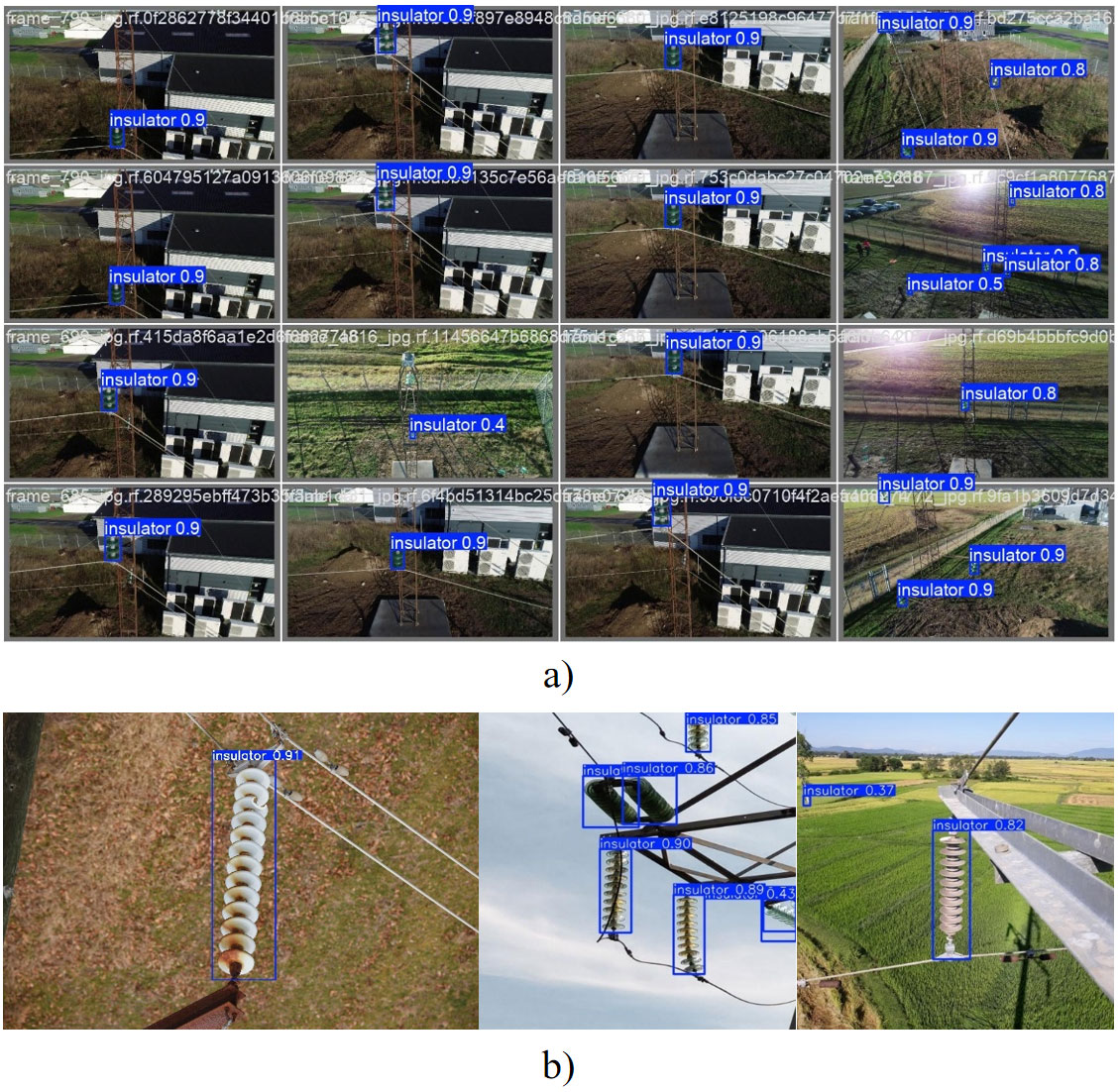
The accumulation of atmospheric and industrial pollution of high-voltage insulators is one of the frequent problems and a pattern of failures in transmission systems. In this paper, a two-phase approach based on deep learning is proposed for the detection of pollution of high-voltage insulators. The proposed approach automatically detects three types of pollution (salt, soot and excrement) based on UAV images. In addition to detection, the classification of pollution is automatically done into three levels (low, medium and high pollution). In the first phase, the You Only Look Once (YOLO) detector is used for precise detection and isolation of insulators, where an average accuracy of [email protected] of 93.75% is achieved. The model was trained on a Merged Public Insulator Dataset (MPID) database containing over 5000 insulators. The second phase utilizes the Zenodo dataset, which contains over 14,000 synthetic insulator images. In the second phase, the model was trained using the EfficientNet-B0 convolutional network to classify the type and level of pollution. In order to solve the problem of real data, fine-tuning was done for all 10 classes. The results show that the accuracy is 88% on a partial classification of 10 levels of pollution. When using 4 levels of pollution, the model achieves an accuracy of 91%. Additional automation was achieved with priority metrics, which by analyzing 100 images showed 24% of critical cases. The system determines the cleaning priority based on the pollution intensity, ensuring that critical cases are addressed first. A comparative analysis was performed when the model was trained with MobileNetV2, ResNet16 and VGG. The results show that the proposed model with the highest recall minimizes the risk of missed critical insulators. For example, in real-world applications, MobileNetV2 has a larger difference, which means too many false positives, while ResNet18 has a smaller difference, which means more false negatives which is a security risk.
Graphical Abstract
Keywords
Data Availability Statement
Funding
Conflicts of Interest
AI Use Statement
Ethical Approval and Consent to Participate
References
- Mussina, D., Irmanova, A., Jamwal, P., & Bagheri, M. (2020). Multi-modal data fusion using deep neural network for condition monitoring of high voltage insulator. IEEE Access, 8, 184486-184496.
[CrossRef] [Google Scholar] - Chatzargyros, G., Papakonstantinou, A., Kotoula, V., Stimoniaris, D., & Tsiamitros, D. (2024). UAV Inspections of Power Transmission Networks with AI Technology: A Case Study of Lesvos Island in Greece. Energies, 17(14), 3518.
[CrossRef] [Google Scholar] - Sampedro, C., Rodriguez-Vazquez, J., Rodriguez-Ramos, A., Carrio, A., & Campoy, P. (2019). Deep Learning-Based System for Automatic Recognition and Diagnosis of Electrical Insulator Strings. IEEE Access, 7, 101283-101308.
[CrossRef] [Google Scholar] - Santos, T., Cunha, T., Dias, A., Moreira, A. P., & Almeida, J. (2024). UAV Visual and Thermographic Power Line Detection Using Deep Learning. Sensors, 24(17), 5678.
[CrossRef] [Google Scholar] - Tingyu, W., Xia, S., Jiaxing, L., & Yue, Z. (2024). A Deep Learning Based Detection Method for Insulator Defects in High Voltage Transmission Lines. International Journal of Advanced Computer Science & Applications, 15(10), 378-385.
[CrossRef] [Google Scholar] - Wang, T., Zhai, Y., Li, Y., Wang, W., Ye, G., & Jin, S. (2024). Insulator Defect Detection Based on ML-YOLOv5 Algorithm. Sensors, 24(1), 204.
[CrossRef] [Google Scholar] - Fahim, F., & Hasan, M. S. (2024). Enhancing the reliability of power grids: A YOLO based approach for insulator defect detection. e-Prime - Advances in Electrical Engineering, Electronics and Energy, 9, 100663.
[CrossRef] [Google Scholar] - Dang, Q., Shang, W., Luo, F., Lu, P., Lin, G., & Gui, X. (2024, August). Insulator Defect Detection Technology Based on Deep Learning. In 2024 4th International Conference on Energy Engineering and Power Systems (EEPS) (pp. 941-947). IEEE.
[CrossRef] [Google Scholar] - Rong, S., He, L., Atici, S. F., & Cetin, A. E. (2025). Advanced YOLO-based Real-time Power Line Detection for Vegetation Management. IEEE Transactions on Power Delivery, 40(4), 2142-2153.
[CrossRef] [Google Scholar] - Gonçalves, R. S., De Oliveira, M., Rocioli, M., Souza, F., Gallo, C., Sudbrack, D., Trautmann, P., Clasen, B., & Homma, R. (2023). Drone–Robot to Clean Power Line Insulators. Sensors, 23(12), 5529.
[CrossRef] [Google Scholar] - Ferraz, H., Gonçalves, R. S., Moura, B. B., Sudbrack, D. E. T., Trautmann, P. V., Clasen, B. C., Homma, R. Z., & Bianchi, R. A. C. (2024). Automated classification of electrical network high-voltage tower insulator cleanliness using deep neural networks. International Journal of Intelligent Robotics and Applications, 9(3), 818-832.
[CrossRef] [Google Scholar] - Ergün, E. (2025). Artificial intelligence approaches for accurate assessment of insulator cleanliness in high-voltage electrical systems. Electrical Engineering, 107(3), 2969-2982.
[CrossRef] [Google Scholar] - Ferraz, H., Gonçalves, R., Moura, B., Sudbrack, D., Trautmann, P., Clasen, B., ... & Bianchi, R. A. (2024). Synthetic images datasets of clean and dirty string insulators used in high-voltage power lines. Journal of the Brazilian Society of Mechanical Sciences and Engineering, 46(11), 636.
[CrossRef] [Google Scholar] - Savadkoohi, E. M., Mirzaie, M., Seyyedbarzegar, S., Mohammadi, M., Khodsuz, M., Pashakolae, M. G., & Ghadikolaei, M. B. (2020). Experimental investigation on composite insulators AC flashover performance with fan-shaped non-uniform pollution under electro-thermal stress. International Journal of Electrical Power & Energy Systems, 121, 106142.
[CrossRef] [Google Scholar] - Luque-Vega, L. F., Castillo-Toledo, B., Loukianov, A., & Gonzalez-Jimenez, L. E. (2014). Power line inspection via an unmanned aerial system based on the quadrotor helicopter. In Proceedings of the 2014 17th IEEE Mediterranean Electrotechnical Conference (MELECON) (pp. 393-397).
[CrossRef] [Google Scholar] - Matikainen, L., Lehtomäki, M., Ahokas, E., Hyyppä, J., Karjalainen, M., Jaakkola, A., ... & Heinonen, T. (2016). Remote sensing methods for power line corridor surveys. ISPRS Journal of Photogrammetry and Remote sensing, 119, 10-31.
[CrossRef] [Google Scholar] - Roboflow Universe. (2026). MPID dataset [Data set]. Roboflow. Retrieved from https://universe.roboflow.com/rt-at8om/mpid-twm1g
[Google Scholar] - Jocher, G., Chaurasia, A., & Qiu, J. (2023). YOLO by Ultralytics (Version 8) [Computer software]. Retrieved from https://github.com/ultralytics/ultralytics
[Google Scholar] - Bianchi, R. A., Ferraz, H. F., Gonçalves, R. S., Moura, B., Sudbrack, D. E., Merini, A., ... & Homma, R. Z. (2024). A synthetic high-voltage power line insulator images dataset. Data in Brief, 55, 110688.
[CrossRef] [Google Scholar] - Gemini Team, Google. (2024). Gemini 1.5: Unlocking multimodal understanding across millions of tokens of context. arXiv preprint arXiv:2403.05530.
[Google Scholar] - Redmon, J., Divvala, S., Girshick, R., & Farhadi, A. (2016). You Only Look Once: Unified, Real-Time Object Detection. In Proceedings of the 2016 IEEE Conference on Computer Vision and Pattern Recognition (CVPR) (pp. 779-788).
[CrossRef] [Google Scholar] - Tan, M., & Le, Q. (2019, May). Efficientnet: Rethinking model scaling for convolutional neural networks. In International conference on machine learning (pp. 6105-6114). PMLR.
[Google Scholar] - Maksimović, V., Petrović, M., Savić, D., Jakšić, B., & Spalević, P. (2021). New Approach of Estimating Edge Detection Threshold and Application of Adaptive Detector Depending on Image Complexity. Optik, 238, 166476.
[CrossRef] [Google Scholar] - Liu, Y., Liu, D., Huang, X., & Li, C. (2023). Insulator defect detection with deep learning: A survey. IET Generation, Transmission & Distribution, 17(16), 3541–3558.
[CrossRef] [Google Scholar]
Cited By (2)
-
Rongcheng Li, Fei Wang, Yuxuan Lin, Liangjie Du, Jiaye Chen, Yunji Xie, Lixia Xu, Stefano Sfarra, V.S. Ghali, R. Mulaveesala, Honghao Yue, Junyan Liu. Lock-in photoluminescence imaging for enhancing in-situ detection of multi-source damage in photovoltaic modules.
Measurement, 2026 , 290 .
[CrossRef] -
Chen-Hao Zhao, Yi-Feng Ren, Long-Kun Cao, Hong-Yu Wang. IISD-YOLO: Infrared Detection of Insulator Strings for Transmission Lines Based on Improved YOLOv11.
Technologies, 2026 , 14 (5).
[CrossRef]
Cite This Article
TY  - JOUR
AU  - Maksimović, Vladimir
AU  - Jakšić, Branimir
PY  - 2026
DA  - 2026/02/27
TI  - Automatic Pollution Detection on High-Voltage Isolators Using a Two-Phase Approach
JO  - ICCK Transactions on Electric Power Networks and Systems
T2  - ICCK Transactions on Electric Power Networks and Systems
JF  - ICCK Transactions on Electric Power Networks and Systems
VL  - 2
IS  - 1
SP  - 7
EP  - 21
DO  - 10.62762/TEPNS.2026.648298
UR  - https://www.icck.org/article/abs/TEPNS.2026.648298
KW  - insulator detection
KW  - insulator pollution
KW  - deep learning
KW  - neural networks
KW  - multi-phase approach
AB  - The accumulation of atmospheric and industrial pollution of high-voltage insulators is one of the frequent problems and a pattern of failures in transmission systems. In this paper, a two-phase approach based on deep learning is proposed for the detection of pollution of high-voltage insulators. The proposed approach automatically detects three types of pollution (salt, soot and excrement) based on UAV images. In addition to detection, the classification of pollution is automatically done into three levels (low, medium and high pollution). In the first phase, the You Only Look Once (YOLO) detector is used for precise detection and isolation of insulators, where an average accuracy of [email protected] of 93.75% is achieved. The model was trained on a Merged Public Insulator Dataset (MPID) database containing over 5000 insulators. The second phase utilizes the Zenodo dataset, which contains over 14,000 synthetic insulator images. In the second phase, the model was trained using the EfficientNet-B0 convolutional network to classify the type and level of pollution. In order to solve the problem of real data, fine-tuning was done for all 10 classes. The results show that the accuracy is 88% on a partial classification of 10 levels of pollution. When using 4 levels of pollution, the model achieves an accuracy of 91%. Additional automation was achieved with priority metrics, which by analyzing 100 images showed 24% of critical cases. The system determines the cleaning priority based on the pollution intensity, ensuring that critical cases are addressed first. A comparative analysis was performed when the model was trained with MobileNetV2, ResNet16 and VGG. The results show that the proposed model with the highest recall minimizes the risk of missed critical insulators. For example, in real-world applications, MobileNetV2 has a larger difference, which means too many false positives, while ResNet18 has a smaller difference, which means more false negatives which is a security risk.
SN  - 3070-2607
PB  - Institute of Central Computation and Knowledge
LA  - English
ER  -
@article{Maksimovi2026Automatic,
  author = {Vladimir Maksimović and Branimir Jakšić},
  title = {Automatic Pollution Detection on High-Voltage Isolators Using a Two-Phase Approach},
  journal = {ICCK Transactions on Electric Power Networks and Systems},
  year = {2026},
  volume = {2},
  number = {1},
  pages = {7-21},
  doi = {10.62762/TEPNS.2026.648298},
  url = {https://www.icck.org/article/abs/TEPNS.2026.648298},
  abstract = {The accumulation of atmospheric and industrial pollution of high-voltage insulators is one of the frequent problems and a pattern of failures in transmission systems. In this paper, a two-phase approach based on deep learning is proposed for the detection of pollution of high-voltage insulators. The proposed approach automatically detects three types of pollution (salt, soot and excrement) based on UAV images. In addition to detection, the classification of pollution is automatically done into three levels (low, medium and high pollution). In the first phase, the You Only Look Once (YOLO) detector is used for precise detection and isolation of insulators, where an average accuracy of [email protected] of 93.75\% is achieved. The model was trained on a Merged Public Insulator Dataset (MPID) database containing over 5000 insulators. The second phase utilizes the Zenodo dataset, which contains over 14,000 synthetic insulator images. In the second phase, the model was trained using the EfficientNet-B0 convolutional network to classify the type and level of pollution. In order to solve the problem of real data, fine-tuning was done for all 10 classes. The results show that the accuracy is 88\% on a partial classification of 10 levels of pollution. When using 4 levels of pollution, the model achieves an accuracy of 91\%. Additional automation was achieved with priority metrics, which by analyzing 100 images showed 24\% of critical cases. The system determines the cleaning priority based on the pollution intensity, ensuring that critical cases are addressed first. A comparative analysis was performed when the model was trained with MobileNetV2, ResNet16 and VGG. The results show that the proposed model with the highest recall minimizes the risk of missed critical insulators. For example, in real-world applications, MobileNetV2 has a larger difference, which means too many false positives, while ResNet18 has a smaller difference, which means more false negatives which is a security risk.},
  keywords = {insulator detection, insulator pollution, deep learning, neural networks, multi-phase approach},
  issn = {3070-2607},
  publisher = {Institute of Central Computation and Knowledge}
}
Publisher's Note
ICCK stays neutral with regard to jurisdictional claims in published maps and institutional affiliations.
Rights and Permissions


Portico
