

Lightning Protection of the 110~kV Substation at the Wind Park – Surge Arresters in the Line Bay or at the Gantry Tower



Article Information
Abstract
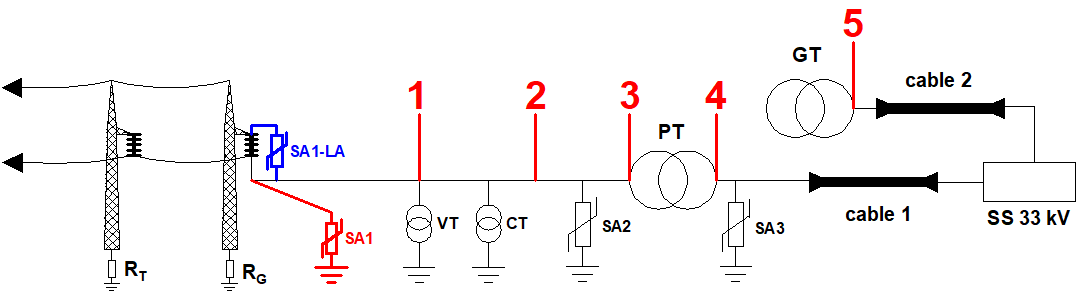
This paper analyzes the lightning protection of a 110~kV substation in a wind park, focusing on transients caused by lightning strikes to the connected 110~kV overhead line. Two configurations of surge arresters are compared: 1) application of the standard surge arresters installed in the line bay between the grounding system and phase conductors, 2) application of the surge arresters at the gantry tower. Both solutions are compared from the aspect of maximum amplitudes of lightning transients in the substation, as well as from the aspect of the energy stress of two sets of surge arresters at the 110 kV voltage level. Regarding the maximum amplitudes of lightning transients in the substation, it is presented that in the analyzed case, both solutions have some advantages and disadvantages, and neither solution is better in all aspects. However, standard installation of surge arresters in the line bay is significantly efficient from the aspect of sharing energy stress between the sets of surge arresters.
Graphical Abstract
Keywords
Data Availability Statement
Funding
Conflicts of Interest
Ethical Approval and Consent to Participate
References
- Ioannidis, A. I., & Tsovilis, T. E. (2023). Evaluation of the Direct-Stroke Shielding Performance of Substations Through Stochastic Modeling of Lightning Attachment. IEEE Transactions on Electromagnetic Compatibility, 66(2), 532-544.
[CrossRef] [Google Scholar] - Ioannidis, A. I., & Tsovilis, T. E. (2021). Shielding failure of high-voltage substations: A fractal-based approach for negative and positive lightning. IEEE Transactions on Industry Applications, 57(3), 2317-2325.
[CrossRef] [Google Scholar] - Savic, M. S., & Savic, A. M. (2015). Substation lightning performance estimation due to strikes into connected overhead lines. IEEE Transactions on Power Delivery, 30(4), 1752-1760.
[CrossRef] [Google Scholar] - Banjanin, M., Crnovčić, V., & Tomšič, M. (2024). Lightning protection of the 110~kV substation at the wind park Ivan Sedlo against transients caused by direct lightning strikes into connected overhead line. International Journal of Electrical Engineering and Computing, 8(2), 43-52.
[CrossRef] [Google Scholar] - Banjanin, M., Taljan, U., Kanduč, P., Lavtar, M., & Radović, B. (2025). EMTP-ATP and MATLAB-Based Parameter Variation Calculations – Case Study of Lightning Protection of 110~kV Substation at the Wind Park. B&H Electrical Engineering, 19(1), 45-51.
[Google Scholar] - Banjanin, M. S. (2017). Line Arresters Application in Lightning Protection of High Voltage Substations with Non-standard Configuration. Electric Power Components and Systems, 45(11), 1173–1181.
[CrossRef] [Google Scholar] - Uglešić, I., Milardić, V., Filipović-Grčić, B., & Tokić, A. (2008). Preventing flashover near a substation by installing surge arresters. In 29th International Conference on Lightning Protection (pp. 6-33).
[Google Scholar] - Franc, B., Filipović-Grčić, B., & Milardić, V. (2016). Lightning overvoltage performance of 110~kV air-insulated substation. Electric Power Systems Research, 138, 78-84.
[CrossRef] [Google Scholar] - Hosseini, S. A., Mirzaie, M., & Barforoshi, T. (2015). Impact of surge arrester number and placement on reliability and lightning overvoltage level in high voltage substations. International Journal of Electrical Power & Energy Systems, 65, 146-158.
[CrossRef] [Google Scholar] - Canadian-American EMTP User Group. (2011). ATP Rule Book. European EMTP–ATP Users Group Association. Retrieved from http://www.ee.mtu.edu/atp
[Google Scholar] - ATPDraw. (n.d.). ATPDraw (Version 7.6) [Computer software]. Retrieved from https://www.atpdraw.net/
[Google Scholar] - The MathWorks Inc. (2023). MATLAB (Version R2023b) [Computer software]. Retrieved from https://www.mathworks.com
[Google Scholar] - Grant, I. S. (1985). A simplified method for estimating lightning performance of transmission lines a report prepared by the working group on lightning performance of transmission lines. IEEE Power Engineering Review, (4), 48-48.
[CrossRef] [Google Scholar] - Whitehead, J. T., Chisholm, W. A., Anderson, J. G., Clayton, R., Elahi, H., Eriksson, A. J., ... & Renowden, J. R. (1993). Estimating lightning performance of transmission line 2--Updates to analytical models. IEEE Transactions on Power Delivery (Institute of Electrical and Electronics Engineers);(United States), 8(3).
[CrossRef] [Google Scholar] - CIGRE Working Group 33.01. (1991). Guide to Procedures for Estimating the Lightning Performance of Transmission Lines (Technical Brochure No. 63). CIGRE.
[Google Scholar] - Imece, A. F., Durbak, D. W., & Elahi, H. (1996). Modeling guidelines for fast front transients. IEEE Transactions on Power Delivery, 11(CONF-950103-).
[CrossRef] [Google Scholar] - International Electrotechnical Commission. (2010). Protection against lightning – Part 1: General principles (IEC 62305-1, 2nd ed.). Geneva, Switzerland: IEC.
[Google Scholar] - International Electrotechnical Commission. (2004). Insulation co-ordination - Part 4: Computational guide to insulation co-ordination and modeling of electrical networks (IEC 60071-4, 1st ed.). Geneva, Switzerland: IEC.
[Google Scholar] - Mcdaniel, J., Chisholm, W. A., Abidin Ab Kadir, M. Z., Alba, J., Aguado, M., Ainscough, J., ... & Zessin, W. N. (2010). IEEE Guide for Improving the Lightning Performance of Electric Power Overhead Distribution Lines (IEEE Std 1410™-2010).
[CrossRef] [Google Scholar] - International Electrotechnical Commission. (2010). Insulation co-ordination—Part 1: Definitions, principles and rules (IEC 60071-1:2006/AMD1:2010; 9th ed.) Retrieved from https://webstore.iec.ch/en/publication/577
[Google Scholar] - International Electrotechnical Commission. (2014). Surge arresters—Part 4: Metal-oxide surge arresters without gaps for a.c. systems (IEC 60099-4; 3rd ed.). Retrieved from https://webstore.iec.ch/en/publication/59657
[Google Scholar]
Cited By (1)
-
Mladen Banjanin, Urban Taljan, Velibor Crnovčić. .
2026 25th International Symposium INFOTEH-JAHORINA (INFOTEH), 2026 .
[CrossRef]
Cite This Article
TY  - JOUR
AU  - Banjanin, Mladen
PY  - 2025
DA  - 2025/10/22
TI  - Lightning Protection of the 110~kV Substation at the Wind Park – Surge Arresters in the Line Bay or at the Gantry Tower
JO  - ICCK Transactions on Electric Power Networks and Systems
T2  - ICCK Transactions on Electric Power Networks and Systems
JF  - ICCK Transactions on Electric Power Networks and Systems
VL  - 1
IS  - 1
SP  - 26
EP  - 37
DO  - 10.62762/TEPNS.2025.439655
UR  - https://www.icck.org/article/abs/TEPNS.2025.439655
KW  - gantry tower
KW  - substation lightning protection
KW  - surge arrester
KW  - transmission line bay
AB  - This paper analyzes the lightning protection of a 110~kV substation in a wind park, focusing on transients caused by lightning strikes to the connected 110~kV overhead line. Two configurations of surge arresters are compared: 1) application of the standard surge arresters installed in the line bay between the grounding system and phase conductors, 2) application of the surge arresters at the gantry tower. Both solutions are compared from the aspect of maximum amplitudes of lightning transients in the substation, as well as from the aspect of the energy stress of two sets of surge arresters at the 110 kV voltage level. Regarding the maximum amplitudes of lightning transients in the substation, it is presented that in the analyzed case, both solutions have some advantages and disadvantages, and neither solution is better in all aspects. However, standard installation of surge arresters in the line bay is significantly efficient from the aspect of sharing energy stress between the sets of surge arresters.
SN  - 3070-2607
PB  - Institute of Central Computation and Knowledge
LA  - English
ER  -
@article{Banjanin2025Lightning,
  author = {Mladen Banjanin},
  title = {Lightning Protection of the 110~kV Substation at the Wind Park – Surge Arresters in the Line Bay or at the Gantry Tower},
  journal = {ICCK Transactions on Electric Power Networks and Systems},
  year = {2025},
  volume = {1},
  number = {1},
  pages = {26-37},
  doi = {10.62762/TEPNS.2025.439655},
  url = {https://www.icck.org/article/abs/TEPNS.2025.439655},
  abstract = {This paper analyzes the lightning protection of a 110~kV substation in a wind park, focusing on transients caused by lightning strikes to the connected 110~kV overhead line. Two configurations of surge arresters are compared: 1) application of the standard surge arresters installed in the line bay between the grounding system and phase conductors, 2) application of the surge arresters at the gantry tower. Both solutions are compared from the aspect of maximum amplitudes of lightning transients in the substation, as well as from the aspect of the energy stress of two sets of surge arresters at the 110 kV voltage level. Regarding the maximum amplitudes of lightning transients in the substation, it is presented that in the analyzed case, both solutions have some advantages and disadvantages, and neither solution is better in all aspects. However, standard installation of surge arresters in the line bay is significantly efficient from the aspect of sharing energy stress between the sets of surge arresters.},
  keywords = {gantry tower, substation lightning protection, surge arrester, transmission line bay},
  issn = {3070-2607},
  publisher = {Institute of Central Computation and Knowledge}
}
Publisher's Note
ICCK stays neutral with regard to jurisdictional claims in published maps and institutional affiliations.
Rights and Permissions


Portico
