

Taguchi-Based Parameter Tuning of PSO for Optimal Capacitor Placement in Unbalanced Distribution Systems



Article Information
Abstract
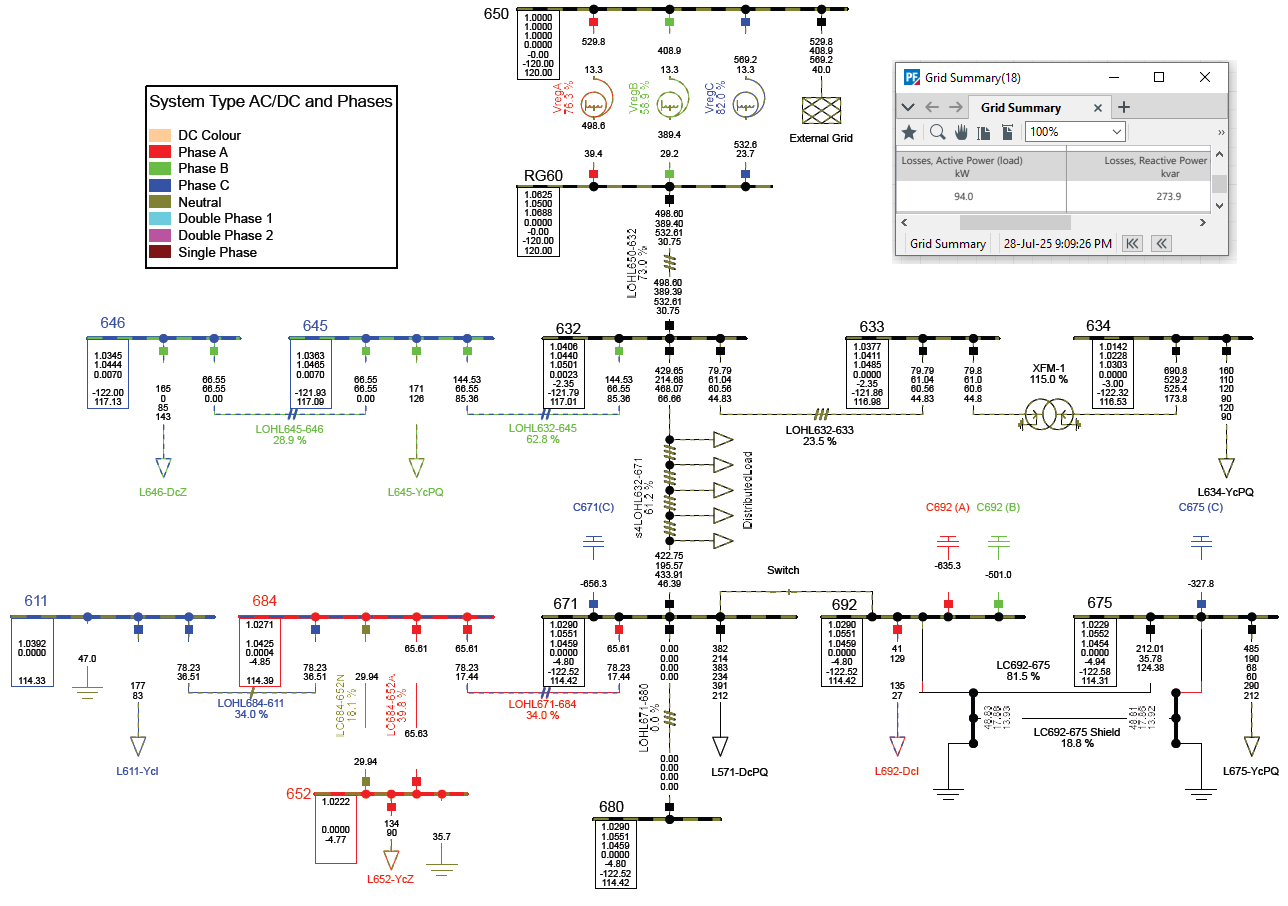
This paper presents a Taguchi-tuned Particle Swarm Optimization (PSO) approach for the optimal placement and sizing of shunt capacitor banks (CBs) in unbalanced distribution systems. The optimization aims to minimize the total operational cost by reducing power losses and improving voltage profile. A systematic parameter tuning was carried out using the Taguchi method based on an L25 orthogonal array, with five PSO parameters evaluated through Signal-to-Noise (SN) ratios and Analysis of Variance (ANOVA). The IEEE 13-bus test feeder was used as a benchmark. The results show that the installation of four optimally placed CBs reduces active power losses by 29.6% (from 133.16 kW to 93.71 kW), improves the minimum bus voltage from 0.942 p.u. to 1.014 p.u., and decreases operating costs by 6,144.55$ compared to the base case. Validation using DIgSILENT PowerFactory confirms the consistency of the proposed method. Moreover, the Taguchi-optimized PSO demonstrated superior performance over the classical PSO in terms of convergence speed, solution quality, and result consistency across multiple independent runs, confirming its effectiveness and robustness for practical distribution system optimization.
Graphical Abstract
Keywords
Data Availability Statement
Funding
Conflicts of Interest
Ethical Approval and Consent to Participate
References
- Aman, M. M., Jasmon, G. B., Bakar, A. H. A., Mokhlis, H., & Karimi, M. (2014). Optimum shunt capacitor placement in distribution system—A review and comparative study. Renewable and Sustainable Energy Reviews, 30, 429-439.
[CrossRef] [Google Scholar] - Mostafa, S. M. G., Shingh, J. G., & Haque, H. E. (2020). An extensive literature review and new proposal on optimal capacitor placement in distribution systems. Journal of Engineering Advancements, 1(04), 150-169.
[CrossRef] [Google Scholar] - Ahmadi Kamarposhti, M., Ghandour, R., Abdel-Aty, M., Hafez, M., Alfiras, M., Alkhazaleh, S., ... & Solyman, A. (2025). Optimizing capacitor bank placement in distribution networks using a multi-objective particle swarm optimization approach for energy efficiency and cost reduction. Scientific Reports, 15(1), 12332.
[CrossRef] [Google Scholar] - Mondal, S., & De, M. (2023). Optimal capacitor placement for unbalanced distribution system using graph theory. IETE Journal of Research, 69(9), 6512-6519.
[CrossRef] [Google Scholar] - De Araujo, L. R., Penido, D. R. R., Carneiro, S., & Pereira, J. L. R. (2018). Optimal unbalanced capacitor placement in distribution systems for voltage control and energy losses minimization. Electric Power Systems Research, 154, 110-121.
[CrossRef] [Google Scholar] - Asabere, P., Sekyere, F., Ayambire, P., & Ofosu, W. K. (2025). Optimal capacitor bank placement and sizing using particle swarm optimization for power loss minimization in distribution network. Journal of Engineering Research, 13(2), 1307-1315.
[CrossRef] [Google Scholar] - Wang, H., Geng, Q., & Qiao, Z. (2014, April). Parameter tuning of particle swarm optimization by using Taguchi method and its application to motor design. In 2014 4th IEEE international conference on information science and technology (pp. 722-726). IEEE.
[CrossRef] [Google Scholar] - Dehnad, K. (1989). Quality control, robust design, and the Taguchi method (1st ed.). Wadsworth & Brooks/Cole Advanced Books & Software.
[Google Scholar] - IEEE Power & Energy Society. (n.d.). IEEE PES Test Feeder. Retrieved from https://cmte.ieee.org/pes-testfeeders/resources/
[Google Scholar] - Sahoo, S., Dalei, R. K., Rath, S. K., & Sahu, U. K. (2023). Selection of PSO parameters based on Taguchi design–ANOVA–ANN methodology for missile gliding trajectory optimization. Cognitive Robotics, 3, 158-172.
[CrossRef] [Google Scholar] - Minitab LLC. (2007). Minitab Statistical Software (Release 15) [Computer software].
[Google Scholar] - DIgSILENT GmbH. (2024). DIgSILENT PowerFactory 2024 User Manual. Gomaringen, Germany.
[Google Scholar] - Cheng, C. S., & Shirmohammadi, D. (1995). A three-phase power flow method for real-time distribution system analysis. IEEE Transactions on Power Systems, 10(2), 671-679.
[CrossRef] [Google Scholar] - Baghzouz, Y., & Ertem, S. (1990). Shunt capacitor sizing for radial distribution feeders with distorted substation voltages. IEEE Transactions on Power Delivery, 5(2), 650-657.
[CrossRef] [Google Scholar] - Milovanović, M., Radosavljević, J., & Perović, B. (2021). Optimal placement and sizing of shunt capacitors in distorted distribution systems using a hybrid algorithm. Serbian Journal of Electrical Engineering, 18(1), 115-135.
[CrossRef] [Google Scholar] - Milovanović, M., Radosavljević, J., & Perović, B. (2019). A backward/forward sweep power flow method for harmonic polluted radial distribution systems with distributed generation units. International Transactions on Electrical Energy Systems, 30(5), e12310.
[CrossRef] [Google Scholar] - Kennedy, J., & Eberhart, R. (1995). Particle swarm optimization. In Proceedings of the IEEE International Conference on Neural Networks (Vol. 4, pp. 1942-1948).
[CrossRef] [Google Scholar] - Marini, F., & Walczak, B. (2015). Particle swarm optimization (PSO): A tutorial. Chemometrics and Intelligent Laboratory Systems, 149, 153-165.
[CrossRef] [Google Scholar] - Clerc, M. (2006). Particle swarm optimization. Wiley-ISTE.
[Google Scholar] - Yang, C., Gao, W., Liu, N., & Song, C. (2015). Low-discrepancy sequence initialized particle swarm optimization algorithm with high-order nonlinear time-varying inertia weight. Applied Soft Computing, 29, 386-394.
[CrossRef] [Google Scholar] - Eberhart, R. C., & Shi, Y. (2001, May). Tracking and optimizing dynamic systems with particle swarms. In Proceedings of the 2001 congress on evolutionary computation (IEEE Cat. No. 01TH8546) (Vol. 1, pp. 94-100). IEEE.
[CrossRef] [Google Scholar] - Montgomery, D. C. (2013). Design and analysis of experiments (8th ed.). John Wiley & Sons.
[Google Scholar]
Cited By (7)
-
Azra Dahiyah Alias, Renuga Verayiah, Agileswari Ramasamy, Hazlie Mokhlis, Saleh Ba-swaimi, Nuramirah Binti Saffee. Multi-objective optimal planning model for solar PV and battery energy storage systems in distribution systems under uncertainty: a multi-horizon comparative analysis.
Renewable Energy Focus, 2026 , 59 .
[CrossRef] -
Pude Yu, Wenxuan Xu, Yichen Shao, Yingjiang Zhao, Cheng Chen, Renfei Wo, Wencai Peng, Shuaiwei Ren, Qing Wang, Yongqing Deng. Research on Planning and Dispatching Strategy of Grid-Side Energy Storage Power Station Considering Regional Power Grid Interconnection.
Electronics, 2026 , 15 (14).
[CrossRef] -
Minquan Ye, Yue Zhang, Huiying Wu, Cong Zeng, Hongyi Chen. Analysis on the thermal performance and economic efficiency of XLPE submarine cable based on electric–thermal–hydraulic coupling simulation.
Scientific Reports, 2026 , 16 (1).
[CrossRef] -
Yangbo Liu, Lisha Peng, Lin Yin, Jingwei Deng, Mingjun Liu, Songling Huang. A non-destructive cable defect localisation method based on instantaneous frequency correlation.
Nondestructive Testing and Evaluation, 2026 .
[CrossRef] -
Fanghong Zhang, Hongwei Wang, Yongliang Zhang, Weipao Miao, Chengyu Hou. A Review of Mathematical Optimization Methods in Offshore Wind Energy Systems: Design, Layout, and Control.
Journal of Marine Science and Engineering, 2026 , 14 (11).
[CrossRef] -
Jiyong Li, Zhiliang Cheng, Yide Peng, Hao Huang, Chen Ye. Research on Microgrid Resilience in Highway Service Areas Based on Federated Multi-Agent Deep Reinforcement Learning.
Sustainability, 2026 , 18 (2).
[CrossRef] -
Mohamed Souissi, Boubakeur Zegnini, Abdelhalim Mahdjoubi. .
2025 5th International Conference on Applied Automation and Industrial Diagnostics (ICAAID), 2025 .
[CrossRef]
Cite This Article
TY  - JOUR
AU  - Milovanović, Miloš J.
AU  - Radosavljević, Jordan N.
AU  - Perović, Bojan D.
PY  - 2025
DA  - 2025/10/18
TI  - Taguchi-Based Parameter Tuning of PSO for Optimal Capacitor Placement in Unbalanced Distribution Systems
JO  - ICCK Transactions on Electric Power Networks and Systems
T2  - ICCK Transactions on Electric Power Networks and Systems
JF  - ICCK Transactions on Electric Power Networks and Systems
VL  - 1
IS  - 1
SP  - 6
EP  - 16
DO  - 10.62762/TEPNS.2025.698044
UR  - https://www.icck.org/article/abs/TEPNS.2025.698044
KW  - capacitor placement
KW  - particle swarm optimization (PSO)
KW  - taguchi method
KW  - unbalanced systems
AB  - This paper presents a Taguchi-tuned Particle Swarm Optimization (PSO) approach for the optimal placement and sizing of shunt capacitor banks (CBs) in unbalanced distribution systems. The optimization aims to minimize the total operational cost by reducing power losses and improving voltage profile. A systematic parameter tuning was carried out using the Taguchi method based on an L25 orthogonal array, with five PSO parameters evaluated through Signal-to-Noise (SN) ratios and Analysis of Variance (ANOVA). The IEEE 13-bus test feeder was used as a benchmark. The results show that the installation of four optimally placed CBs reduces active power losses by 29.6% (from 133.16 kW to 93.71 kW), improves the minimum bus voltage from 0.942 p.u. to 1.014 p.u., and decreases operating costs by 6,144.55$ compared to the base case. Validation using DIgSILENT PowerFactory confirms the consistency of the proposed method. Moreover, the Taguchi-optimized PSO demonstrated superior performance over the classical PSO in terms of convergence speed, solution quality, and result consistency across multiple independent runs, confirming its effectiveness and robustness for practical distribution system optimization.
SN  - 3070-2607
PB  - Institute of Central Computation and Knowledge
LA  - English
ER  -
@article{Milovanovi2025TaguchiBas,
  author = {Miloš J. Milovanović and Jordan N. Radosavljević and Bojan D. Perović},
  title = {Taguchi-Based Parameter Tuning of PSO for Optimal Capacitor Placement in Unbalanced Distribution Systems},
  journal = {ICCK Transactions on Electric Power Networks and Systems},
  year = {2025},
  volume = {1},
  number = {1},
  pages = {6-16},
  doi = {10.62762/TEPNS.2025.698044},
  url = {https://www.icck.org/article/abs/TEPNS.2025.698044},
  abstract = {This paper presents a Taguchi-tuned Particle Swarm Optimization (PSO) approach for the optimal placement and sizing of shunt capacitor banks (CBs) in unbalanced distribution systems. The optimization aims to minimize the total operational cost by reducing power losses and improving voltage profile. A systematic parameter tuning was carried out using the Taguchi method based on an L25 orthogonal array, with five PSO parameters evaluated through Signal-to-Noise (SN) ratios and Analysis of Variance (ANOVA). The IEEE 13-bus test feeder was used as a benchmark. The results show that the installation of four optimally placed CBs reduces active power losses by 29.6\% (from 133.16 kW to 93.71 kW), improves the minimum bus voltage from 0.942 p.u. to 1.014 p.u., and decreases operating costs by 6,144.55\$ compared to the base case. Validation using DIgSILENT PowerFactory confirms the consistency of the proposed method. Moreover, the Taguchi-optimized PSO demonstrated superior performance over the classical PSO in terms of convergence speed, solution quality, and result consistency across multiple independent runs, confirming its effectiveness and robustness for practical distribution system optimization.},
  keywords = {capacitor placement, particle swarm optimization (PSO), taguchi method, unbalanced systems},
  issn = {3070-2607},
  publisher = {Institute of Central Computation and Knowledge}
}
Publisher's Note
ICCK stays neutral with regard to jurisdictional claims in published maps and institutional affiliations.
Rights and Permissions


Portico
