

Seasonal Ampacities of 110 kV Power Cables Installed in Various Trenches Surrounded by Two-Layered Native Soil






Article Information
Abstract
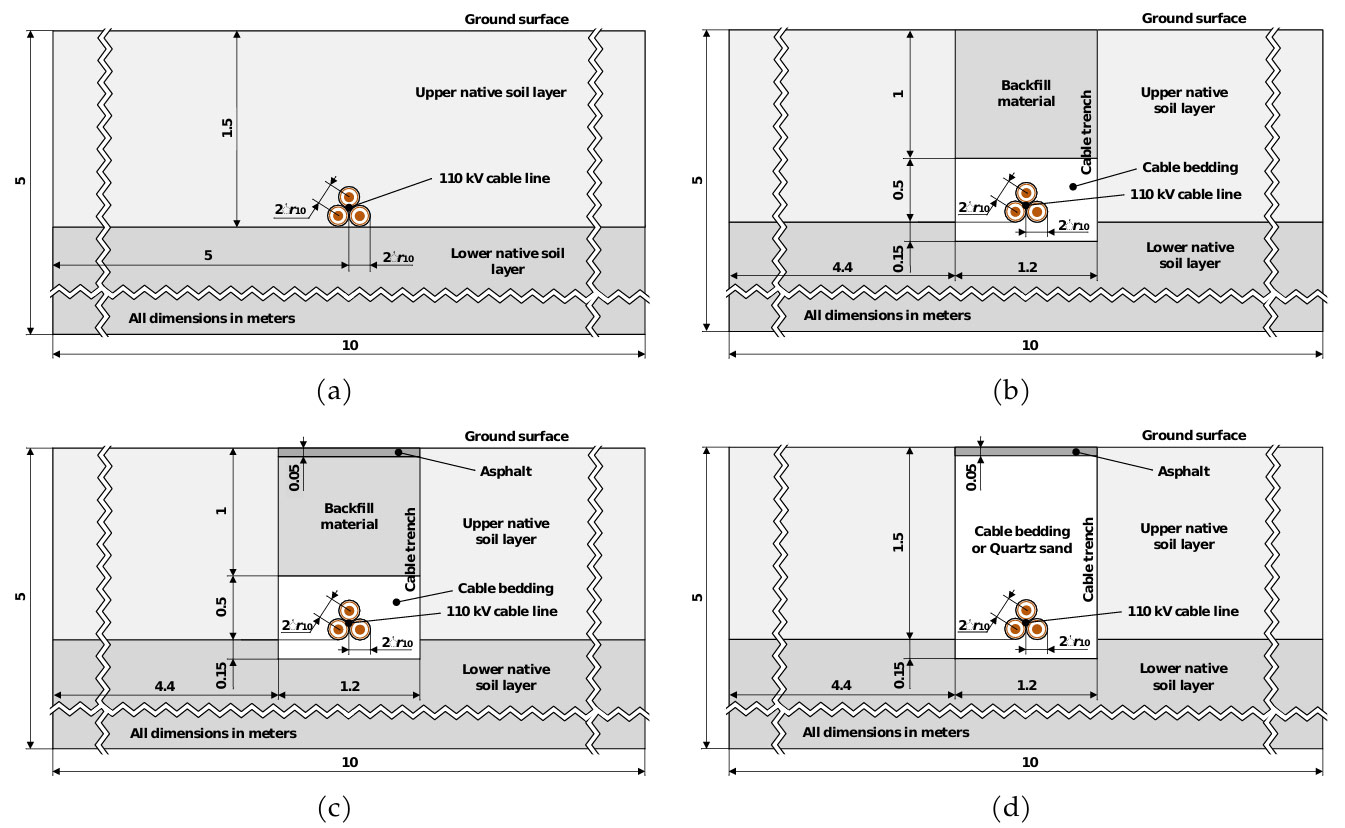
In analytical and numerical calculations of the underground cable ampacities in accordance with the relevant IEC standards and the IEC technical report, it is usually assumed that the native soil, cable bedding, and other materials used in and around cable trenches are homogeneous, although this is not the case in reality. This paper, however, assumes that the native soil consists of two horizontal layers with different thermal conductivities. The upper native soil layer includes soil material as well as shrinkage cracks between the ground surface and the horizontal plane where the reference soil temperature is measured, whereas the lower native soil layer includes only soil material below the upper layer, without any porosity. The concept of effective thermal conductivity is applied to the upper layer of native soil. It is also assumed that the effective thermal conductivity of the upper native soil layer in the summer and winter periods corresponds to the most unfavorable summer and most common winter conditions, respectively. In this regard, the aim is to determine the seasonal thermal behavior of three 110 kV power cables installed in trefoil touching formation, directly in two-layered native soil or in four different cable trenches surrounded by the same two-layered native soil. Ampacities are determined analytically in MATLAB, using a standard IEC-based procedure for cables in single-layered native soil, as well as numerically in COMSOL Multiphysics 4.3, using FEM-based steady-state thermal analysis for cables in single- and two-layered native soils. The IEC-based ampacities are used as base values. It is determined that the summer and winter ampacities of the 110 kV cables, compared to the corresponding base ampacities, can be increased by up to 28.46% under the most unfavorable summer conditions and by up to 31.92% under the most common winter conditions, respectively.
Graphical Abstract
Keywords
Data Availability Statement
Funding
Conflicts of Interest
AI Use Statement
Ethical Approval and Consent to Participate
References
- International Electrotechnical Commission. (2023). Electric cables - Calculation of the current rating - Part 1-1: Current rating equations (100\,\% load factor) and calculation of losses - General (Standard IEC 60287-1-1:2023 CMV). IEC. Retrieved from https://webstore.iec.ch/en/publication/85666
[Google Scholar] - International Electrotechnical Commission. (2023). Electric cables - Calculation of the current rating - Part 2-1: Thermal resistance - Calculation of thermal resistance (Standard IEC 60287-2-1:2023 CMV). IEC. Retrieved from https://webstore.iec.ch/en/publication/85669
[Google Scholar] - International Electrotechnical Commission. (2003). Electric cables - Calculations for current ratings - Finite element method (Technical Report IEC TR 62095:2003). IEC. Retrieved from https://webstore.iec.ch/en/publication/6455
[Google Scholar] - Klimenta, D., Sucurovic, M., & Tasic, D. (2025). Amendments to some IEC TR 62095 recommendations for underground single-core power cables in trefoil formation. ICCK Transactions on Electric Power Networks and Systems, 1(1), 38-49.
[CrossRef] [Google Scholar] - Klimenta, D., Šućurović, M., & Tasić, D. (2026). Thermal Modeling of the Ground Surface for the Purpose of Calculating the Current-Carrying Capacity of Underground Cable Lines Using the FEM. ICCK Transactions on Electric Power Networks and Systems, 2(1), 47-57.
[CrossRef] [Google Scholar] - Neher, J. H., & McGrath, M. H. (1957). The calculation of the temperature rise and load capability of cable systems. Transactions of the American Institute of Electrical Engineers. Part III: Power Apparatus and Systems, 76, 752-772.
[CrossRef] [Google Scholar] - Hanna, M. A., Chikhani, A. Y., & Salama, M. M. A. (1992, August). Modelling of underground cable systems in non-homogeneous soils. In [1992] Proceedings of the 35th Midwest Symposium on Circuits and Systems (pp. 381-384). IEEE.
[CrossRef] [Google Scholar] - Hanna, M. A., Chikhani, A. Y., & Salama, M. M. A. (1993). Thermal analysis of power cables in multi-layered soil - Part 1: Theoretical model. IEEE Transactions on Power Delivery, 8(3), 761-771.
[CrossRef] [Google Scholar] - Hanna, M. A., Chikhani, A. Y., & Salama, M. M. A. (1993). Thermal analysis of power cables in multi-layered soil - Part 2: Practical considerations. IEEE Transactions on Power Delivery, 8(3), 772-778.
[CrossRef] [Google Scholar] - Hanna, M. A., Chikhani, A. Y., & Salama, M. M. A. (1994). Thermal analysis of power cables in multi-layered soil - Part 3: Case of two cables in a trench. IEEE Transactions on Power Delivery, 9(1), 572-578.
[CrossRef] [Google Scholar] - Ackerson, J. P., McInnes, K. J., Morgan, C. L., & Everett, M. E. (2017). Measuring crack porosity using three‐dimensional electrical resistivity tomography. Soil Science Society of America Journal, 81(5), 1025-1035.
[CrossRef] [Google Scholar] - Bagnall, D. K., Crespo Gutierrez, P. M., Yimam, Y. T., Morgan, C. L., Neely, H. L., & Ackerson, J. P. (2018). Effect of air‐and water‐filled voids on neutron moisture meter measurements of clay soil. Vadose Zone Journal, 17(1), 1-9.
[CrossRef] [Google Scholar] - Khumalo, N. Q., Naidoo, R. M., Mbungu, N. T., & Bansal, R. C. (2025). A Critical Assessment of Cable Rating Methods Under Soil Drying Out Conditions. International Transactions on Electrical Energy Systems, 2025(1), 5946564.
[CrossRef] [Google Scholar] - Thapar, B., & Gerez, V. (1995). Equivalent resistivity of non-uniform soil for grounding grid design. IEEE Transactions on Power Delivery, 10(2), 759-767.
[CrossRef] [Google Scholar] - Mabrouki, H., Debel, N., Bouallegue, A., & Hadj Abdallah, H. (2014, March 25-27). Modeling of an underground cable fled in two-layer soil. In 2014 First International Conference on Green Energy (ICGE 2014) (pp. 144-151). IEEE.
[CrossRef] [Google Scholar] - Cox, H. N., & Coates, R. (1965, December). Thermal analysis of power cables in soils of temperature-responsive thermal resistivity. In Proceedings of the Institution of Electrical Engineers (Vol. 112, No. 12, pp. 2275-2283). IEE.
[CrossRef] [Google Scholar] - Saleeby, K. E., Black, W. Z., & Hartley, J. G. (1979). Effective thermal resistivity for power cables buried in thermal backfill. IEEE Transactions on Power Apparatus and Systems, PAS-98(6), 2201-2214.
[CrossRef] [Google Scholar] - Slaninka, P., & Morgan, V. T. (1992). External thermal resistance of power cable in nonuniform soil. IEE Proceedings A (Science, Measurement and Technology), 139(3), 117-124.
[CrossRef] [Google Scholar] - Morgan, V. T., & Slaninka, P. (1994). The external thermal resistance of power cables in a group buried in non-uniform soil. Electric power systems research, 29(1), 35-42.
[CrossRef] [Google Scholar] - Hanna, M. A., Chikhani, A. Y., & Salama, M. M. A. (1998). Thermal analysis of power cable systems in a trench in multi-layered soil. IEEE transactions on power delivery, 13(2), 304-309.
[CrossRef] [Google Scholar] - Al-Saud, M. S., El-Kady, M. A., & Findlay, R. D. (2007, April). Advanced thermal field sensitivity analysis of power cables. In 2007 Canadian Conference on Electrical and Computer Engineering (pp. 133-136). IEEE.
[CrossRef] [Google Scholar] - de Lieto Vollaro, R., Fontana, L., & Vallati, A. (2011). Thermal analysis of underground electrical power cables buried in non-homogeneous soils. Applied Thermal Engineering, 31(5), 772-778.
[CrossRef] [Google Scholar] - Mahmoudi, A., Kahourzade, S., & Lee, D. S. (2011, June). Cable ampacity calculation in heterogenous soil using finite element analysis. In 2011 5th International Power Engineering and Optimization Conference (pp. 416-421). IEEE.
[CrossRef] [Google Scholar] - de Lieto Vollaro, R., Fontana, L., & Vallati, A. (2014). Experimental study of thermal field deriving from an underground electrical power cable buried in non-homogeneous soils. Applied thermal engineering, 62(2), 390-397.
[CrossRef] [Google Scholar] - Diaz-Aguiló, M., De León, F., Jazebi, S., & Terracciano, M. (2014). Ladder-type soil model for dynamic thermal rating of underground power cables. IEEE Power and Energy Technology Systems Journal, 1, 21-30.
[CrossRef] [Google Scholar] - Ocłoń, P., Cisek, P., Pilarczyk, M., & Taler, D. (2015). Numerical simulation of heat dissipation processes in underground power cable system situated in thermal backfill and buried in a multilayered soil. Energy Conversion and Management, 95, 352-370.
[CrossRef] [Google Scholar] - Salata, F., De Lieto Vollaro, A., & De Lieto Vollaro, R. (2015). A model for the evaluation of heat loss from underground cables in non-uniform soil to optimize the system design. Thermal Science, 19(2), 461-474.
[CrossRef] [Google Scholar] - Duraisamy, N., Gooi, H. B., & Ukil, A. (2017, October 29-November 1). Modeling and analysis of HV cable ampacity for power flow optimization. In Proceedings of IECON 2017 - 43rd Annual Conference of the IEEE Industrial Electronics Society (pp. 1-5). IEEE.
[CrossRef] [Google Scholar] - Nguyen, N.-K. (2020, August 18-21). Numerical model of the external thermal resistance of underground cables buried in the multi-layers soil for ampacity calculation. In 2020 4th International Conference on Smart Grid and Smart Cities (ICSGSC 2020) (pp. 57-63). IEEE.
[CrossRef] [Google Scholar] - Balla, S. J., Walker, J. J., & Kyere, I. K. (2021, November). Application of finite element method to compare the installation requirements in a buried cable according to IEC60287 standards. In IET Conference Proceedings CP787 (Vol. 2021, No. 15, pp. 907-911). Stevenage, UK: The Institution of Engineering and Technology.
[CrossRef] [Google Scholar] - COMSOL AB. (2012). COMSOL Multiphysics User's Guide (Version 4.3). COMSOL AB, Stockholm, Sweden. Retrieved from https://doc.comsol.com/
[Google Scholar] - Sredojevic, M. R., Naumov, R. M., Popovic, D. P., & Simie, M. D. (1997, June). Long term investigation of thermal behaviour of 110 kV underground transmission lines in the Belgrade area. In 14th International Conference and Exhibition on Electricity Distribution. Part 1. Contributions (IEE Conf. Publ. No. 438) (Vol. 3, pp. 44-1). IET.
[CrossRef] [Google Scholar] - Sredojevic, M. R., Popovic, D. P., & Simic, M. D. (1999, August). Permissible current rating of the investigated 110 kV underground cable line. In PowerTech Budapest 99. Abstract Records.(Cat. No. 99EX376) (p. 218). IEEE.
[CrossRef] [Google Scholar] - International Electrotechnical Commission. (2017). Electric cables - Calculation of the current rating - Part 3-1: Operating conditions - Site reference conditions (Standard IEC 60287-3-1:2017 RLV). IEC. Retrieved from https://webstore.iec.ch/en/publication/60845
[Google Scholar] - International Electrotechnical Commission. (2023). Conductors of insulated cables (Standard IEC 60228:2023 CMV). IEC. Retrieved from https://webstore.iec.ch/en/publication/90329
[Google Scholar] - Kim, Y.-S., Cong, H. N., Dinh, B. H., & Kim, H.-K. (2025). Effect of ambient air and ground temperatures on heat transfer in underground power cable system buried in newly developed cable bedding material. Geothermics, 125, 103151.
[CrossRef] [Google Scholar] - Klimenta, D., Jevtić, M., Andriukaitis, D., & Mijailović, V. (2021). Increasing the transmission performance of a conventional 110 kV cable line by combining a hydronic concrete pavement system with photovoltaic floor tiles. Electrical Engineering, 103(3), 1401-1415.
[CrossRef] [Google Scholar]
Cite This Article
TY  - JOUR
AU  - Klimenta, Dardan
AU  - Šućurović, Marko
AU  - Salata, Ferdinando
AU  - Brahmachary, Rupali
PY  - 2026
DA  - 2026/09/26
TI  - Seasonal Ampacities of 110 kV Power Cables Installed in Various Trenches Surrounded by Two-Layered Native Soil
JO  - ICCK Transactions on Electric Power Networks and Systems
T2  - ICCK Transactions on Electric Power Networks and Systems
JF  - ICCK Transactions on Electric Power Networks and Systems
VL  - 2
IS  - 3
SP  - 161
EP  - 174
DO  - 10.62762/TEPNS.2026.878901
UR  - https://www.icck.org/article/abs/TEPNS.2026.878901
KW  - finite element method (FEM)
KW  - seasonal ampacity
KW  - two-layered native soil
KW  - underground power cable
AB  - In analytical and numerical calculations of the underground cable ampacities in accordance with the relevant IEC standards and the IEC technical report, it is usually assumed that the native soil, cable bedding, and other materials used in and around cable trenches are homogeneous, although this is not the case in reality. This paper, however, assumes that the native soil consists of two horizontal layers with different thermal conductivities. The upper native soil layer includes soil material as well as shrinkage cracks between the ground surface and the horizontal plane where the reference soil temperature is measured, whereas the lower native soil layer includes only soil material below the upper layer, without any porosity. The concept of effective thermal conductivity is applied to the upper layer of native soil. It is also assumed that the effective thermal conductivity of the upper native soil layer in the summer and winter periods corresponds to the most unfavorable summer and most common winter conditions, respectively. In this regard, the aim is to determine the seasonal thermal behavior of three 110 kV power cables installed in trefoil touching formation, directly in two-layered native soil or in four different cable trenches surrounded by the same two-layered native soil. Ampacities are determined analytically in MATLAB, using a standard IEC-based procedure for cables in single-layered native soil, as well as numerically in COMSOL Multiphysics 4.3, using FEM-based steady-state thermal analysis for cables in single- and two-layered native soils. The IEC-based ampacities are used as base values. It is determined that the summer and winter ampacities of the 110 kV cables, compared to the corresponding base ampacities, can be increased by up to 28.46% under the most unfavorable summer conditions and by up to 31.92% under the most common winter conditions, respectively.
SN  - 3070-2607
PB  - Institute of Central Computation and Knowledge
LA  - English
ER  -
@article{Klimenta2026Seasonal,
  author = {Dardan Klimenta and Marko Šućurović and Ferdinando Salata and Rupali Brahmachary},
  title = {Seasonal Ampacities of 110 kV Power Cables Installed in Various Trenches Surrounded by Two-Layered Native Soil},
  journal = {ICCK Transactions on Electric Power Networks and Systems},
  year = {2026},
  volume = {2},
  number = {3},
  pages = {161-174},
  doi = {10.62762/TEPNS.2026.878901},
  url = {https://www.icck.org/article/abs/TEPNS.2026.878901},
  abstract = {In analytical and numerical calculations of the underground cable ampacities in accordance with the relevant IEC standards and the IEC technical report, it is usually assumed that the native soil, cable bedding, and other materials used in and around cable trenches are homogeneous, although this is not the case in reality. This paper, however, assumes that the native soil consists of two horizontal layers with different thermal conductivities. The upper native soil layer includes soil material as well as shrinkage cracks between the ground surface and the horizontal plane where the reference soil temperature is measured, whereas the lower native soil layer includes only soil material below the upper layer, without any porosity. The concept of effective thermal conductivity is applied to the upper layer of native soil. It is also assumed that the effective thermal conductivity of the upper native soil layer in the summer and winter periods corresponds to the most unfavorable summer and most common winter conditions, respectively. In this regard, the aim is to determine the seasonal thermal behavior of three 110 kV power cables installed in trefoil touching formation, directly in two-layered native soil or in four different cable trenches surrounded by the same two-layered native soil. Ampacities are determined analytically in MATLAB, using a standard IEC-based procedure for cables in single-layered native soil, as well as numerically in COMSOL Multiphysics 4.3, using FEM-based steady-state thermal analysis for cables in single- and two-layered native soils. The IEC-based ampacities are used as base values. It is determined that the summer and winter ampacities of the 110 kV cables, compared to the corresponding base ampacities, can be increased by up to 28.46\% under the most unfavorable summer conditions and by up to 31.92\% under the most common winter conditions, respectively.},
  keywords = {finite element method (FEM), seasonal ampacity, two-layered native soil, underground power cable},
  issn = {3070-2607},
  publisher = {Institute of Central Computation and Knowledge}
}
Article Metrics
Publisher's Note
ICCK stays neutral with regard to jurisdictional claims in published maps and institutional affiliations.
Rights and Permissions


Portico
