
NMRGen: A Generative Modeling Framework for Molecular Structure Prediction from NMR Spectra



Article Information
Abstract
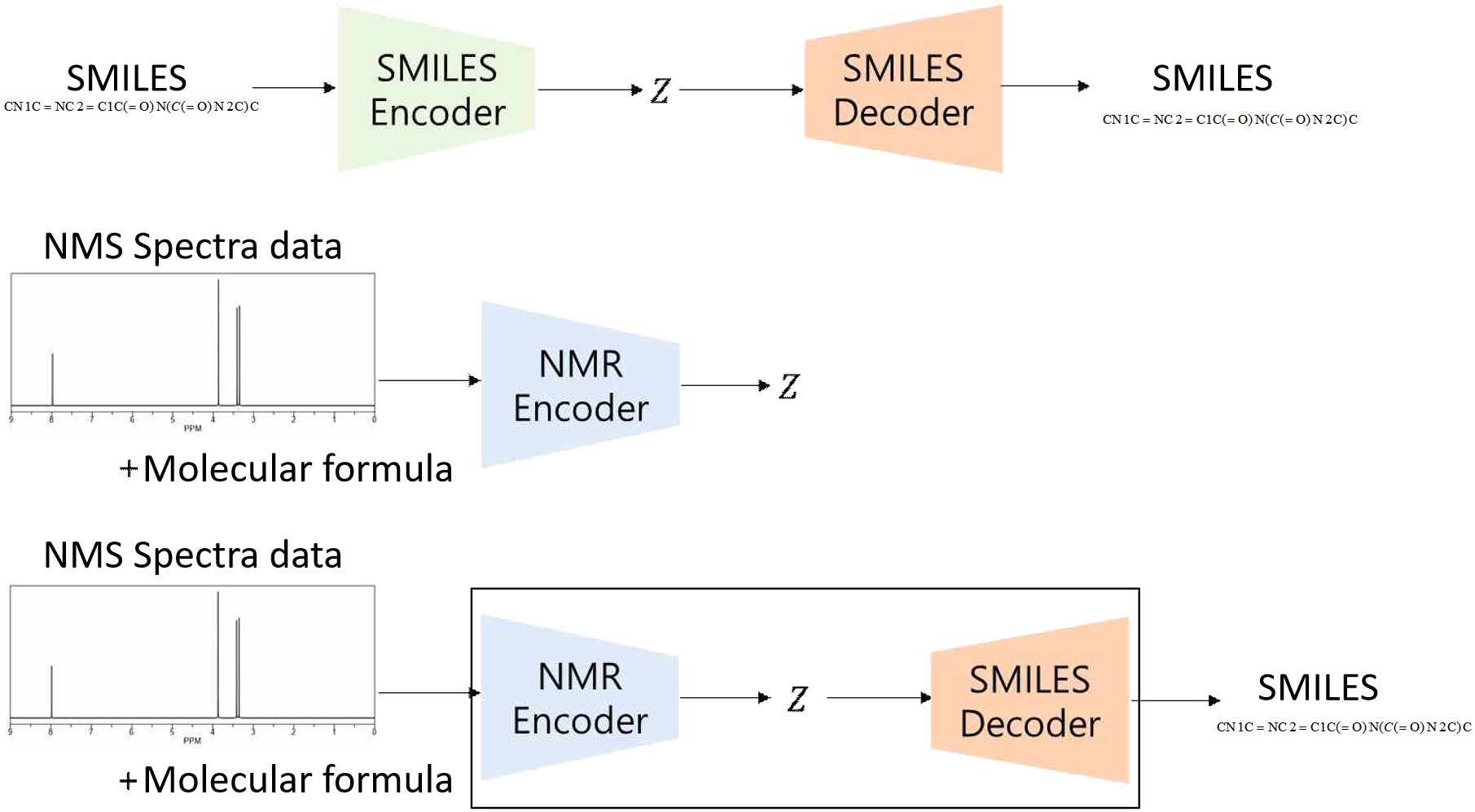
Interpreting NMR spectra to accurately predict molecular structures remains a significant challenge in chemistry due to the complexity of spectral data and the need for precise structural elucidation. This study introduces NMRGen, a generative modeling framework that predicts molecular structures from NMR spectra and molecular formulas. The framework combines a SMILES autoencoder (GRU-based encoder-decoder) and an NMR encoder (CNN and DNN layers) to map spectral data to molecular representations. The SMILES autoencoder compresses and reconstructs SMILES strings, while the NMR encoder processes NMR spectra to generate latent vectors aligned with those from the SMILES encoder. Experiments were conducted using NMR spectra and SMILES datasets. The model was trained in three stages: (1) training the SMILES autoencoder, (2) aligning latent vectors from the NMR encoder, and (3) simultaneous training of both components. Results revealed that while the SMILES autoencoder performed adequately, the NMR encoder struggled to map spectral data effectively. Most generated SMILES strings were invalid, with valid ones primarily consisting of carbon chains (e.g., CCC...C). The Tanimoto coefficient between generated and target molecules ranged from 0.1 to 0.2, indicating low similarity. Despite these limitations, NMRGen demonstrates the potential of generative models for molecular structure prediction. Future work will focus on improving performance through larger datasets, advanced loss functions, and enhanced architectures.
Graphical Abstract
Keywords
Data Availability Statement
Funding
Conflicts of Interest
Ethical Approval and Consent to Participate
References
- Weininger, D. (1988). SMILES, a chemical language and information system. 1. Introduction to methodology and encoding rules. Journal of chemical information and computer sciences, 28(1), 31-36.
[CrossRef] [Google Scholar] - Cereto-Massagué, A., Ojeda, M. J., Valls, C., Mulero, M., Garcia-Vallvé, S., & Pujadas, G. (2015). Molecular fingerprint similarity search in virtual screening. Methods, 71, 58-63.
[CrossRef] [Google Scholar] - Yao, L., Yang, M., Song, J., Yang, Z., Sun, H., Shi, H., ... & Wang, X. (2023). Conditional molecular generation net enables automated structure elucidation based on 13C NMR spectra and prior knowledge. Analytical chemistry, 95(12), 5393-5401.
[CrossRef] [Google Scholar] - Gao, P., Zhang, J., Peng, Q., Zhang, J., & Glezakou, V. A. (2020). A general protocol for the accurate prediction of molecular 13C/1H NMR chemical shifts via machine learning augmented DFT. Journal of Chemical Information and Modeling, 60(8), 3746-3754.
[CrossRef] [Google Scholar] - Bajusz, D., Rácz, A., & Héberger, K. (2015). Why is the Tanimoto index an appropriate choice for fingerprint-based similarity calculations? Journal of cheminformatics, 7, 1-13.
[CrossRef] [Google Scholar] - Segler, M. H., Kogej, T., Tyrchan, C., & Waller, M. P. (2018). Generating focused molecule libraries for drug discovery with recurrent neural networks. ACS central science, 4(1), 120-131.
[CrossRef] [Google Scholar] - Xue, X., Sun, H., Yang, M., Liu, X., Hu, H. Y., Deng, Y., & Wang, X. (2023). Advances in the Application of Artificial Intelligence-Based Spectral Data Interpretation: A Perspective. Analytical Chemistry, 95(37), 13733-13745.
[CrossRef] [Google Scholar] - Sherstinsky, A. (2020). Fundamentals of recurrent neural network (RNN) and long short-term memory (LSTM) network. Physica D: Nonlinear Phenomena, 404, 132306.
[CrossRef] [Google Scholar] - Chung, J., Gulcehre, C., Cho, K., & Bengio, Y. (2014). Empirical evaluation of gated recurrent neural networks on sequence modeling. arXiv preprint arXiv:1412.3555.
[CrossRef] [Google Scholar] - Albawi, S., Mohammed, T. A., & Al-Zawi, S. (2017). Understanding of a convolutional neural network. 2017 International Conference on Engineering and Technology (ICET), Antalya, Turkey, 1-6.
[CrossRef] [Google Scholar] - Smith, S. G., & Goodman, J. M. (2010). Assigning stereochemistry to single diastereoisomers by GIAO NMR calculation: The DP4 probability. Journal of the American Chemical Society, 132(37), 12946-12959.
[CrossRef] [Google Scholar] - Zimmerman, D. E., Kulikowski, C. A., Huang, Y., Feng, W., Tashiro, M., Shimotakahara, S., ... & Montelione, G. T. (1997). Automated analysis of protein NMR assignments using methods from artificial intelligence. Journal of molecular biology, 269(4), 592-610.
[CrossRef] [Google Scholar] - Sridharan, B., Mehta, S., Pathak, Y., & Priyakumar, U. D. (2022). Deep reinforcement learning for molecular inverse problem of nuclear magnetic resonance spectra to molecular structure. The Journal of Physical Chemistry Letters, 13(22), 4924-4933.
[CrossRef] [Google Scholar] - Zhang, C., Idelbayev, Y., Roberts, N., Tao, Y., Nannapaneni, Y., Duggan, B. M., ... & Gerwick, W. H. (2017). Small molecule accurate recognition technology (SMART) to enhance natural products research. Scientific reports, 7(1), 14243.
[CrossRef] [Google Scholar] - Bruguière, A., Derbré, S., Dietsch, J., Leguy, J., Rahier, V., Pottier, Q., ... & Richomme, P. (2020). MixONat, a software for the dereplication of mixtures based on 13C NMR spectroscopy. Analytical Chemistry, 92(13), 8793-8801.
[CrossRef] [Google Scholar] - Meiler, J., & Will, M. (2002). Genius: a genetic algorithm for automated structure elucidation from 13C NMR spectra. Journal of the American Chemical Society, 124(9), 1868-1870.
[CrossRef] [Google Scholar] - Zhang, J., Terayama, K., Sumita, M., Yoshizoe, K., Ito, K., Kikuchi, J., & Tsuda, K. (2020). NMR-TS: de novo molecule identification from NMR spectra. Science and technology of advanced materials, 21(1), 552-561.
[CrossRef] [Google Scholar] - Castillo, A. M., Patiny, L., & Wist, J. (2011). Fast and accurate algorithm for the simulation of NMR spectra of large spin systems. Journal of Magnetic Resonance, 209(2), 123-130.
[CrossRef] [Google Scholar] - Litsa, E., Chenthamarakshan, V., Das, P., & Kavraki, L. (2021). Spec2Mol: An end-to-end deep learning framework for translating MS/MS Spectra to de-novo molecules.
[CrossRef] [Google Scholar] - Gómez-Bombarelli, R., Wei, J. N., Duvenaud, D., Hernández-Lobato, J. M., Sánchez-Lengeling, B., Sheberla, D., ... & Aspuru-Guzik, A. (2018). Automatic chemical design using a data-driven continuous representation of molecules. ACS central science, 4(2), 268-276.
[CrossRef] [Google Scholar] - Wishart, D. S., Sayeeda, Z., Budinski, Z., Guo, A., Lee, B. L., Berjanskii, M., ... & Cort, J. R. (2022). NP-MRD: the natural products magnetic resonance database. Nucleic Acids Research, 50(D1), D665-D677.
[CrossRef] [Google Scholar] - Alberts, M., Zipoli, F., & Vaucher, A. C. (2023). Learning the Language of NMR: Structure Elucidation from NMR spectra using Transformer Models.
[CrossRef] [Google Scholar] - Huang, Z., Chen, M. S., Woroch, C. P., Markland, T. E., & Kanan, M. W. (2021). A framework for automated structure elucidation from routine NMR spectra. Chemical Science, 12(46), 15329-15338.
[CrossRef] [Google Scholar]
Cited By (3)
-
Mukesh Kumar, Sangeeta Davi, Ashvin Kumar, Zainab Muhammad Hanif, F. N. U. Ghansham, Chandni Bai, Sagar Kumar, Jugdesh Kumar, Manesh Kumar, Mohsin Zaheer, F. N. U. Venjhraj, Amogh Verma. A Cross‐Sectional Study on the Role of Biochemical Markers in Cardiovascular Disease Risk Assessment: Comparison of Urban and Rural Populations in Pakistan.
Health Science Reports, 2026 , 9 (4).
[CrossRef] -
Jianliang Gong, Han Zhou, Shicheng Yu, Yiwang Chen. Cognitive AI beyond prediction: toward reasoning and discovery.
Materials Horizons, 2026 , 13 (9).
[CrossRef] -
Tingcai Dong, Chuanling Deng, Liqiu Tai, Meng Zhang, Yongfan Zi, Li Zhu, Fengmei Zhang, Le Cai. Small-Molecule 1H and 13C NMR:
From Chemical-Shift Prediction to Automated Structure Elucidation.
Journal of Chemical Information
and Modeling, 2026 , 66 (21).
[CrossRef]
Cite This Article
TY  - JOUR
AU  - Vavekanand, Raja
PY  - 2025
DA  - 2025/02/26
TI  - NMRGen: A Generative Modeling Framework for Molecular Structure Prediction from NMR Spectra
JO  - ICCK Transactions on Emerging Topics in Artificial Intelligence
T2  - ICCK Transactions on Emerging Topics in Artificial Intelligence
JF  - ICCK Transactions on Emerging Topics in Artificial Intelligence
VL  - 2
IS  - 1
SP  - 16
EP  - 25
DO  - 10.62762/TETAI.2024.277656
UR  - https://www.icck.org/article/abs/tetai.2024.277656
KW  - generative modeling
KW  - molecular structure
KW  - NMR
KW  - AI in chemistry.
AB  - Interpreting NMR spectra to accurately predict molecular structures remains a significant challenge in chemistry due to the complexity of spectral data and the need for precise structural elucidation. This study introduces NMRGen, a generative modeling framework that predicts molecular structures from NMR spectra and molecular formulas. The framework combines a SMILES autoencoder (GRU-based encoder-decoder) and an NMR encoder (CNN and DNN layers) to map spectral data to molecular representations. The SMILES autoencoder compresses and reconstructs SMILES strings, while the NMR encoder processes NMR spectra to generate latent vectors aligned with those from the SMILES encoder. Experiments were conducted using NMR spectra and SMILES datasets. The model was trained in three stages: (1) training the SMILES autoencoder, (2) aligning latent vectors from the NMR encoder, and (3) simultaneous training of both components. Results revealed that while the SMILES autoencoder performed adequately, the NMR encoder struggled to map spectral data effectively. Most generated SMILES strings were invalid, with valid ones primarily consisting of carbon chains (e.g., CCC...C). The Tanimoto coefficient between generated and target molecules ranged from 0.1 to 0.2, indicating low similarity. Despite these limitations, NMRGen demonstrates the potential of generative models for molecular structure prediction. Future work will focus on improving performance through larger datasets, advanced loss functions, and enhanced architectures.
SN  - 3068-6652
PB  - Institute of Central Computation and Knowledge
LA  - English
ER  -
@article{Vavekanand2025NMRGen,
  author = {Raja Vavekanand},
  title = {NMRGen: A Generative Modeling Framework for Molecular Structure Prediction from NMR Spectra},
  journal = {ICCK Transactions on Emerging Topics in Artificial Intelligence},
  year = {2025},
  volume = {2},
  number = {1},
  pages = {16-25},
  doi = {10.62762/TETAI.2024.277656},
  url = {https://www.icck.org/article/abs/tetai.2024.277656},
  abstract = {Interpreting NMR spectra to accurately predict molecular structures remains a significant challenge in chemistry due to the complexity of spectral data and the need for precise structural elucidation. This study introduces NMRGen, a generative modeling framework that predicts molecular structures from NMR spectra and molecular formulas. The framework combines a SMILES autoencoder (GRU-based encoder-decoder) and an NMR encoder (CNN and DNN layers) to map spectral data to molecular representations. The SMILES autoencoder compresses and reconstructs SMILES strings, while the NMR encoder processes NMR spectra to generate latent vectors aligned with those from the SMILES encoder. Experiments were conducted using NMR spectra and SMILES datasets. The model was trained in three stages: (1) training the SMILES autoencoder, (2) aligning latent vectors from the NMR encoder, and (3) simultaneous training of both components. Results revealed that while the SMILES autoencoder performed adequately, the NMR encoder struggled to map spectral data effectively. Most generated SMILES strings were invalid, with valid ones primarily consisting of carbon chains (e.g., CCC...C). The Tanimoto coefficient between generated and target molecules ranged from 0.1 to 0.2, indicating low similarity. Despite these limitations, NMRGen demonstrates the potential of generative models for molecular structure prediction. Future work will focus on improving performance through larger datasets, advanced loss functions, and enhanced architectures.},
  keywords = {generative modeling, molecular structure, NMR, AI in chemistry.},
  issn = {3068-6652},
  publisher = {Institute of Central Computation and Knowledge}
}
Publisher's Note
ICCK stays neutral with regard to jurisdictional claims in published maps and institutional affiliations.
Rights and Permissions
 Copyright © 2025 by the Author(s). Published by Institute of Central Computation and Knowledge. This article is an open access article distributed under the terms and conditions of the Creative Commons Attribution (CC BY) license (https://creativecommons.org/licenses/by/4.0/), which permits use, sharing, adaptation, distribution and reproduction in any medium or format, as long as you give appropriate credit to the original author(s) and the source, provide a link to the Creative Commons licence, and indicate if changes were made.


Portico
