

LoGA: Loop-Carried Graph Attention Based Looped Vision Transformers for Fine-Grained Plant Disease Classification




Article Information
Abstract
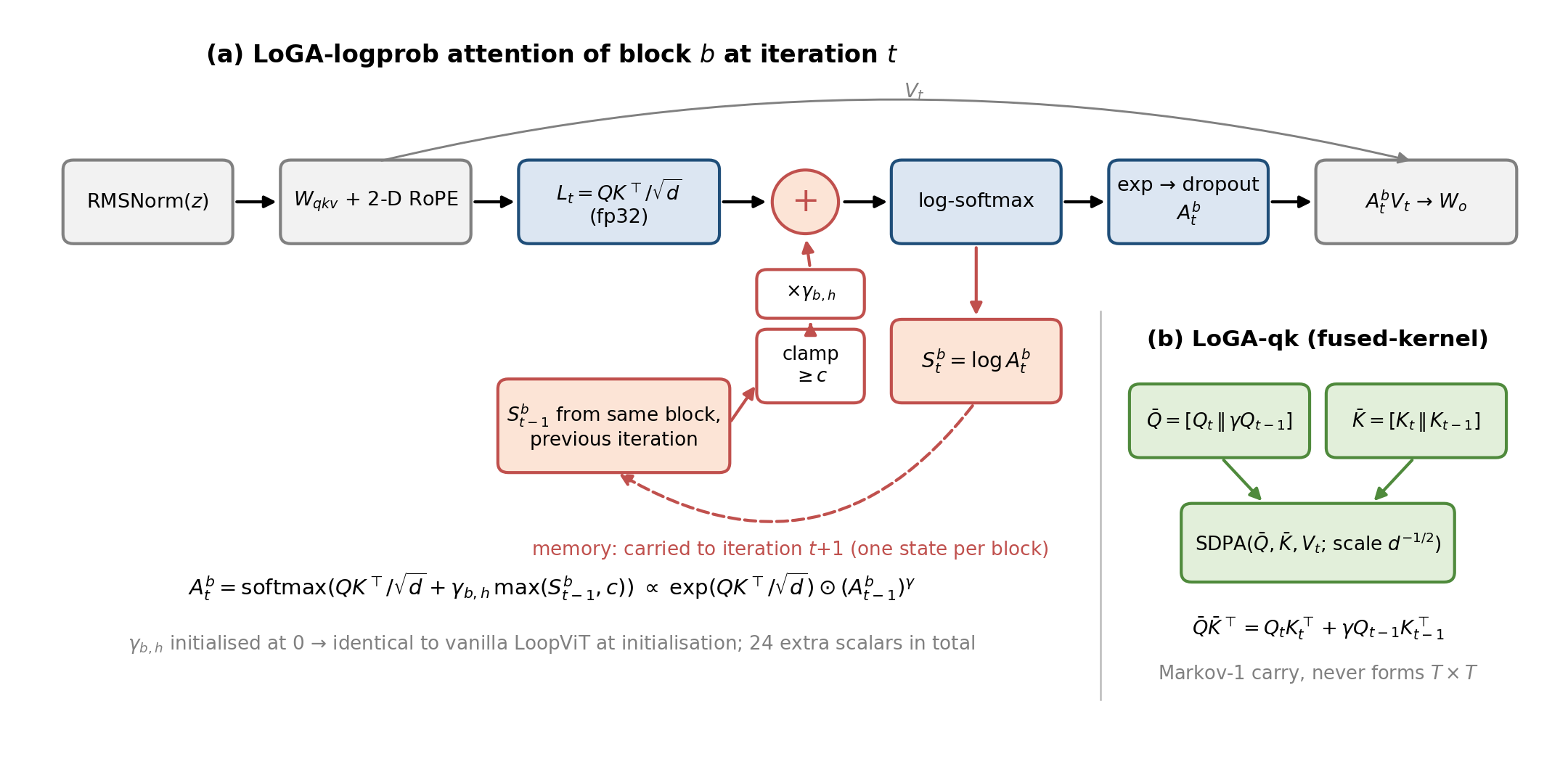
Fine-grained plant disease classification requires separating classes of the same crop that often differ only in small, sparse lesion patterns. Looped Vision Transformers (LoopViTs) obtain depth by applying a small stack of weight-tied blocks repeatedly, yet each block rebuilds its attention graph from scratch at every iteration, although the same block has just computed a graph over the same tokens. We propose LoGA, a looped vision transformer with Loop-Carried Graph Attention, in which the attention graph of each block at iteration $t$ is biased by the graph the same block produced at iteration $t-1$, used as a tempered prior. In its log-prob form the update $A_t \propto \exp(QK^\top/\sqrt{d})\odot A_{t-1}^{\gamma}$ is, when the floor is inactive, equivalent to attending with a geometrically discounted sum of past query-key logits; a flash-compatible qk variant carries one step of raw logits. LoGA adds 24 scalars to a 9.91\,M-parameter model and reduces exactly to vanilla LoopViT at initialisation. We also study a parameter-free graph-stability signal $\Delta_t$ and show that, under label smoothing, predictive entropy stays near 0.671 nats, so a common entropy-exit threshold is never reached. Trained from scratch, LoGA-logprob reaches 99.78%, 94.2%, 98.6% and 99.53% top-1 accuracy on the held-out splits of PlantVillage, PlantDoc, Cassava and Plant Pathology 2020, versus 98.11%, 88.3%, 84.4% and 91.7% for vanilla LoopViT. On PlantVillage, the CLS-attention graph contracts across iterations and accuracy is maintained at twice the training depth. We regard these results as encouraging first evidence and discuss their limitations.
Graphical Abstract
Keywords
Data Availability Statement
Funding
Conflicts of Interest
AI Use Statement
Ethical Approval and Consent to Participate
References
- Strange, R. N., & Scott, P. R. (2005). Plant disease: A threat to global food security. Annual Review of Phytopathology, 43(1), 83-116.
[CrossRef] [Google Scholar] - Dosovitskiy, A. (2020). An image is worth 16x16 words: Transformers for image recognition at scale. arXiv preprint arXiv:2010.11929.
[CrossRef] [Google Scholar] - Touvron, H., Cord, M., Douze, M., Massa, F., Sablayrolles, A., & Jégou, H. (2021, July). Training data-efficient image transformers & distillation through attention. In International conference on machine learning (pp. 10347-10357). PMLR. https://proceedings.mlr.press/v139/touvron21a.html
[Google Scholar] - Mohanty, S. P., Hughes, D. P., & Salathé, M. (2016). Using deep learning for image-based plant disease detection. Frontiers in plant science, 7, 1419.
[CrossRef] [Google Scholar] - Singh, D., Jain, N., Jain, P., Kayal, P., Kumawat, S., & Batra, N. (2020). PlantDoc: A dataset for visual plant disease detection. In Proceedings of the 7th ACM IKDD CoDS and 25th COMAD (pp. 249-253).
[CrossRef] [Google Scholar] - Dehghani, M., Gouws, S., Vinyals, O., Uszkoreit, J., & Kaiser, Ł. (2018). Universal transformers. arXiv preprint arXiv:1807.03819.
[CrossRef] [Google Scholar] - Giannou, A., Rajput, S., Sohn, J. Y., Lee, K., Lee, J. D., & Papailiopoulos, D. (2023, July). Looped transformers as programmable computers. In International Conference on Machine Learning (pp. 11398-11442). PMLR. https://proceedings.mlr.press/v202/giannou23a.html
[Google Scholar] - Yang, L., Lee, K., Nowak, R., & Papailiopoulos, D. (2024, May). Looped transformers are better at learning learning algorithms. In International conference on learning representations (Vol. 2024, pp. 42195-42214).
[Google Scholar] - Shu, W. J., Qiu, X., Zhu, R. J., Chen, H. H., Liu, Y., & Yang, H. (2026). Loopvit: Scaling visual arc with looped transformers. arXiv preprint arXiv:2602.02156.
[CrossRef] [Google Scholar] - He, R., Ravula, A., Kanagal, B., & Ainslie, J. (2021, August). Realformer: Transformer likes residual attention. In Findings of the association for computational linguistics: ACL-IJCNLP 2021 (pp. 929-943).
[CrossRef] [Google Scholar] - Wang, Y., Yang, Y., Bai, J., Zhang, M., Bai, J., Yu, J., ... & Tong, Y. (2021, July). Evolving attention with residual convolutions. In International Conference on Machine Learning (pp. 10971-10980). PMLR. https://proceedings.mlr.press/v139/wang21ab.html
[Google Scholar] - Xiao, T., Li, Y., Zhu, J., Yu, Z., & Liu, T. (2019). Sharing attention weights for fast transformer. In Proceedings of the 28th International Joint Conference on Artificial Intelligence (IJCAI) (pp. 5292-5298).
[CrossRef] [Google Scholar] - Venkataramanan, S., Ghodrati, A., Asano, Y., Porikli, F., & Habibian, A. (2024, May). Skip-attention: Improving vision transformers by paying less attention. In International Conference on Learning Representations (Vol. 2024, pp. 29654-29672).
[Google Scholar] - Liu, Z., Lin, Y., Cao, Y., Hu, H., Wei, Y., Zhang, Z., ... & Guo, B. (2021, October). Swin transformer: Hierarchical vision transformer using shifted windows. In 2021 IEEE/CVF international conference on computer vision (ICCV) (pp. 9992-10002). IEEE.
[CrossRef] [Google Scholar] - Shen, Z., Liu, Z., & Xing, E. (2022, October). Sliced recursive transformer. In European Conference on Computer Vision (pp. 727-744). Cham: Springer Nature Switzerland.
[CrossRef] [Google Scholar] - Zhang, J., Peng, H., Wu, K., Liu, M., Xiao, B., Fu, J., & Yuan, L. (2022, June). MiniViT: Compressing vision transformers with weight multiplexing. In 2022 IEEE/CVF Conference on Computer Vision and Pattern Recognition (CVPR) (pp. 12135-12144). IEEE.
[CrossRef] [Google Scholar] - Bai, S., Kolter, J. Z., & Koltun, V. (2019). Deep equilibrium models. In Advances in Neural Information Processing Systems, 32 (NeurIPS).
[Google Scholar] - Dong, Y., Cordonnier, J. B., & Loukas, A. (2021, July). Attention is not all you need: Pure attention loses rank doubly exponentially with depth. In International conference on machine learning (pp. 2793-2803). PMLR. https://proceedings.mlr.press/v139/dong21a.html
[Google Scholar] - Wang, P., Zheng, W., Chen, T., & Wang, Z. (2022). Anti-oversmoothing in deep vision transformers via the fourier domain analysis: From theory to practice. arXiv preprint arXiv:2203.05962.
[CrossRef] [Google Scholar] - Teerapittayanon, S., McDanel, B., & Kung, H. T. (2016, December). Branchynet: Fast inference via early exiting from deep neural networks. In 2016 23rd international conference on pattern recognition (ICPR) (pp. 2464-2469). IEEE.
[CrossRef] [Google Scholar] - Bakhtiarnia, A., Zhang, Q., & Iosifidis, A. (2022). Single-layer vision transformers for more accurate early exits with less overhead. Neural Networks, 153, 461-473.
[CrossRef] [Google Scholar] - Banino, A., Balaguer, J., & Blundell, C. (2021). Pondernet: Learning to ponder. arXiv preprint arXiv:2107.05407.
[CrossRef] [Google Scholar] - Yin, H., Vahdat, A., Alvarez, J. M., Mallya, A., Kautz, J., & Molchanov, P. (2022, June). A-vit: Adaptive tokens for efficient vision transformer. In 2022 IEEE/CVF Conference on Computer Vision and Pattern Recognition (CVPR) (pp. 10799-10808). IEEE.
[CrossRef] [Google Scholar] - Szegedy, C., Vanhoucke, V., Ioffe, S., Shlens, J., & Wojna, Z. (2016). Rethinking the inception architecture for computer vision. In Proceedings of the IEEE conference on computer vision and pattern recognition (pp. 2818-2826).
[CrossRef] [Google Scholar] - Hughes, D., & Salathé, M. (2015). An open access repository of images on plant health to enable the development of mobile disease diagnostics. arXiv preprint arXiv:1511.08060.
[CrossRef] [Google Scholar] - Salman, Z., Muhammad, A., & Han, D. (2025). Plant disease classification in the wild using vision transformers and mixture of experts. Frontiers in Plant Science, 16, 1522985.
[CrossRef] [Google Scholar] - Mwebaze, E., Gebru, T., Frome, A., Nsumba, S., & Tusubira, J. (2019). iCassava 2019 fine-grained visual categorization challenge. arXiv preprint arXiv:1908.02900.
[CrossRef] [Google Scholar] - Makerere University AI Lab. (2020). Cassava leaf disease classification [Data set]. Kaggle. Retrieved from https://www.kaggle.com/competitions/cassava-leaf-disease-classification
[Google Scholar] - Thapa, R., Zhang, K., Snavely, N., Belongie, S., & Khan, A. (2020). The Plant Pathology Challenge 2020 data set to classify foliar disease of apples. Applications in plant sciences, 8(9), e11390.
[CrossRef] [Google Scholar] - Borhani, Y., Khoramdel, J., & Najafi, E. (2022). A deep learning based approach for automated plant disease classification using vision transformer. Scientific Reports, 12(1), 11554.
[CrossRef] [Google Scholar] - Barman, U., Sarma, P., Rahman, M., Deka, V., Lahkar, S., Sharma, V., & Saikia, M. J. (2024). ViT-SmartAgri: Vision transformer and smartphone-based plant disease detection for smart agriculture. Agronomy, 14(2), 327.
[CrossRef] [Google Scholar] - Li, G., Wang, Y., Zhao, Q., Yuan, P., & Chang, B. (2023). PMVT: a lightweight vision transformer for plant disease identification on mobile devices. Frontiers in Plant Science, 14, 1256773.
[CrossRef] [Google Scholar] - Zhang, S., & Liu, R. (2026). Multi-scale feature fusion-based vision mamba for robust plant disease image classification on field-acquired plantdoc data. Frontiers in Plant Science, 17, 1842426.
[CrossRef] [Google Scholar] - Jain, A. K., & Nain, N. (2026). Detection and classification of cassava diseases using concatenate model. In Real-World Applications of Machine Learning (pp. 355-365). Singapore: Springer Nature Singapore.
[CrossRef] [Google Scholar] - Saood, S., Khan, S. H., & Iqbal, R. (2026). A customized Swin Transformer-based framework for cassava leaf disease classification. Spectrum of Engineering Sciences, 4(2), 37-48. https://thesesjournal.com/index.php/1/article/view/1950
[Google Scholar] - Kaur, K., & Kaur, H. (2026). PomaNet: An Optimized CNN Framework for Apple Leaf Disease Detection Using Advanced Image Processing. Applied Fruit Science, 68(3), 158.
[CrossRef] [Google Scholar] - Lee, S. H., Lee, S., & Song, B. C. (2021). Vision transformer for small-size datasets. arXiv preprint arXiv:2112.13492.
[CrossRef] [Google Scholar] - Steiner, A., Kolesnikov, A., Zhai, X., Wightman, R., Uszkoreit, J., & Beyer, L. (2021). How to train your vit? data, augmentation, and regularization in vision transformers. arXiv preprint arXiv:2106.10270.
[CrossRef] [Google Scholar] - Divakar, S., & Priyadarshini, R. (2024, December). Recursive Additive Attention Based Convolutional Neural Network Model for Plant Disease Detection. In 2024 IEEE 21st India Council International Conference (INDICON) (pp. 01-06). IEEE.
[CrossRef] [Google Scholar] - Divakar, S., Bhattacharjee, A., & Priyadarshini, R. (2021, April). Smote-DL: a deep learning based plant disease detection method. In 2021 6th international conference for convergence in technology (i2ct) (pp. 1-6). IEEE.
[CrossRef] [Google Scholar] - Huang, G., Sun, Y., Liu, Z., Sedra, D., & Weinberger, K. Q. (2016, September). Deep networks with stochastic depth. In European conference on computer vision (pp. 646-661). Cham: Springer International Publishing.
[CrossRef] [Google Scholar] - Shazeer, N. (2020). Glu variants improve transformer. arXiv preprint arXiv:2002.05202.
[CrossRef] [Google Scholar] - Su, J., Ahmed, M., Lu, Y., Pan, S., Bo, W., & Liu, Y. (2024). Roformer: Enhanced transformer with rotary position embedding. Neurocomputing, 568, 127063.
[CrossRef] [Google Scholar] - Heo, B., Park, S., Han, D., & Yun, S. (2024, September). Rotary position embedding for vision transformer. In European Conference on Computer Vision (pp. 289-305). Cham: Springer Nature Switzerland.
[CrossRef] [Google Scholar] - Roy, O., & Vetterli, M. (2007, September). The effective rank: A measure of effective dimensionality. In 2007 15th European signal processing conference (pp. 606-610). IEEE. https://ieeexplore.ieee.org/abstract/document/7098875
[Google Scholar] - He, K., Zhang, X., Ren, S., & Sun, J. (2016). Deep residual learning for image recognition. In Proceedings of the IEEE conference on computer vision and pattern recognition (pp. 770-778).
[CrossRef] [Google Scholar] - Loshchilov, I., & Hutter, F. (2017). Decoupled weight decay regularization. arXiv preprint arXiv:1711.05101.
[CrossRef] [Google Scholar] - Loshchilov, I., & Hutter, F. (2016). Sgdr: Stochastic gradient descent with warm restarts. arXiv preprint arXiv:1608.03983.
[CrossRef] [Google Scholar] - Selvaraju, R. R., Cogswell, M., Das, A., Vedantam, R., Parikh, D., & Batra, D. (2017). Grad-cam: Visual explanations from deep networks via gradient-based localization. In Proceedings of the IEEE international conference on computer vision (pp. 618-626).
[CrossRef] [Google Scholar]
Cite This Article
TY  - JOUR
AU  - Divakar, Subham
AU  - Priyadarshini, Rojalina
PY  - 2026
DA  - 2026/10/29
TI  - LoGA: Loop-Carried Graph Attention Based Looped Vision Transformers for Fine-Grained Plant Disease Classification
JO  - ICCK Transactions on Emerging Topics in Artificial Intelligence
T2  - ICCK Transactions on Emerging Topics in Artificial Intelligence
JF  - ICCK Transactions on Emerging Topics in Artificial Intelligence
VL  - 3
IS  - 4
SP  - 218
EP  - 238
DO  - 10.62762/TETAI.2026.672726
UR  - https://www.icck.org/article/abs/TETAI.2026.672726
KW  - Fine-grained plant disease classification
KW  - looped transformers
KW  - vision transformer
KW  - attention graph
KW  - weight tying
KW  - recurrent depth
KW  - dynamic exit
AB  - Fine-grained plant disease classification requires separating classes of the same crop that often differ only in small, sparse lesion patterns. Looped Vision Transformers (LoopViTs) obtain depth by applying a small stack of weight-tied blocks repeatedly, yet each block rebuilds its attention graph from scratch at every iteration, although the same block has just computed a graph over the same tokens. We propose LoGA, a looped vision transformer with Loop-Carried Graph Attention, in which the attention graph of each block at iteration $t$ is biased by the graph the same block produced at iteration $t-1$, used as a tempered prior. In its log-prob form the update $A_t \propto \exp(QK^\top/\sqrt{d})\odot A_{t-1}^{\gamma}$ is, when the floor is inactive, equivalent to attending with a geometrically discounted sum of past query-key logits; a flash-compatible qk variant carries one step of raw logits. LoGA adds 24 scalars to a 9.91\,M-parameter model and reduces exactly to vanilla LoopViT at initialisation. We also study a parameter-free graph-stability signal $\Delta_t$ and show that, under label smoothing, predictive entropy stays near 0.671 nats, so a common entropy-exit threshold is never reached. Trained from scratch, LoGA-logprob reaches 99.78%, 94.2%, 98.6% and 99.53% top-1 accuracy on the held-out splits of PlantVillage, PlantDoc, Cassava and Plant Pathology 2020, versus 98.11%, 88.3%, 84.4% and 91.7% for vanilla LoopViT. On PlantVillage, the CLS-attention graph contracts across iterations and accuracy is maintained at twice the training depth. We regard these results as encouraging first evidence and discuss their limitations.
SN  - 3068-6652
PB  - Institute of Central Computation and Knowledge
LA  - English
ER  -
@article{Divakar2026LoGA,
  author = {Subham Divakar and Rojalina Priyadarshini},
  title = {LoGA: Loop-Carried Graph Attention Based Looped Vision Transformers for Fine-Grained Plant Disease Classification},
  journal = {ICCK Transactions on Emerging Topics in Artificial Intelligence},
  year = {2026},
  volume = {3},
  number = {4},
  pages = {218-238},
  doi = {10.62762/TETAI.2026.672726},
  url = {https://www.icck.org/article/abs/TETAI.2026.672726},
  abstract = {Fine-grained plant disease classification requires separating classes of the same crop that often differ only in small, sparse lesion patterns. Looped Vision Transformers (LoopViTs) obtain depth by applying a small stack of weight-tied blocks repeatedly, yet each block rebuilds its attention graph from scratch at every iteration, although the same block has just computed a graph over the same tokens. We propose LoGA, a looped vision transformer with Loop-Carried Graph Attention, in which the attention graph of each block at iteration \$t\$ is biased by the graph the same block produced at iteration \$t-1\$, used as a tempered prior. In its log-prob form the update \$A\_t \propto \exp(QK^\top/\sqrt{d})\odot A\_{t-1}^{\gamma}\$ is, when the floor is inactive, equivalent to attending with a geometrically discounted sum of past query-key logits; a flash-compatible qk variant carries one step of raw logits. LoGA adds 24 scalars to a 9.91\,M-parameter model and reduces exactly to vanilla LoopViT at initialisation. We also study a parameter-free graph-stability signal \$\Delta\_t\$ and show that, under label smoothing, predictive entropy stays near 0.671 nats, so a common entropy-exit threshold is never reached. Trained from scratch, LoGA-logprob reaches 99.78\%, 94.2\%, 98.6\% and 99.53\% top-1 accuracy on the held-out splits of PlantVillage, PlantDoc, Cassava and Plant Pathology 2020, versus 98.11\%, 88.3\%, 84.4\% and 91.7\% for vanilla LoopViT. On PlantVillage, the CLS-attention graph contracts across iterations and accuracy is maintained at twice the training depth. We regard these results as encouraging first evidence and discuss their limitations.},
  keywords = {Fine-grained plant disease classification, looped transformers, vision transformer, attention graph, weight tying, recurrent depth, dynamic exit},
  issn = {3068-6652},
  publisher = {Institute of Central Computation and Knowledge}
}
Article Metrics
Publisher's Note
ICCK stays neutral with regard to jurisdictional claims in published maps and institutional affiliations.
Rights and Permissions
 Copyright © 2026 by the Author(s). Published by Institute of Central Computation and Knowledge. This article is an open access article distributed under the terms and conditions of the Creative Commons Attribution (CC BY) license (https://creativecommons.org/licenses/by/4.0/), which permits use, sharing, adaptation, distribution and reproduction in any medium or format, as long as you give appropriate credit to the original author(s) and the source, provide a link to the Creative Commons licence, and indicate if changes were made.


Portico
