

AgriEvoKG: Empirical Failure Modes and Remedies in LLM-Based Cross-Media Agricultural Knowledge Graph Construction




Article Information
Abstract
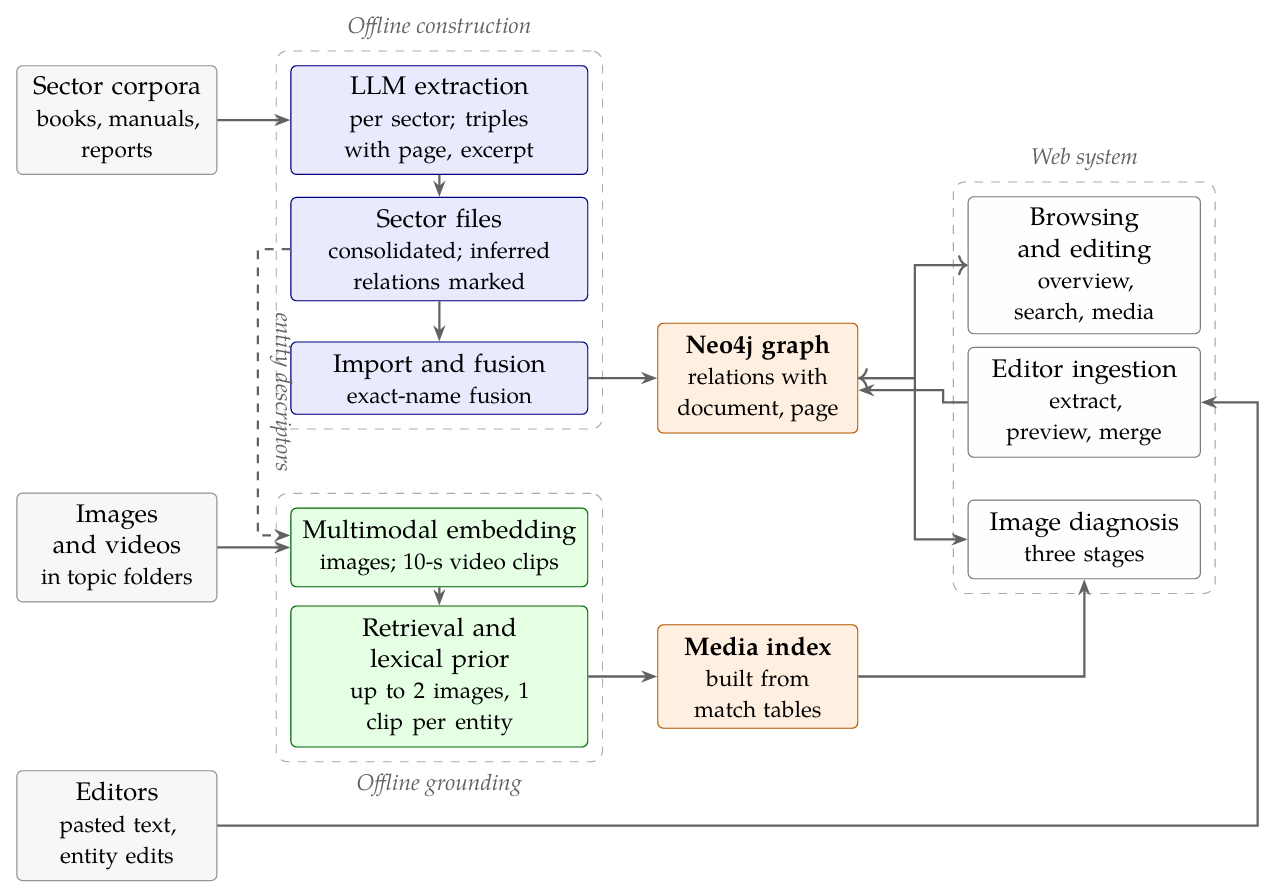
Large language models (LLMs) make it possible to build knowledge graphs from professional literature at scale, but how such graphs fail at that scale is rarely measured. We built \sys{}, a cross-media knowledge graph of swine, aquaculture, tomato, maize and rice production, and analysed its 199,418 entities and 277,053 relations together with the web system that serves it. An LLM extracted typed triples from the professional literature of each sector; 74.9% of the relations carry an evidence record of document, page and excerpt, and a multimodal embedding model links 25,158 entities to images and 14,132 to video clips. We identified five failure modes of construction. First, the sector schemas diverged: the two sectors with free relation labels hold 23,727 and 19,139 distinct labels. Second, in three sectors most numeric facts lost the name of the measured quantity or object, because 85.4% to 98.0% of their value triples use a generic relation. Third, evidence anchoring was asymmetric: the LLM copied 87.5% of the values verbatim from their excerpts but only 38.7% of the head entities. Fourth, exact-name fusion merged 6,805 entity names across sectors but only 7 relations, and about half of the cross-sector relations touch value-like names. Fifth, media links concentrated on hub items: 104 of 15,314 media items held 71.6% of the links. On the deployed system, 62.5% of the relations added from 50 new passages used new relation types, and in a case study on 100 photographs graph context confirmed the model's initial identification rather than correcting it. We organise these findings into a taxonomy that pairs each failure mode with its root cause, a remedy and a test, and argue that most of them cannot be seen in the small samples on which construction methods are usually judged.
Graphical Abstract
Keywords
Data Availability Statement
Funding
Conflicts of Interest
AI Use Statement
Ethical Approval and Consent to Participate
References
- Drury, B., Fernandes, R., Moura, M.-F., & de Andrade Lopes, A. (2019). A survey of semantic web technology for agriculture. Information Processing in Agriculture, 6(4), 487-501.
[CrossRef] [Google Scholar] - Hogan, A., Blomqvist, E., Cochez, M., d’Amato, C., Melo, G. D., Gutierrez, C., ... & Zimmermann, A. (2021). Knowledge graphs. ACM Computing Surveys (Csur), 54(4), 1-37.
[CrossRef] [Google Scholar] - Ji, S., Pan, S., Cambria, E., Marttinen, P., & Yu, P. S. (2021). A survey on knowledge graphs: Representation, acquisition, and applications. IEEE transactions on neural networks and learning systems, 33(2), 494-514.
[CrossRef] [Google Scholar] - Pan, J. Z., Razniewski, S., Kalo, J. C., Singhania, S., Chen, J., Dietze, S., ... & Graux, D. (2023). Large language models and knowledge graphs: Opportunities and challenges. Transactions on Graph Data and Knowledge, 1(1), 2:1-2:38.
[CrossRef] [Google Scholar] - Ji, Z., Lee, N., Frieske, R., Yu, T., Su, D., Xu, Y., ... & Fung, P. (2023). Survey of hallucination in natural language generation. ACM computing surveys, 55(12), 1-38.
[CrossRef] [Google Scholar] - Liu, Y., Li, H., Garcia-Duran, A., Niepert, M., Onoro-Rubio, D., & Rosenblum, D. S. (2019). MMKG: Multi-modal knowledge graphs. In The Semantic Web: ESWC 2019 (Lecture Notes in Computer Science, Vol. 11503, pp. 459-474). Springer.
[CrossRef] [Google Scholar] - Zhu, X., Li, Z., Wang, X., Jiang, X., Sun, P., Wang, X., ... & Yuan, N. J. (2024). Multi-modal knowledge graph construction and application: A survey. IEEE Transactions on Knowledge and Data Engineering, 36(2), 715-735.
[CrossRef] [Google Scholar] - Wang, M., Wang, H., Qi, G., & Zheng, Q. (2020). Richpedia: A large-scale, comprehensive multi-modal knowledge graph. Big Data Research, 22, 100159.
[CrossRef] [Google Scholar] - Alberts, H., Huang, N., Deshpande, Y., Liu, Y., Cho, K., Vania, C., & Calixto, I. (2021, November). Visualsem: a high-quality knowledge graph for vision and language. In Proceedings of the 1st workshop on multilingual representation learning (pp. 138-152).
[CrossRef] [Google Scholar] - Wang, X., Meng, B., Chen, H., Meng, Y., Lv, K., & Zhu, W. (2023). TIVA-KG: A multimodal knowledge graph with text, image, video and audio. In Proceedings of the 31st ACM International Conference on Multimedia (pp. 2391-2399).
[CrossRef] [Google Scholar] - Liu, J., Meng, S., Gao, Y., Mao, S., Cai, P., Yan, G., ... & Shi, B. (2025, October). Aligning vision to language: Annotation-free multimodal knowledge graph construction for enhanced llms reasoning. In 2025 IEEE/CVF International Conference on Computer Vision (ICCV) (pp. 981-992). IEEE.
[CrossRef] [Google Scholar] - Wan, X., & Yu, H. (2025). Mmgraphrag: Bridging vision and language with interpretable multimodal knowledge graphs. arXiv preprint arXiv:2507.20804.
[CrossRef] [Google Scholar] - Park, H., Seo, J., Jang, M., Park, H., Baek, H. D., Chang, G., ... & Kim, S. (2025). VAT-KG: Knowledge-Intensive Multimodal Knowledge Graph Dataset for Retrieval-Augmented Generation. arXiv preprint arXiv:2506.21556.
[CrossRef] [Google Scholar] - Bu, C., Chang, G., Chen, Z., Dang, C., Wu, Z., He, Y., & Wu, X. (2025, July). Query-driven multimodal GraphRAG: Dynamic local knowledge graph construction for online reasoning. In Findings of the association for computational linguistics: ACL 2025 (pp. 21360-21380).
[CrossRef] [Google Scholar] - Caracciolo, C., Stellato, A., Morshed, A., Johannsen, G., Rajbhandari, S., Jaques, Y., & Keizer, J. (2013). The AGROVOC linked dataset. Semantic Web, 4(3), 341-348.
[CrossRef] [Google Scholar] - Chen, Y., Kuang, J., Cheng, D., Zheng, J., Gao, M., & Zhou, A. (2019, April). AgriKG: An agricultural knowledge graph and its applications. In International conference on database systems for advanced applications (pp. 533-537). Cham: Springer International Publishing.
[CrossRef] [Google Scholar] - Lim, S. C., Itharajula, M., M{\oller, M. H., Sunil, R. S., Fo, K., Chuah, Y. S., ... & Mutwil, M. (2025). PlantConnectome: A knowledge graph database encompassing $>$71,000 plant articles. The Plant Cell, 37(7), koaf169.
[CrossRef] [Google Scholar] - Edge, D., Trinh, H., Cheng, N., Bradley, J., Chao, A., Mody, A., ... & Larson, J. (2024). From local to global: A graph rag approach to query-focused summarization. arXiv preprint arXiv:2404.16130.
[CrossRef] [Google Scholar] - Guo, Z., Xia, L., Yu, Y., Ao, T., & Huang, C. (2025, November). LightRAG: Simple and Fast Retrieval-Augmented Generation. In EMNLP (Findings) (pp. 10746-10761).
[CrossRef] [Google Scholar] - Zhang, B., & Soh, H. (2024, November). Extract, define, canonicalize: An llm-based framework for knowledge graph construction. In Proceedings of the 2024 conference on empirical methods in natural language processing (pp. 9820-9836).
[CrossRef] [Google Scholar] - Lairgi, Y., Moncla, L., Cazabet, R., Benabdeslem, K., & Cléau, P. (2024, November). itext2kg: Incremental knowledge graphs construction using large language models. In International Conference on Web Information Systems Engineering (pp. 214-229). Singapore: Springer Nature Singapore.
[CrossRef] [Google Scholar] - Mo, B., Yu, K., Kazdan, J., Mpala, P., Yu, L., Kanatsoulis, C., & Koyejo, S. (2026). Kggen: Extracting knowledge graphs from plain text with language models. Advances in Neural Information Processing Systems, 38, 30092-30115.
[CrossRef] [Google Scholar] - Zhong, L., Wu, J., Li, Q., Peng, H., & Wu, X. (2023). A comprehensive survey on automatic knowledge graph construction. ACM Computing Surveys, 56(4), 1-62.
[CrossRef] [Google Scholar] - Trajanoska, M., Stojanov, R., & Trajanov, D. (2023). Enhancing knowledge graph construction using large language models. arXiv preprint arXiv:2305.04676.
[CrossRef] [Google Scholar] - Carta, S., Giuliani, A., Piano, L., Podda, A. S., Pompianu, L., & Tiddia, S. G. (2023). Iterative zero-shot llm prompting for knowledge graph construction. arXiv preprint arXiv:2307.01128.
[CrossRef] [Google Scholar] - Mihindukulasooriya, N., Tiwari, S., Enguix, C. F., & Lata, K. (2023, October). Text2kgbench: A benchmark for ontology-driven knowledge graph generation from text. In International semantic web conference (pp. 247-265). Cham: Springer Nature Switzerland.
[CrossRef] [Google Scholar] - Yao, S., Zhao, J., Yu, D., Du, N., Shafran, I., Narasimhan, K., & Cao, Y. (2022). React: Synergizing reasoning and acting in language models. arXiv preprint arXiv:2210.03629.
[CrossRef] [Google Scholar] - Luo, H., E, H., Chen, G., Lin, Q., Guo, Y., Xu, F., ... & Luu, A. T. (2026). Graph-R1: Towards agentic GraphRAG framework via end-to-end reinforcement learning. In Proceedings of the 43rd International Conference on Machine Learning (PMLR 306, pp. 82220-82240). https://proceedings.mlr.press/v306/luo26c.html
[Google Scholar] - Peng, Y., Huang, X., & Zhao, Y. (2018). An overview of cross-media retrieval: Concepts, methodologies, benchmarks, and challenges. IEEE Transactions on Circuits and Systems for Video Technology, 28(9), 2372-2385.
[CrossRef] [Google Scholar] - Kim, J., Lee, G., Kim, T., & Shin, K. (2025, July). Kgmel: Knowledge graph-enhanced multimodal entity linking. In Proceedings of the 48th international ACM SIGIR conference on research and development in information retrieval (pp. 3015-3019).
[CrossRef] [Google Scholar] - Chen, X., Zhang, N., Li, L., Deng, S., Tan, C., Xu, C., ... & Chen, H. (2022, July). Hybrid transformer with multi-level fusion for multimodal knowledge graph completion. In Proceedings of the 45th international ACM SIGIR conference on research and development in information retrieval (pp. 904-915).
[CrossRef] [Google Scholar] - Li, M., Zhang, Y., Long, D., Chen, K., Song, S., Bai, S., ... & Lin, J. (2026). Qwen3-vl-embedding and qwen3-vl-reranker: A unified framework for state-of-the-art multimodal retrieval and ranking. arXiv preprint arXiv:2601.04720.
[CrossRef] [Google Scholar] - Pan, S., Luo, L., Wang, Y., Chen, C., Wang, J., & Wu, X. (2024). Unifying large language models and knowledge graphs: A roadmap. IEEE Transactions on Knowledge and Data Engineering, 36(7), 3580-3599.
[CrossRef] [Google Scholar] - Amaral, G., Rodrigues, O., & Simperl, E. (2024). ProVe: A pipeline for automated provenance verification of knowledge graphs against textual sources. Semantic Web, 15(6), 2159-2192.
[CrossRef] [Google Scholar] - Ghanem, H., & Cruz, C. (2025). Fine-tuning or prompting on LLMs: evaluating knowledge graph construction task. Frontiers in big Data, 8, 1505877.
[CrossRef] [Google Scholar] - Yang, S., Liu, Z., Mayer, W., Ding, N., Wang, Y., Huang, Y., ... & Feng, Z. (2024, November). Shizishangpt: An agricultural large language model integrating tools and resources. In International Conference on Web Information Systems Engineering (pp. 284-298). Singapore: Springer Nature Singapore.
[CrossRef] [Google Scholar] - Hughes, D., & Salathé, M. (2015). An open access repository of images on plant health to enable the development of mobile disease diagnostics. arXiv preprint arXiv:1511.08060.
[CrossRef] [Google Scholar] - Singh, D., Jain, N., Jain, P., Kayal, P., Kumawat, S., & Batra, N. (2020). PlantDoc: A dataset for visual plant disease detection. In Proceedings of the 7th ACM IKDD CoDS and 25th COMAD (pp. 249-253).
[CrossRef] [Google Scholar] - Lewis, P., Perez, E., Piktus, A., Petroni, F., Karpukhin, V., Goyal, N., ... & Kiela, D. (2020). Retrieval-augmented generation for knowledge-intensive nlp tasks. Advances in neural information processing systems, 33, 9459-9474. https://proceedings.neurips.cc/paper_files/paper/2020/hash/6b493230-Abstract.html
[Google Scholar] - Sun, J., Xu, C., Tang, L., Wang, S., Lin, C., Gong, Y., ... & Guo, J. (2024, May). Think-on-graph: Deep and responsible reasoning of large language model on knowledge graph. In International Conference on Learning Representations (Vol. 2024, pp. 3868-3898).
[Google Scholar] - Luo, L., Li, Y. F., Haffari, R., & Pan, S. (2024, May). Reasoning on graphs: Faithful and interpretable large language model reasoning. In International Conference on Learning Representations (Vol. 2024, pp. 14400-14423).
[Google Scholar] - Lee, J., Wang, Y., Li, J., & Zhang, M. (2024). Multimodal reasoning with multimodal knowledge graph. In Proceedings of the 62nd Annual Meeting of the Association for Computational Linguistics (Volume 1: Long Papers) (pp. 10767-10782).
[CrossRef] [Google Scholar] - Lin, Q., Zhao, T., He, K., Peng, Z., Xu, F., Huang, L., ... & Feng, M. (2025, July). Self-supervised quantized representation for seamlessly integrating knowledge graphs with large language models. In Proceedings of the 63rd Annual Meeting of the Association for Computational Linguistics (Volume 1: Long Papers) (pp. 13587-13602).
[CrossRef] [Google Scholar] - Liu, H., Li, C., Wu, Q., & Lee, Y. J. (2023). Visual instruction tuning. In Advances in Neural Information Processing Systems (Vol. 36, pp. 34892-34916).
[CrossRef] [Google Scholar] - Bai, J., Bai, S., Yang, S., Wang, S., Tan, S., Wang, P., ... & Zhou, J. (2023). Qwen-VL: A versatile vision-language model for understanding, localization, text reading, and beyond. arXiv preprint arXiv:2308.12966.
[CrossRef] [Google Scholar] - OpenAI. (2023). GPT-4V(ision) system card. Retrieved October 12, 2026 from https://openai.com/index/gpt-4v-system-card/
[Google Scholar] - Neo4j, Inc. (n.d.). Neo4j graph database. Retrieved October 12, 2026 from https://neo4j.com/
[Google Scholar] - Du, Y., Li, C., Guo, R., Yin, X., Liu, W., Zhou, J., ... & Wang, H. (2020). Pp-ocr: A practical ultra lightweight ocr system. arXiv preprint arXiv:2009.09941.
[CrossRef] [Google Scholar] - Christophides, V., Efthymiou, V., Palpanas, T., Papadakis, G., & Stefanidis, K. (2020). An overview of end-to-end entity resolution for big data. ACM Computing Surveys (CSUR), 53(6), 1-42.
[CrossRef] [Google Scholar] - Radford, A., Kim, J. W., Hallacy, C., Ramesh, A., Goh, G., Agarwal, S., ... & Sutskever, I. (2021, July). Learning transferable visual models from natural language supervision. In International conference on machine learning (pp. 8748-8763). PmLR. https://proceedings.mlr.press/v139/radford21a.html
[Google Scholar] - Qdrant. (n.d.). Qdrant: Vector search engine. Retrieved October 12, 2026 from https://qdrant.tech/
[Google Scholar] - Cui, Y., Wang, Y., Sun, Z., Liu, W., Jiang, Y., Han, K., & Hu, W. (2023, June). Lifelong embedding learning and transfer for growing knowledge graphs. In Proceedings of the AAAI conference on artificial intelligence (Vol. 37, No. 4, pp. 4217-4224).
[CrossRef] [Google Scholar] - Radovanovic, M., Nanopoulos, A., & Ivanovic, M. (2010). Hubs in space: Popular nearest neighbors in high-dimensional data. Journal of machine learning research, 11(sept), 2487-2531. https://www.jmlr.org/papers/volume11/radovanovic10a/radovanovic10a.pdf
[Google Scholar] - Paulheim, H. (2016). Knowledge graph refinement: A survey of approaches and evaluation methods. Semantic web, 8(3), 489-508.
[CrossRef] [Google Scholar]
Cite This Article
TY  - JOUR
AU  - Zeng, Xin
AU  - Guo, Wang
AU  - Miao, Yisheng
AU  - Zhu, Huaji
AU  - Wu, Huarui
PY  - 2026
DA  - 2026/11/02
TI  - AgriEvoKG: Empirical Failure Modes and Remedies in LLM-Based Cross-Media Agricultural Knowledge Graph Construction
JO  - ICCK Transactions on Emerging Topics in Artificial Intelligence
T2  - ICCK Transactions on Emerging Topics in Artificial Intelligence
JF  - ICCK Transactions on Emerging Topics in Artificial Intelligence
VL  - 3
IS  - 4
SP  - 239
EP  - 266
DO  - 10.62762/TETAI.2026.882738
UR  - https://www.icck.org/article/abs/TETAI.2026.882738
KW  - cross-media knowledge graph
KW  - large-language-model-based knowledge extraction
KW  - failure analysis
KW  - provenance
KW  - cross-media grounding
KW  - knowledge graph update
KW  - smart agriculture
AB  - Large language models (LLMs) make it possible to build knowledge graphs from professional literature at scale, but how such graphs fail at that scale is rarely measured. We built \sys{}, a cross-media knowledge graph of swine, aquaculture, tomato, maize and rice production, and analysed its 199,418 entities and 277,053 relations together with the web system that serves it. An LLM extracted typed triples from the professional literature of each sector; 74.9% of the relations carry an evidence record of document, page and excerpt, and a multimodal embedding model links 25,158 entities to images and 14,132 to video clips. We identified five failure modes of construction. First, the sector schemas diverged: the two sectors with free relation labels hold 23,727 and 19,139 distinct labels. Second, in three sectors most numeric facts lost the name of the measured quantity or object, because 85.4% to 98.0% of their value triples use a generic relation. Third, evidence anchoring was asymmetric: the LLM copied 87.5% of the values verbatim from their excerpts but only 38.7% of the head entities. Fourth, exact-name fusion merged 6,805 entity names across sectors but only 7 relations, and about half of the cross-sector relations touch value-like names. Fifth, media links concentrated on hub items: 104 of 15,314 media items held 71.6% of the links. On the deployed system, 62.5% of the relations added from 50 new passages used new relation types, and in a case study on 100 photographs graph context confirmed the model's initial identification rather than correcting it. We organise these findings into a taxonomy that pairs each failure mode with its root cause, a remedy and a test, and argue that most of them cannot be seen in the small samples on which construction methods are usually judged.
SN  - 3068-6652
PB  - Institute of Central Computation and Knowledge
LA  - English
ER  -
@article{Zeng2026AgriEvoKG,
  author = {Xin Zeng and Wang Guo and Yisheng Miao and Huaji Zhu and Huarui Wu},
  title = {AgriEvoKG: Empirical Failure Modes and Remedies in LLM-Based Cross-Media Agricultural Knowledge Graph Construction},
  journal = {ICCK Transactions on Emerging Topics in Artificial Intelligence},
  year = {2026},
  volume = {3},
  number = {4},
  pages = {239-266},
  doi = {10.62762/TETAI.2026.882738},
  url = {https://www.icck.org/article/abs/TETAI.2026.882738},
  abstract = {Large language models (LLMs) make it possible to build knowledge graphs from professional literature at scale, but how such graphs fail at that scale is rarely measured. We built \sys{}, a cross-media knowledge graph of swine, aquaculture, tomato, maize and rice production, and analysed its 199,418 entities and 277,053 relations together with the web system that serves it. An LLM extracted typed triples from the professional literature of each sector; 74.9\% of the relations carry an evidence record of document, page and excerpt, and a multimodal embedding model links 25,158 entities to images and 14,132 to video clips. We identified five failure modes of construction. First, the sector schemas diverged: the two sectors with free relation labels hold 23,727 and 19,139 distinct labels. Second, in three sectors most numeric facts lost the name of the measured quantity or object, because 85.4\% to 98.0\% of their value triples use a generic relation. Third, evidence anchoring was asymmetric: the LLM copied 87.5\% of the values verbatim from their excerpts but only 38.7\% of the head entities. Fourth, exact-name fusion merged 6,805 entity names across sectors but only 7 relations, and about half of the cross-sector relations touch value-like names. Fifth, media links concentrated on hub items: 104 of 15,314 media items held 71.6\% of the links. On the deployed system, 62.5\% of the relations added from 50 new passages used new relation types, and in a case study on 100 photographs graph context confirmed the model's initial identification rather than correcting it. We organise these findings into a taxonomy that pairs each failure mode with its root cause, a remedy and a test, and argue that most of them cannot be seen in the small samples on which construction methods are usually judged.},
  keywords = {cross-media knowledge graph, large-language-model-based knowledge extraction, failure analysis, provenance, cross-media grounding, knowledge graph update, smart agriculture},
  issn = {3068-6652},
  publisher = {Institute of Central Computation and Knowledge}
}
Article Metrics
Publisher's Note
ICCK stays neutral with regard to jurisdictional claims in published maps and institutional affiliations.
Rights and Permissions
 Copyright © 2026 by the Author(s). Published by Institute of Central Computation and Knowledge. This article is an open access article distributed under the terms and conditions of the Creative Commons Attribution (CC BY) license (https://creativecommons.org/licenses/by/4.0/), which permits use, sharing, adaptation, distribution and reproduction in any medium or format, as long as you give appropriate credit to the original author(s) and the source, provide a link to the Creative Commons licence, and indicate if changes were made.


Portico
