

Detecting Sentiment Analysis Correlation Between Hotel Employee and Customer Reviews Using Machine Learning Algorithms



Article Information
Abstract
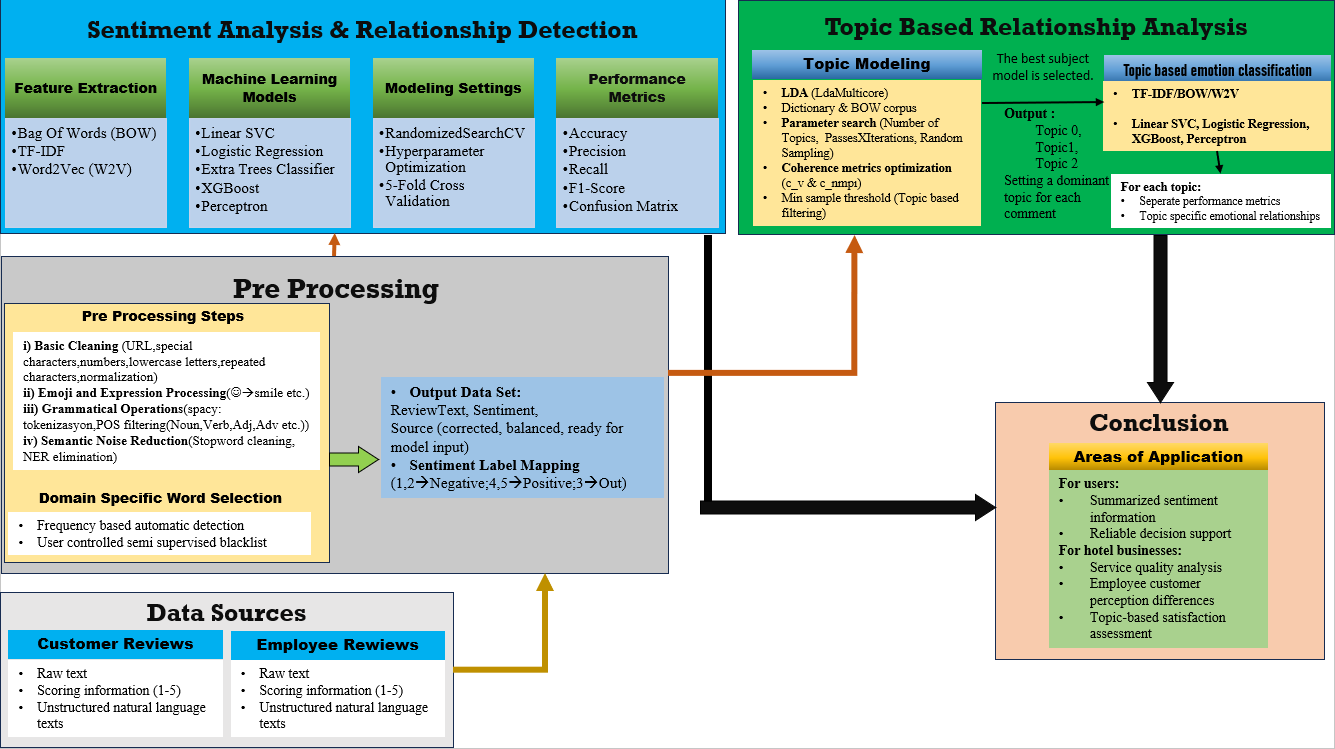
Analyzing heterogeneous online reviews from multiple stakeholder groups represents an emerging challenge in AI-driven service intelligence. This study proposes a two-stage sentiment correlation detection framework and applies it to customer and employee reviews of the Istanbul Marriott \c{S}i\c{s}li hotel. During dataset construction, a semi-supervised domain-specific blacklisting approach was developed alongside standard preprocessing steps to improve sentiment signal quality. In the first phase, customer and employee reviews were treated as separate datasets, and 5-fold cross-validation was applied using TF-IDF, BOW, and Word2Vec representations with multiple classifiers, achieving 99.8% and 93.8% F1-scores respectively. In the second phase, correlation analysis on the combined dataset yielded a 97.1% F1-score. In the final phase, LDA-based topic modeling identified three topic clusters, with the topic-based model achieving a 97.5% F1-score. The findings demonstrate that customer and employee perceptions converge at the macro level but diverge on a topic-by-topic basis. The proposed framework offers a generalizable approach for multi-source sentiment correlation analysis in domain-specific AI applications.
Graphical Abstract
Keywords
Data Availability Statement
Funding
Conflicts of Interest
AI Use Statement
Ethical Approval and Consent to Participate
References
- Ameur, A., Hamdi, S., & Ben Yahia, S. (2023). Sentiment analysis for hotel reviews: A systematic literature review. ACM Computing Surveys, 56(2), 1-38.
[CrossRef] [Google Scholar] - Jain, P. K., Pamula, R., & Srivastava, G. (2021). A systematic literature review on machine learning applications for consumer sentiment analysis using online reviews. Computer science review, 41, 100413.
[CrossRef] [Google Scholar] - Mehraliyev, F., Chan, I. C. C., & Kirilenko, A. P. (2022). Sentiment analysis in hospitality and tourism: a thematic and methodological review. International Journal of Contemporary Hospitality Management, 34(1), 46-77.
[CrossRef] [Google Scholar] - Liu, B. (2012). Sentiment analysis and opinion mining. Springer.
[CrossRef] [Google Scholar] - Pang, B., & Lee, L. (2008). Opinion mining and sentiment analysis. Foundations and Trends® in information retrieval, 2(1-2), 1-135.
[CrossRef] [Google Scholar] - Cambria, E., Schuller, B., Xia, Y., & Havasi, C. (2013). New avenues in opinion mining and sentiment analysis. IEEE Intelligent systems, 28(2), 15-21.
[CrossRef] [Google Scholar] - Yurdasever, E. (2024). İşletmelerde çalışanlara yönelik duygu analizinin uygulanması: Potansiyel faydalar ve zorluklar. Academic Review of Economics and Administrative Sciences, 17(3), 462-488.
[CrossRef] [Google Scholar] - Oğul, B. B., & Ercan, G. (2016, May). Sentiment classification on Turkish hotel reviews. In 2016 24th Signal Processing and Communication Application Conference (SIU) (pp. 497-500). IEEE.
[CrossRef] [Google Scholar] - İnan, H. E. (2024). Comparison of machine learning algorithms for classification of hotel reviews: sentiment analysis of tripadvisor reviews. GSI Journals Serie A: Advancements in Tourism Recreation and Sports Sciences, 7(1), 111-122.
[CrossRef] [Google Scholar] - Gunawan, R., & Hendry, H. (2025). Analisis sentimen ulasan tamu terhadap layanan hotel menggunakan pendekatan machine learning. IT-Explore: Jurnal Penerapan Teknologi Informasi dan Komunikasi, 4(3), 295-306.
[CrossRef] [Google Scholar] - Muhammad, P. F., Kusumaningrum, R., & Wibowo, A. (2021). Sentiment analysis using Word2vec and long short-term memory (LSTM) for Indonesian hotel reviews. Procedia Computer Science, 179, 728-735.
[CrossRef] [Google Scholar] - Ahmetoğlu, H., & Daş, R. (2020). Türkçe otel yorumlarıyla eğitilen kelime vektörü modellerinin duygu analizi ile incelenmesi. Süleyman Demirel Üniversitesi Fen Bilimleri Enstitüsü Dergisi, 24(2), 455-463.
[CrossRef] [Google Scholar] - Erdoğan, D., Kayakuş, M., Çelik Çaylak, P., Ekşili, N., Moiceanu, G., Kabas, O., & Ichimov, M. A. M. (2025). Developing a deep learning-based sentiment analysis system of hotel customer reviews for sustainable tourism. Sustainability, 17(13), 5756.
[CrossRef] [Google Scholar] - Jayanto, R., Kusumaningrum, R., & Wibowo, A. (2022). Aspect-based sentiment analysis for hotel reviews using an improved model of long short-term memory. International Journal of Advances in Intelligent Informatics, 8(3), 391.
[CrossRef] [Google Scholar] - Kusumaningrum, R., Nisa, I. Z., Jayanto, R., Nawangsari, R. P., & Wibowo, A. (2023). Deep learning-based application for multilevel sentiment analysis of Indonesian hotel reviews. Heliyon, 9(6).
[CrossRef] [Google Scholar] - Wen, Y., Liang, Y., & Zhu, X. (2023). Sentiment analysis of hotel online reviews using the BERT model and ERNIE model—Data from China. Plos one, 18(3), e0275382.
[CrossRef] [Google Scholar] - Puh, K., & Bagić Babac, M. (2023). Predicting sentiment and rating of tourist reviews using machine learning. Journal of hospitality and tourism insights, 6(3), 1188-1204.
[CrossRef] [Google Scholar] - Özdemir, A. O., Giritli, E. B., & Can, Y. S. (2024, October). Sentiment analysis for hotel reviews in turkish by using llms. In 2024 9th International Conference on Computer Science and Engineering (UBMK) (pp. 210-214). IEEE.
[CrossRef] [Google Scholar] - Adıgüzel, F., Elsherbiny, M., Aguiar Quintana, J. T., & González-Martel, C. (2021). Topic modelling application for luxury hotel reviews. In 25th PPAD Marketing Congress. Pazarlama ve Pazarlama Araştırmaları Derneği. https://ntu-repository.worktribe.com/output/1763496
[Google Scholar] - Bilge, A. C. (2024). Online Otel Yorumlarının Duygu Analizi ile İncelenmesi: Konya Beş Yıldızlı Oteller Örneği. Selçuk Üniversitesi Akşehir Meslek Yüksekokulu Sosyal Bilimler Dergisi, (17), 84-93. https://izlik.org/JA55PA79RM
[Google Scholar] - Ali, T., Omar, B., & Soulaimane, K. (2022). Analyzing tourism reviews using an LDA topic-based sentiment analysis approach. MethodsX, 9, 101894.
[CrossRef] [Google Scholar] - Nadeem, A., Missen, M. M. S., Al Reshan, M. S., Memon, M. A., Asiri, Y., Nizamani, M. A., ... & Shaikh, A. (2025). Resolving ambiguity in natural language for enhancement of aspect-based sentiment analysis of hotel reviews. PeerJ Computer Science, 11, e2635.
[CrossRef] [Google Scholar] - Gaye, B., Zhang, D., & Wulamu, A. (2021). Sentiment classification for employees reviews using regression vector-stochastic gradient descent classifier (RV-SGDC). PeerJ Computer Science, 7, e712.
[CrossRef] [Google Scholar] - Das, M., & Alphonse, P. J. A. (2023). A comparative study on tf-idf feature weighting method and its analysis using unstructured dataset. arXiv preprint arXiv:2308.04037.
[CrossRef] [Google Scholar] - Soumya George, K., & Joseph, S. (2014). Text classification by augmenting bag of words (BOW) representation with co-occurrence feature. IOSR Journal of Computer Engineering, 16(1), 34–38.
[CrossRef] [Google Scholar] - Mikolov, T., Chen, K., Corrado, G., & Dean, J. (2013). Efficient estimation of word representations in vector space. arXiv preprint arXiv:1301.3781.
[CrossRef] [Google Scholar] - Karcioğlu, A. A., & Aydin, T. (2019, April). Sentiment analysis of Turkish and english twitter feeds using Word2Vec model. In 2019 27th Signal Processing and Communications Applications Conference (SIU) (pp. 1-4). IEEE.
[CrossRef] [Google Scholar] - Cortes, C., & Vapnik, V. (1995). Support-vector networks. Machine learning, 20(3), 273-297.
[CrossRef] [Google Scholar] - Joachims, T. (1998, April). Text categorization with support vector machines: Learning with many relevant features. In European conference on machine learning (pp. 137-142). Berlin, Heidelberg: Springer Berlin Heidelberg.
[CrossRef] [Google Scholar] - Rosenblatt, F. (1958). The perceptron: A probabilistic model for information storage and organization in the brain. Psychological Review, 65(6), 386–408.
[CrossRef] [Google Scholar] - Hosmer, D. W., Lemeshow, S., & Sturdivant, R. X. (2000). Applied logistic regression (Vol. 2, pp. 116-128). New York: wiley. https://onlinelibrary.wiley.com/doi/book/10.1002/9781118548387
[Google Scholar] - Geurts, P., Ernst, D., & Wehenkel, L. (2006). Extremely randomized trees. Machine learning, 63(1), 3-42.
[CrossRef] [Google Scholar] - Chen, T., & Guestrin, C. (2016, August). Xgboost: A scalable tree boosting system. In Proceedings of the 22nd acm sigkdd international conference on knowledge discovery and data mining (pp. 785-794).
[CrossRef] [Google Scholar] - Blei, D. M., Ng, A. Y., & Jordan, M. I. (2003). Latent Dirichlet allocation. Journal of Machine Learning Research, 3, 993-1022. https://jmlr.org/papers/v3/blei03a.html
[Google Scholar] - Powers, D. M. (2020). Evaluation: from precision, recall and F-measure to ROC, informedness, markedness and correlation. arXiv preprint arXiv:2010.16061.
[CrossRef] [Google Scholar]
Cite This Article
TY  - JOUR
AU  - Bakan, Berat
AU  - Karcioglu, Abdullah Ammar
AU  - Katırcıoğlu, Esra
PY  - 2026
DA  - 2026/09/22
TI  - Detecting Sentiment Analysis Correlation Between Hotel Employee and Customer Reviews Using Machine Learning Algorithms
JO  - ICCK Transactions on Emerging Topics in Artificial Intelligence
T2  - ICCK Transactions on Emerging Topics in Artificial Intelligence
JF  - ICCK Transactions on Emerging Topics in Artificial Intelligence
VL  - 3
IS  - 3
SP  - 188
EP  - 201
DO  - 10.62762/TETAI.2026.991738
UR  - https://www.icck.org/article/abs/TETAI.2026.991738
KW  - sentiment analysis
KW  - multi-source correlation detection
KW  - semi-supervised preprocessing
KW  - topic modeling
KW  - service intelligence
AB  - Analyzing heterogeneous online reviews from multiple stakeholder groups represents an emerging challenge in AI-driven service intelligence. This study proposes a two-stage sentiment correlation detection framework and applies it to customer and employee reviews of the Istanbul Marriott \c{S}i\c{s}li hotel. During dataset construction, a semi-supervised domain-specific blacklisting approach was developed alongside standard preprocessing steps to improve sentiment signal quality. In the first phase, customer and employee reviews were treated as separate datasets, and 5-fold cross-validation was applied using TF-IDF, BOW, and Word2Vec representations with multiple classifiers, achieving 99.8% and 93.8% F1-scores respectively. In the second phase, correlation analysis on the combined dataset yielded a 97.1% F1-score. In the final phase, LDA-based topic modeling identified three topic clusters, with the topic-based model achieving a 97.5% F1-score. The findings demonstrate that customer and employee perceptions converge at the macro level but diverge on a topic-by-topic basis. The proposed framework offers a generalizable approach for multi-source sentiment correlation analysis in domain-specific AI applications.
SN  - 3068-6652
PB  - Institute of Central Computation and Knowledge
LA  - English
ER  -
@article{Bakan2026Detecting,
  author = {Berat Bakan and Abdullah Ammar Karcioglu and Esra Katırcıoğlu},
  title = {Detecting Sentiment Analysis Correlation Between Hotel Employee and Customer Reviews Using Machine Learning Algorithms},
  journal = {ICCK Transactions on Emerging Topics in Artificial Intelligence},
  year = {2026},
  volume = {3},
  number = {3},
  pages = {188-201},
  doi = {10.62762/TETAI.2026.991738},
  url = {https://www.icck.org/article/abs/TETAI.2026.991738},
  abstract = {Analyzing heterogeneous online reviews from multiple stakeholder groups represents an emerging challenge in AI-driven service intelligence. This study proposes a two-stage sentiment correlation detection framework and applies it to customer and employee reviews of the Istanbul Marriott \c{S}i\c{s}li hotel. During dataset construction, a semi-supervised domain-specific blacklisting approach was developed alongside standard preprocessing steps to improve sentiment signal quality. In the first phase, customer and employee reviews were treated as separate datasets, and 5-fold cross-validation was applied using TF-IDF, BOW, and Word2Vec representations with multiple classifiers, achieving 99.8\% and 93.8\% F1-scores respectively. In the second phase, correlation analysis on the combined dataset yielded a 97.1\% F1-score. In the final phase, LDA-based topic modeling identified three topic clusters, with the topic-based model achieving a 97.5\% F1-score. The findings demonstrate that customer and employee perceptions converge at the macro level but diverge on a topic-by-topic basis. The proposed framework offers a generalizable approach for multi-source sentiment correlation analysis in domain-specific AI applications.},
  keywords = {sentiment analysis, multi-source correlation detection, semi-supervised preprocessing, topic modeling, service intelligence},
  issn = {3068-6652},
  publisher = {Institute of Central Computation and Knowledge}
}
Article Metrics
Publisher's Note
ICCK stays neutral with regard to jurisdictional claims in published maps and institutional affiliations.
Rights and Permissions
 Copyright © 2026 by the Author(s). Published by Institute of Central Computation and Knowledge. This article is an open access article distributed under the terms and conditions of the Creative Commons Attribution (CC BY) license (https://creativecommons.org/licenses/by/4.0/), which permits use, sharing, adaptation, distribution and reproduction in any medium or format, as long as you give appropriate credit to the original author(s) and the source, provide a link to the Creative Commons licence, and indicate if changes were made.


Portico
