Volume 1, Issue 1, ICCK Transactions on Intelligent Cyber-Physical Systems
Volume 1, Issue 1, 2025
Submit Manuscript Edit a Special Issue
Article QR Code
Article QR Code
Scan the QR code for reading
Popular articles
ICCK Transactions on Intelligent Cyber-Physical Systems, Volume 1, Issue 1, 2025: 38-50

Free to Read | Research Article | 17 February 2026
A Multi-Dimensional Data Learning-Based Production Quality Management Method for Intelligent Manufacturing
1 Nanjing Institute of Technology, Nanjing 211167, China
* Corresponding Author: Leilei Yin, [email protected]
ARK: ark:/57805/ticps.2026.380630
Received: 01 February 2026, Accepted: 08 February 2026, Published: 17 February 2026  
Abstract
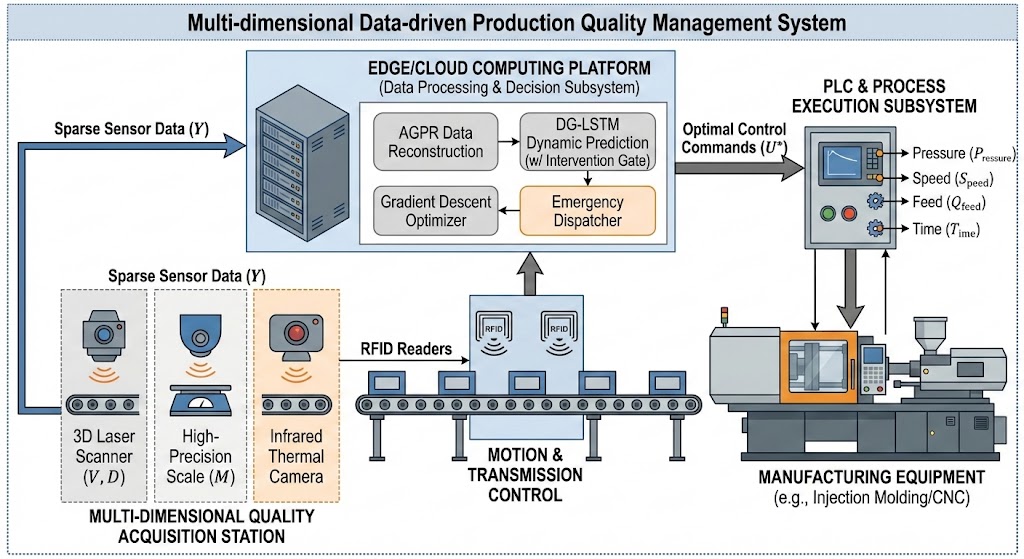
In the field of high-end precision manufacturing, quality control in production processes has long been challenged by both spatiotemporal data sparsity and error lag. Traditional offline sampling methods struggle to capture the dynamic fluctuations in production, while single-dimensional feedback controls fall short in addressing the nonlinear coupling between multi-dimensional process parameters and final product quality. To address these challenges, this paper proposes a production quality management system based on multi-dimensional data learning and an active error elimination method. First, to tackle the issue of sparse sampling, an Adaptive Gaussian Process Regression (AGPR) algorithm with mixed kernel functions is introduced to reconstruct continuous production quality time-series states, effectively resolving the "blind spot" problem caused by discrete monitoring. Second, a Dynamic Gated LSTM network with a "Correction Gate" is designed to explicitly model the dynamic intervention mechanism of process control variables on quality evolution, advancing from passive prediction to active deduction. Most importantly, this paper develops an active error elimination strategy using gradient inversion. By minimizing the quality deviation objective function, the optimal combination of process parameters is inversely determined. In practical terms, this approach enables the "dynamic re-matching of machine tool state and process requirements"—intelligently adjusting process parameters (such as injection pressure and holding time) according to the equipment's real-time state (e.g., thermal drift, wear). This method compensates for physical equipment performance degradation through dynamic scheduling. Experimental results show that the system significantly reduces the rejection rate in precision injection molding scenarios, marking a paradigm shift in production from "post-event rejection" to "pre-event self-healing".

Graphical Abstract
A Multi-Dimensional Data Learning-Based Production Quality Management Method for Intelligent Manufacturing

Keywords
production quality management
multi-dimensional data learning
adaptive gaussian process regression
dynamic gated LSTM
error elimination
smart manufacturing

Data Availability Statement
Data will be made available on request.

Funding
This work was supported without any funding.

Conflicts of Interest
The authors declare no conflicts of interest.

AI Use Statement
The authors declare that no generative AI was used in the preparation of this manuscript.

Ethical Approval and Consent to Participate
Not applicable.

References
  1. MacGregor, J. F., & Kourti, T. (1995). Statistical process control of multivariate processes. Control Engineering Practice, 3(3), 403-414.
    [CrossRef]   [Google Scholar]
  2. Lee, J. M., Yoo, C., Choi, S. W., Vanrolleghem, P. A., & Lee, I. B. (2004). Nonlinear process monitoring using kernel principal component analysis. Chemical engineering science, 59(1), 223-234.
    [CrossRef]   [Google Scholar]
  3. Deng, X., & Zhang, Z. (2020). Nonlinear chemical process fault diagnosis using ensemble deep support vector data description. Sensors, 20(16), 4599.
    [CrossRef]   [Google Scholar]
  4. Ku, W., Storer, R. H., & Georgakis, C. (1995). Disturbance detection and isolation by dynamic principal component analysis. Chemometrics and intelligent laboratory systems, 30(1), 179-196.
    [CrossRef]   [Google Scholar]
  5. Yin, S., Ding, S. X., Haghani, A., Hao, H., & Zhang, P. (2012). A comparison study of basic data-driven fault diagnosis and process monitoring methods on the benchmark Tennessee Eastman process. Journal of process control, 22(9), 1567-1581.
    [CrossRef]   [Google Scholar]
  6. Ge, Z., Song, Z., & Gao, F. (2013). Review of recent research on data-based process monitoring. Industrial & Engineering Chemistry Research, 52(10), 3543-3562.
    [CrossRef]   [Google Scholar]
  7. Kotsiantis, S. B. (2007). Supervised machine learning: A review of classification techniques. Informatica, 31, 249-268.
    [Google Scholar]
  8. Jung, H., Jeon, J., Choi, D., & Park, J. Y. (2021). Application of machine learning techniques in injection molding quality prediction: Implications on sustainable manufacturing industry. Sustainability, 13(8), 4120.
    [CrossRef]   [Google Scholar]
  9. Wang, J., Ma, Y., Zhang, L., Gao, R. X., & Wu, D. (2018). Deep learning for smart manufacturing: Methods and applications. Journal of Manufacturing Systems, 48, 144-156.
    [CrossRef]   [Google Scholar]
  10. Zhao, R., Yan, R., Wang, J., & Mao, K. (2017). Learning to monitor machine health with convolutional bi-directional LSTM networks. Sensors, 17(2), 273.
    [CrossRef]   [Google Scholar]
  11. Zhao, L. P., Li, B. H., & Yao, Y. Y. (2023). A novel predict-prevention quality control method of multi-stage manufacturing process towards zero defect manufacturing. Advances in Manufacturing, 11(2), 280-294.
    [CrossRef]   [Google Scholar]
  12. Zheng, W., Zhao, P., Huang, K., & Chen, G. (2021, October). Understanding the property of long term memory for the LSTM with attention mechanism. In Proceedings of the 30th ACM International Conference on Information & Knowledge Management (pp. 2708-2717).
    [CrossRef]   [Google Scholar]
  13. Wu, Y., Yuan, M., Dong, S., Lin, L., & Liu, Y. (2018). Remaining useful life estimation of engineered systems using vanilla LSTM neural networks. Neurocomputing, 275, 167-179.
    [CrossRef]   [Google Scholar]
  14. Tao, F., Cheng, J., Qi, Q., Zhang, M., Zhang, H., & Sui, F. (2018). Digital twin-driven product design, manufacturing and service with big data. The International Journal of Advanced Manufacturing Technology, 94(9), 3563-3576.
    [CrossRef]   [Google Scholar]
  15. Chen, H., Pang, Y., Hu, Q., & Liu, K. (2020). Solar cell surface defect inspection based on multispectral convolutional neural network. Journal of Intelligent Manufacturing, 31(2), 453-468.
    [CrossRef]   [Google Scholar]
  16. Weimer, D., Scholz-Reiter, B., & Shpitalni, M. (2016). Design of deep convolutional neural network architectures for automated feature extraction in industrial inspection. CIRP annals, 65(1), 417-420.
    [CrossRef]   [Google Scholar]
  17. Seeger, M. (2004). Gaussian processes for machine learning. International journal of neural systems, 14(02), 69-106.
    [CrossRef]   [Google Scholar]
  18. Jin, H., Chen, X., Wang, L., Yang, K., & Wu, L. (2015). Adaptive soft sensor development based on online ensemble Gaussian process regression for nonlinear time-varying batch processes. Industrial & Engineering Chemistry Research, 54(30), 7320-7345.
    [CrossRef]   [Google Scholar]
  19. Kocijan, J., Girard, A., Banko, B., & Murray-Smith, R. (2005). Dynamic systems identification with Gaussian processes. Mathematical and Computer Modelling of Dynamical Systems, 11(4), 411-424.
    [CrossRef]   [Google Scholar]
  20. Goodfellow, I., Pouget-Abadie, J., Mirza, M., Xu, B., Warde-Farley, D., Ozair, S., Courville, A., & Bengio, Y. (2014). Generative adversarial nets. Advances in Neural Information Processing Systems (NIPS), 27, 2672-2680.
    [Google Scholar]
  21. Jiang, W., Hong, Y., Zhou, B., He, X., & Cheng, C. (2019). A GAN-based anomaly detection approach for imbalanced industrial time series. IEEE Access, 7, 143608-143619.
    [CrossRef]   [Google Scholar]
  22. Shao, S., Wang, P., & Yan, R. (2019). Generative adversarial networks for data augmentation in machine fault diagnosis. Computers in Industry, 106, 85-93.
    [CrossRef]   [Google Scholar]
  23. Pan, S. J., & Yang, Q. (2009). A survey on transfer learning. IEEE Transactions on knowledge and data engineering, 22(10), 1345-1359.
    [CrossRef]   [Google Scholar]
  24. Duvenaud, D., Lloyd, J., Grosse, R., Tenenbaum, J., & Zoubin, G. (2013, May). Structure discovery in nonparametric regression through compositional kernel search. In International Conference on Machine Learning (pp. 1166-1174). PMLR.
    [Google Scholar]
  25. Wang, K., & Han, K. (2013). A batch-based run-to-run process control scheme for semiconductor manufacturing. IIE Transactions, 45(6), 658-669.
    [CrossRef]   [Google Scholar]
  26. Apley, D. W., & Cheol Lee, H. (2003). Design of exponentially weighted moving average control charts for autocorrelated processes with model uncertainty. Technometrics, 45(3), 187-198.
    [CrossRef]   [Google Scholar]
  27. Lu, Y., Liu, C., Wang, K. I. K., Huang, H., & Xu, X. (2020). Digital Twin-driven smart manufacturing: Connotation, reference model, applications and research issues. Robotics and Computer-Integrated Manufacturing, 61, 101837.
    [CrossRef]   [Google Scholar]
  28. Wuest, T., Weimer, D., Irgens, C., & Thoben, K. D. (2016). Machine learning in manufacturing: advantages, challenges, and applications. Production & manufacturing research, 4(1), 23-45.
    [CrossRef]   [Google Scholar]
  29. Kober, J., Bagnell, J. A., & Peters, J. (2013). Reinforcement learning in robotics: A survey. The International Journal of Robotics Research, 32(11), 1238-1274.
    [CrossRef]   [Google Scholar]
  30. Panjapornpon, C., Chinchalongporn, P., Bardeeniz, S., Makkayatorn, R., & Wongpunnawat, W. (2022). Reinforcement learning control with deep deterministic policy gradient algorithm for multivariable pH process. Processes, 10(12), 2514.
    [CrossRef]   [Google Scholar]
  31. Oliff, H., Liu, Y., Kumar, M., Williams, M., & Ryan, M. (2020). Reinforcement learning for facilitating human-robot-interaction in manufacturing. Journal of Manufacturing Systems, 56, 326-340.
    [CrossRef]   [Google Scholar]

Cite This Article
APA Style
Ding, Y., & Yin, L. (2026). A Multi-Dimensional Data Learning-Based Production Quality Management Method for Intelligent Manufacturing. ICCK Transactions on Intelligent Cyber-Physical Systems, 1(1), 38–50. https://doi.org/10.62762/TICPS.2026.380630
Export Citation
RIS Format
Compatible with EndNote, Zotero, Mendeley, and other reference managers
RIS format data for reference managers
TY  - JOUR
AU  - Ding, Yuxing
AU  - Yin, Leilei
PY  - 2026
DA  - 2026/02/17
TI  - A Multi-Dimensional Data Learning-Based Production Quality Management Method for Intelligent Manufacturing
JO  - ICCK Transactions on Intelligent Cyber-Physical Systems
T2  - ICCK Transactions on Intelligent Cyber-Physical Systems
JF  - ICCK Transactions on Intelligent Cyber-Physical Systems
VL  - 1
IS  - 1
SP  - 38
EP  - 50
DO  - 10.62762/TICPS.2026.380630
UR  - https://www.icck.org/article/abs/TICPS.2026.380630
KW  - production quality management
KW  - multi-dimensional data learning
KW  - adaptive gaussian process regression
KW  - dynamic gated LSTM
KW  - error elimination
KW  - smart manufacturing
AB  - In the field of high-end precision manufacturing, quality control in production processes has long been challenged by both spatiotemporal data sparsity and error lag. Traditional offline sampling methods struggle to capture the dynamic fluctuations in production, while single-dimensional feedback controls fall short in addressing the nonlinear coupling between multi-dimensional process parameters and final product quality. To address these challenges, this paper proposes a production quality management system based on multi-dimensional data learning and an active error elimination method. First, to tackle the issue of sparse sampling, an Adaptive Gaussian Process Regression (AGPR) algorithm with mixed kernel functions is introduced to reconstruct continuous production quality time-series states, effectively resolving the "blind spot" problem caused by discrete monitoring. Second, a Dynamic Gated LSTM network with a "Correction Gate" is designed to explicitly model the dynamic intervention mechanism of process control variables on quality evolution, advancing from passive prediction to active deduction. Most importantly, this paper develops an active error elimination strategy using gradient inversion. By minimizing the quality deviation objective function, the optimal combination of process parameters is inversely determined. In practical terms, this approach enables the "dynamic re-matching of machine tool state and process requirements"—intelligently adjusting process parameters (such as injection pressure and holding time) according to the equipment's real-time state (e.g., thermal drift, wear). This method compensates for physical equipment performance degradation through dynamic scheduling. Experimental results show that the system significantly reduces the rejection rate in precision injection molding scenarios, marking a paradigm shift in production from "post-event rejection" to "pre-event self-healing".
SN  - pending
PB  - Institute of Central Computation and Knowledge
LA  - English
ER  - 
BibTeX Format
Compatible with LaTeX, BibTeX, and other reference managers
BibTeX format data for LaTeX and reference managers
@article{Ding2026A,
  author = {Yuxing Ding and Leilei Yin},
  title = {A Multi-Dimensional Data Learning-Based Production Quality Management Method for Intelligent Manufacturing},
  journal = {ICCK Transactions on Intelligent Cyber-Physical Systems},
  year = {2026},
  volume = {1},
  number = {1},
  pages = {38-50},
  doi = {10.62762/TICPS.2026.380630},
  url = {https://www.icck.org/article/abs/TICPS.2026.380630},
  abstract = {In the field of high-end precision manufacturing, quality control in production processes has long been challenged by both spatiotemporal data sparsity and error lag. Traditional offline sampling methods struggle to capture the dynamic fluctuations in production, while single-dimensional feedback controls fall short in addressing the nonlinear coupling between multi-dimensional process parameters and final product quality. To address these challenges, this paper proposes a production quality management system based on multi-dimensional data learning and an active error elimination method. First, to tackle the issue of sparse sampling, an Adaptive Gaussian Process Regression (AGPR) algorithm with mixed kernel functions is introduced to reconstruct continuous production quality time-series states, effectively resolving the "blind spot" problem caused by discrete monitoring. Second, a Dynamic Gated LSTM network with a "Correction Gate" is designed to explicitly model the dynamic intervention mechanism of process control variables on quality evolution, advancing from passive prediction to active deduction. Most importantly, this paper develops an active error elimination strategy using gradient inversion. By minimizing the quality deviation objective function, the optimal combination of process parameters is inversely determined. In practical terms, this approach enables the "dynamic re-matching of machine tool state and process requirements"—intelligently adjusting process parameters (such as injection pressure and holding time) according to the equipment's real-time state (e.g., thermal drift, wear). This method compensates for physical equipment performance degradation through dynamic scheduling. Experimental results show that the system significantly reduces the rejection rate in precision injection molding scenarios, marking a paradigm shift in production from "post-event rejection" to "pre-event self-healing".},
  keywords = {production quality management, multi-dimensional data learning, adaptive gaussian process regression, dynamic gated LSTM, error elimination, smart manufacturing},
  issn = {pending},
  publisher = {Institute of Central Computation and Knowledge}
}

Article Metrics
Citations:

Crossref

0

Scopus

0

Web of Science

0
Article Access Statistics:
Views: 14
PDF Downloads: 6

Publisher's Note
ICCK stays neutral with regard to jurisdictional claims in published maps and institutional affiliations.

Rights and Permissions
Institute of Central Computation and Knowledge (ICCK) or its licensor (e.g. a society or other partner) holds exclusive rights to this article under a publishing agreement with the author(s) or other rightsholder(s); author self-archiving of the accepted manuscript version of this article is solely governed by the terms of such publishing agreement and applicable law.
ICCK Transactions on Intelligent Cyber-Physical Systems

ICCK Transactions on Intelligent Cyber-Physical Systems

ISSN: pending (Online)

Email: [email protected]

Portico

Portico

All published articles are preserved here permanently:
https://www.portico.org/publishers/icck/