Pedestrian Trajectory Reconstruction for Indoor Movement Based on Foot-Mounted IMU





Article Information
Abstract
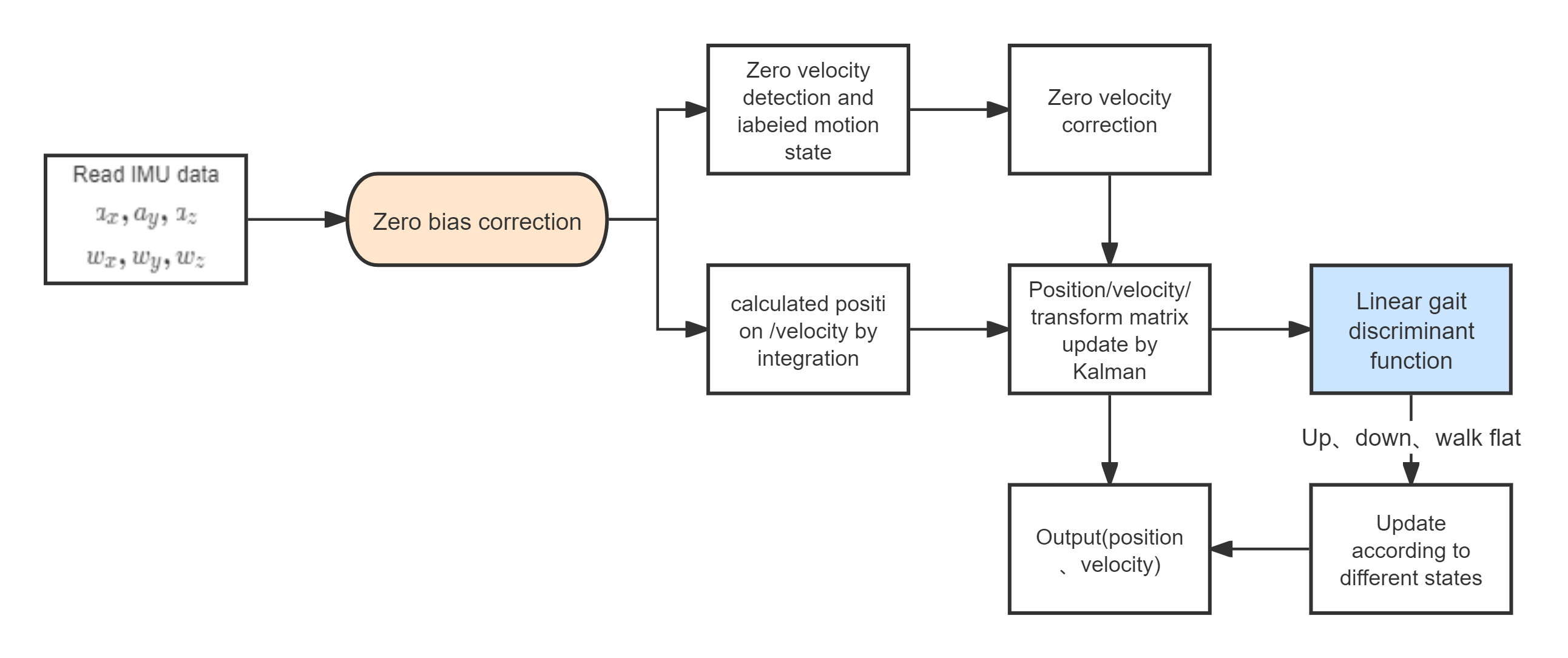
A pedestrian navigation system (PNS) that only relies on the foot-mounted IMU is useful for various applications, especially under some severe conditions, such as tracking of firefighters and miners. Due to the complexity of the indoor environment, signal occlusion problems could lead to the failure of certain positioning methods. In complex environments such as fire rescue and emergency rescue, the barometric altimeter fails because of the influence of air pressure and temperature. This paper used an improved zero velocity detection algorithm to improve the accuracy of gait detection. Then, combine the Kalman filter with the zero velocity update algorithm to recognize gait accurately and take corresponding actions. Finally, the trajectory involving both horizontal and vertical movement was obtained. The proposed method avoids the redundancy associated with multi-sensor data fusion and can be used in complex unknown environments.
Graphical Abstract
Keywords
Data Availability Statement
Funding
Conflicts of Interest
Ethical Approval and Consent to Participate
References
- Basso, M., Galanti, M., Innocenti, G., & Miceli, D. (2020). Triggered INS/GNSS data fusion algorithms for enhanced pedestrian navigation system. IEEE Sensors Journal, 20(13), 7447-7459.
[CrossRef] [Google Scholar] - Lan, H., Yu, C., & El-Sheimy, N. (2015, April). An integrated PDR/GNSS pedestrian navigation system. In China Satellite Navigation Conference (CSNC) 2015 Proceedings: Volume III (pp. 677-690). Berlin, Heidelberg: Springer Berlin Heidelberg.
[CrossRef] [Google Scholar] - Xu, J., Li, Z., Zhang, K., Yang, J., Gao, N., Zhang, Z., & Meng, Z. (2023). The principle, methods and recent progress in RFID positioning techniques: A review. IEEE Journal of Radio Frequency Identification, 7, 50-63.
[CrossRef] [Google Scholar] - Sung, S., Kim, H., & Jung, J.-I. (2023). Accurate Indoor Positioning for UWB-Based Personal Devices Using Deep Learning. IEEE Access, 11, 20095-20113.
[CrossRef] [Google Scholar] - Ladetto, Q., & Merminod, B. (2002). Digital magnetic compass and gyroscope integration for pedestrian navigation. In 9th Saint Petersburg international conference on integrated navigation systems, Saint Petersburg, Russia.
[Google Scholar] - Harle, R. (2013). A survey of indoor inertial positioning systems for pedestrians. IEEE Communications Surveys & Tutorials, 15(3), 1281-1293.
[CrossRef] [Google Scholar] - Wang, Q., Fu, M., Wang, J., Sun, L., Huang, R., Li, X., ... & Jiang, C. (2024). Free-walking: Pedestrian inertial navigation based on dual foot-mounted IMU. Defence Technology, 33, 573-587.
[CrossRef] [Google Scholar] - Foxlin E. (2005). Pedestrian Tracking with Shoe-Mounted Inertial Sensors. IEEE Computer Graphics & Applications, 25(6):38-46.
[CrossRef] [Google Scholar] - Cai, Y., Sun, Q., Zhang, Y., Yu, C., & Bai, H. (2016, October). Integrated navigation for pedestrian with building heading algorithm and inertial measurement unit. In 2016 International Conference on Control, Automation and Information Sciences (ICCAIS) (pp. 167-170). IEEE.
[CrossRef] [Google Scholar] - Robertson, P., Angermann, M., Krach, B., & Khider, M. (2009, September). Inertial systems based joint mapping and positioning for pedestrian navigation. In In Proceedings of the 22nd International Technical Meeting of the Satellite Division of The Institute of Navigation (ION GNSS 2009): 2096-2107).
[Google Scholar] - Jirawimut, R., Prakoonwit, S., Cecelja, F., & Balachandran, W. (2003). Visual odometer for pedestrian navigation. IEEE Transactions on Instrumentation and measurement, 52(4), 1166-1173.
[CrossRef] [Google Scholar] - Flores J Z, Farcy R. (2014). Indoor Navigation System for the Visually Impaired Using One Inertial Measurement Unit (IMU) and Barometer to Guide in the Subway Stations and Commercial Centers. In International Conference on Computers for Handicapped Persons. Springer, Cham:411-418.
[CrossRef] [Google Scholar] - Jimenez, A. R., Seco, F., Prieto, C., & Guevara, J. (2009, August). A comparison of pedestrian dead-reckoning algorithms using a low-cost MEMS IMU. In 2009 IEEE International Symposium on Intelligent Signal Processing (pp. 37-42). IEEE.
[CrossRef] [Google Scholar] - Skog, I., Handel, P., Nilsson, J. O., & Rantakokko, J. (2010). Zero-velocity detection—An algorithm evaluation. IEEE transactions on biomedical engineering, 57(11), 2657-2666.
[CrossRef] [Google Scholar] - Shuster, M. D. (1993). A survey of attitude representations. Journal of the Astronautical Sciences, 41(4), 439-517. https://www.malcolmdshuster.com/Pub_1993h_J_Repsurv_scan.pdf
[Google Scholar]
Cited By (6)
-
Yuting Bai, Qingyu Guo, Xuebo Jin, Tingli Su, Wei Jia. Data-driven inertial positioning method based on dual-end feature extraction.
Discover Computing, 2026 , 29 (1).
[CrossRef] -
Piotr Golański. Assessment of the accuracy of mapping spatial relations of real objects in a mixed reality simulatorusing the HTC VIVE tracker.
Journal of Konbin, 2026 , 56 (3).
[CrossRef] -
Zhongwei Hou, Jin Han, Wenbing Yu, Fenglei Han, Xuefu Zhang. Research on spatial coordinate perception technology for water-rich underground channels based on inertial signal representation analysis.
Measurement, 2026 , 280 .
[CrossRef] -
Paweł Tomiło. AIMUMETER: Neural network based aircraft take-off and landing distance measurement system with uncertainty measurement.
Measurement, 2025 , 252 .
[CrossRef] -
Yuting Bai, Bin Yan, Wei Dong, Xuebo Jin, Tingli Su, Huijun Ma. A Novel Adaptive State Estimation Model: Kalman Filter Coupled With Neural Networks.
International Journal of Adaptive Control and Signal Processing, 2025 , 39 (5).
[CrossRef] -
Oscar G. Ibarra-Manzano, José A. Andrade-Lucio, Miguel A. Vázquez-Olguín, Yuriy S. Shmaliy. Transfer function-based robust filtering: Review and critical evaluation.
Signal Processing, 2025 , 237 .
[CrossRef]
Cite This Article
TY  - JOUR
AU  - Wang, Yeqing
AU  - Wang, Binbin
PY  - 2024
DA  - 2024/05/26
TI  - Pedestrian Trajectory Reconstruction for Indoor Movement Based on Foot-Mounted IMU
JO  - ICCK Transactions on Intelligent Systematics
T2  - ICCK Transactions on Intelligent Systematics
JF  - ICCK Transactions on Intelligent Systematics
VL  - 1
IS  - 1
SP  - 19
EP  - 29
DO  - 10.62762/TIS.2024.136995
UR  - https://www.icck.org/article/abs/tis.2024.136995
KW  - pedestrian navigation
KW  - zero-velocity detection
KW  - Kalman filter
KW  - foot-mounted IMU
AB  - A pedestrian navigation system (PNS) that only relies on the foot-mounted IMU is useful for various applications, especially under some severe conditions, such as tracking of firefighters and miners. Due to the complexity of the indoor environment, signal occlusion problems could lead to the failure of certain positioning methods. In complex environments such as fire rescue and emergency rescue, the barometric altimeter fails because of the influence of air pressure and temperature. This paper used an improved zero velocity detection algorithm to improve the accuracy of gait detection. Then, combine the Kalman filter with the zero velocity update algorithm to recognize gait accurately and take corresponding actions. Finally, the trajectory involving both horizontal and vertical movement was obtained. The proposed method avoids the redundancy associated with multi-sensor data fusion and can be used in complex unknown environments.
SN  - 3068-5079
PB  - Institute of Central Computation and Knowledge
LA  - English
ER  -
@article{Wang2024Pedestrian,
  author = {Yeqing Wang and Binbin Wang},
  title = {Pedestrian Trajectory Reconstruction for Indoor Movement Based on Foot-Mounted IMU},
  journal = {ICCK Transactions on Intelligent Systematics},
  year = {2024},
  volume = {1},
  number = {1},
  pages = {19-29},
  doi = {10.62762/TIS.2024.136995},
  url = {https://www.icck.org/article/abs/tis.2024.136995},
  abstract = {A pedestrian navigation system (PNS) that only relies on the foot-mounted IMU is useful for various applications, especially under some severe conditions, such as tracking of firefighters and miners. Due to the complexity of the indoor environment, signal occlusion problems could lead to the failure of certain positioning methods. In complex environments such as fire rescue and emergency rescue, the barometric altimeter fails because of the influence of air pressure and temperature. This paper used an improved zero velocity detection algorithm to improve the accuracy of gait detection. Then, combine the Kalman filter with the zero velocity update algorithm to recognize gait accurately and take corresponding actions. Finally, the trajectory involving both horizontal and vertical movement was obtained. The proposed method avoids the redundancy associated with multi-sensor data fusion and can be used in complex unknown environments.},
  keywords = {pedestrian navigation, zero-velocity detection, Kalman filter, foot-mounted IMU},
  issn = {3068-5079},
  publisher = {Institute of Central Computation and Knowledge}
}
Publisher's Note
ICCK stays neutral with regard to jurisdictional claims in published maps and institutional affiliations.
Rights and Permissions


Portico