Parameter Adaptive Non-Model-Based State Estimation Combining Attention Mechanism and LSTM
Article Information
Abstract
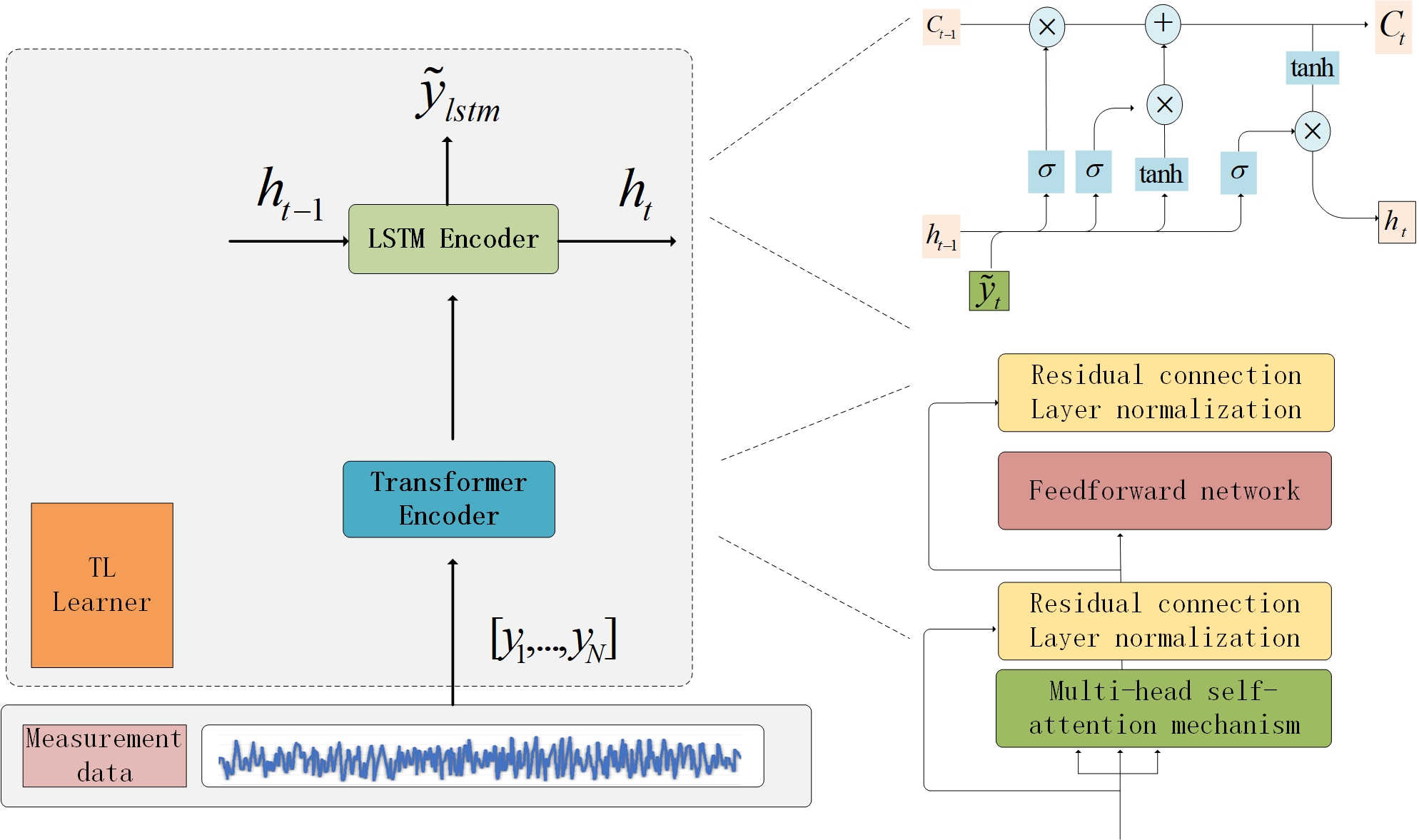
Nowadays, state estimation is widely used in fields such as autonomous driving and drone navigation. However, in practical applications, it is difficult to obtain accurate target motion models and noise covariance.This leads to a decrease in the estimation accuracy of traditional Kalman filters. To address this issue, this paper proposes an adaptive model free state estimation method based on attention parameter learning module. This method combines Transformer's encoder with Long Short Term Memory Network (LSTM), and obtains the system's operational characteristics through offline learning of measurement data without modeling the system dynamics and measurement characteristics. In addition, based on the output of the attention learning module, the expectation maximization (EM) algorithm is used to estimate the system model parameters online, and a Kalman filter is used to obtain state estimation. This paper was validated using the GPS trajectory path dataset, and the experimental results showed that the proposed parameter adaptive model free state estimation method has better estimation accuracy than other models, providing an effective method for using deep learning networks for state estimation.
Graphical Abstract
Keywords
Data Availability Statement
Funding
Conflicts of Interest
Ethical Approval and Consent to Participate
References
- Jason, S., & Marilyn, Wolf. (2015). Tailoring design for embedded computer vision applications. Computer, 48(5), 58-62.
[CrossRef] [Google Scholar] - Freitas, E. J. D. R., Guimarães, M. P., Ramos, J. V., & Júnior, C. D. D. S. (2023, October). A Robotics Club in High School: an experience report. In 2023 Latin American Robotics Symposium (LARS), 2023 Brazilian Symposium on Robotics (SBR), and 2023 Workshop on Robotics in Education (WRE) (pp. 683-688). IEEE.
[CrossRef] [Google Scholar] - Okuyama, T., Gonsalves, T., & Upadhay, J. (2018, March). Autonomous driving system based on deep q learnig. In 2018 International conference on intelligent autonomous systems (ICoIAS) (pp. 201-205). IEEE.
[CrossRef] [Google Scholar] - Kalman, R. (1960). A New Approach to Linear Filtering and Prediction Problems. Journal of Basic Engineering, 82D, 35-45.
[CrossRef] [Google Scholar] - Kalman, R. E., & Bucy, R. S. (1961). New results in linear filtering and prediction theory.
[CrossRef] [Google Scholar] - Xiong, K., Chan, C. W., & Zhang, H. Y. (2005). Unscented Kalman filter for fault detection. IFAC Proceedings Volumes, 38(1), 113-118.
[CrossRef] [Google Scholar] - Arasaratnam, I., & Haykin, S. (2011). Cubature kalman smoothers. Automatica, 47(10), 2245-2250.
[CrossRef] [Google Scholar] - Ghahramani, Z., & Hinton, G. (1996). Parameter Estimation for Linear Dynamical Systems.
[Google Scholar] - Yunita, A., Pratama, M. I., Almuzakki, M. Z., Ramadhan, H., Akhir, E. A. P., Mansur, A. B. F., & Basori, A. H. (2025). Performance analysis of neural network architectures for time series forecasting: A comparative study of RNN, LSTM, GRU, and hybrid models. MethodsX, 15, 103462.
[CrossRef] [Google Scholar] - Vaswani, A., Shazeer, N., Parmar, N., Uszkoreit, J., Jones, L., Gomez, A. N., ... & Polosukhin, I. (2017). Attention is all you need. Advances in neural information processing systems, 30.
[Google Scholar] - Wang, H., & Tu, M. (2020, December). Enhancing attention models via multi-head collaboration. In 2020 International Conference on Asian Language Processing (IALP) (pp. 19-23). IEEE.
[CrossRef] [Google Scholar] - Wang, J., Zhang, W., & Yang, H. (2021). Visual Analytics for RNN-Based Deep Reinforcement Learning. IEEE Transactions on Visualization and Computer Graphics, 28(12), 4141-4155.
[CrossRef] [Google Scholar] - Zhou, X., Shi, J., Gong, K., Zhu, C., Hua, J., & Xu, J. (2021). A Novel Quench Detection Method Based on CNN-LSTM Model. IEEE Transactions on Applied Superconductivity, 31(5), 1-5.
[CrossRef] [Google Scholar] - Huang, H., Zeng, Z., Yao, D., Pei, X., & Zhang, Y. (2021). Spatial-temporal ConvLSTM for vehicle driving intention prediction. Tsinghua Science and Technology, 27(3), 599-609.
[CrossRef] [Google Scholar] - Jin, X. B., Gong, W. T., Kong, J. L., Bai, Y. T., & Su, T. L. (2022). PFVAE: a planar flow-based variational auto-encoder prediction model for time series data. Mathematics, 10(4), 610.
[CrossRef] [Google Scholar]
Cite This Article
TY - JOUR AU - Jin, Xuebo AU - Sun, Tianxiao AU - Chen, Wei AU - Ma, Huijun AU - Wang, Yeqing AU - Zheng, Yusen PY - 2024 DA - 2024/05/29 TI - Parameter Adaptive Non-Model-Based State Estimation Combining Attention Mechanism and LSTM JO - ICCK Transactions on Intelligent Systematics T2 - ICCK Transactions on Intelligent Systematics JF - ICCK Transactions on Intelligent Systematics VL - 1 IS - 1 SP - 40 EP - 48 DO - 10.62762/TIS.2024.137329 UR - https://www.icck.org/article/abs/TIS.2024.137329 KW - state estimation KW - kalman filter KW - transformer KW - LSTM AB - Nowadays, state estimation is widely used in fields such as autonomous driving and drone navigation. However, in practical applications, it is difficult to obtain accurate target motion models and noise covariance.This leads to a decrease in the estimation accuracy of traditional Kalman filters. To address this issue, this paper proposes an adaptive model free state estimation method based on attention parameter learning module. This method combines Transformer's encoder with Long Short Term Memory Network (LSTM), and obtains the system's operational characteristics through offline learning of measurement data without modeling the system dynamics and measurement characteristics. In addition, based on the output of the attention learning module, the expectation maximization (EM) algorithm is used to estimate the system model parameters online, and a Kalman filter is used to obtain state estimation. This paper was validated using the GPS trajectory path dataset, and the experimental results showed that the proposed parameter adaptive model free state estimation method has better estimation accuracy than other models, providing an effective method for using deep learning networks for state estimation. SN - 3068-5079 PB - Institute of Central Computation and Knowledge LA - English ER -
@article{Jin2024Parameter,
author = {Xuebo Jin and Tianxiao Sun and Wei Chen and Huijun Ma and Yeqing Wang and Yusen Zheng},
title = {Parameter Adaptive Non-Model-Based State Estimation Combining Attention Mechanism and LSTM},
journal = {ICCK Transactions on Intelligent Systematics},
year = {2024},
volume = {1},
number = {1},
pages = {40-48},
doi = {10.62762/TIS.2024.137329},
url = {https://www.icck.org/article/abs/TIS.2024.137329},
abstract = {Nowadays, state estimation is widely used in fields such as autonomous driving and drone navigation. However, in practical applications, it is difficult to obtain accurate target motion models and noise covariance.This leads to a decrease in the estimation accuracy of traditional Kalman filters. To address this issue, this paper proposes an adaptive model free state estimation method based on attention parameter learning module. This method combines Transformer's encoder with Long Short Term Memory Network (LSTM), and obtains the system's operational characteristics through offline learning of measurement data without modeling the system dynamics and measurement characteristics. In addition, based on the output of the attention learning module, the expectation maximization (EM) algorithm is used to estimate the system model parameters online, and a Kalman filter is used to obtain state estimation. This paper was validated using the GPS trajectory path dataset, and the experimental results showed that the proposed parameter adaptive model free state estimation method has better estimation accuracy than other models, providing an effective method for using deep learning networks for state estimation.},
keywords = {state estimation, kalman filter, transformer, LSTM},
issn = {3068-5079},
publisher = {Institute of Central Computation and Knowledge}
}
Article Metrics
Publisher's Note
ICCK stays neutral with regard to jurisdictional claims in published maps and institutional affiliations.
Rights and Permissions
Portico