Topic Mining and Sentiment Analysis for Consumer Reviews of Automotive Spare Parts on E-commerce Platforms



Article Information
Abstract
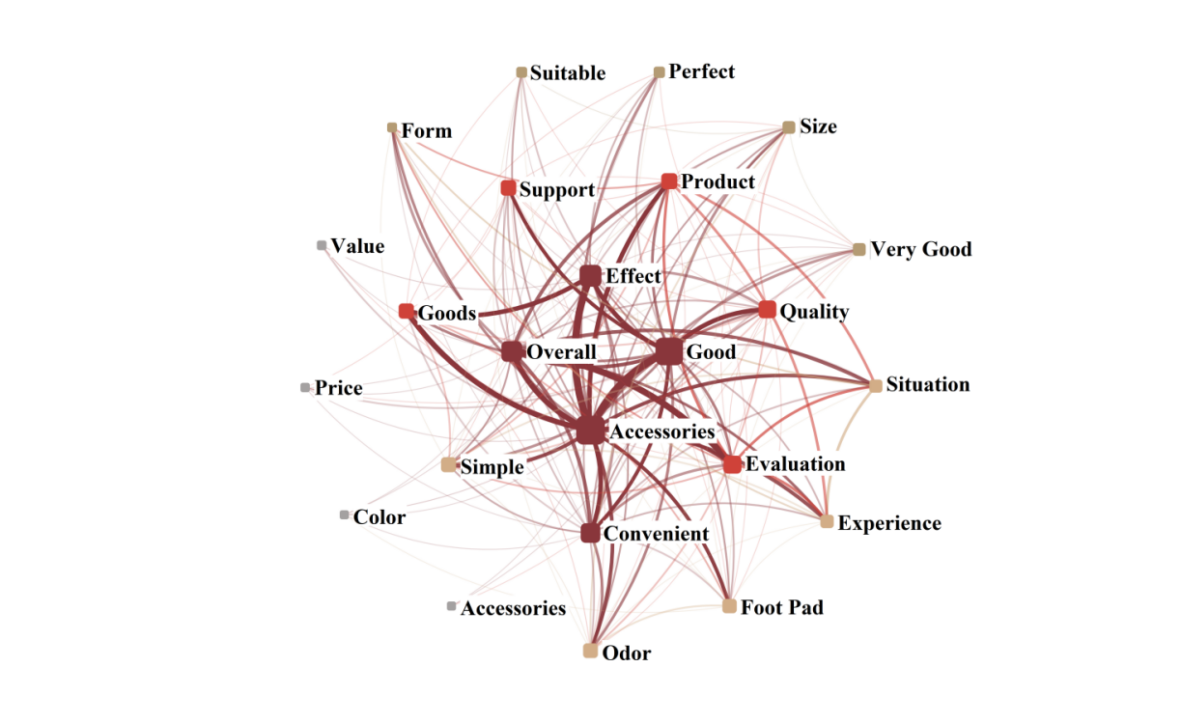
Consumer satisfaction in automotive spare parts e-commerce is shaped by multidimensional factors that are difficult to quantify through conventional survey methods. This paper presents an intelligent text mining framework that integrates multiple machine learning and natural language processing techniques to systematically extract and analyze consumer sentiment from 1,236 validated Taobao reviews. Specifically, TF-IDF (Term Frequency-Inverse Document Frequency) is employed for discriminative keyword extraction, semantic network analysis is applied to model inter-word relational structures, and LDA (Latent Dirichlet Allocation) topic modeling is used to discover latent thematic patterns, identifying four core satisfaction dimensions: Logistics, Quality, Price, and Customer Service. For sentiment quantification, a domain-adaptive SnowNLP model based on the Naive Bayes algorithm is fine-tuned on a domain-specific automotive e-commerce corpus, achieving an accuracy improvement from 11.4% to 83.1%. Additionally, a domain-specific sentiment lexicon is constructed via the SO-PMI (Semantic Orientation-Pointwise Mutual Information) method to enhance lexicon-level sentiment scoring. The integrated intelligent analysis reveals that positive sentiment is predominantly driven by logistics efficiency and product reliability, while negative sentiment concentrates on installation complexity and service knowledge deficiencies. The proposed system provides an automated, domain-adaptable intelligent pipeline for e-commerce opinion mining, with demonstrated applicability to the automotive spare parts domain, offering data-driven decision support for product optimization and service quality improvement.
Graphical Abstract
Keywords
Data Availability Statement
Funding
Conflicts of Interest
Ethical Approval and Consent to Participate
References
- Blei, D. M., Ng, A. Y., & Jordan, M. I. (2003). Latent dirichlet allocation. Journal of machine Learning research, 3(Jan), 993-1022.
[Google Scholar] - Zhang, S., Zhou, C., & Liu, Y. (2020). Consumer purchasing intentions and marketing segmentation of remanufactured new‐energy auto parts in China. Mathematical Problems in Engineering, 2020(1), 5647383.
[CrossRef] [Google Scholar] - Mohamad Sheriff, N., Roslan, N. I., & Yusoff, Y. (2020). Determinants of satisfaction for automotive after sales service quality: A preliminary application of AutoSERVPERF model. Jurnal Intelek, 15(2), 197-208. https://ir.uitm.edu.my/id/eprint/69285
[Google Scholar] - Gajewska, T., Zimon, D., Kaczor, G., & Madzík, P. (2020). The impact of the level of customer satisfaction on the quality of e-commerce services. International Journal of Productivity and Performance Management, 69(4), 666-684.
[CrossRef] [Google Scholar] - Celuch, K. (2021). Customers' experience of purchasing event tickets: mining online reviews based on topic modeling and sentiment analysis. International Journal of Event and Festival Management, 12(1), 36-50.
[CrossRef] [Google Scholar] - Turney, P. (2002, July). Thumbs up or thumbs down? Semantic orientation applied to unsupervised classification of reviews. In Proceedings of the 40th annual meeting of the Association for Computational Linguistics (pp. 417-424).
[Google Scholar] - Churchill, R., & Singh, L. (2022). The evolution of topic modeling. ACM Computing Surveys, 54(10s), 1-35.
[CrossRef] [Google Scholar] - Havrlant, L., & Kreinovich, V. (2017). A simple probabilistic explanation of term frequency-inverse document frequency (tf-idf) heuristic (and variations motivated by this explanation). International Journal of General Systems, 46(1), 27-36.
[CrossRef] [Google Scholar] - Jain, S., Jain, S. K., & Vasal, S. (2024, April). An effective TF-IDF model to improve the text classification performance. In 2024 IEEE 13th International Conference on Communication Systems and Network Technologies (CSNT) (pp. 1-4). IEEE.
[CrossRef] [Google Scholar] - Alemerien, K., Al-Ghareeb, A., & Alksasbeh, M. Z. (2024). Sentiment analysis of online reviews: a machine learning based approach with TF-IDF vectorization. Journal of Mobile Multimedia, 20(5), 1089-1116.
[CrossRef] [Google Scholar] - Bodendorf, F., & Kaiser, C. (2010, January). Mining customer opinions on the internet-a case study in the automotive industry. In 2010 Third International Conference on Knowledge Discovery and Data Mining (pp. 24-27). IEEE.
[CrossRef] [Google Scholar] - Jelodar, H., Wang, Y., Yuan, C., Feng, X., Jiang, X., Li, Y., & Zhao, L. (2019). Latent Dirichlet allocation (LDA) and topic modeling: models, applications, a survey. Multimedia tools and applications, 78, 15169-15211.
[CrossRef] [Google Scholar] - Wallach, H., Mimno, D., & McCallum, A. (2009). Rethinking LDA: Why priors matter. Advances in neural information processing systems, 22.
[Google Scholar] - Pavlinek, M., & Podgorelec, V. (2017). Text classification method based on self-training and LDA topic models. Expert Systems with Applications, 80, 83-93.
[CrossRef] [Google Scholar] - Lu, S., Liu, Q., & Zhang, Z. (2023, July). Sentiment analysis of Weibo platform based on LDA-SnowNLP Model. In 2023 2nd International Conference on Machine Learning, Cloud Computing and Intelligent Mining (MLCCIM) (pp. 505-510). IEEE.
[CrossRef] [Google Scholar] - Salehan, M., & Kim, D. J. (2016). Predicting the performance of online consumer reviews: A sentiment mining approach to big data analytics. Decision Support Systems, 81, 30-40.
[CrossRef] [Google Scholar] - Xu, F., Pan, Z., & Xia, R. (2020). E-commerce product review sentiment classification based on a naïve Bayes continuous learning framework. Information Processing & Management, 57(5), 102221.
[CrossRef] [Google Scholar] - Wang, M., You, H., Ma, H., Sun, X., & Wang, Z. (2023). Sentiment analysis of online new energy vehicle reviews. Applied Sciences, 13(14), 8176.
[CrossRef] [Google Scholar] - Dhaoui, C., Webster, C. M., & Tan, L. P. (2017). Social media sentiment analysis: lexicon versus machine learning. Journal of Consumer Marketing, 34(6), 480-488.
[CrossRef] [Google Scholar] - Qazi, A., Tamjidyamcholo, A., Raj, R. G., Hardaker, G., & Standing, C. (2017). Assessing consumers' satisfaction and expectations through online opinions: Expectation and disconfirmation approach. Computers in Human Behavior, 75, 450-460.
[CrossRef] [Google Scholar] - Kim, E. G., & Chun, S. H. (2019). Analyzing online car reviews using text mining. Sustainability, 11(6), 1611.
[CrossRef] [Google Scholar] - Wang, X., Lv, T., & Fan, L. (2022). New energy vehicle consumer demand mining research based on fusion topic model: A case in China. Sustainability, 14(6), 3316.
[CrossRef] [Google Scholar] - He, S., & Wang, Y. (2023). Evaluating new energy vehicles by picture fuzzy sets based on sentiment analysis from online reviews. Artificial Intelligence Review, 56(3), 2171-2192.
[CrossRef] [Google Scholar] - Liu, Y., Lu, J., Yang, J., & Mao, F. (2020). Sentiment analysis for e-commerce product reviews by deep learning model of Bert-BiGRU-Softmax. Mathematical Biosciences and Engineering, 17(6), 7819-7837.
[CrossRef] [Google Scholar]
Cited By (3)
-
Hugo Pérez-Moure, Jesús F. Lampón, Miguel A. Crespo-Velando, M. Mar Rodríguez-Domínguez. E-commerce, servitization and digital transformation in the automotive industry.
Electronic Commerce Research, 2026 .
[CrossRef] -
Mariana Akemi Ikegawa Bernabé, Rafael González Perea, Juan Antonio Rodríguez Díaz, Jorge García Morillo. Transformer-based artificial intelligence for forecasting energy demand in irrigation districts.
Computers and Electronics in Agriculture, 2026 , 246 .
[CrossRef] -
Qingchuan Zhang, Zexi Song, Delong Wang, Yuanyuan Cai, Mingwen Bi, Min Zuo. Named entity recognition and coreference resolution using prompt-based generative multimodal.
Complex & Intelligent Systems, 2026 , 12 (1).
[CrossRef]
Cite This Article
TY  - JOUR
AU  - Zeng, Minling
AU  - Deng, Xiaoli
PY  - 2025
DA  - 2025/07/09
TI  - Topic Mining and Sentiment Analysis for Consumer Reviews of Automotive Spare Parts on E-commerce Platforms
JO  - ICCK Transactions on Intelligent Systematics
T2  - ICCK Transactions on Intelligent Systematics
JF  - ICCK Transactions on Intelligent Systematics
VL  - 2
IS  - 3
SP  - 137
EP  - 148
DO  - 10.62762/TIS.2025.106283
UR  - https://www.icck.org/article/abs/tis.2025.106283
KW  - machine learning
KW  - natural language processing
KW  - LDA topic modeling
KW  - text classification
KW  - sentiment analysis
KW  - text mining
AB  - Consumer satisfaction in automotive spare parts e-commerce is shaped by multidimensional factors that are difficult to quantify through conventional survey methods. This paper presents an intelligent text mining framework that integrates multiple machine learning and natural language processing techniques to systematically extract and analyze consumer sentiment from 1,236 validated Taobao reviews. Specifically, TF-IDF (Term Frequency-Inverse Document Frequency) is employed for discriminative keyword extraction, semantic network analysis is applied to model inter-word relational structures, and LDA (Latent Dirichlet Allocation) topic modeling is used to discover latent thematic patterns, identifying four core satisfaction dimensions: Logistics, Quality, Price, and Customer Service. For sentiment quantification, a domain-adaptive SnowNLP model based on the Naive Bayes algorithm is fine-tuned on a domain-specific automotive e-commerce corpus, achieving an accuracy improvement from 11.4% to 83.1%. Additionally, a domain-specific sentiment lexicon is constructed via the SO-PMI (Semantic Orientation-Pointwise Mutual Information) method to enhance lexicon-level sentiment scoring. The integrated intelligent analysis reveals that positive sentiment is predominantly driven by logistics efficiency and product reliability, while negative sentiment concentrates on installation complexity and service knowledge deficiencies. The proposed system provides an automated, domain-adaptable intelligent pipeline for e-commerce opinion mining, with demonstrated applicability to the automotive spare parts domain, offering data-driven decision support for product optimization and service quality improvement.
SN  - 3068-5079
PB  - Institute of Central Computation and Knowledge
LA  - English
ER  -
@article{Zeng2025Topic,
  author = {Minling Zeng and Xiaoli Deng},
  title = {Topic Mining and Sentiment Analysis for Consumer Reviews of Automotive Spare Parts on E-commerce Platforms},
  journal = {ICCK Transactions on Intelligent Systematics},
  year = {2025},
  volume = {2},
  number = {3},
  pages = {137-148},
  doi = {10.62762/TIS.2025.106283},
  url = {https://www.icck.org/article/abs/tis.2025.106283},
  abstract = {Consumer satisfaction in automotive spare parts e-commerce is shaped by multidimensional factors that are difficult to quantify through conventional survey methods. This paper presents an intelligent text mining framework that integrates multiple machine learning and natural language processing techniques to systematically extract and analyze consumer sentiment from 1,236 validated Taobao reviews. Specifically, TF-IDF (Term Frequency-Inverse Document Frequency) is employed for discriminative keyword extraction, semantic network analysis is applied to model inter-word relational structures, and LDA (Latent Dirichlet Allocation) topic modeling is used to discover latent thematic patterns, identifying four core satisfaction dimensions: Logistics, Quality, Price, and Customer Service. For sentiment quantification, a domain-adaptive SnowNLP model based on the Naive Bayes algorithm is fine-tuned on a domain-specific automotive e-commerce corpus, achieving an accuracy improvement from 11.4\% to 83.1\%. Additionally, a domain-specific sentiment lexicon is constructed via the SO-PMI (Semantic Orientation-Pointwise Mutual Information) method to enhance lexicon-level sentiment scoring. The integrated intelligent analysis reveals that positive sentiment is predominantly driven by logistics efficiency and product reliability, while negative sentiment concentrates on installation complexity and service knowledge deficiencies. The proposed system provides an automated, domain-adaptable intelligent pipeline for e-commerce opinion mining, with demonstrated applicability to the automotive spare parts domain, offering data-driven decision support for product optimization and service quality improvement.},
  keywords = {machine learning, natural language processing, LDA topic modeling, text classification, sentiment analysis, text mining},
  issn = {3068-5079},
  publisher = {Institute of Central Computation and Knowledge}
}
Publisher's Note
ICCK stays neutral with regard to jurisdictional claims in published maps and institutional affiliations.
Rights and Permissions


Portico