
Volume 2, Issue 1, ICCK Transactions on Information Security and Cryptography
Volume 2, Issue 1, 2026
Submit Manuscript Edit a Special Issue
Article QR Code
Article QR Code
Scan the QR code for reading
Popular articles
ICCK Transactions on Information Security and Cryptography, Volume 2, Issue 1, 2026: 43-54

Free to Read | Research Article | 10 February 2026
Optimized Copyright Protection of Scale-Adaptive Saliency-Driven ROI of Medical Records with MSER-Based authentication
1 Department of Electronics and Communication Engineering, GLA University, Mathura 281406, India
2 Department of Electronics and Communication Engineering, Motilal Nehru National Institute of Technology Allahabad, Prayagraj, Uttar Pradesh 211004, India
* Corresponding Author: Divyanshu Awasthi, [email protected]
ARK: ark:/57805/tisc.2025.898154
Received: 10 December 2025, Accepted: 06 January 2026, Published: 10 February 2026  
Abstract
The medical information is always vulnerable to security violations. After the COVID-19 pandemic, the volume of medical information has exponentially increased and the major information is in the form of images. So, the security of this image information is crucial during the transfer using modern information and communication technologies from one place to another. Image watermarking is one of the methods to protect the copyright and integrity of medical records. The medical images consist of some area that has vital information regarding the disease and this area will be considered as the region of interest (ROI). Therefore, the protection of the copyright of this vital area is crucial for the effective diagnosis. The proposed technique utilizes a scale-adaptive anatomical saliency and a statistical information-guided ROI detection technique. The redundant wavelet transform (RDWT) and diagonalized Hessenberg decomposition (Diag-HD), along with the discrete cosine transform (DCT), are used for watermark embedding and extraction procedures. To get the optimized scaling weight, nature-inspired Salp Swarm Optimization (SSO) is used. Maximally stable extremal regions (MSER) are used for feature-based authentication. The simulation results analysis demonstrates the effectiveness in terms of visual similarity and robustness of the proposed technique. The experimental results obtained also highlight the superiority of the proposed technique over other existing methods in terms of imperceptibility and robustness.

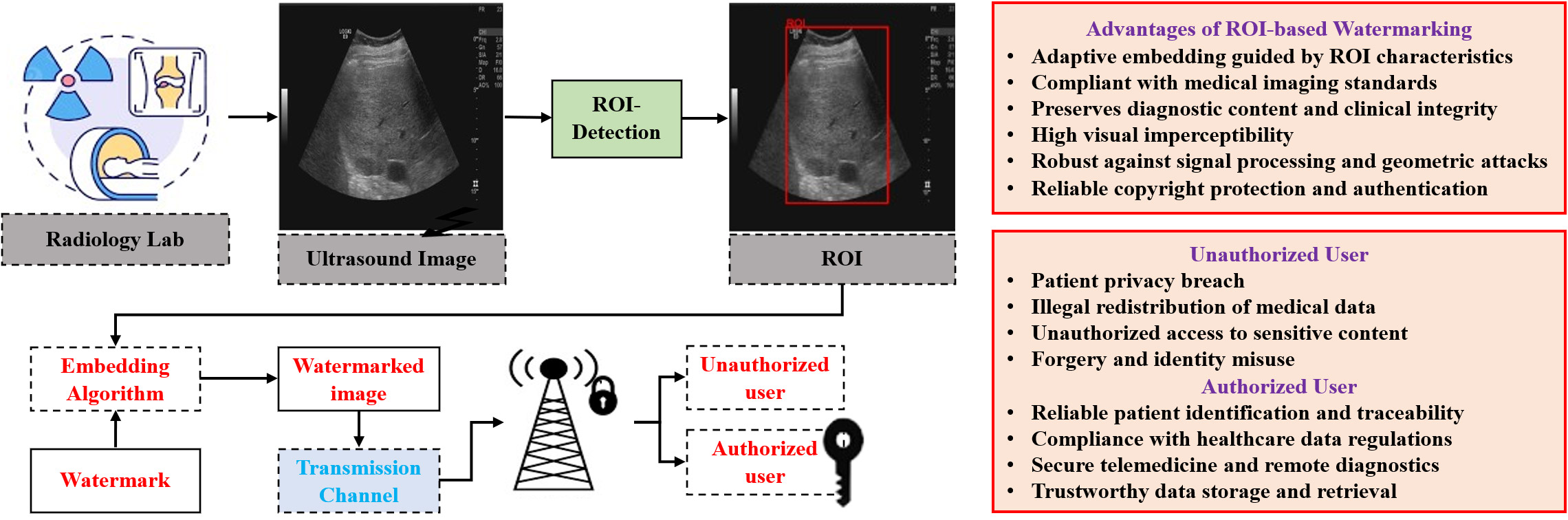
Graphical Abstract
Optimized Copyright Protection of Scale-Adaptive Saliency-Driven ROI of Medical Records with MSER-Based authentication

Keywords
region of interest
watermarking
optimization
authentication

Data Availability Statement
Data will be made available on request.

Funding
This work was supported without any funding.

Conflicts of Interest
The authors declare no conflicts of interest.

AI Use Statement
The authors declare that no generative AI was used in the preparation of this manuscript.

Ethical Approval and Consent to Participate
Not applicable.

References
  1. Tiwari, A., Awasthi, D., & Srivastava, V. K. (2025). RFPPFMark: robust and false positive problem free image watermarking scheme with its performance comparison by PSO and MRFO in Schur domain. Signal, Image and Video Processing, 19(3), 199.
    [CrossRef]   [Google Scholar]
  2. Singh, H. K., Baranwal, N., Singh, K. N., & Singh, A. K. (2024). Using multimodal biometric fusion for watermarking of multiple images. IEEE Transactions on Consumer Electronics, 70(1), 3487-3494.
    [CrossRef]   [Google Scholar]
  3. Singh, H. K., Singh, K. N., & Singh, A. K. (2025). Split ways: Using GAN watermarking for digital image protection with privacy-preserving split model training. Future Generation Computer Systems, 163, 107523.
    [CrossRef]   [Google Scholar]
  4. Castelli, M., Manzoni, L., Mariot, L., Nobile, M. S., & Tangherloni, A. (2022). Salp swarm optimization: a critical review. Expert Systems with Applications, 189, 116029.
    [CrossRef]   [Google Scholar]
  5. Abualigah, L., Shehab, M., Alshinwan, M., & Alabool, H. (2020). Salp swarm algorithm: A comprehensive survey. Neural Computing and Applications, 32(15), 11195-11215.
    [CrossRef]   [Google Scholar]
  6. Kimmel, R., Zhang, C., Bronstein, A., & Bronstein, M. (2011). Are MSER features really interesting?. IEEE Transactions on Pattern Analysis and Machine Intelligence, 33(11), 2316-2320.
    [CrossRef]   [Google Scholar]
  7. Eswaraiah, R., & Sreenivasa Reddy, E. (2014). Medical image watermarking technique for accurate tamper detection in ROI and exact recovery of ROI. International Journal of Telemedicine and Applications, 2014(1), 984646.
    [CrossRef]   [Google Scholar]
  8. Ravichandran, D., Praveenkumar, P., Rajagopalan, S., Rayappan, J. B. B., & Amirtharajan, R. (2021). ROI-based medical image watermarking for accurate tamper detection, localisation and recovery. Medical & Biological Engineering & Computing, 59(6), 1355-1372.
    [CrossRef]   [Google Scholar]
  9. Das, S., & Kundu, M. K. (2013). Effective management of medical information through ROI-lossless fragile image watermarking technique. Computer Methods and Programs in Biomedicine, 111(3), 662-675.
    [CrossRef]   [Google Scholar]
  10. Eswaraiah, R., & Sreenivasa Reddy, E. (2015). Robust medical image watermarking technique for accurate detection of tampers inside region of interest and recovering original region of interest. IET Image Processing, 9(8), 615-625.
    [CrossRef]   [Google Scholar]
  11. Keshavarzian, R., & Aghagolzadeh, A. (2016). ROI based robust and secure image watermarking using DWT and Arnold map. AEU-International Journal of Electronics and Communications, 70(3), 278-288.
    [CrossRef]   [Google Scholar]
  12. Bhalerao, S., Ansari, I. A., & Kumar, A. (2023). A reversible medical image watermarking for ROI tamper detection and recovery. Circuits, Systems, and Signal Processing, 42(11), 6701-6725.
    [CrossRef]   [Google Scholar]
  13. Awasthi, D., & Srivastava, V. K. (2025). ROI-based optimized image watermarking with real-time authentication. Cluster Computing, 28(7), 463.
    [CrossRef]   [Google Scholar]
  14. Qasim, A. F., Aspin, R., Meziane, F., & Hogg, P. (2019). ROI-based reversible watermarking scheme for ensuring the integrity and authenticity of DICOM MR images. Multimedia Tools and Applications, 78(12), 16433-16463.
    [CrossRef]   [Google Scholar]
  15. Alshanbari, H. S. (2021). Medical image watermarking for ownership & tamper detection. Multimedia Tools and Applications, 80(11), 16549-16564.
    [CrossRef]   [Google Scholar]
  16. Awasthi, D., Khare, P., Srivastava, V. K., Singh, A. K., & Gupta, B. B. (2025). DeepNet: Protection of deepfake images with aid of deep learning networks. Image and Vision Computing, 158, 105540.
    [CrossRef]   [Google Scholar]
  17. Awasthi, D., Khare, P., & Srivastava, V. K. (2025). ANFISmark: ANFIS-based secure watermarking approach for telemedicine applications. Neural Computing and Applications, 37(14), 8677-8698.
    [CrossRef]   [Google Scholar]
  18. Dwivedi, R., Awasthi, D., & Srivastava, V. K. (2025). WSOMedMark: Robust and optimized dual image watermarking using RDWT and its authentication using BRISK and MSER features for smart healthcare system. Multimedia Tools and Applications, 84(14), 13653-13690.
    [CrossRef]   [Google Scholar]
  19. Singh, H., Deshmukh, M., & Awasthi, L. K. (2025). Secure healthcare data management using multimodal image fusion and dual watermarking. Scientific Reports, 15(1), 9047.
    [CrossRef]   [Google Scholar]
  20. Saïd, B. A., Ali, W., Amine, K., Redouane, K. M., & Sahu, A. K. (2025). Robust medical image watermarking based on Ridgelet transform and Ant Colony Optimization for telemedicine security. Systems and Soft Computing, 200390.
    [CrossRef]   [Google Scholar]
  21. Gupta, A. K., Chakraborty, C., & Gupta, B. (2025). Bio-inspired optimization based secure model for watermarking of medical data. Multimedia Tools and Applications, 1-31.
    [CrossRef]   [Google Scholar]
  22. Zhang, G. D., Zhang, Z. X., Li, J. Y., Guo, Y., Ding, H., Xi, X. T., ... & Han, Y. C. (2025). Robust Image Watermarking in Wavelet Domain using RDWT-HD-SVD and Whale Optimization Algorithm. Circuits, Systems, and Signal Processing, 44(4), 2681-2705.
    [CrossRef]   [Google Scholar]
  23. Tiwari, A., & Srivastava, V. K. (2025). MIWHSmark: Multiple Image Watermarking Based on Hybrid Technique in Schur Domain for Smart Healthcare System. Circuits, Systems, and Signal Processing, 1-38.
    [CrossRef]   [Google Scholar]
  24. Mirjalili, S., Gandomi, A. H., Mirjalili, S. Z., Saremi, S., Faris, H., & Mirjalili, S. M. (2017). Salp swarm algorithm: A bio-inspired optimizer for engineering design problems. Advances in Engineering Software, 114, 163-191.
    [CrossRef]   [Google Scholar]
  25. Anand, A., & Singh, A. K. (2022). Hybrid nature-inspired optimization and encryption-based watermarking for e-healthcare. IEEE Transactions on Computational Social Systems, 10(4), 2033-2040.
    [CrossRef]   [Google Scholar]
  26. Anand, A., & Singh, A. K. (2022). Dual watermarking for security of COVID-19 patient record. IEEE Transactions on Dependable and Secure Computing, 20(1), 859-866.
    [CrossRef]   [Google Scholar]
  27. Clark, K., Vendt, B., Smith, K., Freymann, J., Kirby, J., Koppel, P., ... & Tarbox, L. (2013). The Cancer Imaging Archive (TCIA): Maintaining and operating a public information repository. Journal of Digital Imaging, 26(6), 1045-1057.
    [CrossRef]   [Google Scholar]
  28. Anand, A., Singh, A. K., Lv, Z., & Bhatnagar, G. (2020). Compression-then-encryption-based secure watermarking technique for smart healthcare system. IEEE MultiMedia, 27(4), 133-143.
    [CrossRef]   [Google Scholar]

Cite This Article
APA Style
Awasthi, D., & Srivastava, V. K. (2026). Optimized Copyright Protection of Scale-Adaptive Saliency-Driven ROI of Medical Records with MSER-Based authentication. ICCK Transactions on Information Security and Cryptography, 2(1), 43–54. https://doi.org/10.62762/TISC.2025.898154
Export Citation
RIS Format
Compatible with EndNote, Zotero, Mendeley, and other reference managers
RIS format data for reference managers
TY  - JOUR
AU  - Awasthi, Divyanshu
AU  - Srivastava, Vinay Kumar
PY  - 2026
DA  - 2026/02/10
TI  - Optimized Copyright Protection of Scale-Adaptive Saliency-Driven ROI of Medical Records with MSER-Based authentication
JO  - ICCK Transactions on Information Security and Cryptography
T2  - ICCK Transactions on Information Security and Cryptography
JF  - ICCK Transactions on Information Security and Cryptography
VL  - 2
IS  - 1
SP  - 43
EP  - 54
DO  - 10.62762/TISC.2025.898154
UR  - https://www.icck.org/article/abs/TISC.2025.898154
KW  - region of interest
KW  - watermarking
KW  - optimization
KW  - authentication
AB  - The medical information is always vulnerable to security violations. After the COVID-19 pandemic, the volume of medical information has exponentially increased and the major information is in the form of images. So, the security of this image information is crucial during the transfer using modern information and communication technologies from one place to another. Image watermarking is one of the methods to protect the copyright and integrity of medical records. The medical images consist of some area that has vital information regarding the disease and this area will be considered as the region of interest (ROI). Therefore, the protection of the copyright of this vital area is crucial for the effective diagnosis. The proposed technique utilizes a scale-adaptive anatomical saliency and a statistical information-guided ROI detection technique. The redundant wavelet transform (RDWT) and diagonalized Hessenberg decomposition (Diag-HD), along with the discrete cosine transform (DCT), are used for watermark embedding and extraction procedures. To get the optimized scaling weight, nature-inspired Salp Swarm Optimization (SSO) is used. Maximally stable extremal regions (MSER) are used for feature-based authentication. The simulation results analysis demonstrates the effectiveness in terms of visual similarity and robustness of the proposed technique. The experimental results obtained also highlight the superiority of the proposed technique over other existing methods in terms of imperceptibility and robustness.
SN  - 3070-2429
PB  - Institute of Central Computation and Knowledge
LA  - English
ER  - 
BibTeX Format
Compatible with LaTeX, BibTeX, and other reference managers
BibTeX format data for LaTeX and reference managers
@article{Awasthi2026Optimized,
  author = {Divyanshu Awasthi and Vinay Kumar Srivastava},
  title = {Optimized Copyright Protection of Scale-Adaptive Saliency-Driven ROI of Medical Records with MSER-Based authentication},
  journal = {ICCK Transactions on Information Security and Cryptography},
  year = {2026},
  volume = {2},
  number = {1},
  pages = {43-54},
  doi = {10.62762/TISC.2025.898154},
  url = {https://www.icck.org/article/abs/TISC.2025.898154},
  abstract = {The medical information is always vulnerable to security violations. After the COVID-19 pandemic, the volume of medical information has exponentially increased and the major information is in the form of images. So, the security of this image information is crucial during the transfer using modern information and communication technologies from one place to another. Image watermarking is one of the methods to protect the copyright and integrity of medical records. The medical images consist of some area that has vital information regarding the disease and this area will be considered as the region of interest (ROI). Therefore, the protection of the copyright of this vital area is crucial for the effective diagnosis. The proposed technique utilizes a scale-adaptive anatomical saliency and a statistical information-guided ROI detection technique. The redundant wavelet transform (RDWT) and diagonalized Hessenberg decomposition (Diag-HD), along with the discrete cosine transform (DCT), are used for watermark embedding and extraction procedures. To get the optimized scaling weight, nature-inspired Salp Swarm Optimization (SSO) is used. Maximally stable extremal regions (MSER) are used for feature-based authentication. The simulation results analysis demonstrates the effectiveness in terms of visual similarity and robustness of the proposed technique. The experimental results obtained also highlight the superiority of the proposed technique over other existing methods in terms of imperceptibility and robustness.},
  keywords = {region of interest, watermarking, optimization, authentication},
  issn = {3070-2429},
  publisher = {Institute of Central Computation and Knowledge}
}

Article Metrics
Citations:

Crossref

0

Scopus

0

Web of Science

0
Article Access Statistics:
Views: 23
PDF Downloads: 11

Publisher's Note
ICCK stays neutral with regard to jurisdictional claims in published maps and institutional affiliations.

Rights and Permissions
Institute of Central Computation and Knowledge (ICCK) or its licensor (e.g. a society or other partner) holds exclusive rights to this article under a publishing agreement with the author(s) or other rightsholder(s); author self-archiving of the accepted manuscript version of this article is solely governed by the terms of such publishing agreement and applicable law.
ICCK Transactions on Information Security and Cryptography

ICCK Transactions on Information Security and Cryptography

ISSN: 3070-2429 (Online)

Email: [email protected]

Portico

Portico

All published articles are preserved here permanently:
https://www.portico.org/publishers/icck/