

Exploring the Frontiers of Neural Computing: Innovations, Architectures, and Applications in Intelligent Systems




Article Information
Abstract
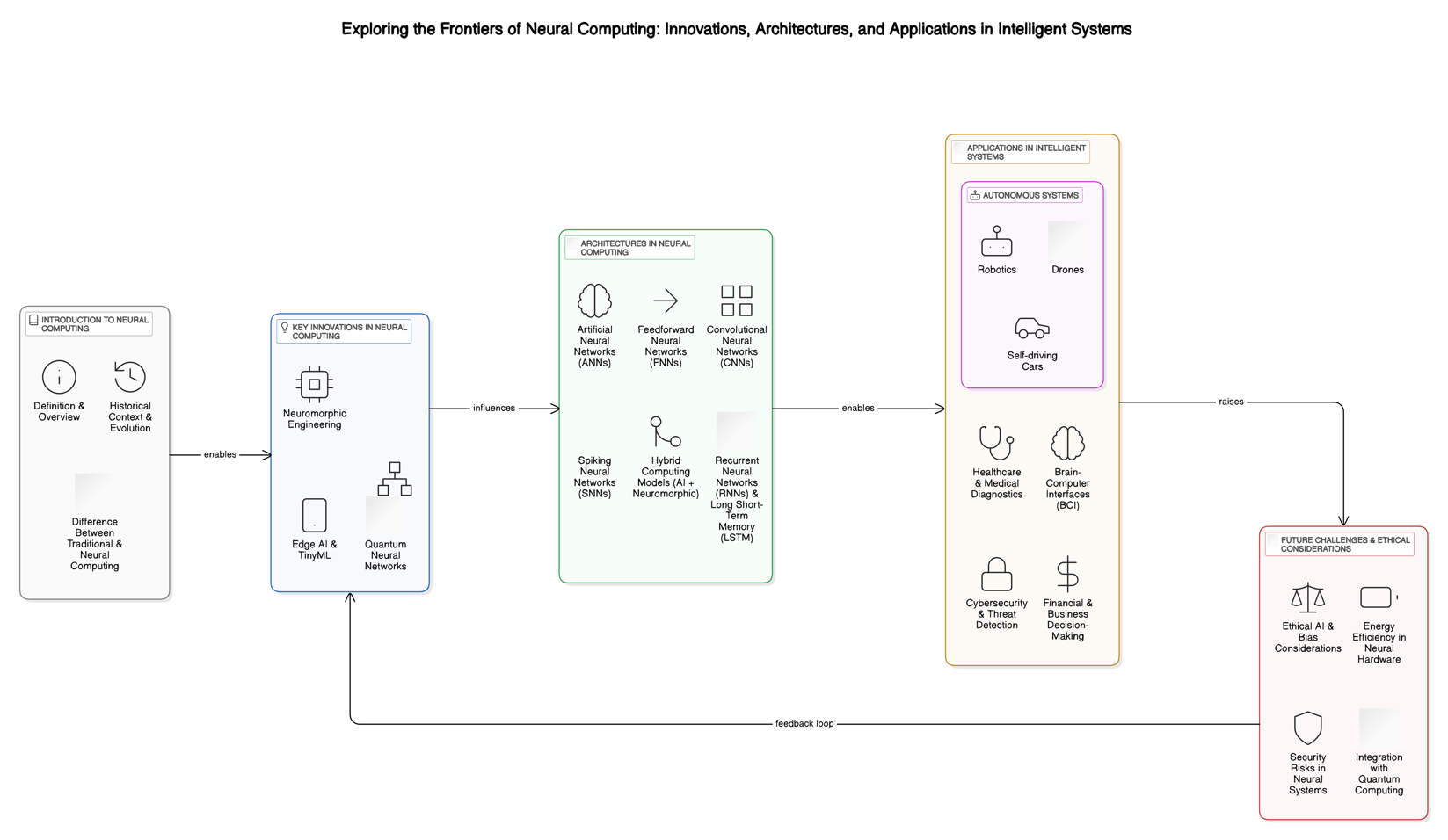
Neural computing, as an influential factor of artificial intelligence, is an industry that has managed to achieve an extensive array of innovations. This paper presents an overview of the recent advancements in the field of neural computing, which are focused on state-of-the-art architectures, novel computational paradigms, and their applications in intelligent systems. The paper traces the development of neural networks, from the original artificial neural network (ANN) through deep learning models and on to neuromorphic computing. In other words, the main points of emphasis are breakthroughs in hardware acceleration, hybrid models, and bio-inspired computing, which are responsible for intelligent systems moving to the next generation. This paper also sheds light on how neural computing is ushering in innovations in healthcare, autonomous vehicles, and natural language processing indicating its capacity to influence the decision-making and automation process. It also considers issues related to scalability, interpretability, and ethical issues of neural computing. The goal of the paper is to illustrate the future course of neural computing and its role in advancing AI-driven technologies via an in-depth presentation of the above fields.
Graphical Abstract
Keywords
Data Availability Statement
Funding
Conflicts of Interest
Ethical Approval and Consent to Participate
References
- Nayak, P. K., Singh, R. S., Kushwaha, S., Bevara, P. K., Kumar, V., & Medara, R. (2024). Efficient task scheduling on the cloud using artificial neural network and particle swarm optimization. Concurrency and Computation: Practice and Experience, 36(6), e7954.
[CrossRef] [Google Scholar] - Alzahrani, A., & Khan, R. A. (2024). Secure software design evaluation and decision making model for ubiquitous computing: A two-stage ANN-Fuzzy AHP approach. Computers in Human Behavior, 153, 108109.
[CrossRef] [Google Scholar] - Singh, B., Sihag, P., Singh, V. P., Sepahvand, A., & Singh, K. (2021). Soft computing technique-based prediction of water quality index. Water Supply, 21(8), 4015-4029.
[CrossRef] [Google Scholar] - Cao, Y., Zandi, Y., Agdas, A. S., Wang, Q., Qian, X., Fu, L., ... & Roco-Videla, A. (2021). A review study of application of artificial intelligence in construction management and composite beams. Steel and Composite Structures, An International Journal, 39(6), 685-700.
[CrossRef] [Google Scholar] - Yang, X., Guan, J., Ding, L., You, Z., Lee, V. C., Hasan, M. R. M., & Cheng, X. (2021). Research and applications of artificial neural network in pavement engineering: A state-of-the-art review. Journal of Traffic and Transportation Engineering (English Edition), 8(6), 1000-1021.
[CrossRef] [Google Scholar] - Arri, H. S., Singh, R., Jha, S., Prashar, D., Joshi, G. P., & Doo, I. C. (2021). Optimized task group aggregation-based overflow handling on fog computing environment using neural computing. Mathematics, 9(19), 2522.
[CrossRef] [Google Scholar] - Mu, H., He, F., Yuan, L., Hatamian, H., Commins, P., & Pan, Z. (2024). Online distortion simulation using generative machine learning models: A step toward digital twin of metallic additive manufacturing. Journal of Industrial Information Integration, 38, 100563.
[CrossRef] [Google Scholar] - Naqi, M., Kim, T., Cho, Y., Pujar, P., Park, J., & Kim, S. (2024). Large scale integrated IGZO crossbar memristor array based artificial neural architecture for scalable in-memory computing. Materials Today Nano, 25, 100441.
[CrossRef] [Google Scholar] - Bhattacharya, A., & Majumdar, P. (2024). Artificial intelligence-machine learning algorithms for the simulation of combustion thermal analysis. Heat Transfer Engineering, 45(2), 176-193.
[CrossRef] [Google Scholar] - Bilal, B., Yetilmezsoy, K., & Ouassaid, M. (2024). Benchmarking of Various Flexible Soft-Computing Strategies for the Accurate Estimation of Wind Turbine Output Power. Energies, 17(3), 697.
[CrossRef] [Google Scholar] - Mougkogiannis, P., & Adamatzky, A. (2024). On interaction of proteinoids with simulated neural networks. BioSystems, 237, 105175.
[CrossRef] [Google Scholar] - Li, H., Fan, L., Gao, Y., Liu, Z., & Gao, P. (2024). Coupling video vision transformer (ViVit) into land change simulation: a comparison with three-dimensional convolutional neural network (3DCNN). Journal of Spatial Science, 69(3), 873-895.
[CrossRef] [Google Scholar] - Di Giacomo, S., Ronchi, M., Carminati, M., & Fiorini, C. (2023, September). Towards Analog Neural Networks Integrated in Detectors Readout. In Annual Meeting of the Italian Electronics Society (pp. 60-65). Cham: Springer Nature Switzerland.
[CrossRef] [Google Scholar] - Kwak, H., Kim, N., Jeon, S., Kim, S., & Woo, J. (2024). Electrochemical random-access memory: recent advances in materials, devices, and systems towards neuromorphic computing. Nano Convergence, 11(1), 9.
[CrossRef] [Google Scholar] - Taleshi, M. M., Tajik, N., Mahmoudian, A., & Yekrangnia, M. (2024). Prediction of pull-out behavior of timber glued-in glass fiber reinforced polymer and steel rods under various environmental conditions based on ANN and GEP models. Case Studies in Construction Materials, 20, e02842.
[CrossRef] [Google Scholar] - Nandhakumar, A. R., Baranwal, A., Choudhary, P., Golec, M., & Gill, S. S. (2024). EdgeAISim: A toolkit for simulation and modelling of AI models in edge computing environments. Measurement: Sensors, 31, 100939.
[CrossRef] [Google Scholar] - Smolensky, P., McCoy, R., Fernandez, R., Goldrick, M., & Gao, J. (2022). Neurocompositional computing: From the central paradox of cognition to a new generation of ai systems. AI Magazine, 43(3), 308-322.
[CrossRef] [Google Scholar] - Zhang, X., Liu, S., Wang, X., & Li, Y. (2024). A fragmented neural network ensemble method and its application to image classification. Scientific Reports, 14(1), 2291.
[CrossRef] [Google Scholar] - Yang, Y., Zhao, J., Liu, Y., Hua, X., Wang, T., Zheng, J., ... & Luo, Y. (2024). Advances in neuromorphic computing: Expanding horizons for AI development through novel artificial neurons and in-sensor computing. Chinese Physics B, 33(3), 030702.
[CrossRef] [Google Scholar] - Castanyer, R. C., Martínez-Fernández, S., & Franch, X. (2024). Which design decisions in AI-enabled mobile applications contribute to greener AI?. Empirical Software Engineering, 29(1), 2.
[CrossRef] [Google Scholar] - Radanliev, P. (2024). Artificial intelligence and quantum cryptography. Journal of Analytical Science and Technology, 15(1), 4.
[CrossRef] [Google Scholar] - Singla, A. (2024). Cognitive computing emulating human intelligence in AI systems. Journal of Artificial Intelligence General science (JAIGS) ISSN: 3006-4023, 1(1).
[CrossRef] [Google Scholar] - Tang, Z., Sun, B., Zhou, G., Zhou, Y., Cao, Z., Duan, X., ... & Shao, J. (2024). Research progress of artificial neural systems based on memristors. Materials Today Nano, 25, 100439.
[CrossRef] [Google Scholar] - Bhansali, A., Patra, R. K., Divakarachari, P. B., Falkowski-Gilski, P., Shivakanth, G., & Patil, S. N. (2024). CNN-CLFFA: support mobile edge computing in transportation cyber physical system. IEEE Access, 12, 21026-21037.
[CrossRef] [Google Scholar] - Ghazal, M., Kumar, A., Garg, N., Pecqueur, S., & Alibart, F. (2024). Neuromorphic signal classification using organic electrochemical transistor array and spiking neural simulations. IEEE Sensors Journal, 24(6), 9104-9114.
[CrossRef] [Google Scholar] - Bhoi, S. K., Chakraborty, S., Verbrugge, B., Helsen, S., Robyns, S., El Baghdadi, M., & Hegazy, O. (2024). Intelligent data-driven condition monitoring of power electronics systems using smart edge–cloud framework. Internet of Things, 26, 101158.
[CrossRef] [Google Scholar] - Radanliev, P. (2024). Artificial intelligence: reflecting on the past and looking towards the next paradigm shift. Journal of Experimental & Theoretical Artificial Intelligence, 1-18.
[CrossRef] [Google Scholar] - Li, D. (2024). Research on Innovation of Translation Teaching and Translation Strategies for College Students in Multimedia Background. Applied Mathematics and Nonlinear Sciences, 9(1), 4.
[CrossRef] [Google Scholar] - Yang, F., Ng, H. K., Ju, X., Cai, W., Cao, J., Chi, D., ... & Wu, J. (2024). Emerging Opportunities for Ferroelectric Field‐Effect Transistors: Integration of 2D Materials. Advanced Functional Materials, 34(21), 2310438.
[CrossRef] [Google Scholar] - Zhao, D., Li, H., Xu, A., & Song, T. (2022). Psychological Mobilization of Innovative Teaching Methods for Students' Basic Educational Curriculum Reform Under Deep Learning. Frontiers in Psychology, 13, 843493.
[CrossRef] [Google Scholar]
Cite This Article
TY  - JOUR
AU  - Rehman, Abdur
AU  - Ahmad, Munir
PY  - 2025
DA  - 2025/05/16
TI  - Exploring the Frontiers of Neural Computing: Innovations, Architectures, and Applications in Intelligent Systems
JO  - ICCK Transactions on Neural Computing
T2  - ICCK Transactions on Neural Computing
JF  - ICCK Transactions on Neural Computing
VL  - 1
IS  - 2
SP  - 65
EP  - 77
DO  - 10.62762/TNC.2025.168636
UR  - https://www.icck.org/article/abs/TNC.2025.168636
KW  - neural computing
KW  - deep learning
KW  - intelligent systems
KW  - neuromorphic computing
KW  - artificial intelligence
AB  - Neural computing, as an influential factor of artificial intelligence, is an industry that has managed to achieve an extensive array of innovations. This paper presents an overview of the recent advancements in the field of neural computing, which are focused on state-of-the-art architectures, novel computational paradigms, and their applications in intelligent systems. The paper traces the development of neural networks, from the original artificial neural network (ANN) through deep learning models and on to neuromorphic computing. In other words, the main points of emphasis are breakthroughs in hardware acceleration, hybrid models, and bio-inspired computing, which are responsible for intelligent systems moving to the next generation. This paper also sheds light on how neural computing is ushering in innovations in healthcare, autonomous vehicles, and natural language processing indicating its capacity to influence the decision-making and automation process. It also considers issues related to scalability, interpretability, and ethical issues of neural computing. The goal of the paper is to illustrate the future course of neural computing and its role in advancing AI-driven technologies via an in-depth presentation of the above fields.
SN  - 3068-7519
PB  - Institute of Central Computation and Knowledge
LA  - English
ER  -
@article{Rehman2025Exploring,
  author = {Abdur Rehman and Munir Ahmad},
  title = {Exploring the Frontiers of Neural Computing: Innovations, Architectures, and Applications in Intelligent Systems},
  journal = {ICCK Transactions on Neural Computing},
  year = {2025},
  volume = {1},
  number = {2},
  pages = {65-77},
  doi = {10.62762/TNC.2025.168636},
  url = {https://www.icck.org/article/abs/TNC.2025.168636},
  abstract = {Neural computing, as an influential factor of artificial intelligence, is an industry that has managed to achieve an extensive array of innovations. This paper presents an overview of the recent advancements in the field of neural computing, which are focused on state-of-the-art architectures, novel computational paradigms, and their applications in intelligent systems. The paper traces the development of neural networks, from the original artificial neural network (ANN) through deep learning models and on to neuromorphic computing. In other words, the main points of emphasis are breakthroughs in hardware acceleration, hybrid models, and bio-inspired computing, which are responsible for intelligent systems moving to the next generation. This paper also sheds light on how neural computing is ushering in innovations in healthcare, autonomous vehicles, and natural language processing indicating its capacity to influence the decision-making and automation process. It also considers issues related to scalability, interpretability, and ethical issues of neural computing. The goal of the paper is to illustrate the future course of neural computing and its role in advancing AI-driven technologies via an in-depth presentation of the above fields.},
  keywords = {neural computing, deep learning, intelligent systems, neuromorphic computing, artificial intelligence},
  issn = {3068-7519},
  publisher = {Institute of Central Computation and Knowledge}
}
Article Metrics
Publisher's Note
ICCK stays neutral with regard to jurisdictional claims in published maps and institutional affiliations.
Rights and Permissions
 Copyright © 2025 by the Author(s). Published by Institute of Central Computation and Knowledge. This article is an open access article distributed under the terms and conditions of the Creative Commons Attribution (CC BY) license (https://creativecommons.org/licenses/by/4.0/), which permits use, sharing, adaptation, distribution and reproduction in any medium or format, as long as you give appropriate credit to the original author(s) and the source, provide a link to the Creative Commons licence, and indicate if changes were made.


Portico
