

Visual Intelligence in Neuro-Oncology: Effective Brain Tumor Detection through Optimized Convolutional Neural Networks




Article Information
Abstract
Brain tumor detection (BTD) is a crucial task, as early detection can save lives. Medical professionals require visual intelligence assistance to efficiently and accurately identify brain tumors. Conventional methods often result in misrecognition, highlighting a critical research gap. To address this, a novel BTD system is proposed to predict the presence of a tumor in a given MRI image. The system leverages a convolutional neural network (CNN) architecture, combined with a multi-layer perceptron (MLP) for feature extraction and understanding complex pixel patterns. An extensive ablation study was conducted to empirically analyze and identify the optimal model for the task. The findings demonstrate that the proposed method outperforms existing approaches. Notably, the model with two convolutional layers achieved an accuracy of 86.17%, while a single-layer model attained an impressive accuracy of 99.6%.
Graphical Abstract
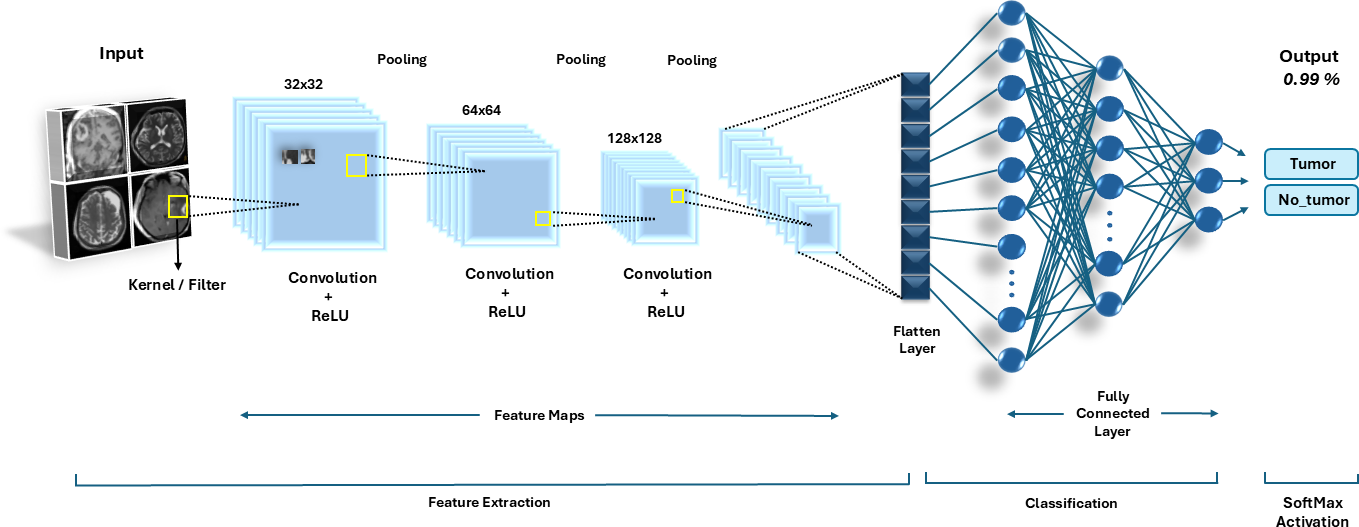
Keywords
Data Availability Statement
Funding
Conflicts of Interest
Ethical Approval and Consent to Participate
References
- Reyes, D., & Sánchez, J. (2024). Performance of convolutional neural networks for the classification of brain tumors using magnetic resonance imaging. Heliyon, 10(3), e25468.
[CrossRef] [Google Scholar] - Srinivasan, S., Francis, D., Mathivanan, S. K., Rajadurai, H., Shivahare, B. D., & Shah, M. A. (2024). A hybrid deep CNN model for brain tumor image multi-classification. BMC Medical Imaging, 24(1), 21.
[CrossRef] [Google Scholar] - Saeedi, S., Rezayi, S., Keshavarz, H., & R. Niakan Kalhori, S. (2023). MRI-based brain tumor detection using convolutional deep learning methods and chosen machine learning techniques. BMC Medical Informatics and Decision Making, 23(1), 16.
[CrossRef] [Google Scholar] - Işın, A., Direkoğlu, C., & Şah, M. (2016). Review of MRI-based Brain Tumor Image Segmentation Using Deep Learning Methods. Procedia Computer Science, 102, 317–324.
[CrossRef] [Google Scholar] - Mathivanan, S. K., Sonaimuthu, S., Murugesan, S., Rajadurai, H., Shivahare, B. D., & Shah, M. A. (2024). Employing deep learning and transfer learning for accurate brain tumor detection. Scientific Reports, 14(1), 7232.
[CrossRef] [Google Scholar] - Soomro, T. A., Zheng, L., Afifi, A. J., Ali, A., Soomro, S., Yin, M., & Gao, J. (2022). Image segmentation for MR brain tumor detection using machine learning: a review. IEEE Reviews in Biomedical Engineering, 16, 70-90.
[CrossRef] [Google Scholar] - Amin, J., Sharif, M., Raza, M., Saba, T., & Anjum, M. A. (2019). Brain tumor detection using statistical and machine learning method. Computer methods and programs in biomedicine, 177, 69-79.
[CrossRef] [Google Scholar] - Rawas, S., Tafran, C., & AlSaeed, D. (2024). ChatGPT-powered deep learning: elevating brain tumor detection in MRI scans. Applied Computing and Informatics.
[CrossRef] [Google Scholar] - Li, M., Jiang, Y., Zhang, Y., & Zhu, H. (2023). Medical image analysis using deep learning algorithms. Frontiers in Public Health, 11.
[CrossRef] [Google Scholar] - Pereira, S., Pinto, A., Alves, V., & Silva, C. A. (2016). Brain tumor segmentation using convolutional neural networks in MRI images. IEEE transactions on medical imaging, 35(5), 1240-1251.
[CrossRef] [Google Scholar] - Srinivas, C., K. S., N. P., Zakariah, M., Alothaibi, Y. A., Shaukat, K., Partibane, B., & Awal, H. (2022). Deep Transfer Learning Approaches in Performance Analysis of Brain Tumor Classification Using MRI Images. Journal of Healthcare Engineering, 2022, 1–17.
[CrossRef] [Google Scholar] - Dhar, T., Dey, N., Borra, S., & Sherratt, R. S. (2023). Challenges of Deep Learning in Medical Image Analysis—Improving Explainability and Trust. IEEE Transactions on Technology and Society, 4(1), 68–75.
[CrossRef] [Google Scholar] - Nassar, S. E., Yasser, I., Amer, H. M., & Mohamed, M. A. (2024). A robust MRI-based brain tumor classification via a hybrid deep learning technique. The Journal of Supercomputing, 80(2), 2403–2427.
[CrossRef] [Google Scholar] - Sankararao, Y., & Khasim, S. (2024). An Effective analysis of brain tumor detection using deep learning. EAI Endorsed Transactions on Pervasive Health and Technology, 10.
[CrossRef] [Google Scholar] - Swati, Z. N. K., Zhao, Q., Kabir, M., Ali, F., Ali, Z., Ahmed, S., & Lu, J. (2019). Brain tumor classification for MR images using transfer learning and fine-tuning. Computerized Medical Imaging and Graphics, 75, 34-46.
[CrossRef] [Google Scholar] - ATASEVER, S., AZGINOGLU, N., TERZI, D. S., & TERZI, R. (2023). A comprehensive survey of deep learning research on medical image analysis with focus on transfer learning. Clinical Imaging, 94, 18–41.
[CrossRef] [Google Scholar] - Akter, A., Nosheen, N., Ahmed, S., Hossain, M., Yousuf, M. A., Almoyad, M. A. A., Hasan, K. F., & Moni, M. A. (2024). Robust clinical applicable CNN and U-Net based algorithm for MRI classification and segmentation for brain tumor. Expert Systems with Applications, 238, 122347.
[CrossRef] [Google Scholar] - Zahoor, M. M., Khan, S. H., Alahmadi, T. J., Alsahfi, T., Mazroa, A. S. Al, Sakr, H. A., Alqahtani, S., Albanyan, A., & Alshemaimri, B. K. (2024). Brain Tumor MRI Classification Using a Novel Deep Residual and Regional CNN. Biomedicines, 12(7), 1395.
[CrossRef] [Google Scholar] - Gómez-Guzmán, M. A., Jiménez-Beristaín, L., García-Guerrero, E. E., López-Bonilla, O. R., Tamayo-Perez, U. J., Esqueda-Elizondo, J. J., Palomino-Vizcaino, K., & Inzunza-González, E. (2023). Classifying Brain Tumors on Magnetic Resonance Imaging by Using Convolutional Neural Networks. Electronics, 12(4), 955.
[CrossRef] [Google Scholar] - Sajjad, M., Khan, S., Muhammad, K., Wu, W., Ullah, A., & Baik, S. W. (2019). Multi-grade brain tumor classification using deep CNN with extensive data augmentation. Journal of computational science, 30, 174-182.
[CrossRef] [Google Scholar] - Smitha, P. S., Balaarunesh, G., Sruthi Nath, C., & Sabatini S, A. (2024). Classification of brain tumor using deep learning at early stage. Measurement: Sensors, 35, 101295.
[CrossRef] [Google Scholar] - Ullah, N., Khan, J. A., Khan, M. S., Khan, W., Hassan, I., Obayya, M., Negm, N., & Salama, A. S. (2022). An Effective Approach to Detect and Identify Brain Tumors Using Transfer Learning. Applied Sciences, 12(11), 5645.
[CrossRef] [Google Scholar] - Rana, M., & Bhushan, M. (2023). Machine learning and deep learning approach for medical image analysis: diagnosis to detection. Multimedia Tools and Applications, 82(17), 26731–26769.
[CrossRef] [Google Scholar] - Talukder, M. A., Islam, M. M., Uddin, M. A., Akhter, A., Pramanik, M. A. J., Aryal, S., Almoyad, M. A. A., Hasan, K. F., & Moni, M. A. (2023). An efficient deep learning model to categorize brain tumor using reconstruction and fine-tuning. Expert Systems with Applications, 230, 120534.
[CrossRef] [Google Scholar] - Younis, A., Qiang, L., Nyatega, C. O., Adamu, M. J., & Kawuwa, H. B. (2022). Brain Tumor Analysis Using Deep Learning and VGG-16 Ensembling Learning Approaches. Applied Sciences, 12(14), 7282.
[CrossRef] [Google Scholar] - Chelghoum, R., Ikhlef, A., Hameurlaine, A., & Jacquir, S. (2020, May). Transfer learning using convolutional neural network architectures for brain tumor classification from MRI images. In IFIP international conference on artificial intelligence applications and innovations (pp. 189-200). Cham: Springer International Publishing.
[CrossRef] [Google Scholar] - Tandel, G. S., Biswas, M., Kakde, O. G., Tiwari, A., Suri, H. S., Turk, M., ... & Suri, J. S. (2019). A review on a deep learning perspective in brain cancer classification. Cancers, 11(1), 111.
[CrossRef] [Google Scholar] - Anantharajan, S., Gunasekaran, S., Subramanian, T., & R, V. (2024). MRI brain tumor detection using deep learning and machine learning approaches. Measurement: Sensors, 31, 101026.
[CrossRef] [Google Scholar] - Seetha, J., & Raja, S. S. (2018). Brain Tumor Classification Using Convolutional Neural Networks. Biomedical and Pharmacology Journal, 11(3), 1457–1461.
[CrossRef] [Google Scholar] - Kalaiselvi, K., Karthikeyan, C., Devi, M. S., & Kalpana, C. (2020). Improved classification of brain tumor in MR images using RNN classification framework. Int. J. Innov. Technol. Explor. Eng.(IJITEE), 9, 1098-1101.
[CrossRef] [Google Scholar] - Amin, J., Sharif, M., Raza, M., Saba, T., Sial, R., & Shad, S. A. (2020). Brain tumor detection: a long short-term memory (LSTM)-based learning model. Neural Computing and Applications, 32, 15965-15973.
[CrossRef] [Google Scholar] - Vankdothu, R., Hameed, M. A., & Fatima, H. (2022). A brain tumor identification and classification using deep learning based on CNN-LSTM method. Computers and Electrical Engineering, 101, 107960.
[CrossRef] [Google Scholar] - Fasihi, M. S., & Mikhael, W. B. (2021, August). Brain tumor grade classification using LSTM neural networks with domain pre-transforms. In 2021 IEEE International Midwest Symposium on Circuits and Systems (MWSCAS) (pp. 529-532). IEEE.
[CrossRef] [Google Scholar] - Deepak, S., & Ameer, P. M. (2019). Brain tumor classification using deep CNN features via transfer learning. Computers in biology and medicine, 111, 103345.
[CrossRef] [Google Scholar]
Cited By (6)
-
Xu Wang, Zhaoshui He, Hao Liang, Jing Guo, Zhijie Lin, Liqiang Zhang, Xingfang Pan. APCA-Net: Adaptive Patch-Correlation Attention Network for Vision-Based Human Hand Acupoint Detection in Acupuncture.
IEEE Transactions on Human-Machine Systems, 2026 , 56 (3).
[CrossRef] -
Om Prakash Suthar, Karan Nakrani, Siddharth Makwana, Krunal Vaghela, Sushil Kumar Singh, Shivani Sharma. .
Proceedings of International Conference on Computational Technologies for Research in Data Analytics, 2026 , 1968 .
[CrossRef] -
Chengpeng Tian, Yuanyuan Peng, Yan Xi, Bin Tang, Qingkai Ma, Na Cheng, Zhen Liang, Kai Xu. A parallel hybrid convolutional state space network with multi-attention mechanisms for retinal vessel segmentation.
Biomedical Signal Processing and Control, 2026 , 116 .
[CrossRef] -
Devrajsinh Gohil, Jay Nasit, Om Prakash Suthar. .
2025 IEEE International Conference on Communication Networks and Computing (CNC), 2025 .
[CrossRef] -
Rahul Bhandari, Suresh Kaswan, Daulat Sihag, Reshma Khan. .
2025 International Conference on Emerging Technologies in Electronics and Green Energy (ICETEG), 2025 .
[CrossRef] -
Shivangi Verma, Rahul Bhandari, Nitika Kapoor. .
2025 Artificial Intelligence and Smart Technologies for Sustainability Conference (AISTS), 2025 .
[CrossRef]
Cite This Article
TY  - JOUR
AU  - Suthar, Om Prakash
AU  - Zinzuvadia, Yash
AU  - Ullah, Waqas
AU  - Khan, Haseeb
AU  - Agarwal, Chirag
PY  - 2025
DA  - 2025/03/20
TI  - Visual Intelligence in Neuro-Oncology: Effective Brain Tumor Detection through Optimized Convolutional Neural Networks
JO  - ICCK Transactions on Sensing, Communication, and Control
T2  - ICCK Transactions on Sensing, Communication, and Control
JF  - ICCK Transactions on Sensing, Communication, and Control
VL  - 2
IS  - 1
SP  - 25
EP  - 35
DO  - 10.62762/TSCC.2024.964451
UR  - https://www.icck.org/article/abs/TSCC.2024.964451
KW  - deep learning
KW  - convolutional neural network
KW  - brain tumor classification
KW  - multilayer perceptron
KW  - detection system
KW  - AI
AB  - Brain tumor detection (BTD) is a crucial task, as early detection can save lives. Medical professionals require visual intelligence assistance to efficiently and accurately identify brain tumors. Conventional methods often result in misrecognition, highlighting a critical research gap. To address this, a novel BTD system is proposed to predict the presence of a tumor in a given MRI image. The system leverages a convolutional neural network (CNN) architecture, combined with a multi-layer perceptron (MLP) for feature extraction and understanding complex pixel patterns. An extensive ablation study was conducted to empirically analyze and identify the optimal model for the task. The findings demonstrate that the proposed method outperforms existing approaches. Notably, the model with two convolutional layers achieved an accuracy of 86.17%, while a single-layer model attained an impressive accuracy of 99.6%.
SN  - 3068-9287
PB  - Institute of Central Computation and Knowledge
LA  - English
ER  -
@article{Suthar2025Visual,
  author = {Om Prakash Suthar and Yash Zinzuvadia and Waqas Ullah and Haseeb Khan and Chirag Agarwal},
  title = {Visual Intelligence in Neuro-Oncology: Effective Brain Tumor Detection through Optimized Convolutional Neural Networks},
  journal = {ICCK Transactions on Sensing, Communication, and Control},
  year = {2025},
  volume = {2},
  number = {1},
  pages = {25-35},
  doi = {10.62762/TSCC.2024.964451},
  url = {https://www.icck.org/article/abs/TSCC.2024.964451},
  abstract = {Brain tumor detection (BTD) is a crucial task, as early detection can save lives. Medical professionals require visual intelligence assistance to efficiently and accurately identify brain tumors. Conventional methods often result in misrecognition, highlighting a critical research gap. To address this, a novel BTD system is proposed to predict the presence of a tumor in a given MRI image. The system leverages a convolutional neural network (CNN) architecture, combined with a multi-layer perceptron (MLP) for feature extraction and understanding complex pixel patterns. An extensive ablation study was conducted to empirically analyze and identify the optimal model for the task. The findings demonstrate that the proposed method outperforms existing approaches. Notably, the model with two convolutional layers achieved an accuracy of 86.17\%, while a single-layer model attained an impressive accuracy of 99.6\%.},
  keywords = {deep learning, convolutional neural network, brain tumor classification, multilayer perceptron, detection system, AI},
  issn = {3068-9287},
  publisher = {Institute of Central Computation and Knowledge}
}
Publisher's Note
ICCK stays neutral with regard to jurisdictional claims in published maps and institutional affiliations.
Rights and Permissions


Portico
