

Volume 2, Issue 1, ICCK Transactions on Systems Safety and Reliability
Volume 2, Issue 1, 2026
Submit Manuscript Edit a Special Issue
Article QR Code
Article QR Code
Scan the QR code for reading
Popular articles
ICCK Transactions on Systems Safety and Reliability, Volume 2, Issue 1, 2026: 26-35

Free to Read | Research Article | 08 February 2026
Design and Implementation of a Fire Fighting System for a High-Rise Residential Building: A Case Study of SAMA Tower in Palestine
1 Department of Mechanical Engineering, Palestine Technical University – Kadoorie, Tulkarm, Palestine
2 Department of Computer Science, Palestine Technical University – Kadoorie, Tulkarm, Palestine
3 Department of Electrical Engineering, National Kaohsiung University of Science and Technology, Kaohsiung 807618, Taiwan
4 Department of Electrical Engineering, Faculty of Engineering at Shoubra, Benha University, Cairo 11629, Egypt
* Corresponding Author: Mohammed Amer, [email protected]
ARK: ark:/57805/tssr.2025.636226
Received: 29 November 2025, Accepted: 31 December 2025, Published: 08 February 2026  
Abstract
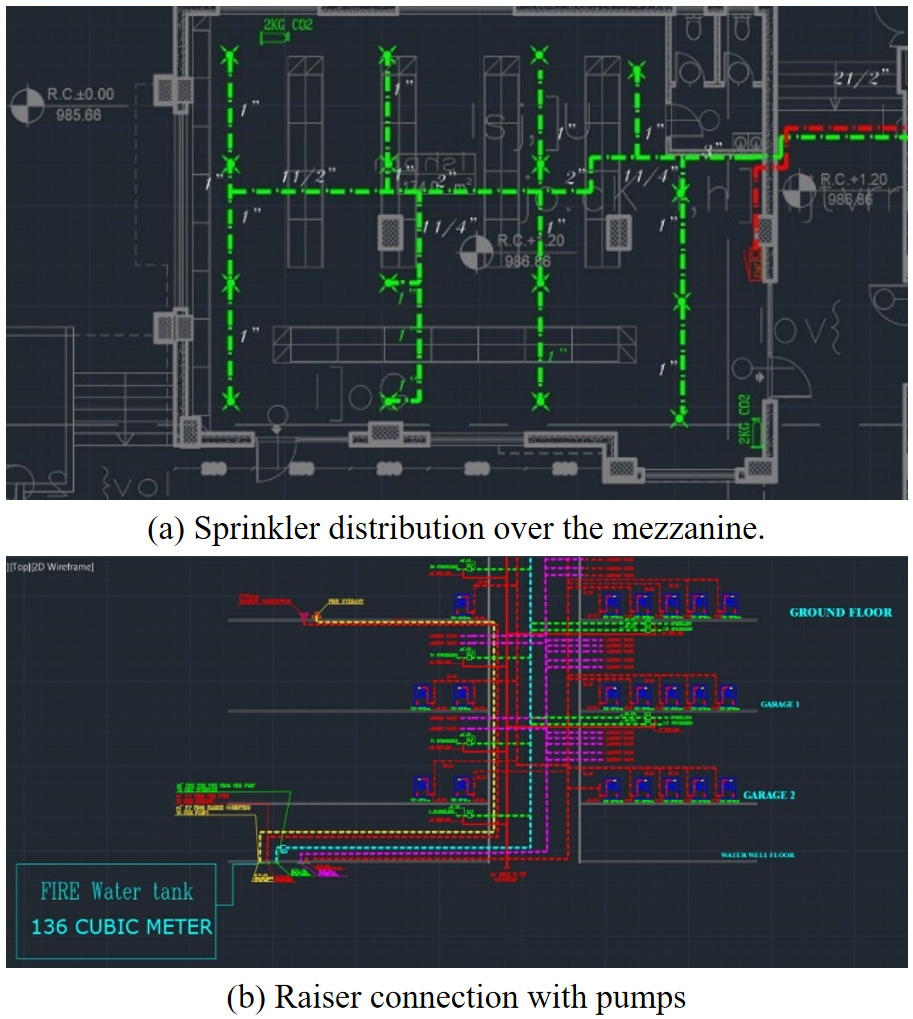
This paper describes the design and installation of a fire-fighting system in a high-rise building, the SAMA Residential Tower in Palestine. A sprinkler system, a standpipe system, a fire hose cabinet, a landing valve, externally accessible fire hydrants, and a Siamese connection are all included in this system. Additionally, it complies with NFPA 13, 14, and 20 codes, as well as those of the Palestinian and Jordanian governments. Hydraulic calculations were performed manually and confirmed using Elite Fire Protection software. The layouts were developed using AutoCAD, and 3D modeling was created in Revit to optimize the placement of components. All zones of the building will be protected by this integrated approach, which ensures reliable flow, sufficient pressure, and code compliance. In the application of an integrated design workflow, the coordination between fire protection components was improved, design errors were reduced, and implementation accuracy was enhanced. As a result of systematic validation between manual hydraulic calculations and software outputs, pressure and flow assurance was also more reliable. As a result, there was a clear increase in efficiency and performance for high-rise firefighting systems.

Graphical Abstract
Design and Implementation of a Fire Fighting System for a High-Rise Residential Building: A Case Study of SAMA Tower in Palestine

Keywords
fire-fighting system
high-rise residential building
NFPA standards
fire protection design

Data Availability Statement
Data will be made available on request.

Funding
This work was supported without any funding.

Conflicts of Interest
The authors declare no conflicts of interest.

AI Use Statement
The authors declare that no generative AI was used in the preparation of this manuscript.

Ethical Approval and Consent to Participate
Not applicable.

References
  1. Craighead, G. (2009). High-Rise Security and Fire Life Safety. Butterworth-Heinemann.
    [Google Scholar]
  2. Kumar, K., & Paul, V. K. (2023). Significance of fire protection system reliability for structure fire safety. Structural Engineering Digest, 42–50.
    [Google Scholar]
  3. Song, L. Z., Zhu, J., Liu, S. T., & Qu, Z. J. (2022). Recent fire safety design of high-rise buildings. J. Urban Dev. Manag, 1(1), 50-57.
    [CrossRef]   [Google Scholar]
  4. Kironji, M. (2015). Evaluation of fire protection systems in commercial highrise buildings for fire safety optimization: A case of Nairobi Central Business District. International Journal of Scientific and Research Publications, 5(10), 1-8.
    [Google Scholar]
  5. Zhang, Y. (2025). Design and Implementation of Fire Safety Assessment and Early Warning System for High Rise Buildings. In Smart Infrastructures in the IoT Era (pp. 245-257). Springer Nature Switzerland.
    [CrossRef]   [Google Scholar]
  6. Oaikhena, O. H., & Akande, O. K. (2024). Passive design fire protection in high-rise residential buildings: challenges and strategies for sustainable implementation in Abuja, NIGERIA. Journal of Built Environment and Geological Research.
    [Google Scholar]
  7. Omar, M., Mahmoud, A., & Aziz, S. A. B. A. (2023). Fire safety index for high-rise buildings in the Emirate of Sharjah, UAE. Fire, 6(2), 51.
    [CrossRef]   [Google Scholar]
  8. Gorbett, G. E., & Kozhumal, S. P. (2022). Fire fundamentals. In Handbook of Fire and the Environment: Impacts and Mitigation (pp. 55–100). Springer International Publishing.
    [CrossRef]   [Google Scholar]
  9. Samanth, M. (2025). Advancements in fire chemistry and dynamics: Implications for safety, environmental sustainability, and technological innovation. Journal of Applicable Chemistry, 14(3), 593–603.
    [Google Scholar]
  10. Hurley, M. J., Gottuk, D. T., Hall Jr, J. R., Harada, K., Kuligowski, E. D., Puchovsky, M., ... & Wieczorek, C. J. (Eds.). (2015). SFPE handbook of fire protection engineering. Springer.
    [CrossRef]   [Google Scholar]
  11. Klote, J. H., & Milke, J. A. (2016). Principles of Smoke Management. American Society of Heating, Refrigerating and Air-Conditioning Engineers.
    [Google Scholar]
  12. Morgan, A. B., & Lorenzetti, A. (2024). Flame-Retardant Design and Protection for Building Materials. In Fire Retardancy of Polymeric Materials (pp. 724-735). CRC Press.
    [Google Scholar]
  13. National Fire Protection Association. (2011). NFPA 557 standard for determination of fire loads for use in structural fire protection design. NFPA.
    [Google Scholar]
  14. Grill, R. A. (2018). Standardizing NFPA 13: NFPA 13-2016 is applicable to all sprinkler system designs and installations, with the exception of sprinkler systems in low-rise residential buildings and one-and two-family dwellings and manufactured homes. Consulting Specifying Engineer, 55(9), 40-46.
    [Google Scholar]
  15. National Fire Protection Association. (2003). NFPA 14: Standard for the Installation of Standpipe and Hose Systems, 2003. National Fire Protection Association.
    [Google Scholar]
  16. National Fire Protection Association. (2012). NFPA 20 Standard for the Installation of Stationary Pumps for Fire Protection. National Fire Protection Association.
    [Google Scholar]
  17. Salaheldin, M. H., Hassanain, M. A., Hamida, M. B., & Ibrahim, A. M. (2021). A code-compliance assessment tool for fire prevention measures in educational facilities. International Journal of Emergency Services, 10(3), 412-426.
    [CrossRef]   [Google Scholar]
  18. Hassanain, M. A., & Albugami, Z. A. (2024). Towards disaster prevention in community centers: development of a code-based fire risk assessment tool. International Journal of Emergency Services, 13(1), 17-32.
    [CrossRef]   [Google Scholar]

Cite This Article
APA Style
Amer, M., Yaghmour, J., Dababat, A., & Elsisi, M. (2026). Design and Implementation of a Fire Fighting System for a High-Rise Residential Building: A Case Study of SAMA Tower in Palestine. ICCK Transactions on Systems Safety and Reliability, 2(1), 26–35. https://doi.org/10.62762/TSSR.2025.636226
Export Citation
RIS Format
Compatible with EndNote, Zotero, Mendeley, and other reference managers
RIS format data for reference managers
TY  - JOUR
AU  - Amer, Mohammed
AU  - Yaghmour, Jihad
AU  - Dababat, Alya’
AU  - Elsisi, Mahmoud
PY  - 2026
DA  - 2026/02/08
TI  - Design and Implementation of a Fire Fighting System for a High-Rise Residential Building: A Case Study of SAMA Tower in Palestine
JO  - ICCK Transactions on Systems Safety and Reliability
T2  - ICCK Transactions on Systems Safety and Reliability
JF  - ICCK Transactions on Systems Safety and Reliability
VL  - 2
IS  - 1
SP  - 26
EP  - 35
DO  - 10.62762/TSSR.2025.636226
UR  - https://www.icck.org/article/abs/TSSR.2025.636226
KW  - fire-fighting system
KW  - high-rise residential building
KW  - NFPA standards
KW  - fire protection design
AB  - This paper describes the design and installation of a fire-fighting system in a high-rise building, the SAMA Residential Tower in Palestine. A sprinkler system, a standpipe system, a fire hose cabinet, a landing valve, externally accessible fire hydrants, and a Siamese connection are all included in this system. Additionally, it complies with NFPA 13, 14, and 20 codes, as well as those of the Palestinian and Jordanian governments. Hydraulic calculations were performed manually and confirmed using Elite Fire Protection software. The layouts were developed using AutoCAD, and 3D modeling was created in Revit to optimize the placement of components. All zones of the building will be protected by this integrated approach, which ensures reliable flow, sufficient pressure, and code compliance. In the application of an integrated design workflow, the coordination between fire protection components was improved, design errors were reduced, and implementation accuracy was enhanced. As a result of systematic validation between manual hydraulic calculations and software outputs, pressure and flow assurance was also more reliable. As a result, there was a clear increase in efficiency and performance for high-rise firefighting systems.
SN  - 3069-1087
PB  - Institute of Central Computation and Knowledge
LA  - English
ER  - 
BibTeX Format
Compatible with LaTeX, BibTeX, and other reference managers
BibTeX format data for LaTeX and reference managers
@article{Amer2026Design,
  author = {Mohammed Amer and Jihad Yaghmour and Alya’ Dababat and Mahmoud Elsisi},
  title = {Design and Implementation of a Fire Fighting System for a High-Rise Residential Building: A Case Study of SAMA Tower in Palestine},
  journal = {ICCK Transactions on Systems Safety and Reliability},
  year = {2026},
  volume = {2},
  number = {1},
  pages = {26-35},
  doi = {10.62762/TSSR.2025.636226},
  url = {https://www.icck.org/article/abs/TSSR.2025.636226},
  abstract = {This paper describes the design and installation of a fire-fighting system in a high-rise building, the SAMA Residential Tower in Palestine. A sprinkler system, a standpipe system, a fire hose cabinet, a landing valve, externally accessible fire hydrants, and a Siamese connection are all included in this system. Additionally, it complies with NFPA 13, 14, and 20 codes, as well as those of the Palestinian and Jordanian governments. Hydraulic calculations were performed manually and confirmed using Elite Fire Protection software. The layouts were developed using AutoCAD, and 3D modeling was created in Revit to optimize the placement of components. All zones of the building will be protected by this integrated approach, which ensures reliable flow, sufficient pressure, and code compliance. In the application of an integrated design workflow, the coordination between fire protection components was improved, design errors were reduced, and implementation accuracy was enhanced. As a result of systematic validation between manual hydraulic calculations and software outputs, pressure and flow assurance was also more reliable. As a result, there was a clear increase in efficiency and performance for high-rise firefighting systems.},
  keywords = {fire-fighting system, high-rise residential building, NFPA standards, fire protection design},
  issn = {3069-1087},
  publisher = {Institute of Central Computation and Knowledge}
}

Article Metrics
Citations:

Crossref

0

Scopus

0

Web of Science

0
Article Access Statistics:
Views: 189
PDF Downloads: 25

Publisher's Note
ICCK stays neutral with regard to jurisdictional claims in published maps and institutional affiliations.

Rights and Permissions
Institute of Central Computation and Knowledge (ICCK) or its licensor (e.g. a society or other partner) holds exclusive rights to this article under a publishing agreement with the author(s) or other rightsholder(s); author self-archiving of the accepted manuscript version of this article is solely governed by the terms of such publishing agreement and applicable law.
ICCK Transactions on Systems Safety and Reliability

ICCK Transactions on Systems Safety and Reliability

ISSN: 3069-1087 (Online)

Email: [email protected]

Portico

Portico

All published articles are preserved here permanently:
https://www.portico.org/publishers/icck/