

Exploration of the Reform of Comprehensive Practice Course in Advanced Programming Driven by Large Models


Article Information
Abstract
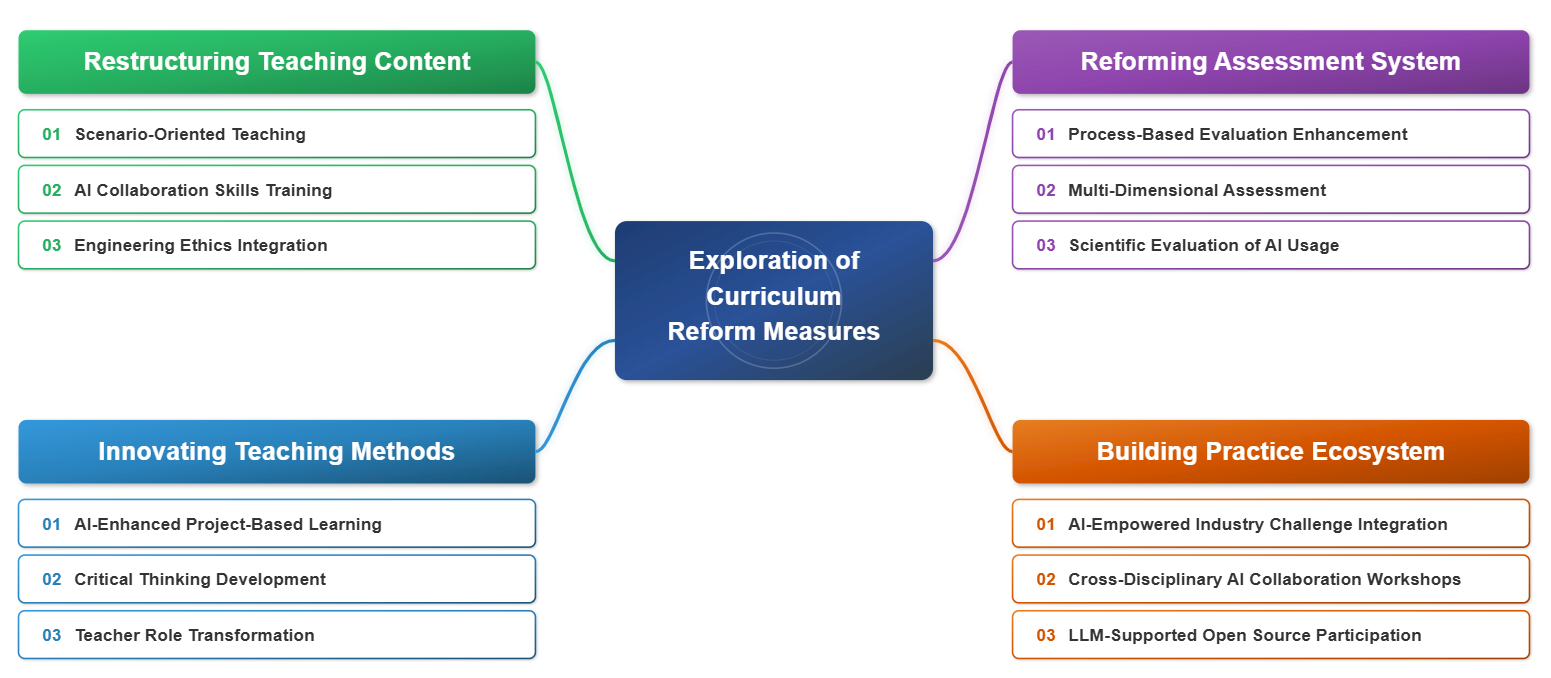
The rapid advancement of AI and large language models has placed newer and higher demands on comprehensive programming practice courses in higher education. Significant shifts in students' learning styles, knowledge acquisition channels, and innovative capabilities have rendered traditional curriculum content and teaching methods inadequate for meeting the talent development requirements of the new era. This paper thoroughly examines the profound impact of the widespread adoption of AI technologies on the curriculum system and proposes a systematic reform framework centered on "AI empowerment, competency orientation, and student-centered approaches." By integrating AI tools into the course, it aims to enhance the efficiency and innovation of students' programming practice, strengthen their ability to use intelligent tools rationally and critically, emphasize interdisciplinary integration and engineering ethics, and ultimately foster students' capacity to solve complex engineering problems systematically.
Graphical Abstract
Keywords
Data Availability Statement
Funding
Conflicts of Interest
Ethical Approval and Consent to Participate
References
- Peláez-Sánchez, I. C., Velarde-Camaqui, D., & Glasserman-Morales, L. D. (2024, June). The impact of large language models on higher education: exploring the connection between AI and Education 4.0. In Frontiers in Education (Vol. 9, p. 1392091). Frontiers Media SA.
[CrossRef] [Google Scholar] - Vemula, S. (2024, October). Enriching Python Programming Education With Generative AI: Leveraging Large Language Models for Personalized Support and Interactive Learning. In 2024 IEEE Frontiers in Education Conference (FIE) (pp. 1-8). IEEE.
[CrossRef] [Google Scholar] - Laato, S., Morschheuser, B., Hamari, J., & Björne, J. (2023, July). AI-assisted learning with ChatGPT and large language models: Implications for higher education. In 2023 IEEE International Conference on Advanced Learning Technologies (ICALT) (pp. 226-230). IEEE.
[CrossRef] [Google Scholar] - Scholl, A., & Kiesler, N. (2024, October). How Novice Programmers Use and Experience ChatGPT when Solving Programming Exercises in an Introductory Course. In 2024 IEEE Frontiers in Education Conference (FIE) (pp. 1-9). IEEE.
[CrossRef] [Google Scholar] - Kizilcec, R. F., Huber, E., Papanastasiou, E. C., Cram, A., Makridis, C. A., Smolansky, A., ... & Raduescu, C. (2024). Perceived impact of generative AI on assessments: Comparing educator and student perspectives in Australia, Cyprus, and the United States. Computers and Education: Artificial Intelligence, 7, 100269.
[CrossRef] [Google Scholar] - Anderson, N., McGowan, A., Galway, L., Hanna, P., Collins, M., & Cutting, D. (2023, November). Implementing generative AI and large language models in education. In 2023 7th International Symposium on Innovative Approaches in Smart Technologies (ISAS) (pp. 1-6). IEEE.
[CrossRef] [Google Scholar] - Boguslawski, S., Deer, R., & Dawson, M. G. (2025). Programming education and learner motivation in the age of generative AI: student and educator perspectives. Information and Learning Sciences, 126(1/2), 91-109.
[CrossRef] [Google Scholar] - Allison, J., Hwang, G. J., Mayer, R. E., Pellas, N., Karnalim, O., de Freitas, S., ... & Sanusi, I. (2025). From generative AI to extended reality: Multidisciplinary perspectives on the challenges, opportunities, and future of educational computing. Journal of Educational Computing Research, 63(6), 1327-1363.
[CrossRef] [Google Scholar] - Denny, P., Leinonen, J., Prather, J., Luxton-Reilly, A., Amarouche, T., Becker, B. A., & Reeves, B. N. (2024, March). Prompt Problems: A new programming exercise for the generative AI era. In Proceedings of the 55th ACM Technical Symposium on Computer Science Education V. 1 (pp. 296-302).
[CrossRef] [Google Scholar] - Wilkinson, G. G. (2024). Enhancing Generic Skills Development in Higher Education in the Era of Large Language Model Artificial Intelligence. Journal of Higher Education Theory & Practice, 24(3).
[CrossRef] [Google Scholar] - Zawacki-Richter, O., Marín, V. I., Bond, M., & Gouverneur, F. (2019). Systematic review of research on artificial intelligence applications in higher education–where are the educators?. International journal of educational technology in higher education, 16(1), 1-27.
[CrossRef] [Google Scholar] - Velázquez-García, L., Cedillo-Hernández, A., Colón-Vallejo, A., Del Pilar Longar-Blanco, M., & Cedillo-Hernández, M. (2025). AI-Based Applications Enhancing Computer Science Teaching in Higher Education. Journal of Information Systems Engineering and Management, 10(2), 14-32.
[Google Scholar] - Alanazi, M., Soh, B., Samra, H., & Li, A. (2025). The Influence of Artificial Intelligence Tools on Learning Outcomes in Computer Programming: A Systematic Review and Meta-Analysis. Computers (2073-431X), 14(5).
[CrossRef] [Google Scholar] - Arya, V., Saraf, A., Chichkanov, N., Papa, A., & Romano, M. (2025). AI-enhanced competency transfer hubs: a conceptual framework for university-industry engagement and knowledge sharing. The Journal of Technology Transfer, 1-31.
[CrossRef] [Google Scholar] - Atchley, P., Pannell, H., Wofford, K., Hopkins, M., & Atchley, R. A. (2024). Human and AI collaboration in the higher education environment: opportunities and concerns. Cognitive research: principles and implications, 9(1), 20.
[CrossRef] [Google Scholar]
Cite This Article
TY  - JOUR
AU  - Guo, Nan
AU  - Han, Bing
AU  - Qiao, Junfei
PY  - 2025
DA  - 2025/12/25
TI  - Exploration of the Reform of Comprehensive Practice Course in Advanced Programming Driven by Large Models
JO  - Frontiers in Educational Innovation and Research
T2  - Frontiers in Educational Innovation and Research
JF  - Frontiers in Educational Innovation and Research
VL  - 1
IS  - 3
SP  - 81
EP  - 91
DO  - 10.62762/FEIR.2025.722615
UR  - https://www.icck.org/article/abs/FEIR.2025.722615
KW  - artificial intelligence
KW  - large language models
KW  - curriculum reform
KW  - competency-oriented
AB  - The rapid advancement of AI and large language models has placed newer and higher demands on comprehensive programming practice courses in higher education. Significant shifts in students' learning styles, knowledge acquisition channels, and innovative capabilities have rendered traditional curriculum content and teaching methods inadequate for meeting the talent development requirements of the new era. This paper thoroughly examines the profound impact of the widespread adoption of AI technologies on the curriculum system and proposes a systematic reform framework centered on "AI empowerment, competency orientation, and student-centered approaches." By integrating AI tools into the course, it aims to enhance the efficiency and innovation of students' programming practice, strengthen their ability to use intelligent tools rationally and critically, emphasize interdisciplinary integration and engineering ethics, and ultimately foster students' capacity to solve complex engineering problems systematically.
SN  - 3068-5664
PB  - Institute of Central Computation and Knowledge
LA  - English
ER  -
@article{Guo2025Exploratio,
  author = {Nan Guo and Bing Han and Junfei Qiao},
  title = {Exploration of the Reform of Comprehensive Practice Course in Advanced Programming Driven by Large Models},
  journal = {Frontiers in Educational Innovation and Research},
  year = {2025},
  volume = {1},
  number = {3},
  pages = {81-91},
  doi = {10.62762/FEIR.2025.722615},
  url = {https://www.icck.org/article/abs/FEIR.2025.722615},
  abstract = {The rapid advancement of AI and large language models has placed newer and higher demands on comprehensive programming practice courses in higher education. Significant shifts in students' learning styles, knowledge acquisition channels, and innovative capabilities have rendered traditional curriculum content and teaching methods inadequate for meeting the talent development requirements of the new era. This paper thoroughly examines the profound impact of the widespread adoption of AI technologies on the curriculum system and proposes a systematic reform framework centered on "AI empowerment, competency orientation, and student-centered approaches." By integrating AI tools into the course, it aims to enhance the efficiency and innovation of students' programming practice, strengthen their ability to use intelligent tools rationally and critically, emphasize interdisciplinary integration and engineering ethics, and ultimately foster students' capacity to solve complex engineering problems systematically.},
  keywords = {artificial intelligence, large language models, curriculum reform, competency-oriented},
  issn = {3068-5664},
  publisher = {Institute of Central Computation and Knowledge}
}
Article Metrics
Publisher's Note
ICCK stays neutral with regard to jurisdictional claims in published maps and institutional affiliations.
Rights and Permissions
 Copyright © 2025 by the Author(s). Published by Institute of Central Computation and Knowledge. This article is an open access article distributed under the terms and conditions of the Creative Commons Attribution (CC BY) license (https://creativecommons.org/licenses/by/4.0/), which permits use, sharing, adaptation, distribution and reproduction in any medium or format, as long as you give appropriate credit to the original author(s) and the source, provide a link to the Creative Commons licence, and indicate if changes were made.


Portico
