Volume 2, Issue 3 (In Progress)


In Progress
Citations: Crossref logo 0,   0   |   Viewed: 1508, Download: 499

Table of Contents

Open Access | Review Article | 22 September 2026
Research on Paths of Artificial Intelligence-Empowered Education for Elderly Care Service Practitioners
Frontiers in Educational Innovation and Research | Volume 2, Issue 3: 116-127, 2026 | DOI: 10.62762/FEIR.2026.849704
Abstract
With the continuous deepening of population aging in China, talent education for elderly care services is confronted with a prominent imbalance between talent supply and demand, structural misalignment, homogenization of course content, and weak teaching effectiveness. With its powerful data processing, personalized services, and intelligent decision-making capabilities, artificial intelligence (AI) offers new opportunities for solving traditional training problems and promoting the reform and innovation of talent education. Based on clarifying the value of AI in empowering the education of elderly care service talents and its role positioning as an ``innovator, manager, and evaluator'', thi... More >
Open Access | Research Article | 16 September 2026
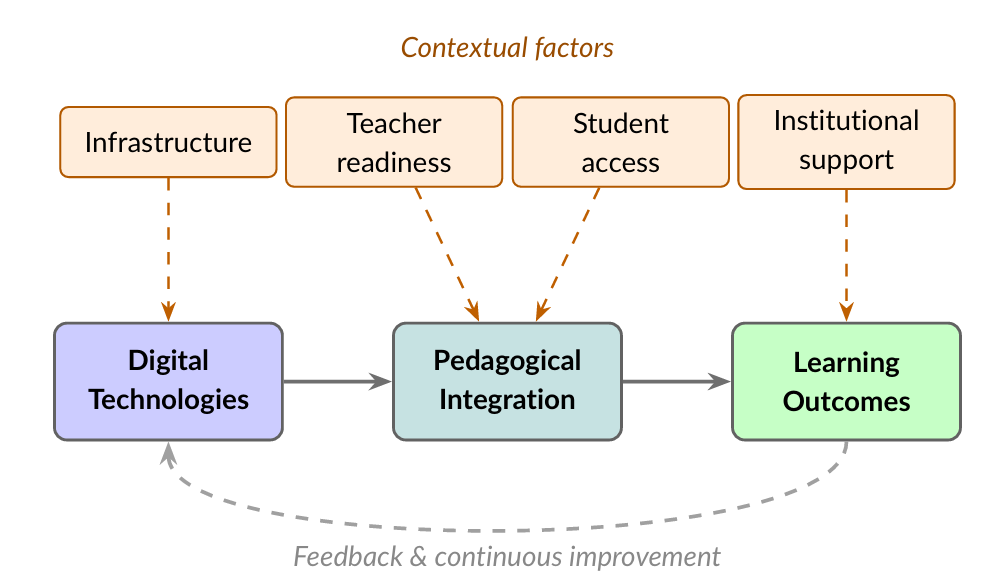
Digital Tools Integration in Teaching and Digital Transformation in Higher Education: A Qualitative Analysis of Learning Processes
Frontiers in Educational Innovation and Research | Volume 2, Issue 3: 104-115, 2026 | DOI: 10.62762/FEIR.2026.990020
Abstract
Digital transformation has emerged as an important driver of change in higher education, reshaping traditional teaching and learning through the incorporation of advanced digital technologies. This paper presents a qualitative study of the implementation of digital tools in higher education and examines the key factors that facilitate their effective integration, focusing on teaching, student-teacher interaction, and learning. An interpretive qualitative design was adopted in selected government colleges in Himachal Pradesh, India, involving 37 participants (12 faculty members and 25 undergraduate students). Data were gathered through semi-structured faculty interviews, student focus group d... More >

Graphical Abstract
Digital Tools Integration in Teaching and Digital Transformation in Higher Education: A Qualitative Analysis of Learning Processes
Open Access | Research Article | 11 September 2026
Building a Sustainable Educational Ecology for Arts Major Students: Practice-Based Model Development of a Counselor-Led Mental Health Support Model
Frontiers in Educational Innovation and Research | Volume 2, Issue 3: 90-103, 2026 | DOI: 10.62762/FEIR.2026.535517
Abstract
Student mental health has become a core issue in university governance, yet existing support models remain insufficiently adaptive to the ecosystem of arts education, which is shaped by public performance, iterative critique, and identity exposure. This practice-oriented paper develops a counselor-led mental health support model for arts major students through a narrative review of relevant literature, reflection on the authors' long-term front-line counseling and student-affairs practice, and the analysis of illustrative de-identified composite cases derived from real practice. Drawing on ecological systems theory, the paper argues that sustainable support must link micro-level counseling w... More >

Graphical Abstract
Building a Sustainable Educational Ecology for Arts Major Students: Practice-Based Model Development of a Counselor-Led Mental Health Support Model
Open Access | Research Article | 04 September 2026
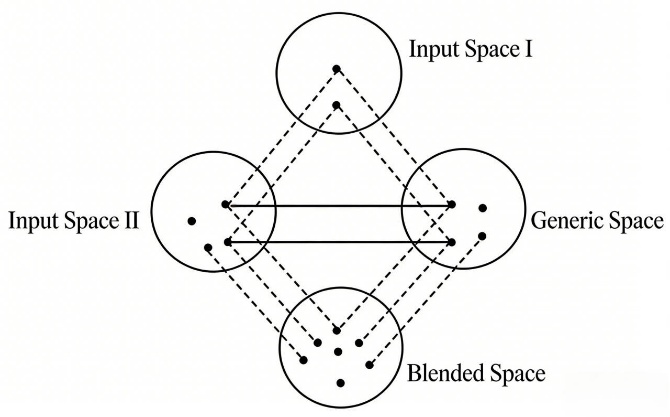
Investigating the Cognitive Mechanisms of L2 Learners’ Continuation Writing: A Conceptual Blending Perspective
Frontiers in Educational Innovation and Research | Volume 2, Issue 3: 72-89, 2026 | DOI: 10.62762/FEIR.2026.926415
Abstract
In recent years, continuation writing has attracted growing scholarly attention in second language (L2) pedagogy and assessment. However, most existing studies have focused on learners’ surface-level linguistic output, failing to unpack the underlying conceptual blending mechanism. In particular, cognitive comparative analyses across learners with varying proficiency levels remain scarce. Drawing on Conceptual Blending Theory (CBT), this study selected 18 continuation writing samples produced by L2 English learners from a key senior high school in Sichuan Province. NVivo was employed to conduct coding and cross-group comparative analyses across four dimensions, namely plot coherence, chara... More >

Graphical Abstract
Investigating the Cognitive Mechanisms of L2 Learners’ Continuation Writing: A Conceptual Blending Perspective
Open Access | Research Article | 26 August 2026
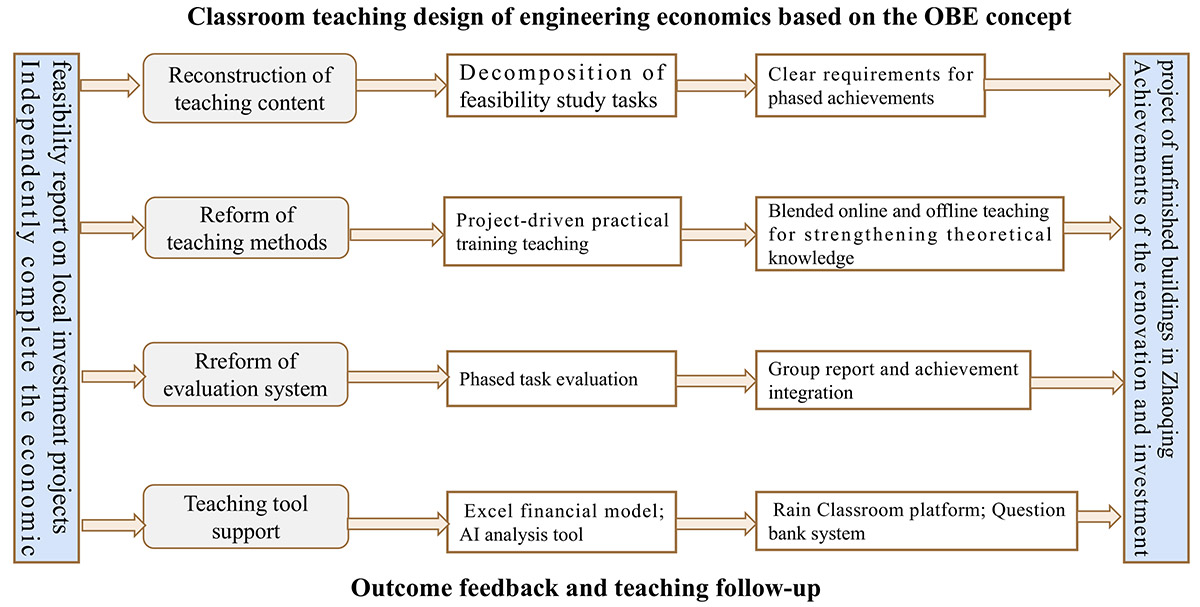
Construction and Practice of Outcomes-Based Education-Guided Project-Driven Teaching Model for Engineering Economics in Application-Oriented Undergraduate Universities
Frontiers in Educational Innovation and Research | Volume 2, Issue 3: 58-71, 2026 | DOI: 10.62762/FEIR.2026.394100
Abstract
Engineering Economics is a core course for the Engineering Cost major in application-oriented undergraduate universities, yet traditional teaching often suffers from a theory-practice gap, low student participation, and polarized academic performance. Guided by Outcomes-Based Education (OBE), this study developed a three-in-one project-driven teaching model integrating modular theory, whole-process project practice, and diversified assessment. Theoretical content was reorganized into four application modules within a closed-loop ``lecture-practice-assessment'' process. A real local project---the renovation of an unfinished building into affordable rental housing in Zhaoqing City---served as... More >

Graphical Abstract
Construction and Practice of Outcomes-Based Education-Guided Project-Driven Teaching Model for Engineering Economics in Application-Oriented Undergraduate Universities