

Digital Tools Integration in Teaching and Digital Transformation in Higher Education: A Qualitative Analysis of Learning Processes


Article Information
Abstract
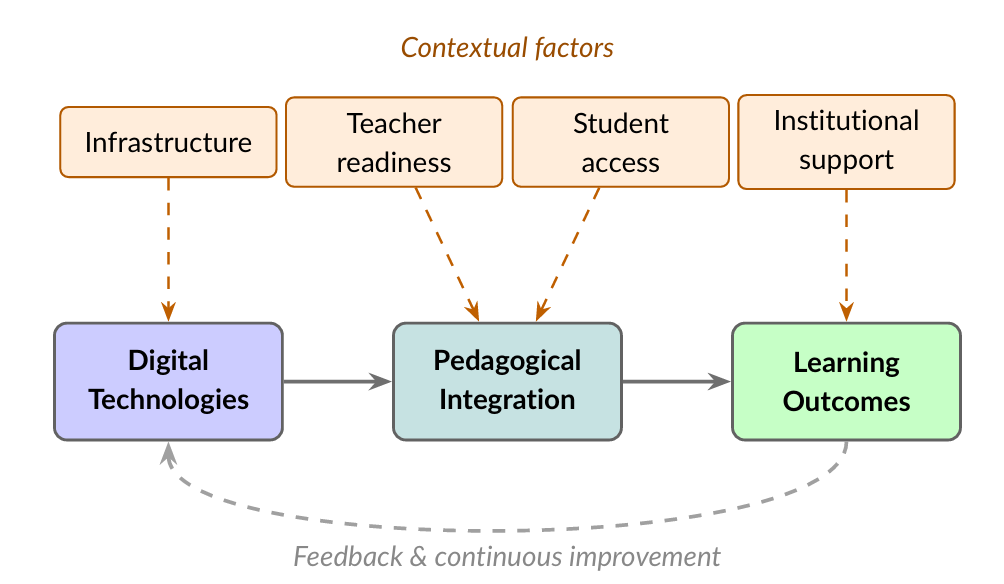
Digital transformation has emerged as an important driver of change in higher education, reshaping traditional teaching and learning through the incorporation of advanced digital technologies. This paper presents a qualitative study of the implementation of digital tools in higher education and examines the key factors that facilitate their effective integration, focusing on teaching, student-teacher interaction, and learning. An interpretive qualitative design was adopted in selected government colleges in Himachal Pradesh, India, involving 37 participants (12 faculty members and 25 undergraduate students). Data were gathered through semi-structured faculty interviews, student focus group discussions, classroom observations, and document analysis, and were examined using thematic analysis (open, axial, and selective coding) interpreted through the TPACK and SAMR frameworks. The analysis identifies Learning Management Systems, virtual classrooms, artificial intelligence, and multimedia platforms as key enablers of flexible, personalized, and collaborative learning. Five themes emerged: enhanced student engagement, a shift toward learner-centered pedagogy, improved accessibility and flexibility, personalization of learning, and structural and technical challenges, while persistent barriers include the digital divide, insufficient infrastructure, limited digital literacy, and resistance to pedagogical change. Meaningful educational change requires the alignment of technological integration with pedagogical approaches and institutional support. The study proposes a context-sensitive conceptual framework for successful digital integration and offers policy and practice recommendations for sustainable implementation, contributing a qualitative perspective on the transforming role of technology in higher education.
Graphical Abstract
Keywords
Data Availability Statement
Funding
Conflicts of Interest
AI Use Statement
Ethical Approval and Consent to Participate
References
- Warschauer, M., & Matuchniak, T. (2010). New technology and digital worlds: Analyzing evidence of equity in access, use, and outcomes. Review of Research in Education, 34(1), 179-225.
[CrossRef] [Google Scholar] - Selwyn, N. (2011). Education and technology: Key issues and debates. A&C Black. https://research.monash.edu/en/publications/education-and-technology-key-issues-and-debates/
[Google Scholar] - Redecker, C. (2017). European framework for the digital competence of educators: DigCompEdu. Publications Office of the European Union. https://publications.jrc.ec.europa.eu/repository/bitstream/JRC107466/pdf_digcomedu_a4_final.pdf
[Google Scholar] - Abdullah, R., Karnati, N., Effendi, M. S., & Kamaludin, K. (2026). Trends and Predictive Factors of Teacher Digital Literacy: A Literature Review (2020–2025). Journal of Educational Sciences, 10(1), 1379-1390.
[CrossRef] [Google Scholar] - UNESCO. (2020). Education in a post-COVID world: Nine ideas for public action. United Nations Educational, Scientific and Cultural Organization. Retrieved from https://unesdoc.unesco.org/ark:/48223/pf0000373717
[Google Scholar] - OECD. (2021). OECD digital education outlook 2021: Pushing the frontiers with artificial intelligence, blockchain and robots. OECD Publishing.
[CrossRef] [Google Scholar] - Johnson, L., Becker, S. A., Cummins, M., Estrada, V., Freeman, A., & Hall, C. (2016). NMC horizon report: 2016 higher education edition (pp. 1-50). The New Media Consortium. https://www.learntechlib.org/p/171478/
[Google Scholar] - Anderson, T., & Elloumi, F. (2004). Theory and practice of online learning. Athabasca University. https://dl.acm.org/doi/abs/10.5555/1550848
[Google Scholar] - Bates, T. (2019). Teaching in a digital age: Guidelines for designing teaching and learning. BCcampus. https://open.umn.edu/opentextbooks/textbooks/221
[Google Scholar] - Deshen, M., Harari, R., & Aharony, N. (2026). Teachers' artificial intelligence (AI) literacy: An exploratory study. Smart Learning Environments, 13(1), 7.
[CrossRef] [Google Scholar] - Means, B., Toyama, Y., Murphy, R., & Baki, M. (2013). The effectiveness of online and blended learning: A meta-analysis of the empirical literature. Teachers college record, 115(3), 1-47.
[CrossRef] [Google Scholar] - Garrison, D. R., & Vaughan, N. D. (2011). Blended learning in higher education: Framework, principles, and guidelines. Wiley. https://www.sidalc.net/search/Record/dig-unesdoc-ark:-48223-pf0000168724/Description
[Google Scholar] - Koehler, M., & Mishra, P. (2009). What is technological pedagogical content knowledge (TPACK)?. Contemporary issues in technology and teacher education, 9(1), 60-70. https://www.learntechlib.org/primary/p/29544/
[Google Scholar] - Puentedura, R. (2010). SAMR and TPCK: Intro to advanced practice. http://hippasus.com/resources/sweden2010/SAMR_TPCK_IntroToAdvancedPractice.pdf
[Google Scholar] - Lincoln, Y. S., & Guba, E. G. (1985). Naturalistic inquiry. Sage. https://www.sagepub.com/shop/buy-a-book/naturalistic-inquiry-1-842
[Google Scholar] - Ertmer, P. A. (1999). Addressing first- and second-order barriers to change: Strategies for technology integration. Educational Technology Research and Development, 47(4), 47-61.
[CrossRef] [Google Scholar] - Tondeur, J., Van Braak, J., Sang, G., Voogt, J., Fisser, P., & Ottenbreit-Leftwich, A. (2012). Preparing pre-service teachers to integrate technology in education: A synthesis of qualitative evidence. Computers & education, 59(1), 134-144.
[CrossRef] [Google Scholar]
Cite This Article
TY  - JOUR
AU  - Kumar, Atul
PY  - 2026
DA  - 2026/09/16
TI  - Digital Tools Integration in Teaching and Digital Transformation in Higher Education: A Qualitative Analysis of Learning Processes
JO  - Frontiers in Educational Innovation and Research
T2  - Frontiers in Educational Innovation and Research
JF  - Frontiers in Educational Innovation and Research
VL  - 2
IS  - 3
SP  - 104
EP  - 115
DO  - 10.62762/FEIR.2026.990020
UR  - https://www.icck.org/article/abs/FEIR.2026.990020
KW  - digital transformation
KW  - higher education
KW  - digital pedagogy
KW  - TPACK
KW  - educational technology
KW  - digital equity
KW  - qualitative research
AB  - Digital transformation has emerged as an important driver of change in higher education, reshaping traditional teaching and learning through the incorporation of advanced digital technologies. This paper presents a qualitative study of the implementation of digital tools in higher education and examines the key factors that facilitate their effective integration, focusing on teaching, student-teacher interaction, and learning. An interpretive qualitative design was adopted in selected government colleges in Himachal Pradesh, India, involving 37 participants (12 faculty members and 25 undergraduate students). Data were gathered through semi-structured faculty interviews, student focus group discussions, classroom observations, and document analysis, and were examined using thematic analysis (open, axial, and selective coding) interpreted through the TPACK and SAMR frameworks. The analysis identifies Learning Management Systems, virtual classrooms, artificial intelligence, and multimedia platforms as key enablers of flexible, personalized, and collaborative learning. Five themes emerged: enhanced student engagement, a shift toward learner-centered pedagogy, improved accessibility and flexibility, personalization of learning, and structural and technical challenges, while persistent barriers include the digital divide, insufficient infrastructure, limited digital literacy, and resistance to pedagogical change. Meaningful educational change requires the alignment of technological integration with pedagogical approaches and institutional support. The study proposes a context-sensitive conceptual framework for successful digital integration and offers policy and practice recommendations for sustainable implementation, contributing a qualitative perspective on the transforming role of technology in higher education.
SN  - 3068-5664
PB  - Institute of Central Computation and Knowledge
LA  - English
ER  -
@article{Kumar2026Digital,
  author = {Atul Kumar},
  title = {Digital Tools Integration in Teaching and Digital Transformation in Higher Education: A Qualitative Analysis of Learning Processes},
  journal = {Frontiers in Educational Innovation and Research},
  year = {2026},
  volume = {2},
  number = {3},
  pages = {104-115},
  doi = {10.62762/FEIR.2026.990020},
  url = {https://www.icck.org/article/abs/FEIR.2026.990020},
  abstract = {Digital transformation has emerged as an important driver of change in higher education, reshaping traditional teaching and learning through the incorporation of advanced digital technologies. This paper presents a qualitative study of the implementation of digital tools in higher education and examines the key factors that facilitate their effective integration, focusing on teaching, student-teacher interaction, and learning. An interpretive qualitative design was adopted in selected government colleges in Himachal Pradesh, India, involving 37 participants (12 faculty members and 25 undergraduate students). Data were gathered through semi-structured faculty interviews, student focus group discussions, classroom observations, and document analysis, and were examined using thematic analysis (open, axial, and selective coding) interpreted through the TPACK and SAMR frameworks. The analysis identifies Learning Management Systems, virtual classrooms, artificial intelligence, and multimedia platforms as key enablers of flexible, personalized, and collaborative learning. Five themes emerged: enhanced student engagement, a shift toward learner-centered pedagogy, improved accessibility and flexibility, personalization of learning, and structural and technical challenges, while persistent barriers include the digital divide, insufficient infrastructure, limited digital literacy, and resistance to pedagogical change. Meaningful educational change requires the alignment of technological integration with pedagogical approaches and institutional support. The study proposes a context-sensitive conceptual framework for successful digital integration and offers policy and practice recommendations for sustainable implementation, contributing a qualitative perspective on the transforming role of technology in higher education.},
  keywords = {digital transformation, higher education, digital pedagogy, TPACK, educational technology, digital equity, qualitative research},
  issn = {3068-5664},
  publisher = {Institute of Central Computation and Knowledge}
}
Article Metrics
Publisher's Note
ICCK stays neutral with regard to jurisdictional claims in published maps and institutional affiliations.
Rights and Permissions
 Copyright © 2026 by the Author(s). Published by Institute of Central Computation and Knowledge. This article is an open access article distributed under the terms and conditions of the Creative Commons Attribution (CC BY) license (https://creativecommons.org/licenses/by/4.0/), which permits use, sharing, adaptation, distribution and reproduction in any medium or format, as long as you give appropriate credit to the original author(s) and the source, provide a link to the Creative Commons licence, and indicate if changes were made.


Portico
