

Construction and Practice of Outcomes-Based Education-Guided Project-Driven Teaching Model for Engineering Economics in Application-Oriented Undergraduate Universities


Article Information
Abstract
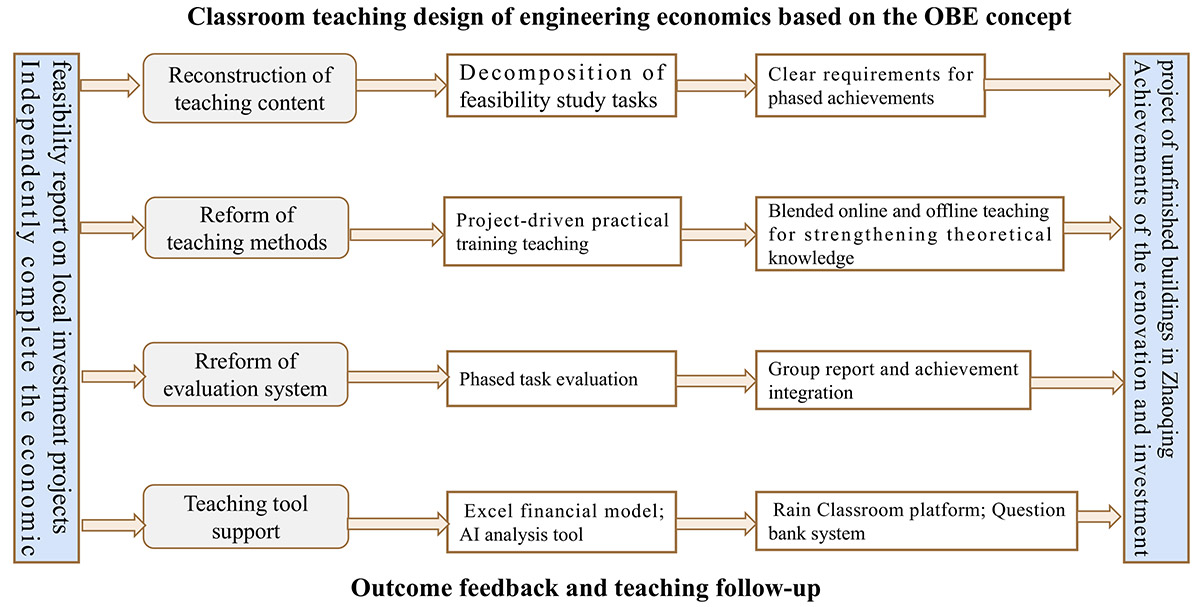
Engineering Economics is a core course for the Engineering Cost major in application-oriented undergraduate universities, yet traditional teaching often suffers from a theory-practice gap, low student participation, and polarized academic performance. Guided by Outcomes-Based Education (OBE), this study developed a three-in-one project-driven teaching model integrating modular theory, whole-process project practice, and diversified assessment. Theoretical content was reorganized into four application modules within a closed-loop ``lecture-practice-assessment'' process. A real local project---the renovation of an unfinished building into affordable rental housing in Zhaoqing City---served as the practical carrier, incorporating differentiated parameters, rotating group roles, and full-process Excel modeling. Formative assessment accounted for 40% of the total grade. The model was implemented over three semesters with 134 Engineering Cost students from the 2022--2024 cohorts at Guangdong Technology College. After the reform, the average course score increased from 70.38 to 85.65, the good and excellent rate from 31.4% to 83.9%, and the failure rate decreased from 25.5% to 3.2%. Moreover, 87.5% of students could construct dynamically linked financial models, while the classroom head-up rate in the reform class exceeded 85%, compared with approximately 50%--60% in the concurrent control class. The results demonstrate that the model effectively enhances learning outcomes and practical engineering economic analysis skills, providing a replicable approach for similar courses in application-oriented undergraduate universities, although further multi-institutional validation is needed.
Graphical Abstract
Keywords
Data Availability Statement
Funding
Conflicts of Interest
AI Use Statement
Ethical Approval and Consent to Participate
References
- Shen, J., Li, T., & Wu, M. (2020). The new engineering education in China. Procedia Computer Science, 172, 886-895.
[CrossRef] [Google Scholar] - Hossain, N. A., Saad, H. S., & Larsen, K. F. (2023, April). Teaching an Undergraduate Introductory Engineering Economics Course: Successful Implementation for Students Learning. In 2023 ASEE PNW Section Conference.
[CrossRef] [Google Scholar] - Crawley, E. F., Malmqvist, J., Östlund, S., & Brodeur, D. R. (2007). Rethinking engineering education: The CDIO approach. Boston, MA: Springer US.
[CrossRef] [Google Scholar] - Nachtmann, H., Needy, K. L., Lavelle, J. P., & Eschenbach, T. G. (1999, June). Engineering economy: Current teaching practices. In 1999 Annual Conference (pp. 4-233).
[CrossRef] [Google Scholar] - Wang, J., Li, X., Zhang, Q., & Song, H. (2024). Reform and practice of teaching Engineering Economics courses for applied undergraduate based on the OBE concept. International Journal of New Developments in Education, 6(9), 247–252.
[CrossRef] [Google Scholar] - Spady, W. G. (1982). Outcome-based instructional management: A sociological perspective. Australian Journal of Education, 26(2), 123-143.
[CrossRef] [Google Scholar] - Ecclestone, K. (1999). Empowerng or ensnaring?: the implications of outcome‐based assessment in higher education. Higher Education Quarterly, 53(1), 29-48.
[CrossRef] [Google Scholar] - Tshai, K. Y., Ho, J. H., Yap, E. H., & Ng, H. K. (2014). Outcome-based education–the assessment of programme educational objectives for an engineering undergraduate degree. Engineering Education, 9(1), 74-85.
[CrossRef] [Google Scholar] - Naveed Bin Rais, R., Rashid, M., Zakria, M., Hussain, S., Qadir, J., & Imran, M. A. (2021). Employing industrial quality management systems for quality assurance in outcome-based engineering education: A review. Education Sciences, 11(2), 45.
[CrossRef] [Google Scholar] - Syeed, M. M., Shihavuddin, A. S. M., Uddin, M. F., Hasan, M., & Khan, R. H. (2022). Outcome based education (OBE): Defining the process and practice for engineering education. IEEE Access, 10, 119170-119192.
[CrossRef] [Google Scholar] - Shi, W., Shi, X., Zhuang, L., Zhu, T., Li, G., & Huang, C. (2025). Integrating Outcome-Based Education (OBE) and Problem-Based Learning (PBL) in psychiatric clinical practice teaching: an empirical study. BMC Medical Education, 25(1), 1610.
[CrossRef] [Google Scholar] - Yang, T., & Pang, Y. (2026, May). Exploring the Reform Practice of an Integrated BOPPPS and PBL Teaching Model in Professional Courses Under the Guidance of OBE. In 2026 5th International Conference on Educational Innovation and Multimedia Technology (EIMT 2026) (pp. 467-481). Atlantis Press.
[CrossRef] [Google Scholar] - Guo, P., Saab, N., Post, L. S., & Admiraal, W. (2020). A review of project-based learning in higher education: Student outcomes and measures. International journal of educational research, 102, 101586.
[CrossRef] [Google Scholar] - Dewey, J. (1986, September). Experience and education. In The educational forum (Vol. 50, No. 3, pp. 241-252). Taylor & Francis Group.
[CrossRef] [Google Scholar] - Lev Semenovič forme avant 2007 Vygotskij, & John-Steiner, V. (1979). Mind in society: The development of higher psychological processes. Harvard University Press.
[CrossRef] [Google Scholar] - Blumenfeld, P. C., Soloway, E., Marx, R. W., Krajcik, J. S., Guzdial, M., & Palincsar, A. (1991). Motivating project-based learning: Sustaining the doing, supporting the learning. Educational psychologist, 26(3-4), 369-398.
[CrossRef] [Google Scholar] - Tiwari, R., Arya, R. K., & Bansal, M. (2017). Motivating students for project-based learning for application of research methodology skills. International journal of applied and basic medical research, 7(Suppl 1), S4.
[CrossRef] [Google Scholar] - Belwal, R., Belwal, S., Sufian, A. B., & Al Badi, A. (2021). Project-based learning (PBL): outcomes of students’ engagement in an external consultancy project in Oman. Education+ Training, 63(3), 336-359.
[CrossRef] [Google Scholar] - Ricaurte, M., Ordóñez, P. E., Navas-Cárdenas, C., Meneses, M. A., Tafur, J. P., & Viloria, A. (2022). Industrial processes online teaching: A good practice for undergraduate engineering students in times of COVID-19. Sustainability, 14(8), 4776.
[CrossRef] [Google Scholar] - Kolmos, A., Bøgelund, P., & Spliid, C. M. (2019). Learning and Assessing Problem‐Based Learning at Aalborg University: A Case Study. The Wiley handbook of problem‐based learning, 437-458.
[CrossRef] [Google Scholar] - LeBlanc, H. J., & Boulanger, B. O. N. (2014, June). A Cross-Discipline, Project-Based Approach to Teaching Engineering Economy. In 2014 ASEE Annual Conference & Exposition (pp. 24-42).
[CrossRef] [Google Scholar] - Elmiligi, H., & Iverson, S. (2008). An Industrial Design-Oriented Engineering Economics Course. Proceedings of the Canadian Engineering Education Association (CEEA).
[CrossRef] [Google Scholar] - Almulla, M. A. (2020). The effectiveness of the project-based learning (PBL) approach as a way to engage students in learning. Sage Open, 10(3), 2158244020938702.
[CrossRef] [Google Scholar] - Schlemer, L. T. (2013, June). Project based learning in engineering economics: Teaching advanced topics using a stock price prediction modeling. In 2013 ASEE Annual Conference & Exposition (pp. 23-991).
[CrossRef] [Google Scholar] - Sullivan, W., Terpenny, J., & Singh, H. (2004). A virtual classroom experiment for teaching engineering economy. The Engineering Economist, 49(4), 279-306.
[CrossRef] [Google Scholar] - Egbue, O. (2018, June). Incorporating Active Learning Strategies into An Engineering Economics Course. In 2018 ASEE Annual Conference & Exposition.
[CrossRef] [Google Scholar] - Lavelle, J. P., Stimpson, M. T., & Brill, E. D. (2015, June). Evolution of a flipped engineering economy course. In 2015 ASEE Annual Conference & Exposition (pp. 26-701).
[CrossRef] [Google Scholar] - Rane, V., & MacKenzie, C. A. (2020). Evaluating students with online testing modules in engineering economics: A comparision of student performance with online testing and with traditional assessments. The Engineering Economist, 65(3), 213-235.
[CrossRef] [Google Scholar] - Burns, J., White, B., & Konstant, A. (2020). Engineering economy as a vibrant and relevant course in the engineering programs of today and tomorrow. The Engineering Economist, 65(3), 236-258.
[CrossRef] [Google Scholar]
Cite This Article
TY  - JOUR
AU  - Cai, Xianquan
AU  - Zheng, Xuejiao
PY  - 2026
DA  - 2026/08/26
TI  - Construction and Practice of Outcomes-Based Education-Guided Project-Driven Teaching Model for Engineering Economics in Application-Oriented Undergraduate Universities
JO  - Frontiers in Educational Innovation and Research
T2  - Frontiers in Educational Innovation and Research
JF  - Frontiers in Educational Innovation and Research
VL  - 2
IS  - 3
SP  - 58
EP  - 71
DO  - 10.62762/FEIR.2026.394100
UR  - https://www.icck.org/article/abs/FEIR.2026.394100
KW  - OBE
KW  - engineering economics
KW  - project-driven teaching
KW  - application-oriented undergraduate
KW  - excel modeling
KW  - engineering cost
AB  - Engineering Economics is a core course for the Engineering Cost major in application-oriented undergraduate universities, yet traditional teaching often suffers from a theory-practice gap, low student participation, and polarized academic performance. Guided by Outcomes-Based Education (OBE), this study developed a three-in-one project-driven teaching model integrating modular theory, whole-process project practice, and diversified assessment. Theoretical content was reorganized into four application modules within a closed-loop ``lecture-practice-assessment'' process. A real local project---the renovation of an unfinished building into affordable rental housing in Zhaoqing City---served as the practical carrier, incorporating differentiated parameters, rotating group roles, and full-process Excel modeling. Formative assessment accounted for 40% of the total grade. The model was implemented over three semesters with 134 Engineering Cost students from the 2022--2024 cohorts at Guangdong Technology College. After the reform, the average course score increased from 70.38 to 85.65, the good and excellent rate from 31.4% to 83.9%, and the failure rate decreased from 25.5% to 3.2%. Moreover, 87.5% of students could construct dynamically linked financial models, while the classroom head-up rate in the reform class exceeded 85%, compared with approximately 50%--60% in the concurrent control class. The results demonstrate that the model effectively enhances learning outcomes and practical engineering economic analysis skills, providing a replicable approach for similar courses in application-oriented undergraduate universities, although further multi-institutional validation is needed.
SN  - 3068-5664
PB  - Institute of Central Computation and Knowledge
LA  - English
ER  -
@article{Cai2026Constructi,
  author = {Xianquan Cai and Xuejiao Zheng},
  title = {Construction and Practice of Outcomes-Based Education-Guided Project-Driven Teaching Model for Engineering Economics in Application-Oriented Undergraduate Universities},
  journal = {Frontiers in Educational Innovation and Research},
  year = {2026},
  volume = {2},
  number = {3},
  pages = {58-71},
  doi = {10.62762/FEIR.2026.394100},
  url = {https://www.icck.org/article/abs/FEIR.2026.394100},
  abstract = {Engineering Economics is a core course for the Engineering Cost major in application-oriented undergraduate universities, yet traditional teaching often suffers from a theory-practice gap, low student participation, and polarized academic performance. Guided by Outcomes-Based Education (OBE), this study developed a three-in-one project-driven teaching model integrating modular theory, whole-process project practice, and diversified assessment. Theoretical content was reorganized into four application modules within a closed-loop ``lecture-practice-assessment'' process. A real local project---the renovation of an unfinished building into affordable rental housing in Zhaoqing City---served as the practical carrier, incorporating differentiated parameters, rotating group roles, and full-process Excel modeling. Formative assessment accounted for 40\% of the total grade. The model was implemented over three semesters with 134 Engineering Cost students from the 2022--2024 cohorts at Guangdong Technology College. After the reform, the average course score increased from 70.38 to 85.65, the good and excellent rate from 31.4\% to 83.9\%, and the failure rate decreased from 25.5\% to 3.2\%. Moreover, 87.5\% of students could construct dynamically linked financial models, while the classroom head-up rate in the reform class exceeded 85\%, compared with approximately 50\%--60\% in the concurrent control class. The results demonstrate that the model effectively enhances learning outcomes and practical engineering economic analysis skills, providing a replicable approach for similar courses in application-oriented undergraduate universities, although further multi-institutional validation is needed.},
  keywords = {OBE, engineering economics, project-driven teaching, application-oriented undergraduate, excel modeling, engineering cost},
  issn = {3068-5664},
  publisher = {Institute of Central Computation and Knowledge}
}
Article Metrics
Publisher's Note
ICCK stays neutral with regard to jurisdictional claims in published maps and institutional affiliations.
Rights and Permissions
 Copyright © 2026 by the Author(s). Published by Institute of Central Computation and Knowledge. This article is an open access article distributed under the terms and conditions of the Creative Commons Attribution (CC BY) license (https://creativecommons.org/licenses/by/4.0/), which permits use, sharing, adaptation, distribution and reproduction in any medium or format, as long as you give appropriate credit to the original author(s) and the source, provide a link to the Creative Commons licence, and indicate if changes were made.


Portico
