

Investigating the Cognitive Mechanisms of L2 Learners’ Continuation Writing: A Conceptual Blending Perspective


Article Information
Abstract
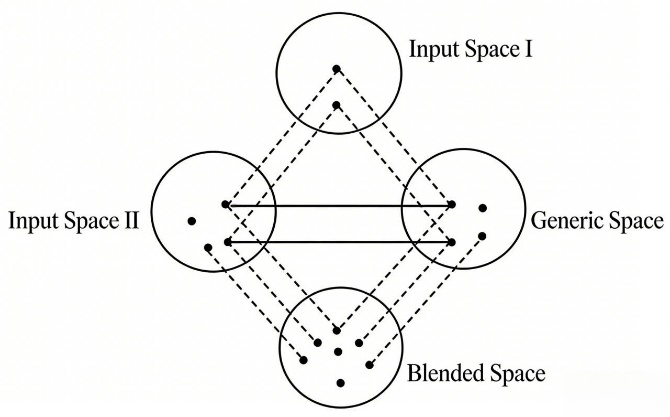
In recent years, continuation writing has attracted growing scholarly attention in second language (L2) pedagogy and assessment. However, most existing studies have focused on learners’ surface-level linguistic output, failing to unpack the underlying conceptual blending mechanism. In particular, cognitive comparative analyses across learners with varying proficiency levels remain scarce. Drawing on Conceptual Blending Theory (CBT), this study selected 18 continuation writing samples produced by L2 English learners from a key senior high school in Sichuan Province. NVivo was employed to conduct coding and cross-group comparative analyses across four dimensions, namely plot coherence, character consistency, emotional alignment, and thematic continuity. This study examined differences in mapping patterns and emergent structures within the blended space. The findings reveal that high-proficiency learners tend to effectively integrate multiple cognitive domains, producing well-structured and thematically enriched continuations, whereas intermediate and low-proficiency learners are more prone to inappropriate mappings or blending failures. This study further underscores the theoretical value of CBT in explaining the creative linguistic output of L2 learners.
Graphical Abstract
Keywords
Data Availability Statement
Funding
Conflicts of Interest
AI Use Statement
Ethical Approval and Consent to Participate
References
- Ye, W., & Ren, W. (2019). Source use in the story continuation writing task. Assessing Writing, 39, 39-49.
[CrossRef] [Google Scholar] - Ye, W., Ren, W., & Zheng, S. (2021). The construct of the story continuation writing task: Insights from the China’s standards of English language ability. Chinese Journal of Applied Linguistics, 44(3), 382-398.
[CrossRef] [Google Scholar] - Wang, M., Gan, Q., & Boland, J. (2021). L2 syntactic alignment in the reading-writing integrated continuation task: Evidence from Chinese EFL learners’ description of motion events. Chinese Journal of Applied Linguistics, 44(3), 292-313.
[CrossRef] [Google Scholar] - Wang, C., & Wang, M. (2015). Effect of alignment on L2 written production. Applied linguistics, 36(5), 503-526.
[CrossRef] [Google Scholar] - Li, X., & Wang, Y. (2024). Effects of input text genre on Chinese young EFL learners’ performance on continuation tasks. Language Testing in Asia, 14(1), 3.
[CrossRef] [Google Scholar] - Meng, L., & Yin, H. (2023). Effects of input enhancement and genre on L2 learners’ performance in the continuation writing task. Humanities and Social Sciences Communications, 10(1), 959.
[CrossRef] [Google Scholar] - Shi, B., Huang, L., & Lu, X. (2020). Effect of prompt type on test-takers’ writing performance and writing strategy use in the continuation task. Language Testing, 37(3), 361-388.
[CrossRef] [Google Scholar] - Ye, W., & Liu, J. (2023). Exploring and modeling the reading-writing connection in EFL integrated writing. Frontiers in Psychology, 14, 1161272.
[CrossRef] [Google Scholar] - Plakans, L. (2009). Discourse synthesis in integrated second language writing assessment. Language Testing, 26(4), 561-587.
[CrossRef] [Google Scholar] - Hayes, J. R., & Flower, L. S. (2016). Identifying the organization of writing processes. In Cognitive processes in writing (pp. 3-30). Routledge. https://www.taylorfrancis.com/chapters/edit/10.4324/9781315630274-3/identifying-organization-writing-processes-john-hayes-linda-flower
[Google Scholar] - Kellogg, R. T. (1996). A model of working memory in writing. In C. M. Levy & S. Ransdell (Eds.), The science of writing: Theories, methods, individual differences, and applications (pp. 57–71). Lawrence Erlbaum Associates, Inc. https://www.taylorfrancis.com/chapters/edit/10.4324/9780203811122-4/model-working-memory-writing-ronald-kellogg
[Google Scholar] - Fauconnier, G., & Turner, M. (2002). The Way We Think: Conceptual Blending and the Mind's Hidden Complexities. New York, NY: Basic Books. https://philpapers.org/rec/FAUTWW
[Google Scholar] - Fauconnier, G., & Turner, M. (1998). Conceptual integration networks. Cognitive science, 22(2), 133-187.
[CrossRef] [Google Scholar] - Oakley, T. (1998). Conceptual blending, narrative discourse, and rhetoric. Cognitive Linguistics, 9(4), 321–360.
[CrossRef] [Google Scholar] - Coulson, S., & Oakley, T. (2000). Blending basics. Cognitive Linguistics, 11(3–4), 175–196.
[CrossRef] [Google Scholar] - Coulson, S., & Oakley, T. (2005). Blending and coded meaning: Literal and figurative meaning in cognitive semantics. Journal of pragmatics, 37(10), 1510-1536.
[CrossRef] [Google Scholar] - Bache, C. (2005). Constraining conceptual integration theory: Levels of blending and disintegration. Journal of Pragmatics, 37(10), 1615-1635.
[CrossRef] [Google Scholar] - Grady, J., Oakley, T., & Coulson, S. (1999). Blending and metaphor. In R. W. Gibbs Jr. & G. J. Steen (Eds.), Metaphor in Cognitive Linguistics: Selected papers from the 5th International Cognitive Linguistics Conference, Amsterdam, 1997 (Current Issues in Linguistic Theory, Vol. 175, pp. 101–124). Amsterdam: John Benjamins.
[CrossRef] [Google Scholar]
Cite This Article
TY  - JOUR
AU  - Tian, Shengjiao
AU  - Zhang, Hao
PY  - 2026
DA  - 2026/09/04
TI  - Investigating the Cognitive Mechanisms of L2 Learners’ Continuation Writing: A Conceptual Blending Perspective
JO  - Frontiers in Educational Innovation and Research
T2  - Frontiers in Educational Innovation and Research
JF  - Frontiers in Educational Innovation and Research
VL  - 2
IS  - 3
SP  - 72
EP  - 89
DO  - 10.62762/FEIR.2026.926415
UR  - https://www.icck.org/article/abs/FEIR.2026.926415
KW  - continuation writing
KW  - conceptual blending theory
KW  - L2 learners
KW  - cognitive mechanism
AB  - In recent years, continuation writing has attracted growing scholarly attention in second language (L2) pedagogy and assessment. However, most existing studies have focused on learners’ surface-level linguistic output, failing to unpack the underlying conceptual blending mechanism. In particular, cognitive comparative analyses across learners with varying proficiency levels remain scarce. Drawing on Conceptual Blending Theory (CBT), this study selected 18 continuation writing samples produced by L2 English learners from a key senior high school in Sichuan Province. NVivo was employed to conduct coding and cross-group comparative analyses across four dimensions, namely plot coherence, character consistency, emotional alignment, and thematic continuity. This study examined differences in mapping patterns and emergent structures within the blended space. The findings reveal that high-proficiency learners tend to effectively integrate multiple cognitive domains, producing well-structured and thematically enriched continuations, whereas intermediate and low-proficiency learners are more prone to inappropriate mappings or blending failures. This study further underscores the theoretical value of CBT in explaining the creative linguistic output of L2 learners.
SN  - 3068-5664
PB  - Institute of Central Computation and Knowledge
LA  - English
ER  -
@article{Tian2026Investigat,
  author = {Shengjiao Tian and Hao Zhang},
  title = {Investigating the Cognitive Mechanisms of L2 Learners’ Continuation Writing: A Conceptual Blending Perspective},
  journal = {Frontiers in Educational Innovation and Research},
  year = {2026},
  volume = {2},
  number = {3},
  pages = {72-89},
  doi = {10.62762/FEIR.2026.926415},
  url = {https://www.icck.org/article/abs/FEIR.2026.926415},
  abstract = {In recent years, continuation writing has attracted growing scholarly attention in second language (L2) pedagogy and assessment. However, most existing studies have focused on learners’ surface-level linguistic output, failing to unpack the underlying conceptual blending mechanism. In particular, cognitive comparative analyses across learners with varying proficiency levels remain scarce. Drawing on Conceptual Blending Theory (CBT), this study selected 18 continuation writing samples produced by L2 English learners from a key senior high school in Sichuan Province. NVivo was employed to conduct coding and cross-group comparative analyses across four dimensions, namely plot coherence, character consistency, emotional alignment, and thematic continuity. This study examined differences in mapping patterns and emergent structures within the blended space. The findings reveal that high-proficiency learners tend to effectively integrate multiple cognitive domains, producing well-structured and thematically enriched continuations, whereas intermediate and low-proficiency learners are more prone to inappropriate mappings or blending failures. This study further underscores the theoretical value of CBT in explaining the creative linguistic output of L2 learners.},
  keywords = {continuation writing, conceptual blending theory, L2 learners, cognitive mechanism},
  issn = {3068-5664},
  publisher = {Institute of Central Computation and Knowledge}
}
Article Metrics
Publisher's Note
ICCK stays neutral with regard to jurisdictional claims in published maps and institutional affiliations.
Rights and Permissions
 Copyright © 2026 by the Author(s). Published by Institute of Central Computation and Knowledge. This article is an open access article distributed under the terms and conditions of the Creative Commons Attribution (CC BY) license (https://creativecommons.org/licenses/by/4.0/), which permits use, sharing, adaptation, distribution and reproduction in any medium or format, as long as you give appropriate credit to the original author(s) and the source, provide a link to the Creative Commons licence, and indicate if changes were made.


Portico
