

The Impact of Market Orientation and Self-Perception on the Heterogeneity of Cooperative Members: Analysis Based on Structural Equation Modeling


Article Information
Abstract
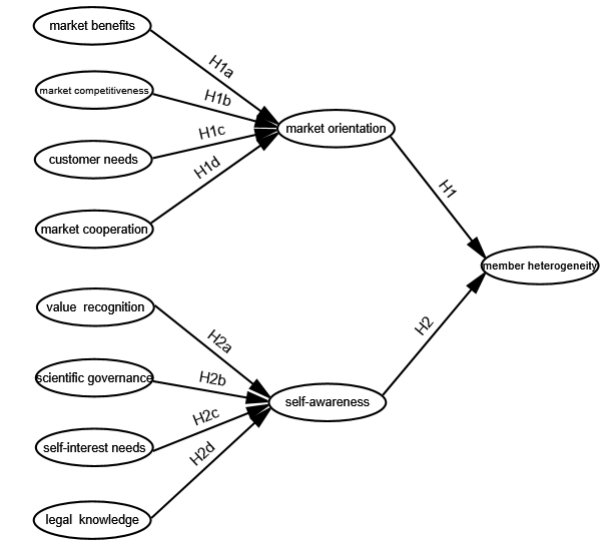
Effective governance and operation of cooperatives will play an important role in rural revitalization. Taking Henan Province as an example, this paper uses structural equation model to analyze the impact of external market orientation and internal self-awareness on the heterogeneity of farmers' professional cooperatives. It is concluded that the formation of the heterogeneity of farmer specialized cooperative members is not only caused by the influence of external market factors, but also caused by the difference in the degree of self-cognition of members. Moreover, the influence degree of market factors is greater than that of members' self-cognition, and the direct influence effects are 0.192 and 0.592 respectively. In the market orientation, the attainment of more market benefits, the need to improve market competitiveness, the satisfaction of different customer needs in the market and the success of cooperation among market cooperatives or other organizations will aggravate the degree of member heterogeneity. The higher the degree of self-cognition on the value of cooperatives, the necessity of scientific internal governance of cooperatives, the demand for profits in cooperatives and the more knowledge on the relevant laws of cooperatives will increase the possibility of the formation of member heterogeneity.
Graphical Abstract
Keywords
Data Availability Statement
Funding
Conflicts of Interest
Ethical Approval and Consent to Participate
References
- Nilsson, J. (2001). Organisational principles for co-operative firms. Scandinavian journal of management, 17(3), 329-356.
[CrossRef] [Google Scholar] - Iliopoulos, C., & Valentinov, V. (2018). Member heterogeneity in agricultural cooperatives: A systems-theoretic perspective. Sustainability, 10(4), 1271.
[CrossRef] [Google Scholar] - LeVay, C. (1983). Agricultural co‐operative theory: A review. Journal of agricultural economics, 34(1), 1-44.
[CrossRef] [Google Scholar] - Karantininis, K., & Zago, A. (2001). Endogenous membership in mixed duopsonies. American Journal of Agricultural Economics, 83(5), 1266-1272.
[CrossRef] [Google Scholar] - Grashuis, J., & Cook, M. L. (2021). Members of cooperatives: more heterogeneous, less satisfied?. International Food and Agribusiness Management Review, 24(5), 813-826.
[CrossRef] [Google Scholar] - Grashuis, J., & Su, Y. (2019). A review of the empirical literature on farmer cooperatives: Performance, ownership and governance, finance, and member attitude. Annals of Public and Cooperative Economics, 90(1), 77-102.
[CrossRef] [Google Scholar] - Huang, Z., & Liang, Q. (2018). Agricultural organizations and the role of farmer cooperatives in China since 1978: Past and future. China Agricultural Economic Review, 10(1), 48-64.
[CrossRef] [Google Scholar] - Yang, H., Klerkx, L., & Leeuwis, C. (2014). Functions and limitations of farmer cooperatives as innovation intermediaries: Findings from China. Agricultural Systems, 127, 115-125.
[CrossRef] [Google Scholar] - Iliopoulos, C., & Valentinov, V. (2022). Cooperative governance under increasing member diversity: Towards a new theoretical framework. Scandinavian Journal of Management, 38(1), 101192.
[CrossRef] [Google Scholar] - Galbraith, C. S., Rodriguez, C. L., & Stiles, C. H. (2007). Social capital as a club good: the case of ethnic communities and entrepreneurship. Journal of Enterprising communities: people and places in the global economy, 1(1), 38-53.
[CrossRef] [Google Scholar] - Wu, F., Guo, X., & Guo, X. (2023). Cooperative membership and new technology adoption of family farms: Evidence from China. Annals of Public and Cooperative Economics, 94(3), 719-739.
[CrossRef] [Google Scholar] - Höhler, J., & Kühl, R. (2018). Dimensions of member heterogeneity in cooperatives and their impact on organization–a literature review. Annals of public and cooperative economics, 89(4), 697-712.
[CrossRef] [Google Scholar] - Wu, F., Guo, X., & Guo, X. (2023). The impact of cooperative membership on family farms’ income: evidence from China. Applied Economics, 55(55), 6520-6537.
[CrossRef] [Google Scholar] - Sacchetti, S., & Tortia, E. (2012). The internal and external governance of cooperatives: The effective membership and consistency of value. AICCON, University of Bologna. Available at: http://hdl.handle.net/1893/10618
[Google Scholar] - Hart, O., & Moore, J. (1996). The governance of exchanges: members' cooperatives versus outside ownership. Oxford review of economic policy, 12(4), 53-69.
[CrossRef] [Google Scholar] - Iliopoulos, C., & Cook, M. L. (1999). The internal organization of the cooperative firm: An extension of a new institutional digest. Journal of Cooperatives, 14, 77-85.
[CrossRef] [Google Scholar] - Liang, Q., Dong, H., Bailey, A. R., Hu, W., & Jia, F. (2022). Exploring multiple drivers of cooperative governance: a paired case comparison of vegetable growing cooperatives in the UK and China. International Food and Agribusiness Management Review, 25(4), 651-670.
[CrossRef] [Google Scholar] - Deng, H., Huang, J., Xu, Z., & Rozelle, S. (2010). Policy support and emerging farmer professional cooperatives in rural China. China economic review, 21(4), 495-507.
[CrossRef] [Google Scholar] - Song, J. (2016). Innovation ecosystem: impact of interactive patterns, member location and member heterogeneity on cooperative innovation performance. Innovation, 18(1), 13-29.
[CrossRef] [Google Scholar] - Martynova, E., West, S. G., & Liu, Y. (2018). Review of principles and practice of structural equation modeling. Structural Equation Modeling: A Multidisciplinary Journal, 25(2), 325-329.
[CrossRef] [Google Scholar] - Zhang, Y. Y., Ju, G. W., & Zhan, J. T. (2019). Farmers using insurance and cooperatives to manage agricultural risks: A case study of the swine industry in China. Journal of Integrative Agriculture, 18(12), 2910-2918.
[CrossRef] [Google Scholar] - Liang, Q., & Hendrikse, G. (2013). Core and common members in the genesis of farmer cooperatives in China. Managerial and Decision Economics, 34(3-5), 244-257.
[CrossRef] [Google Scholar]
Cite This Article
TY  - JOUR
AU  - Zhao, Liming
AU  - Liu, Sumei
PY  - 2024
DA  - 2024/06/02
TI  - The Impact of Market Orientation and Self-Perception on the Heterogeneity of Cooperative Members: Analysis Based on Structural Equation Modeling
JO  - Journal of Social Systems and Policy Analysis
T2  - Journal of Social Systems and Policy Analysis
JF  - Journal of Social Systems and Policy Analysis
VL  - 1
IS  - 2
SP  - 61
EP  - 71
DO  - 10.62762/JSSPA.2024.184862
UR  - https://www.icck.org/article/abs/JSSPA.2024.184862
KW  - market orientation
KW  - self-perception
KW  - heterogeneity of members
AB  - Effective governance and operation of cooperatives will play an important role in rural revitalization. Taking Henan Province as an example, this paper uses structural equation model to analyze the impact of external market orientation and internal self-awareness on the heterogeneity of farmers' professional cooperatives. It is concluded that the formation of the heterogeneity of farmer specialized cooperative members is not only caused by the influence of external market factors, but also caused by the difference in the degree of self-cognition of members. Moreover, the influence degree of market factors is greater than that of members' self-cognition, and the direct influence effects are 0.192 and 0.592 respectively. In the market orientation, the attainment of more market benefits, the need to improve market competitiveness, the satisfaction of different customer needs in the market and the success of cooperation among market cooperatives or other organizations will aggravate the degree of member heterogeneity. The higher the degree of self-cognition on the value of cooperatives, the necessity of scientific internal governance of cooperatives, the demand for profits in cooperatives and the more knowledge on the relevant laws of cooperatives will increase the possibility of the formation of member heterogeneity.
SN  - 3068-5540
PB  - Institute of Central Computation and Knowledge
LA  - English
ER  -
@article{Zhao2024The,
  author = {Liming Zhao and Sumei Liu},
  title = {The Impact of Market Orientation and Self-Perception on the Heterogeneity of Cooperative Members: Analysis Based on Structural Equation Modeling},
  journal = {Journal of Social Systems and Policy Analysis},
  year = {2024},
  volume = {1},
  number = {2},
  pages = {61-71},
  doi = {10.62762/JSSPA.2024.184862},
  url = {https://www.icck.org/article/abs/JSSPA.2024.184862},
  abstract = {Effective governance and operation of cooperatives will play an important role in rural revitalization. Taking Henan Province as an example, this paper uses structural equation model to analyze the impact of external market orientation and internal self-awareness on the heterogeneity of farmers' professional cooperatives. It is concluded that the formation of the heterogeneity of farmer specialized cooperative members is not only caused by the influence of external market factors, but also caused by the difference in the degree of self-cognition of members. Moreover, the influence degree of market factors is greater than that of members' self-cognition, and the direct influence effects are 0.192 and 0.592 respectively. In the market orientation, the attainment of more market benefits, the need to improve market competitiveness, the satisfaction of different customer needs in the market and the success of cooperation among market cooperatives or other organizations will aggravate the degree of member heterogeneity. The higher the degree of self-cognition on the value of cooperatives, the necessity of scientific internal governance of cooperatives, the demand for profits in cooperatives and the more knowledge on the relevant laws of cooperatives will increase the possibility of the formation of member heterogeneity.},
  keywords = {market orientation, self-perception, heterogeneity of members},
  issn = {3068-5540},
  publisher = {Institute of Central Computation and Knowledge}
}
Article Metrics
Publisher's Note
ICCK stays neutral with regard to jurisdictional claims in published maps and institutional affiliations.
Rights and Permissions
 Copyright © 2024 by the Author(s). Published by Institute of Central Computation and Knowledge. This article is an open access article distributed under the terms and conditions of the Creative Commons Attribution (CC BY) license (https://creativecommons.org/licenses/by/4.0/), which permits use, sharing, adaptation, distribution and reproduction in any medium or format, as long as you give appropriate credit to the original author(s) and the source, provide a link to the Creative Commons licence, and indicate if changes were made.


Portico
