

ICCK Journal of Applied Mathematics

Publishing Model:
ISSN:
ISSN: 3068-5656
ICCK Journal of Applied Mathematics is a peer-reviewed international journal dedicated to the publication of high-quality research in all areas of applied mathematics.
DOI Prefix: 10.62762/JAM

Journal Metrics

-
Impact Factor
-
CiteScore

Recent Articles

Open Access | Research Article | 25 April 2026
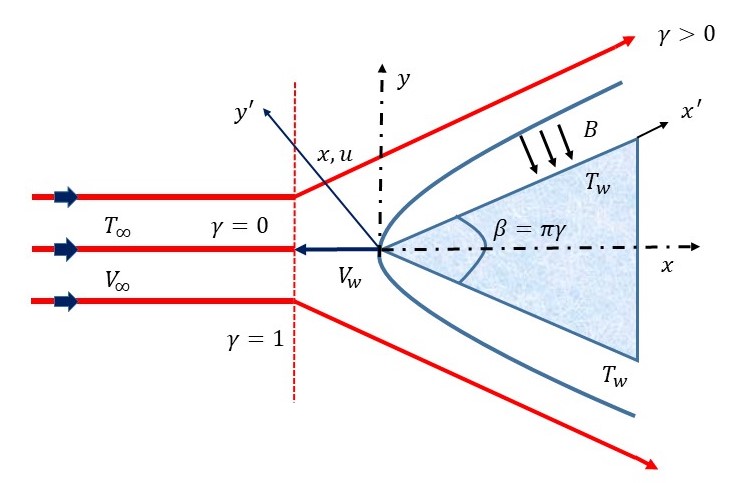
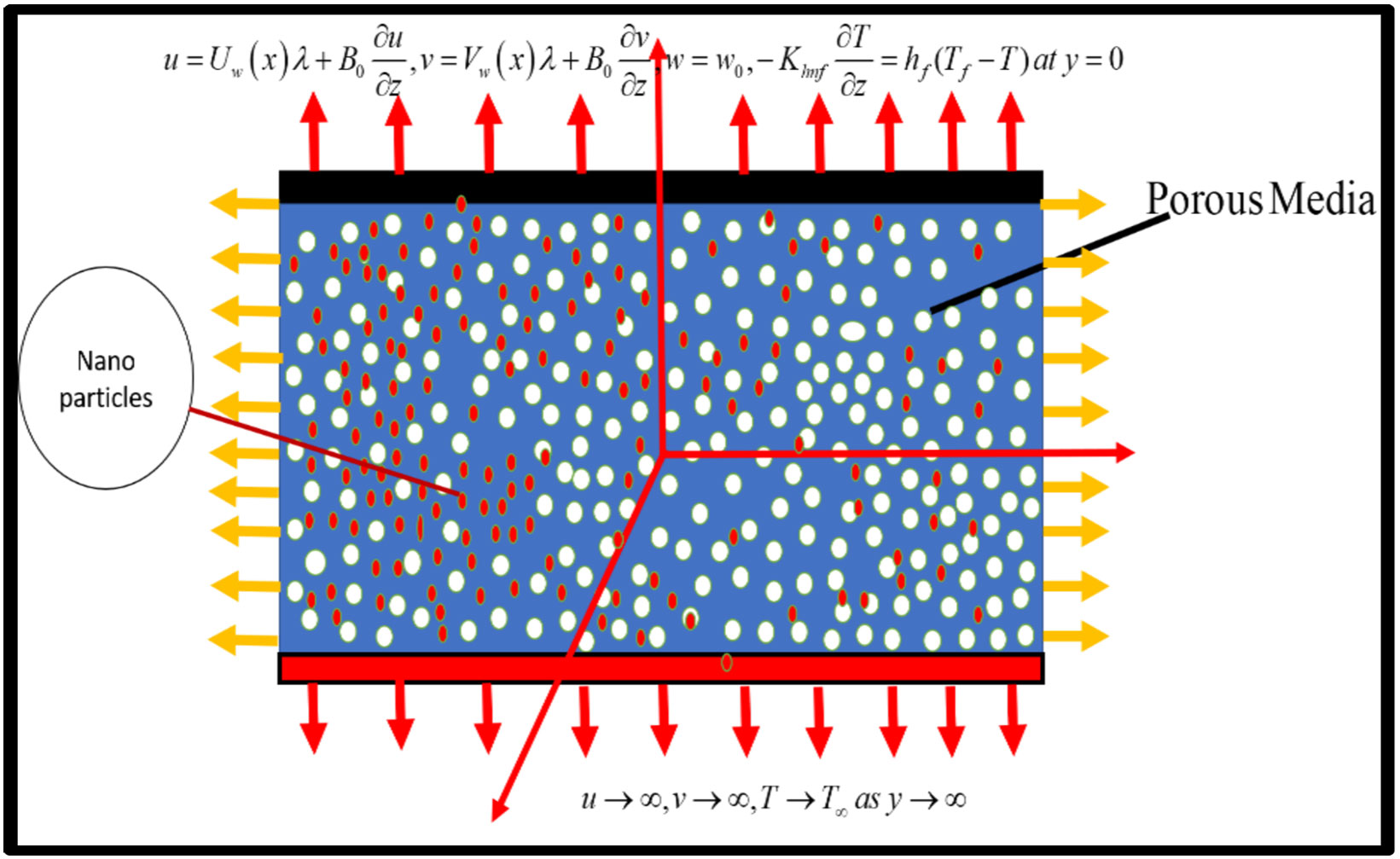
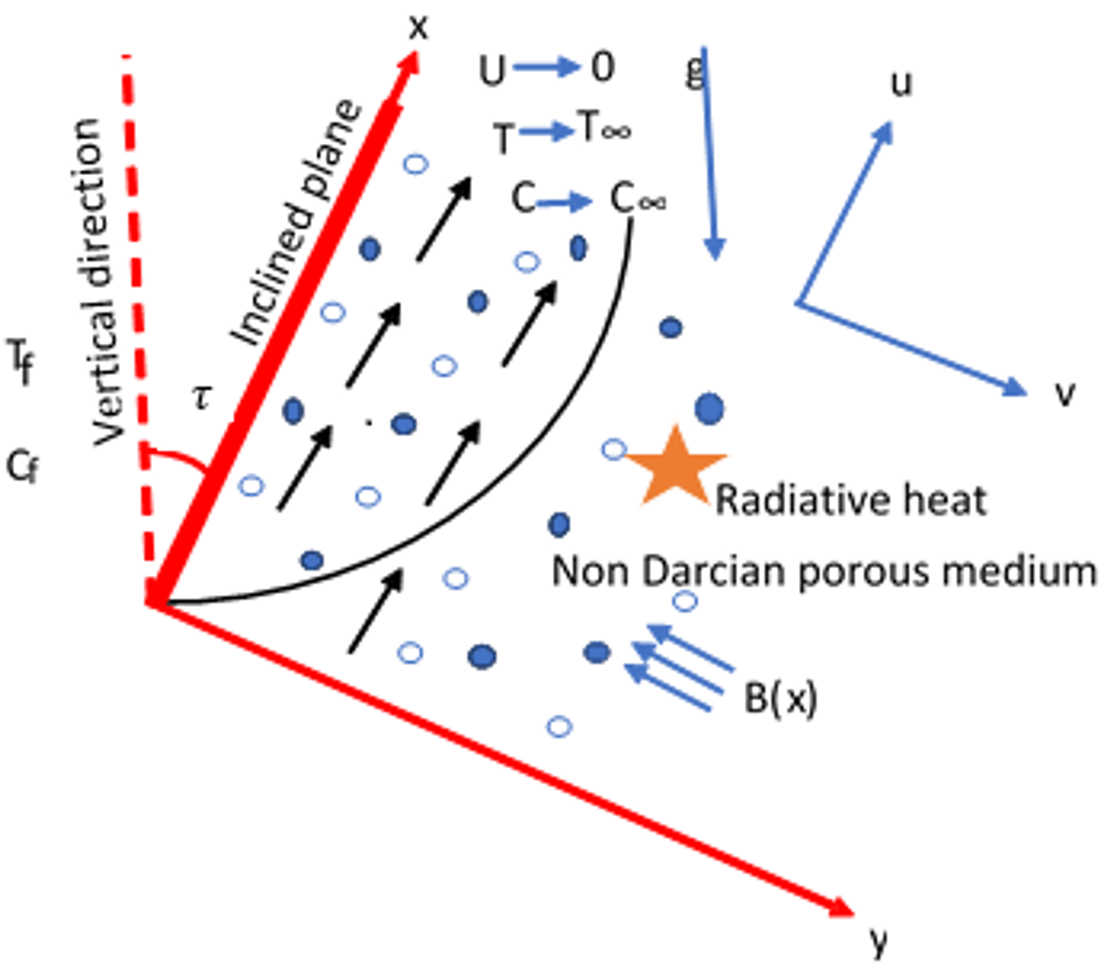
Radiative and Viscous Dissipative Flow of a Chemically Reacting MHD Casson Nanofluid over an Inclined Slippery Stretching Surface with Non-Darcian Medium
ICCK Journal of Applied Mathematics | Volume 2, Issue 2: 153-165, 2026 | DOI: 10.62762/JAM.2026.785346
Abstract
The study of coupled reaction transport in Casson rheology bridges the gap between idealized Newtonian models and practical non-Newtonian fluids, as chemically reacting nanoparticles alter the concentration and thermal behavior of the base fluid. This complexity intensifies when nanoparticles are introduced into conventional refrigerants. This work presents a unified investigation of radiative and viscous dissipative magnetohydrodynamic flow of a chemically reacting Casson nanofluid over an inclined slippery stretching surface embedded in a non-Darcy porous medium. The simultaneous consideration of Casson rheology, nanoparticle-enhanced heat transfer, magnetic control, surface slip, chemical... More >

Graphical Abstract
Radiative and Viscous Dissipative Flow of a Chemically Reacting MHD Casson Nanofluid over an Inclined Slippery Stretching Surface with Non-Darcian Medium
Open Access | Research Article | 16 April 2026 | Cited: Crossref logo  1
Optimized Irreversibilities and Quartic Autocatalysis Chemical Reaction in A Wedge Flow
ICCK Journal of Applied Mathematics | Volume 2, Issue 2: 137-152, 2026 | DOI: 10.62762/JAM.2025.513035
Abstract
Entropy optimization in the dissipative flow of a viscous liquid with a chemical species of quartic autocatalysis inside wedge geometry is investigated in this study by executing the revised Buongiorno model using numerical simulations. To demonstrate the feasibility of this approach, an illustration of the well-known model of laminar flow in the wedge domain of a planar surface is provided. The term for nanoparticles amalgamation in the heat equation is omitted, which accounts for additional involvement brought on by the migration of the nanoparticles in relation to the fluid. In addition, the energy released by autocatalysis processes is assumed to be insignificant. The studied nanofluid a... More >

Graphical Abstract
Optimized Irreversibilities and Quartic Autocatalysis Chemical Reaction in A Wedge Flow
Open Access | Research Article | 01 April 2026
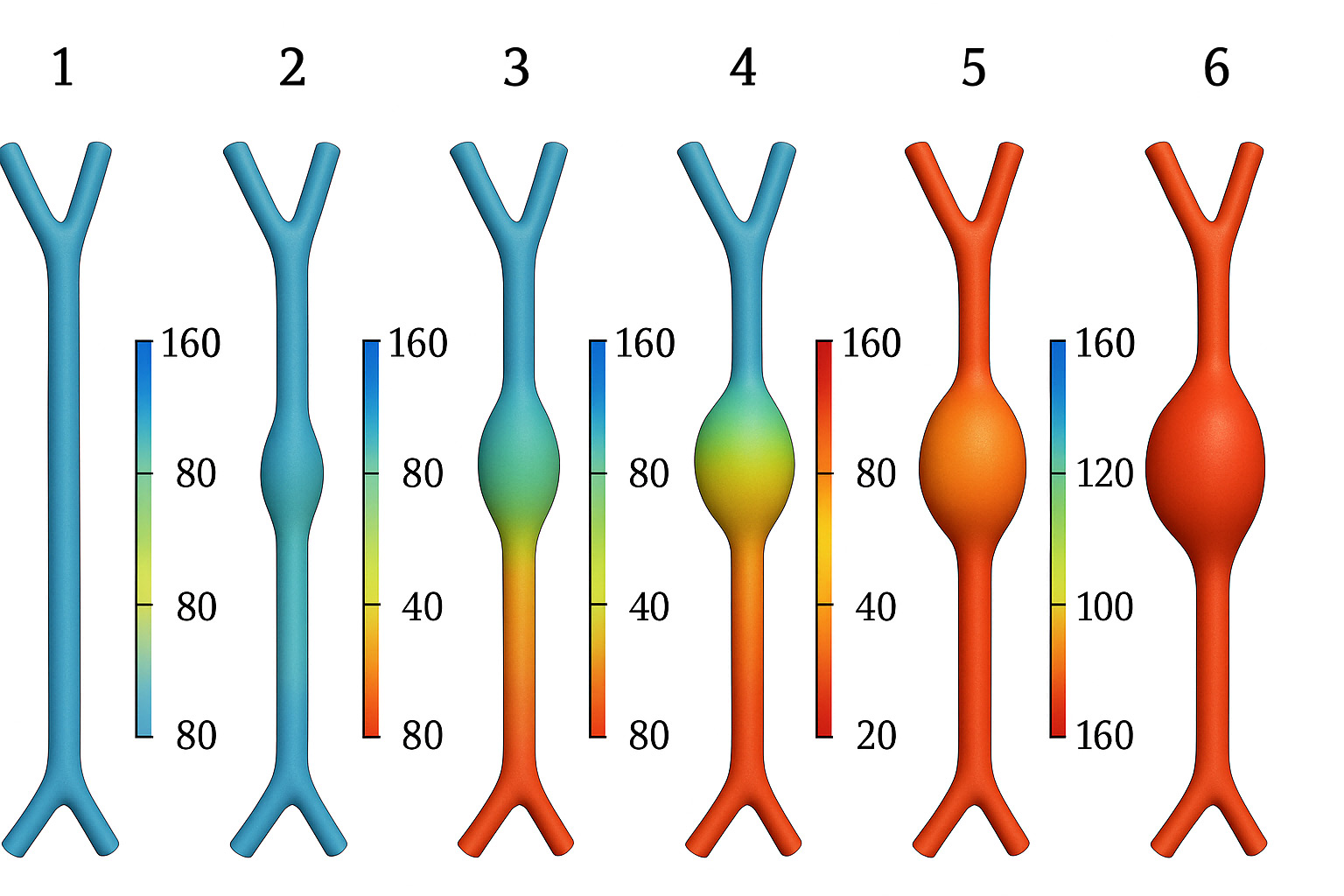
Analysis of the Cardiovascular System and an Aorta with Abdominal Aneurysm Using Lattice Boltzmann
ICCK Journal of Applied Mathematics | Volume 2, Issue 2: 120-136, 2026 | DOI: 10.62762/JAM.2026.170486
Abstract
This study presents a mathematical and computational analysis of blood flow in the abdominal aorta under healthy, aneurysmal, and rupture-related conditions. The proposed framework combines a Newtonian fluid approximation with a Lattice Boltzmann formulation to simulate the hemodynamic behavior of the aorta in three-dimensional geometry. The governing equations were implemented in Python, allowing the generation of numerical simulations and corresponding three-dimensional visualizations of aneurysm progression. The analysis considered clinically inspired stages ranging from the healthy vessel to advanced aneurysmal dilation and rupture. The results showed that aneurysm growth significantly a... More >

Graphical Abstract
Analysis of the Cardiovascular System and an Aorta with Abdominal Aneurysm Using Lattice Boltzmann
Open Access | Research Article | 16 March 2026
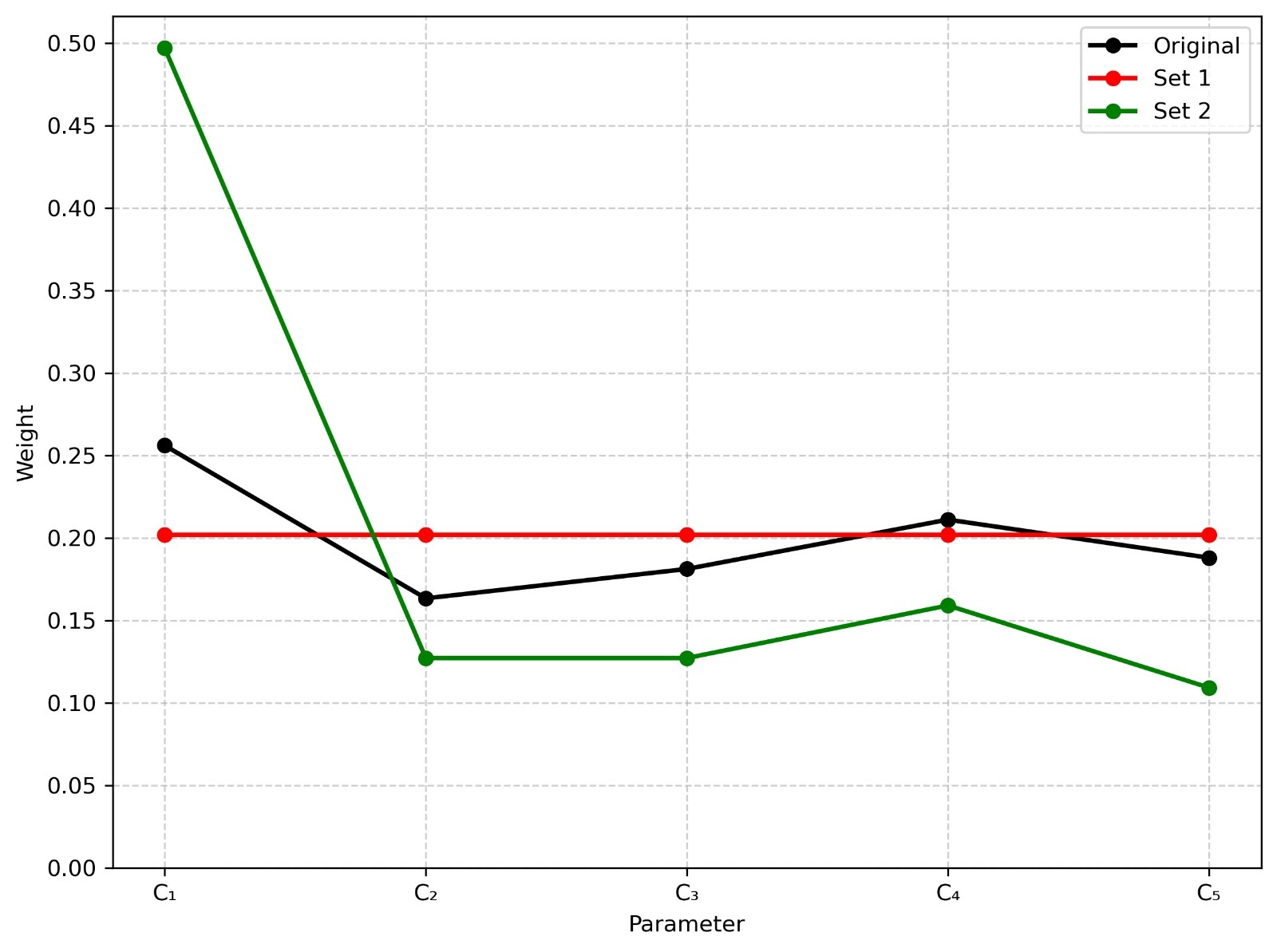
CRITIC-EDAS Method for Linguistic Picture Fuzzy Soft Sets and Its Application in Decision Making Problem
ICCK Journal of Applied Mathematics | Volume 2, Issue 1: 111-119, 2026 | DOI: 10.62762/JAM.2026.193939
Abstract
Linguistic picture fuzzy soft sets (LPFSSs) provide a powerful tool for handling uncertainties in decision-making problems, particularly when multiple parameters are involved. By integrating the advantages of linguistic picture fuzzy sets (LPFSs) and soft sets (SSs), LPFSSs prove especially effective in situations involving imprecise and ambiguous information. This study extends the conventional CRITIC (Criteria Importance Through Inter-criteria Correlation) and EDAS (Evaluation based on Distance from Average Solution) methods to the LPFSS environment. First, the definitions of LPFSSs and linguistic picture fuzzy soft numbers (LPFSNs) are introduced along with their key properties. Subsequen... More >

Graphical Abstract
CRITIC-EDAS Method for Linguistic Picture Fuzzy Soft Sets and Its Application in Decision Making Problem
Open Access | Research Article | 04 March 2026
Time Dependent Algorithm using Modified Three-Point Superclass of Block Backward Differentiation Formula for Solving Stiff Ordinary Differential Equations
ICCK Journal of Applied Mathematics | Volume 2, Issue 1: 87-110, 2026 | DOI: 10.62762/JAM.2026.213905
Abstract
In this paper, we present a modified three-point superclass of Block Backward Differentiation Formula (BBDF) for the efficient numerical solution of stiff systems of ordinary differential equations (ODEs). The principal enhancement of this work is a structural modification of the classical BBDF that forms a new parameterized superclass of methods, leading to improved stability and reduced error constants compared with the standard three-point BBDFs. The proposed scheme is formulated as a fully implicit block method capable of simultaneously producing three solution approximations within each integration step. A detailed theoretical analysis is conducted to establish the order of accuracy, co... More >

Graphical Abstract
Time Dependent Algorithm using Modified Three-Point Superclass of Block Backward Differentiation Formula for Solving Stiff Ordinary Differential Equations
Open Access | Research Article | 29 January 2026
On Strategic Planning of a Dynamic Allocation of Vehicles with Stochastic Breakdown to Destinations with Multiple Alternative Routes for Returns Maximization
ICCK Journal of Applied Mathematics | Volume 2, Issue 1: 64-86, 2026 | DOI: 10.62762/JAM.2025.632255
Abstract
This paper proposes a dynamic programming (DP) approach for a stochastic multi-period allocation problem, whereby fleet of vehicles are assigned from stations to destinations with multiple alternative routes in order to maximize returns, while the vehicles are subject to random failure. In the process of managing the business, the company is assumed to incur proportional management costs and pay tax to government. The expected returns is modelled as a function of random failure of vehicles due to bad roads and depreciation. The depreciation rate is assumed to follow a straight-line approach. The breakdown rate is modelled as function of the rate of bad roads on the fleets, depreciation rate... More >
Open Access | Research Article | 17 January 2026 | Cited: Crossref logo  3
Influence of Darcy-Forchheimer Effects on 3D MHD Rotating Flow of Casson Hybrid Nanofluid with Velocity Slip and Convective Boundary Conditions
ICCK Journal of Applied Mathematics | Volume 2, Issue 1: 44-63, 2026 | DOI: 10.62762/JAM.2025.945696
Abstract
In order to improve heat transfer efficiency, it is essential to examine that MHD hybrid nanofluid flows behave under convective and slip boundary conditions. Researchers have looked at a variety of factors when adding hybrid nanofluids to these flows, including Forchheimer number, radiation, magnetic fields, Biot number, and the Joule heating. The novelty of the current study lies in investigating the consequences of Casson fluid in the Darcy Forchheimer flow of a three-dimensional rotating hybrid nanofluid, which have not been thoroughly covered in the literature. This includes combinations of heat sources/sinks, magnetic parameters, and radiation absorption as well as convective condition... More >

Graphical Abstract
Influence of Darcy-Forchheimer Effects on 3D MHD Rotating Flow of Casson Hybrid Nanofluid with Velocity Slip and Convective Boundary Conditions
Open Access | Research Article | 15 January 2026
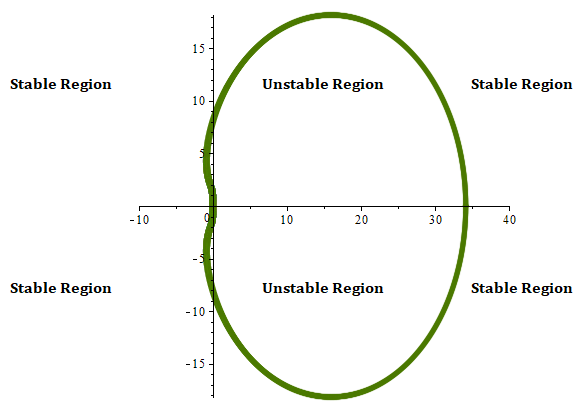
Equilibria and Stability Analysis of a Compartmental Model for Crime Dynamics with Recidivism and Corruption
ICCK Journal of Applied Mathematics | Volume 2, Issue 1: 1-43, 2026 | DOI: 10.62762/JAM.2025.240326
Abstract
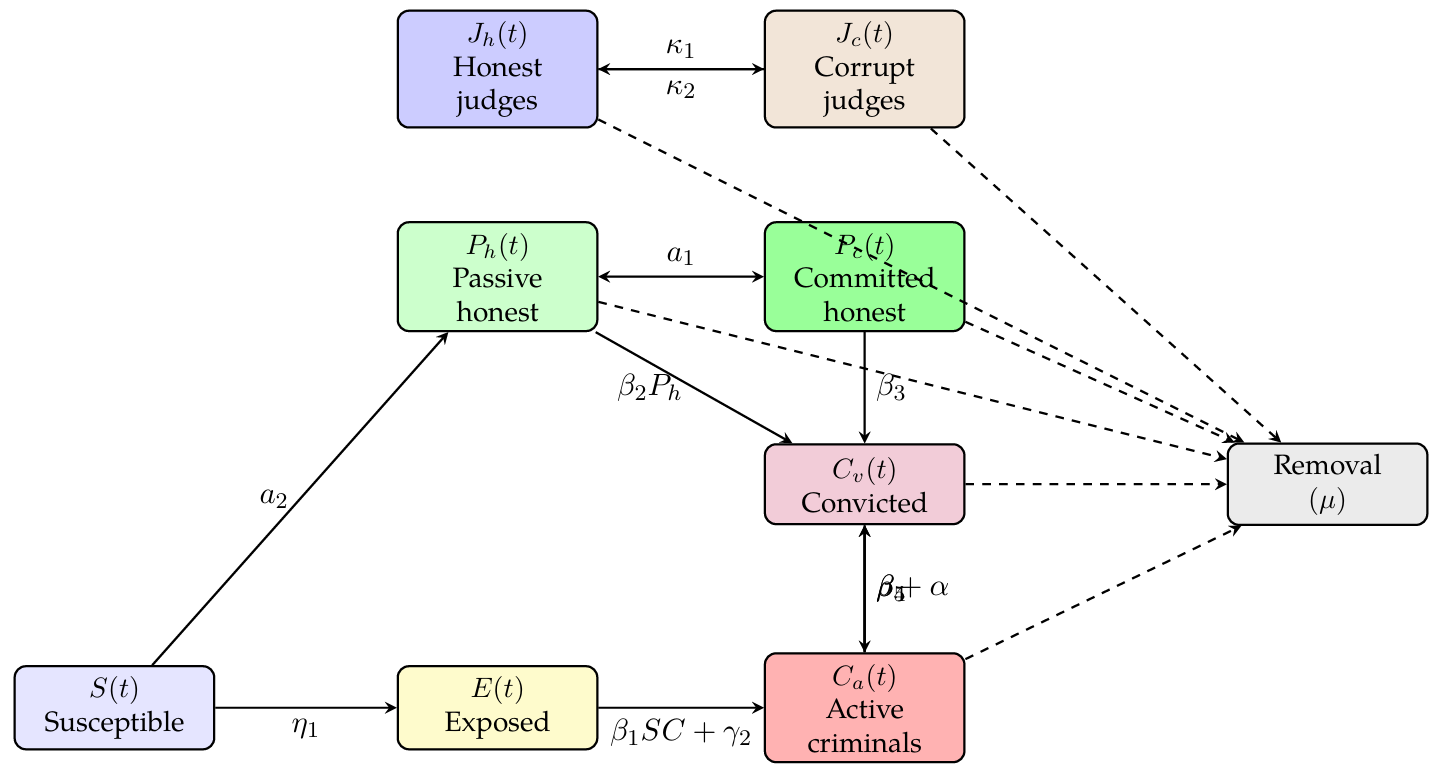
A nonlinear compartmental model is developed to analyze crime dynamics in a structured society. The population is stratified into eight compartments: \(S(t)\) (susceptible), \(E(t)\) (exposed), \(C(t)\) (active criminals), \(C_v(t)\) (convicted criminals), \(P_h(t)\) (passive-honest), \(P_c(t)\) (committed-honest), \(J_h(t)\) (honest judges), and \(J_c(t)\) (corrupt judges). The model incorporates nonlinear mechanisms such as institutional corruption (\(\kappa_1\)), judicial correction (\(\kappa_2\)), recidivism feedback (\(\rho_1,\rho_2\)), exposure intensity (\(\eta_1\)), and rehabilitation (\(r_2\)), providing a realistic portrayal of crime--justice interactions. Solutions remain positive... More >

Graphical Abstract
Equilibria and Stability Analysis of a Compartmental Model for Crime Dynamics with Recidivism and Corruption

Journal Statistics

71
Authors
11
Countries / Regions
31
Articles
29
Scopus Citations
29% Cited
2025
Published Since
55,039
Article Views
14,259
Article Downloads
ICCK Journal of Applied Mathematics
eISSN: 3068-5656
Crossref
Crossref
Member of Crossref
Visit Crossref →