

ICCK Journal of Applied Mathematics

Publishing Model:
ISSN:
ISSN: 3068-5656
ICCK Journal of Applied Mathematics is a peer-reviewed international journal dedicated to the publication of high-quality research in all areas of applied mathematics.
DOI Prefix: 10.62762/JAM

Journal Metrics

-
Impact Factor
-
CiteScore

Recent Articles

Open Access | Research Article | 29 October 2025
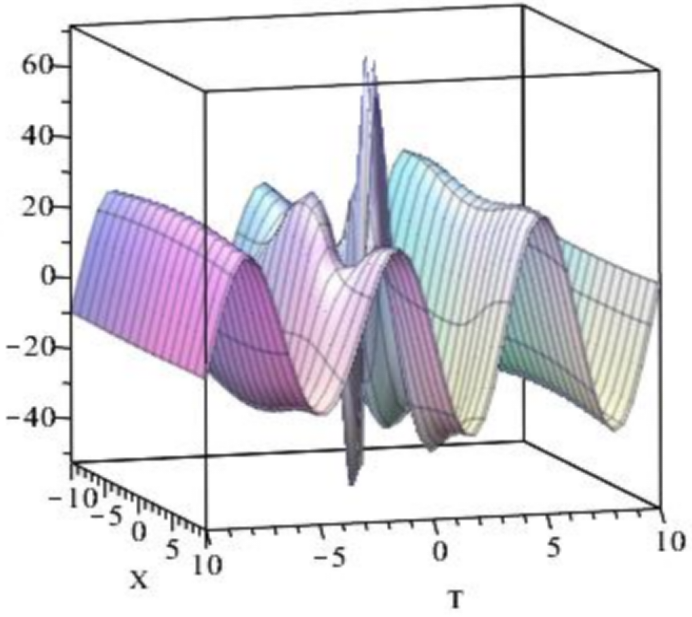
Electrostatic Freak Waves in Pair-Ion and Pair-Ion-Electron Plasmas
ICCK Journal of Applied Mathematics | Volume 1, Issue 3: 120-128, 2025 | DOI: 10.62762/JAM.2025.698605
Abstract
This work investigates the formation and dynamics of electrostatic freak waves in pair-ion (PI) and pair-ion--electron (PIE) plasmas. The analysis begins with the derivation of the Korteweg--de Vries (KdV) equations for both plasma configurations, from which the corresponding nonlinear and dispersive coefficients are obtained. By employing the wave superposition principle, the KdV equations are systematically reduced to the nonlinear Schrödinger equation (NLSE), enabling the exploration of modulation instability and rogue wave generation. Analytical solutions of the NLSE are utilized to construct parametric plots that elucidate the evolution of freak waves in PI and PIE plasmas. Comparative... More >

Graphical Abstract

Electrostatic Freak Waves in Pair-Ion and Pair-Ion-Electron Plasmas
Open Access | Research Article | 26 October 2025 | Cited: Crossref logo  9 , Scopus 7
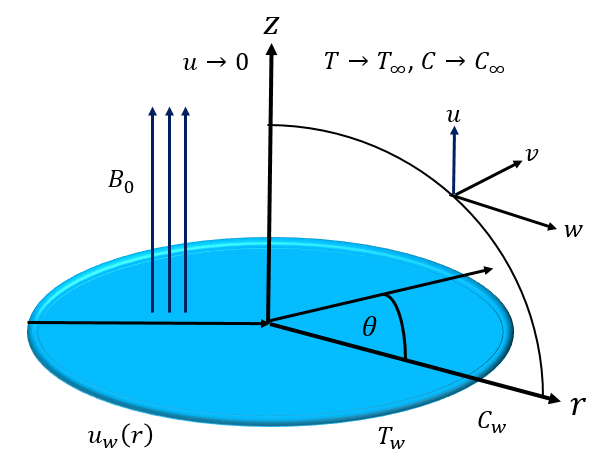
Magnetohydrodynamic Flow and Heat Transfer of Boger Tri-Hybrid Nanofluid over a Porous Disk with Cattaneo-Christov Heat Flux Theory Using Artificial Neural Network Framework
ICCK Journal of Applied Mathematics | Volume 1, Issue 3: 97-119, 2025 | DOI: 10.62762/JAM.2025.640044
Abstract
This study investigates the magnetohydrodynamic (MHD) flow of Boger tri-hybrid nanofluid (tri-HNF) through a stretching disk. A novel machine learning technique, specifically the Levenberg--Marquardt (LM) scheme under a backpropagated artificial neural network (ANN), is used to predict the flow dynamics with heat and mass transfer. The Cattaneo-Christov mass and heat fluxes model, permeable media, and viscous dissipation are considered. The well-known Brinkman-Hamilton and Crosser model is used to describe thermal conductivity and viscosity models. The computational solution to the current problem has been obtained using the Bvp4c approach, which is based on finite differences. In order to e... More >

Graphical Abstract
Magnetohydrodynamic Flow and Heat Transfer of Boger Tri-Hybrid Nanofluid over a Porous Disk with Cattaneo-Christov Heat Flux Theory Using Artificial Neural Network Framework
Open Access | Research Article | 15 September 2025
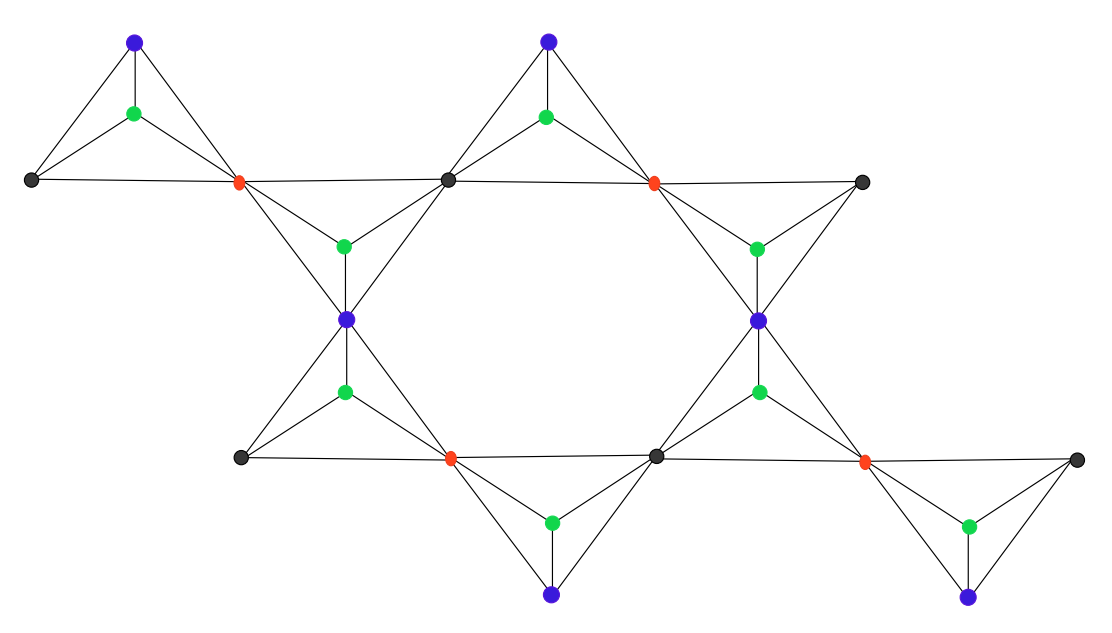
Results on Domination and Chromatic Numbers of Rhombus Silicate Molecular Structure
ICCK Journal of Applied Mathematics | Volume 1, Issue 2: 86-96, 2025 | DOI: 10.62762/JAM.2025.445811
Abstract
In this article, we specially focused on rhombus silicate molecular structure. Graph is a data structure for describing complex systems, which contains a set of objects and relationships. A molecular graph, also known as a chemical graph, is a graph-theoretic representation of the structural formula of a chemical compound used in chemical graph theory and mathematical chemistry. A chemical graph is a labelled graph whose edges represent covalent bonds and vertices represent the atoms. A set of vertices (atoms) of a graph G is known as its dominating set with respect to the vertices, if every vertex other than that set is adjacent to some vertex in set. The vertex and edge dominating sets, to... More >

Graphical Abstract

Results on Domination and Chromatic Numbers of Rhombus Silicate Molecular Structure
Open Access | Research Article | 26 August 2025 | Cited: Crossref logo  7 , Scopus 6
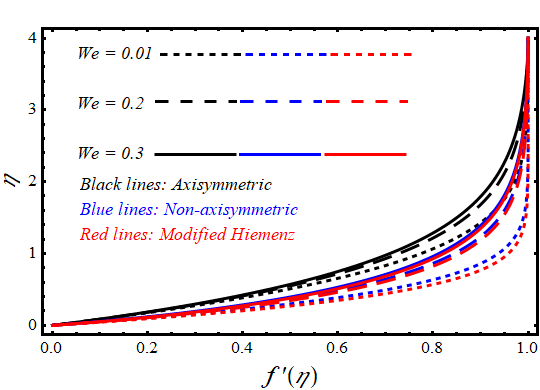
Modified Hiemenz Stagnation Point Flow of Second Grade Nano Fluid
ICCK Journal of Applied Mathematics | Volume 1, Issue 2: 66-85, 2025 | DOI: 10.62762/JAM.2025.411313
Abstract
Three-dimensional (3D) flow of a viscoelastic fluid in the neighborhood of new family of modified stagnation point depending on shear to strain ratio over a flat surface is numerically investigated. Similarity equations are obtained from the fundamental conservation laws of mass, momentum, energy and nanoparticle concentration. The resulting set of nonlinear equations are solved numerically using an implicit finite difference scheme known as Keller-Box Method. A comparative analysis for modified Hiemenz flow, non-axisymmetric stagnation point and axisymmetric stagnation point flow is carried out. Velocity, temperature and concentration profiles, skin frictions local Nusselt and Sherwood numb... More >

Graphical Abstract
Modified Hiemenz Stagnation Point Flow of Second Grade Nano Fluid
Open Access | Research Article | 04 August 2025
Bornological Semi Continuous Maps
ICCK Journal of Applied Mathematics | Volume 1, Issue 2: 62-65, 2025 | DOI: 10.62762/JAM.2025.997630
Abstract
In the current study, a new approach had been constructed to define new maps using the concept of bornological semi open and bornological semi closed sets, which includes sequential bornological semi continuous maps, bornological semi closed (open) maps, bornological strongly semi closed (open) maps, and bornological semi-irresolute closed (open) maps. We investigate and study the properties of these concepts. More >
Open Access | Research Article | 03 August 2025 | Cited: Crossref logo  7 , Scopus 3
Numerical Study of Nonlinear Third-Grade Nanofluid with Generalized Heat and Mass Flux in Mixed Convective Flow
ICCK Journal of Applied Mathematics | Volume 1, Issue 2: 52-61, 2025 | DOI: 10.62762/JAM.2025.671250
Abstract
This paper investigates the bio-convective behavior of a third-grade non-Newtonian nanofluid over a stretching sheet. While the influence of Newtonian fluid flow based on classical Fourier and Fick’s laws has been widely discussed in previous studies, this work focuses on a novel third-grade nanofluid model incorporating various physical effects. Notably, the classical Fourier law is replaced by the Cattaneo–Christov (CC) theory for both heat and mass fluxes, capturing relaxation phenomena in the presence of bioconvective effects. Heat and mass transport are modeled using the CC framework, and nanoscale mechanisms are described via the Buongiorno nanofluid model. The influences of thermo... More >

Graphical Abstract
Numerical Study of Nonlinear Third-Grade Nanofluid with Generalized Heat and Mass Flux in Mixed Convective Flow
Open Access | Research Article | 27 July 2025 | Cited: Crossref logo  1 , Scopus 1
Bifurcation and Stability Analysis of Transmission Dynamics of Ebola Virus Using Seirvh Model
ICCK Journal of Applied Mathematics | Volume 1, Issue 2: 41-51, 2025 | DOI: 10.62762/JAM.2025.550087
Abstract
This study presents a mathematical framework to analyze the transmission dynamics of the Ebola Virus Disease (EVD) using an extended SEIRVH model. The model incorporates vaccinated and hospitalized compartments, addressing critical factors such as vaccination efficacy, healthcare interventions, and natural disease progression. Differential equations describe the transitions between six population compartments. The study evaluates model stability and bifurcation through well-posedness, positivity, and boundedness analyzes, ensuring realistic and biologically valid solutions. The basic reproduction number, R0, derived from the next generation matrix, serves as a threshold for outbreak control.... More >

Graphical Abstract
Bifurcation and Stability Analysis of Transmission Dynamics of Ebola Virus Using Seirvh Model
Open Access | Research Article | 27 June 2025 | Cited: Crossref logo  5 , Scopus 5
Heat Transfer and Modified Darcy's Principle in Peristaltic Motion with Hartmann Boundary Layer
ICCK Journal of Applied Mathematics | Volume 1, Issue 1: 32-40, 2025 | DOI: 10.62762/JAM.2025.463651
Abstract
This research contains the Hartmann boundary layer effectiveness in peristaltic flow of non-Newtonian viscoelastic fluids through asymmetric channel walls. Due to the Hartmann boundary layer, Hartmann number is considered very large. Porosity effects are included in view of modified Darcy's principle. Energy equation is modelled in the presence of viscous dissipation and Joule heating features. No slip condition for fluid velocity is considered at both channel walls. Large wavelength and dominating viscous forces implementation reduce the PDEs into ODEs. The resulting system of ODEs approximate solution is attained through perturbation and matching techniques for large magnetic field effects... More >

Graphical Abstract
Heat Transfer and Modified Darcy's Principle in Peristaltic Motion with Hartmann Boundary Layer

Journal Statistics

69
Authors
11
Countries / Regions
28
Articles
Scopus: 27
Citations
2025
Published Since
49,939
Article Views
12,946
Article Downloads
ICCK Journal of Applied Mathematics
eISSN: 3068-5656
Crossref
Crossref
Member of Crossref
Visit Crossref →