

ICCK Journal of Applied Mathematics

Publishing Model:
ISSN:
ISSN: 3068-5656
ICCK Journal of Applied Mathematics is a peer-reviewed international journal dedicated to the publication of high-quality research in all areas of applied mathematics.
DOI Prefix: 10.62762/JAM

Journal Metrics

-
Impact Factor
-
CiteScore

Recent Articles

Open Access | Research Article | 19 October 2026
Toward a Theory of Granular Digital Twins: Mathematical Foundations for Adaptive Digital Twin Systems
ICCK Journal of Applied Mathematics | Volume 2, Issue 4: 302-314, 2026 | DOI: 10.62762/JAM.2026.667211
Abstract
Digital Twin (DT) technology models and synchronizes physical systems through virtual counterparts. Existing mathematical formulations of DTs concentrate on physical-virtual synchronization and say little about how representations of the same system at different levels of detail should be related. This paper builds a mathematical foundation for Granular Digital Twins (GDTs) by combining Granular Computing with DT theory. We introduce information granules, the Granular Representation Mapping, the Granular Twin Space, and the Granular Digital Twin, and then construct a Granular Twin Algebra whose aggregation, refinement, and adaptive transformation operators act on an ordered family of granula... More >

Graphical Abstract
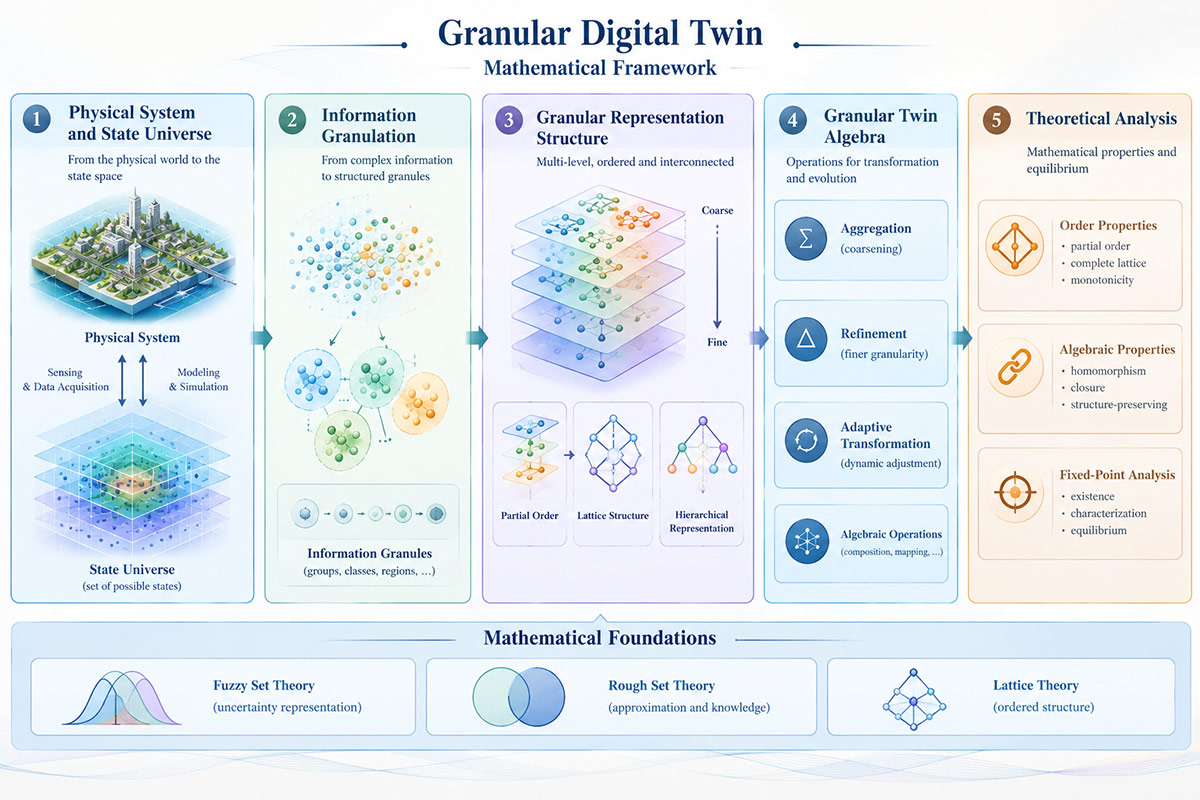
Toward a Theory of Granular Digital Twins: Mathematical Foundations for Adaptive Digital Twin Systems
Open Access | Research Article | 16 October 2026
A Brain Uptake Constant for Mathematical Modeling of Cerebral Radiopharmaceutical Uptake: A Synthetic Computational Study
ICCK Journal of Applied Mathematics | Volume 2, Issue 4: 293-301, 2026 | DOI: 10.62762/JAM.2026.965290
Abstract
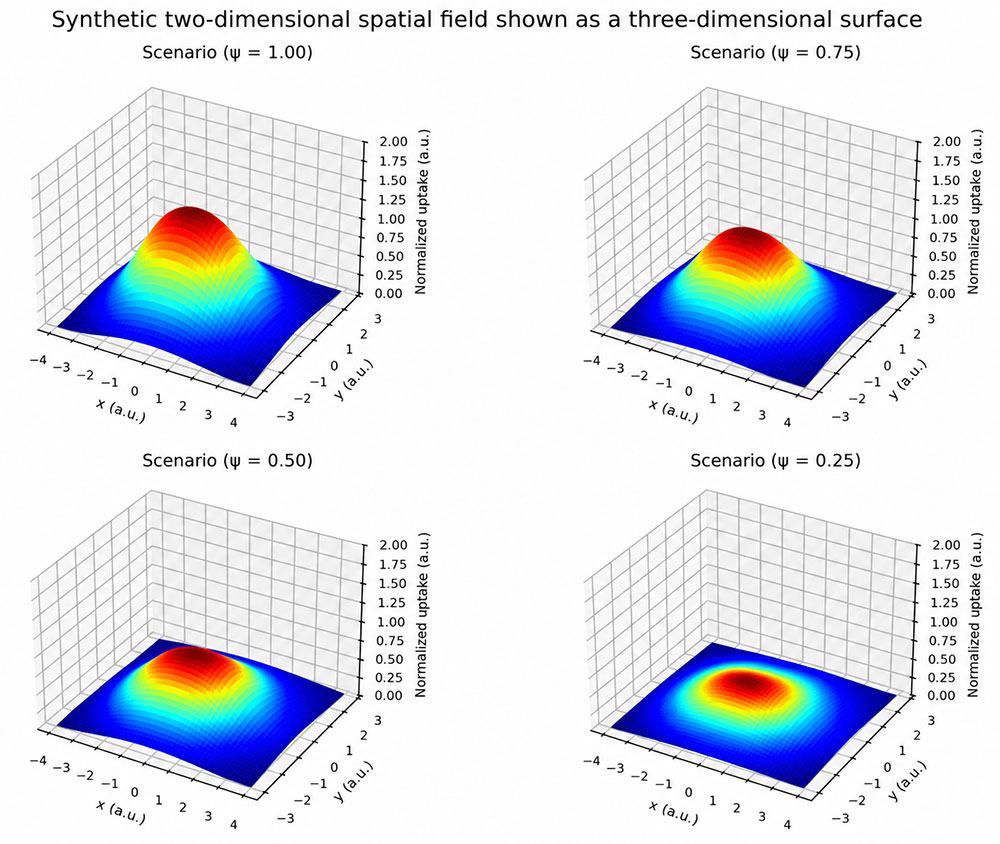
Compartmental and tracer-kinetic models are widely used to describe radiopharmaceutical uptake in brain PET and SPECT, but in simple analytical models the fraction of transferred activity that reaches the brain is seldom isolated as a parameter of its own. This study defines a dimensionless Brain Uptake Constant, $\psi$, as the uptake fraction in a two-stage first-order model of cerebral radiopharmaceutical activity and examines its behaviour in a purely synthetic setting. Activity in the systemic pool, $A(t)$, is lost at a first-order rate $k$; cerebral activity, $A_c(t)$, receives a source term $\psi k A(t)$ and is lost at an effective decay rate $\lambda$. The closed-form solution was eva... More >

Graphical Abstract

A Brain Uptake Constant for Mathematical Modeling of Cerebral Radiopharmaceutical Uptake: A Synthetic Computational Study
Open Access | Research Article | 07 October 2026
Mathematical Formulation and Computational Implementation of a Fisher-KPP Model for Glioblastoma Invasion under Fractionated Radiotherapy
ICCK Journal of Applied Mathematics | Volume 2, Issue 4: 283-292, 2026 | DOI: 10.62762/JAM.2026.576302
Abstract
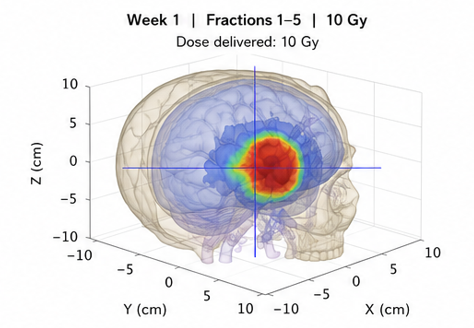
Glioblastoma (GBM) is a highly infiltrative primary brain tumor, and reaction-diffusion models are widely used to describe how its cells spread and proliferate. We derive the classical Fisher-KPP equation from mass conservation, Fickian diffusion, and logistic growth, and extend it to fractionated radiotherapy through a linear-quadratic survival update applied to the tumor-density field at each fraction. The Fisher-KPP equation is solved by finite differences on a three-dimensional voxel grid with 0.5-mm spacing; Geant4 is used only for Monte Carlo photon transport and dose calculation. The schedule of 60~Gy in 30 fractions from the clinical case reported by Roda et al. is reproduced, and th... More >

Graphical Abstract
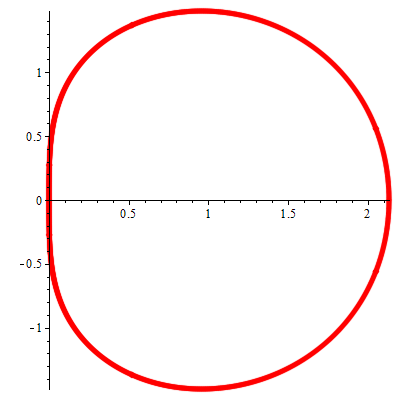
Mathematical Formulation and Computational Implementation of a Fisher-KPP Model for Glioblastoma Invasion under Fractionated Radiotherapy
Open Access | Research Article | 06 October 2026
Artificial Neural Network-Based Modeling of Transient Bio-Convective Williamson Tri-Hybrid Nanofluid Flow with Gyrotactic Microorganisms over a Stretching Sheet
ICCK Journal of Applied Mathematics | Volume 2, Issue 4: 266-282, 2026 | DOI: 10.62762/JAM.2026.618998
Abstract
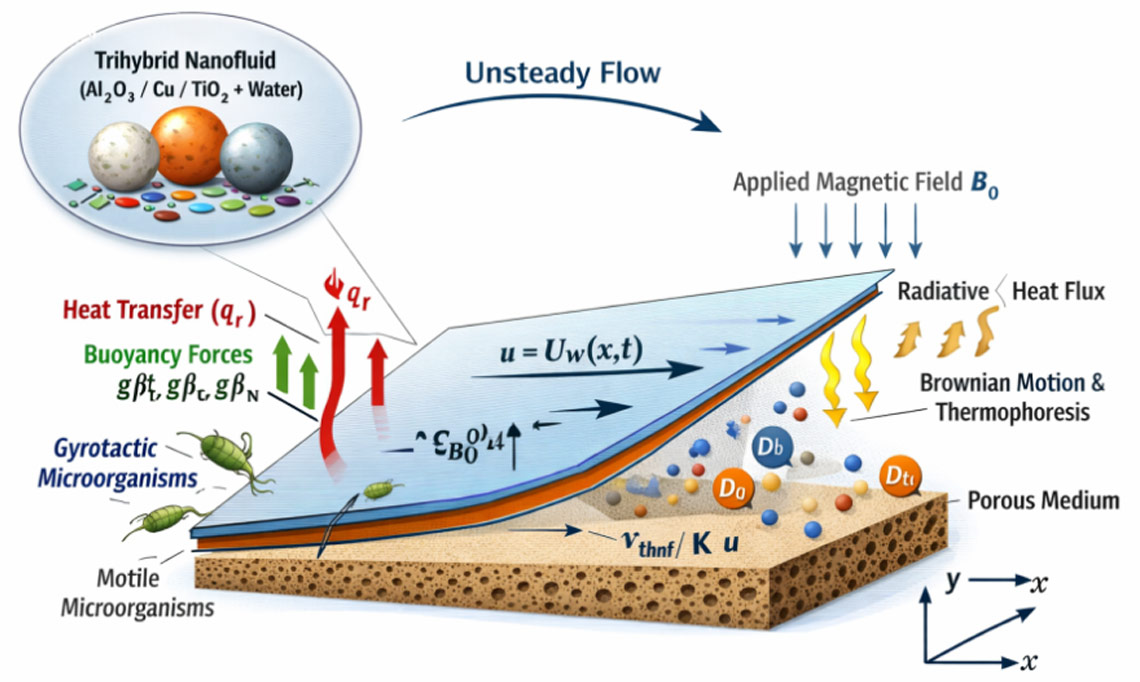
In this paper, we study the unsteady magnetohydrodynamic (MHD) flow and the heat and mass transfer of a Williamson tri-hybrid nanofluid (THNF) composed of water and Al$_2$O$_3$, TiO$_2$ and Cu nanoparticles over a stretching sheet. The model incorporates thermal radiation, activation energy, chemical reaction, a heat source and the bioconvection of motile gyrotactic microorganisms. An artificial neural network (ANN) is employed for the predictive modeling of such THNF flows under these combined effects. Similarity transformations reduce the governing nonlinear partial differential equations (PDEs) to coupled ordinary differential equations (ODEs), which are solved numerically with a boundary... More >

Graphical Abstract
Artificial Neural Network-Based Modeling of Transient Bio-Convective Williamson Tri-Hybrid Nanofluid Flow with Gyrotactic Microorganisms over a Stretching Sheet
Open Access | Research Article | 05 September 2026
Impact of Joule Heating and Viscous Dissipation on MHD Slip Flow of Tangent Hyperbolic Aluminum Alloys (AA7072-AA7075/H$_2$O) in a Porous Medium with Activation Energy
ICCK Journal of Applied Mathematics | Volume 2, Issue 4: 251-265, 2026 | DOI: 10.62762/JAM.2026.103707
Abstract
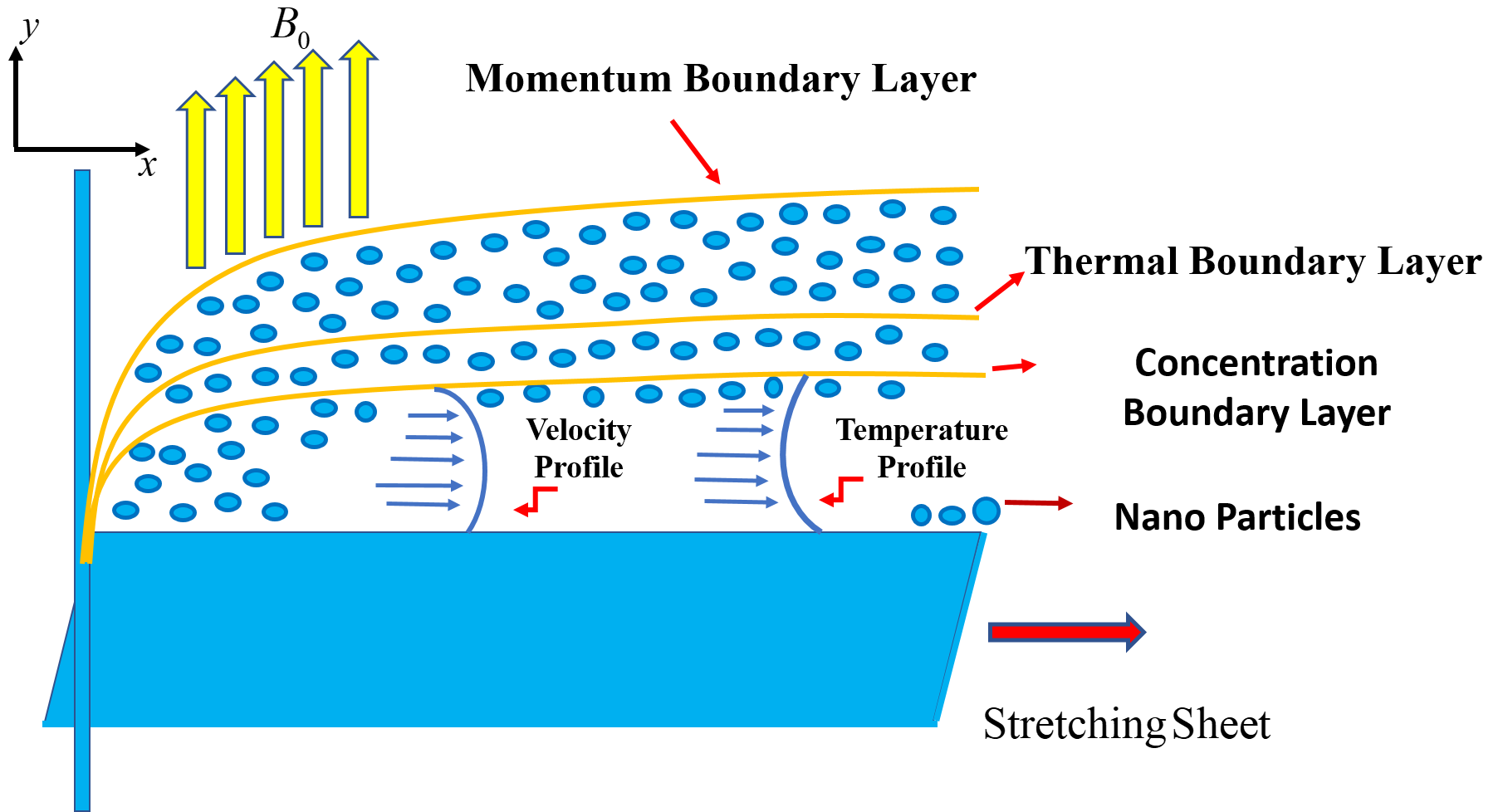
This study investigates the two-dimensional magnetohydrodynamic (MHD) slip flow of a tangent-hyperbolic (TGH) aluminum-alloy hybrid nanofluid over a stretching surface in a porous medium. The model incorporates magnetic effects, velocity and thermal slip, thermal radiation, heat generation, viscous dissipation, chemical reaction, and activation energy. The governing nonlinear partial differential equations are transformed into ordinary differential equations using similarity transformations and solved numerically in MATLAB using the bvp4c solver. The effects of key parameters on the velocity, temperature, and concentration profiles are analyzed, together with the skin-friction coefficient, N... More >

Graphical Abstract

Impact of Joule Heating and Viscous Dissipation on MHD Slip Flow of Tangent Hyperbolic Aluminum Alloys (AA7072-AA7075/H$_2$O) in a Porous Medium with Activation Energy
Open Access | Research Article | 04 September 2026
A Modified Third-Order Block Numerical Integration Technique for First Order Stiff and Oscillatory Differential Equations
ICCK Journal of Applied Mathematics | Volume 2, Issue 3: 242-250, 2026 | DOI: 10.62762/JAM.2026.326643
Abstract
This paper proposes a modified two-point block backward differentiation formula (MBBDF) for the numerical solution of highly stiff and oscillatory ordinary differential equations. The method achieves third-order accuracy with a reduced error constant and computes two solution values simultaneously at each step. For the selected parameter value $\rho=-\dfrac{7}{8}$, stability analysis shows that the resulting scheme is A-stable, making it suitable for the numerical integration of stiff initial value problems. The method is also consistent and zero-stable, and hence convergent. Numerical experiments on benchmark stiff problems show that the relative accuracy of the considered methods depends o... More >

Graphical Abstract
A Modified Third-Order Block Numerical Integration Technique for First Order Stiff and Oscillatory Differential Equations
Open Access | Research Article | 31 August 2026
On the Convergence and Order of An Extended 2-Point Super Class BBDF with Two Intermediate Points for Solving Stiff IVPs
ICCK Journal of Applied Mathematics | Volume 2, Issue 3: 233-241, 2026 | DOI: 10.62762/JAM.2026.599481
Abstract
This study investigates the order and convergence properties of an extended two-point superclass Block Backward Differentiation Formula (BBDF) incorporating two intermediate (off-step) points for the numerical solution of stiff initial value problems (IVPs). Stiff systems frequently arise in scientific and engineering applications and require numerical methods that combine stability, accuracy, and computational efficiency. While classical Backward Differentiation Formula (BDF) methods are well known for their stability, their sequential nature limits efficiency, particularly for large-scale problems. To address these limitations, the proposed framework extends the BBDF approach by introducin... More >
Open Access | Research Article | 13 August 2026
Mathematical Modelling of PM2.5 Dynamics in Hyderabad: A First-Order ODE Approach with Wind-Driven Removal
ICCK Journal of Applied Mathematics | Volume 2, Issue 3: 221-232, 2026 | DOI: 10.62762/JAM.2026.575197
Abstract
Daily mean PM\(_{2.5}\) concentrations in Hyderabad routinely exceed both the 24-hour (\(60\,\mu\text{g/m}^3\)) and the annual (\(40\,\mu\text{g/m}^3\)) National Ambient Air Quality Standards, motivating the development of transparent and inexpensive descriptive models of their seasonal behaviour. To this end, we develop and calibrate a parsimonious first-order linear ordinary differential equation (ODE) that describes the daily evolution of ambient PM\(_{2.5}\) as the balance between a seasonally varying emission source \(E(t)=E_{0}+A\cos(2\pi(t-\varphi)/365)\) and a wind-driven first-order removal \(\lambda(t)=\alpha v(t)+\lambda_{0}\). The five parameters are estimated by Differential Evo... More >

Graphical Abstract
Mathematical Modelling of PM2.5 Dynamics in Hyderabad: A First-Order ODE Approach with Wind-Driven Removal

Journal Statistics

77
Authors
12
Countries / Regions
35
Articles
37
Scopus Citations
31.4% Cited
2025
Published Since
63,305
Article Views
16,531
Article Downloads
ICCK Journal of Applied Mathematics
eISSN: 3068-5656
Crossref
Crossref
Member of Crossref
Visit Crossref →