


CRITIC-EDAS Method for Linguistic Picture Fuzzy Soft Sets and Its Application in Decision Making Problem



Article Information
Abstract
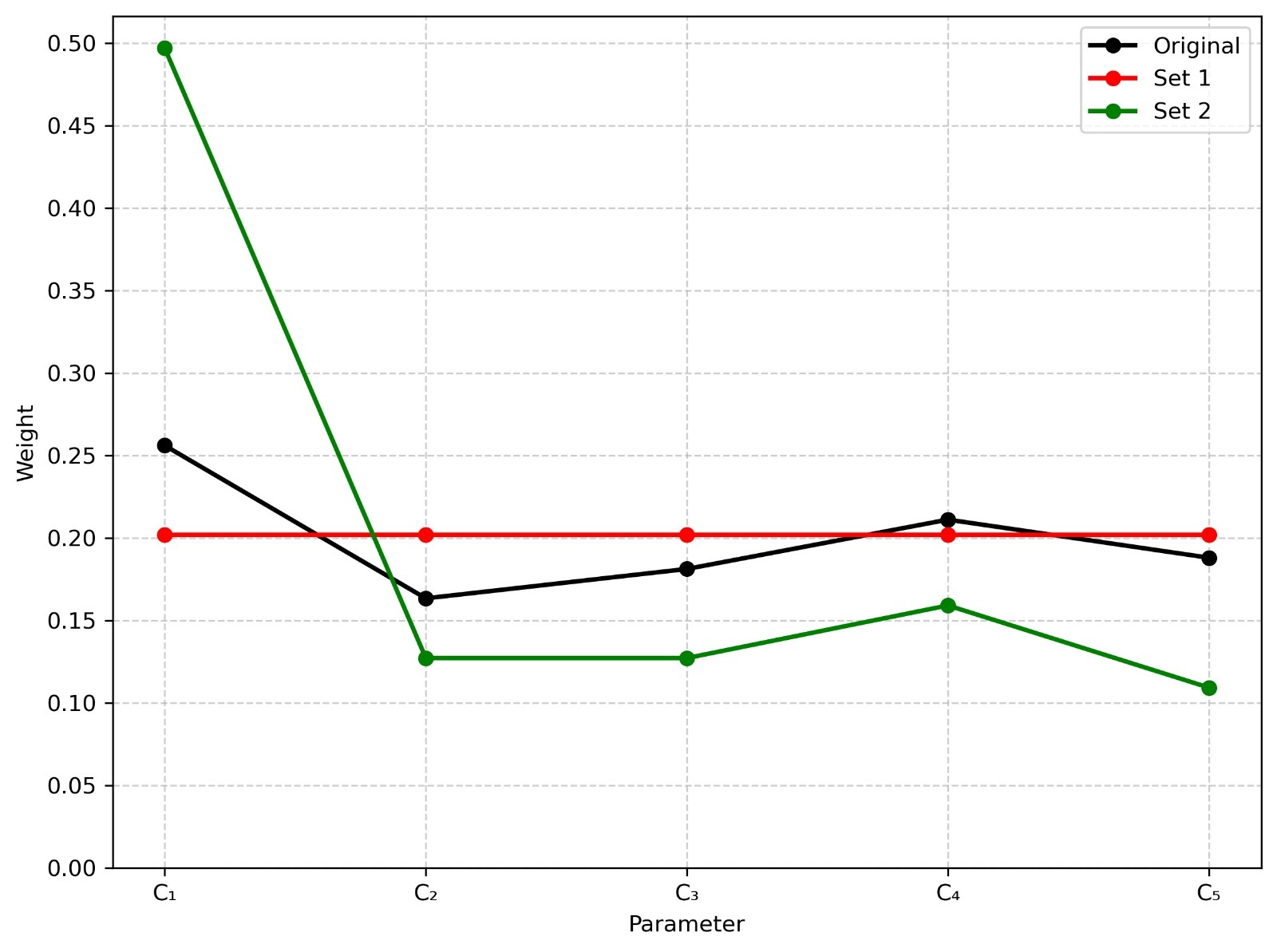
Linguistic picture fuzzy soft sets (LPFSSs) provide a powerful tool for handling uncertainties in decision-making problems, particularly when multiple parameters are involved. By integrating the advantages of linguistic picture fuzzy sets (LPFSs) and soft sets (SSs), LPFSSs prove especially effective in situations involving imprecise and ambiguous information. This study extends the conventional CRITIC (Criteria Importance Through Inter-criteria Correlation) and EDAS (Evaluation based on Distance from Average Solution) methods to the LPFSS environment. First, the definitions of LPFSSs and linguistic picture fuzzy soft numbers (LPFSNs) are introduced along with their key properties. Subsequently, a CRITIC-EDAS framework is developed under the linguistic picture fuzzy soft setting. Finally, a numerical example concerning the selection of the most suitable organic fertilizer is presented to illustrate the effectiveness of the proposed approach.
Graphical Abstract
Keywords
Data Availability Statement
Funding
Conflicts of Interest
AI Use Statement
Ethical Approval and Consent to Participate
References
- Zadeh, L. A. (1965). Fuzzy sets.Information and Control, 8(3), 338-353.
[CrossRef] [Google Scholar] - Zadeh, L. A. (1975). The concept of a linguistic variable and its application to approximate reasoning—I. Information Sciences, 8(3), 199–249.
[CrossRef] [Google Scholar] - Zadeh, L. A. (1975). The concept of a linguistic variable and its application to approximate reasoning—II. Information Sciences, 8(4), 301–357.
[CrossRef] [Google Scholar] - Zadeh, L. A. (1975). The concept of a linguistic variable and its application to approximate reasoning—III. Information Sciences, 9(1), 43–80.
[CrossRef] [Google Scholar] - Herrera, F., & Herrera-Viedma, E. (2000). Linguistic decision analysis: Steps for solving decision problems under linguistic information. Fuzzy Sets and Systems, 115(1), 67–82.
[CrossRef] [Google Scholar] - Herrera, F., Herrera-Viedma, E., & Martinez, L. (2008). A fuzzy linguistic methodology to deal with unbalanced linguistic term sets. IEEE Transactions on Fuzzy Systems, 16(2), 354–370.
[CrossRef] [Google Scholar] - Martinez-Lopez, L., Ruan, D., Herrera, F., Herrera-Viedma, E., & Wang, P. P. (2009). Linguistic decision-making: Tools and applications. Information Sciences, 179(14), 2297–2298.
[CrossRef] [Google Scholar] - Rodríguez, R. M., Martínez, L., & Herrera, F. (2013). A group decision-making model dealing with comparative linguistic expressions based on hesitant fuzzy linguistic term sets. Information Sciences, 241, 28–42.
[CrossRef] [Google Scholar] - Liao, H., Xu, Z., Zeng, X. J., & Merigó, J. M. (2015). Qualitative decision-making with correlation coefficients of hesitant fuzzy linguistic term sets. Knowledge-Based Systems, 76, 127–138.
[CrossRef] [Google Scholar] - Chen, Z., Liu, P., & Pei, Z. (2015). An approach to multiple attribute group decision-making based on linguistic intuitionistic fuzzy numbers. International Journal of Computational Intelligence Systems, 8(4), 747–760.
[CrossRef] [Google Scholar] - Qiyas, M., Abdullah, S., Ashraf, S., & Aslam, M. (2020). Utilizing linguistic picture fuzzy aggregation operators for multiple-attribute decision-making problems. International Journal of Fuzzy Systems, 22(1), 310-320.
[CrossRef] [Google Scholar] - Liu, D., Luo, Y., & Liu, Z. (2020). The linguistic picture fuzzy set and its application in multi-criteria decision-making: an illustration to the TOPSIS and TODIM methods based on entropy weight. Symmetry, 12(7), 1170.
[CrossRef] [Google Scholar] - Molodtsov, D. (1999). Soft set theory—First results. Computers and Mathematics with Applications, 37(4-5), 19-31.
[CrossRef] [Google Scholar] - Cagman, N., Enginoglu, S., & Citak, F. (2011). Fuzzy soft set theory and its applications. Iranian Journal of Fuzzy Systems, 8(3), 137-147.
[CrossRef] [Google Scholar] - Xu, Y. J., Sun, Y. K., & Li, D. F. (2010, May). Intuitionistic fuzzy soft set. In 2010 2nd International Workshop on Intelligent Systems and Applications (pp. 1-4). IEEE.
[CrossRef] [Google Scholar] - Hovanov, N. V., Kolari, J. W., & Sokolov, M. V. (2008). Deriving weights from general pairwise comparison matrices. Mathematical Social Sciences, 55(2), 205–220.
[CrossRef] [Google Scholar] - Golden, B. L., Wasil, E. A., & Harker, P. T. (1989). The analytic hierarchy process. Applications and Studies, Berlin, Heidelberg, 2(1), 1-273.
[CrossRef] [Google Scholar] - Krylovas, A., Zavadskas, E. K., Kosareva, N., & Dadelo, S. (2014). New KEMIRA method for determining criteria priority and weights in solving MCDM problem. International journal of information technology & decision making, 13(06), 1119-1133.
[CrossRef] [Google Scholar] - Danielson, M., & Ekenberg, L. (2019). An improvement to swing techniques for elicitation in MCDM methods. Knowledge-Based Systems, 168, 70-79.
[CrossRef] [Google Scholar] - Stanujkic, D., Zavadskas, E. K., Karabasevic, D., Smarandache, F., & Turskis, Z. (2017). The use of the pivot pairwise relative criteria importance assessment method for determining the weights of criteria. Infinite Study.
[Google Scholar] - Pamučar, D., Stević, Ž., & Sremac, S. (2018). A new model for determining weight coefficients of criteria in mcdm models: Full consistency method (fucom). symmetry, 10(9), 393.
[CrossRef] [Google Scholar] - Hwang, C. L., & Yoon, K. (2012). Multiple attribute decision making: methods and applications a state-of-the-art survey. Springer Science & Business Media.
[CrossRef] [Google Scholar] - Diakoulaki, D., Mavrotas, G., & Papayannakis, L. (1995). Determining objective weights in multiple criteria problems: The CRITIC method. Computers & Operations Research, 22(7), 763–770.
[CrossRef] [Google Scholar] - Zavadskas, E. K., & Podvezko, V. (2016). Integrated determination of objective criteria weights in MCDM. International Journal of Information Technology & Decision Making, 15(02), 267–283.
[CrossRef] [Google Scholar] - Keshavarz Ghorabaee, M., Zavadskas, E. K., Olfat, L., & Turskis, Z. (2015). Multi-criteria inventory classification using a new method of evaluation based on distance from average solution (EDAS). Informatica, 26(3), 435-451.
[CrossRef] [Google Scholar] - Mitra, A. (2022). Selection of cotton fabrics using EDAS method. Journal of Natural Fibers, 19(7), 2706–2718.
[CrossRef] [Google Scholar] - Maduekwe, V. C., & Oke, S. A. (2022). The Application of the EDAS Method in the Parametric Selection Scheme for Maintenance Plans in the Nigerian Food Industry. Jurnal Rekayasa Sistem Industri, 11(1), 1-22.
[CrossRef] [Google Scholar] - Paul, S., & Roy, D. (2024). Geospatial modeling and analysis of groundwater stress prone areas using GIS based TOPSIS, VIKOR, and EDAS techniques in Murshidabad district, India. Modeling Earth Systems and Environment, 10(1), 121–141.
[CrossRef] [Google Scholar] - Zolfani, S. H., Görçün, Ö. F., & Küçükönder, H. (2021). International market selection: A MABA based EDAS analysis framework. Oeconomia Copernicana, 12(1), 99-124.
[CrossRef] [Google Scholar] - Mathew, M. A. N. O. J., & Thomas, J. (2019). Interval valued multi criteria decision making methods for the selection of flexible manufacturing system. International Journal of Data and Network Science, 3(4), 349-358.
[CrossRef] [Google Scholar] - Qian, L., Liu, S., & Fang, Z. (2019). Grey risky multi-attribute decision-making method based on regret theory and EDAS. Grey Systems: Theory and Application, 9(1), 101-113.
[CrossRef] [Google Scholar] - Valipour, A., Sarvari, H., & Tamošaitiene, J. (2018). Risk assessment in PPP projects by applying different MCDM methods and comparative results analysis. Administrative Sciences, 8(4), 80.
[CrossRef] [Google Scholar] - Hasheminasab, H., Gholipour, Y., Kharrazi, M., Streimikiene, D., & Hashemkhani, S. (2020). A dynamic sustainability framework for petroleum refinery projects with a life cycle attitude. Sustainable Development, 28(5), 1033-1048.
[CrossRef] [Google Scholar] - Zhang, F., Ju, Y., Santibanez Gonzalez, E. D., & Wang, A. (2020). SNA-based multi-criteria evaluation of multiple construction equipment: A case study of loaders selection. Advanced Engineering Informatics, 44, 101056.
[CrossRef] [Google Scholar] - Agbakwuru, J. A., Nwaoha, T. C., & Udosoh, N. E. (2023). Application of CRITIC–EDAS-based approach in structural health monitoring and maintenance of offshore wind turbine systems. Journal of Marine Science and Application, 22(3), 545–555.
[CrossRef] [Google Scholar] - Yazdani, M., Torkayesh, A. E., Santibanez-Gonzalez, E. D., & Otaghsara, S. K. (2020). Evaluation of renewable energy resources using integrated Shannon Entropy—EDAS model. Sustainable Operations and Computers, 1, 35-42.
[CrossRef] [Google Scholar] - Asante, D., He, Z., Adjei, N. O., & Asante, B. (2020). Exploring the barriers to renewable energy adoption utilising MULTIMOORA-EDAS method. Energy Policy, 142, 111479.
[CrossRef] [Google Scholar] - Adalı, E. A., & Tuş, A. (2021). Hospital site selection with distance-based multi-criteria decision-making methods. International Journal of Healthcare Management, 14(2), 534-544.
[CrossRef] [Google Scholar] - Sahoo, S., & Choudhury, B. (2022). Optimal selection of an electric power wheelchair using an integrated COPRAS and EDAS approach based on Entropy weighting technique. Decision Science Letters, 11(1), 21-34.
[CrossRef] [Google Scholar] - Fan, J. P., Li, Y. J., & Wu, M. Q. (2019). Technology selection based on EDAS cross-efficiency evaluation method. IEEE Access, 7, 58974-58980.
[CrossRef] [Google Scholar]
Cite This Article
TY  - JOUR
AU  - Ali, Md. Yasin
AU  - Islam, Md. Ashraful
PY  - 2026
DA  - 2026/03/16
TI  - CRITIC-EDAS Method for Linguistic Picture Fuzzy Soft Sets and Its Application in Decision Making Problem
JO  - ICCK Journal of Applied Mathematics
T2  - ICCK Journal of Applied Mathematics
JF  - ICCK Journal of Applied Mathematics
VL  - 2
IS  - 1
SP  - 111
EP  - 119
DO  - 10.62762/JAM.2026.193939
UR  - https://www.icck.org/article/abs/JAM.2026.193939
KW  - linguistic picture fuzzy set
KW  - linguistic picture fuzzy soft set
KW  - CRITIC method
KW  - EDAS method
AB  - Linguistic picture fuzzy soft sets (LPFSSs) provide a powerful tool for handling uncertainties in decision-making problems, particularly when multiple parameters are involved. By integrating the advantages of linguistic picture fuzzy sets (LPFSs) and soft sets (SSs), LPFSSs prove especially effective in situations involving imprecise and ambiguous information. This study extends the conventional CRITIC (Criteria Importance Through Inter-criteria Correlation) and EDAS (Evaluation based on Distance from Average Solution) methods to the LPFSS environment. First, the definitions of LPFSSs and linguistic picture fuzzy soft numbers (LPFSNs) are introduced along with their key properties. Subsequently, a CRITIC-EDAS framework is developed under the linguistic picture fuzzy soft setting. Finally, a numerical example concerning the selection of the most suitable organic fertilizer is presented to illustrate the effectiveness of the proposed approach.
SN  - 3068-5656
PB  - Institute of Central Computation and Knowledge
LA  - English
ER  -
@article{Ali2026CRITICEDAS,
  author = {Md. Yasin Ali and Md. Ashraful Islam},
  title = {CRITIC-EDAS Method for Linguistic Picture Fuzzy Soft Sets and Its Application in Decision Making Problem},
  journal = {ICCK Journal of Applied Mathematics},
  year = {2026},
  volume = {2},
  number = {1},
  pages = {111-119},
  doi = {10.62762/JAM.2026.193939},
  url = {https://www.icck.org/article/abs/JAM.2026.193939},
  abstract = {Linguistic picture fuzzy soft sets (LPFSSs) provide a powerful tool for handling uncertainties in decision-making problems, particularly when multiple parameters are involved. By integrating the advantages of linguistic picture fuzzy sets (LPFSs) and soft sets (SSs), LPFSSs prove especially effective in situations involving imprecise and ambiguous information. This study extends the conventional CRITIC (Criteria Importance Through Inter-criteria Correlation) and EDAS (Evaluation based on Distance from Average Solution) methods to the LPFSS environment. First, the definitions of LPFSSs and linguistic picture fuzzy soft numbers (LPFSNs) are introduced along with their key properties. Subsequently, a CRITIC-EDAS framework is developed under the linguistic picture fuzzy soft setting. Finally, a numerical example concerning the selection of the most suitable organic fertilizer is presented to illustrate the effectiveness of the proposed approach.},
  keywords = {linguistic picture fuzzy set, linguistic picture fuzzy soft set, CRITIC method, EDAS method},
  issn = {3068-5656},
  publisher = {Institute of Central Computation and Knowledge}
}
Article Metrics
Publisher's Note
ICCK stays neutral with regard to jurisdictional claims in published maps and institutional affiliations.
Rights and Permissions
 Copyright © 2026 by the Author(s). Published by Institute of Central Computation and Knowledge. This article is an open access article distributed under the terms and conditions of the Creative Commons Attribution (CC BY) license (https://creativecommons.org/licenses/by/4.0/), which permits use, sharing, adaptation, distribution and reproduction in any medium or format, as long as you give appropriate credit to the original author(s) and the source, provide a link to the Creative Commons licence, and indicate if changes were made.

