

Aerospace Engineering Communications

Publishing Model:
ISSN:
ISSN: 3071-1967
Aerospace Engineering Communications is a peer-reviewed journal dedicated to the dissemination of high-quality research in all areas of aerospace engineering, including aerodynamics, propulsion, structures, materials, avionics, and space systems.
DOI Prefix: 10.62762/AEC

Journal Metrics

-
Impact Factor
-
CiteScore

Recent Articles

Open Access | Research Article | 26 September 2026
Communication Topology Resilience-Guided Optimization for Multi-UAV Cooperative Planning
Aerospace Engineering Communications | Volume 1, Issue 3: 128-136, 2026 | DOI: 10.62762/AEC.2026.595594
Abstract
This paper studies cooperative mission planning for multi-unmanned aerial vehicle (UAV) swarms in obstacle-cluttered environments, with particular attention to mission feasibility and communication-topology resilience. Considering that task assignment and waypoint selection directly affect the inter-UAV communication graph, a communication topology resilience-guided (CTR) method is proposed by introducing algebraic connectivity as an explicit topology metric. The method first performs topology-guided one-to-one task assignment using simulated annealing, jointly considering normalized distance, obstacle risk, and algebraic connectivity. It then selects topology-aware key waypoints according t... More >

Graphical Abstract
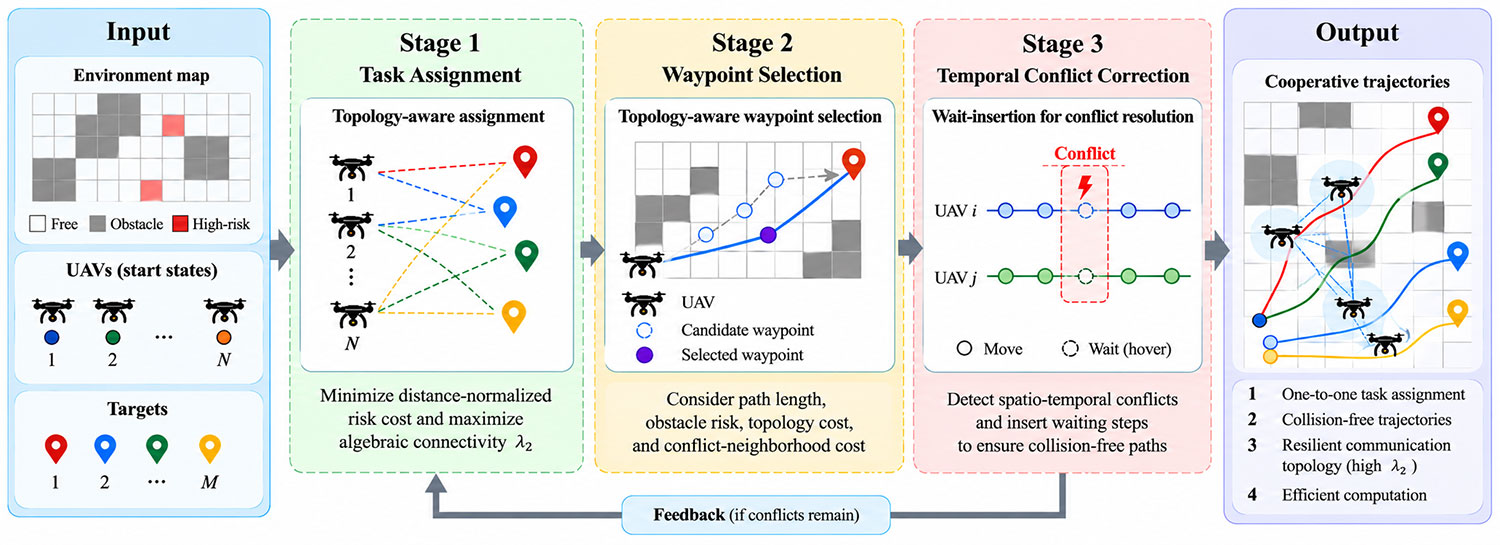
Communication Topology Resilience-Guided Optimization for Multi-UAV Cooperative Planning
Open Access | Research Article | 24 September 2026
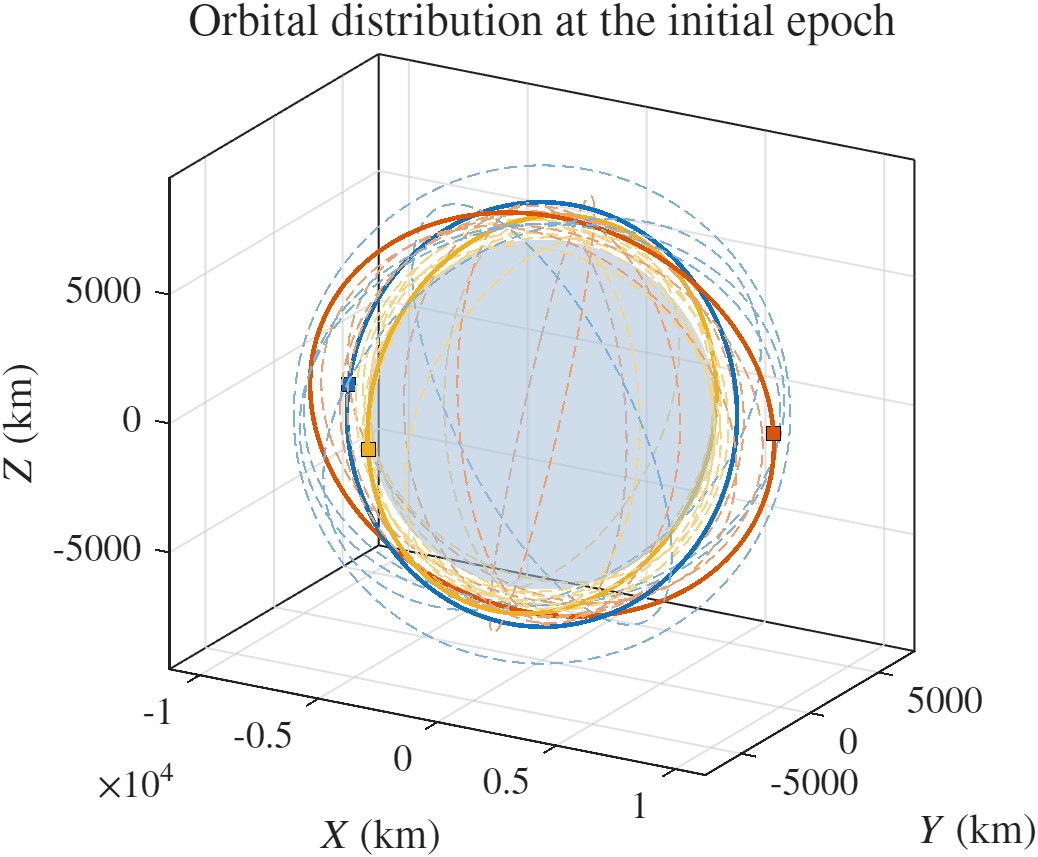
$J2$-Aware Joint Optimization of Fuel Station Placement and Satellite Assignment for SSO Satellite Clusters
Aerospace Engineering Communications | Volume 1, Issue 3: 119-127, 2026 | DOI: 10.62762/AEC.2026.761344
Abstract
On-orbit refueling of sun-synchronous-orbit (SSO) satellite clusters requires effective deployment of fuel stations (FSs). To this end, this paper investigates the deployment optimization problem of fuel stations for SSO clusters by considering orbital geometry, satellite-to-station assignment, and refueling mission feasibility. A \(J_2\)-aware optimization framework is proposed, in which a particle swarm optimizer searches for optimal fuel-station orbital parameters and satellite assignments. For each candidate deployment, a deterministic mission evaluator is employed to estimate natural alignment opportunities, transfer requirements, and fuel consumption. The proposed approach considers th... More >

Graphical Abstract
$J2$-Aware Joint Optimization of Fuel Station Placement and Satellite Assignment for SSO Satellite Clusters
Open Access | Research Article | 21 September 2026
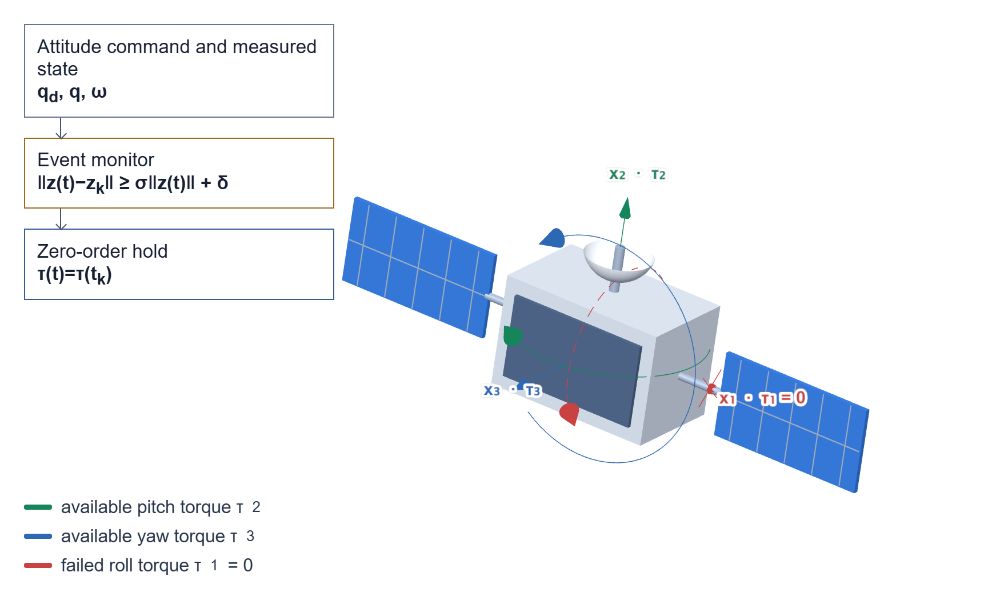
Event-Triggered Attitude Control of Underactuated Spacecraft
Aerospace Engineering Communications | Volume 1, Issue 3: 110-118, 2026 | DOI: 10.62762/AEC.2026.732691
Abstract
This paper presents an event-triggered attitude control method for an underactuated spacecraft with only two bounded body-axis torques. Gyroscopic coupling supplies the missing control action: two periodic angular-rate references generate the average gyroscopic rate product required to regulate the unactuated axis. A relative-plus-absolute event condition updates the bounded torque command, while a zero-order hold and a timeout provide implementable inter-event intervals. An elementary energy argument establishes asymptotic stability of the explicitly defined nominal averaged local error model, while a nonlinear simulation assesses the complete implementation. Under a 2 N$\cdot$m torque lim... More >

Graphical Abstract
Event-Triggered Attitude Control of Underactuated Spacecraft
Open Access | Review Article | 11 August 2026
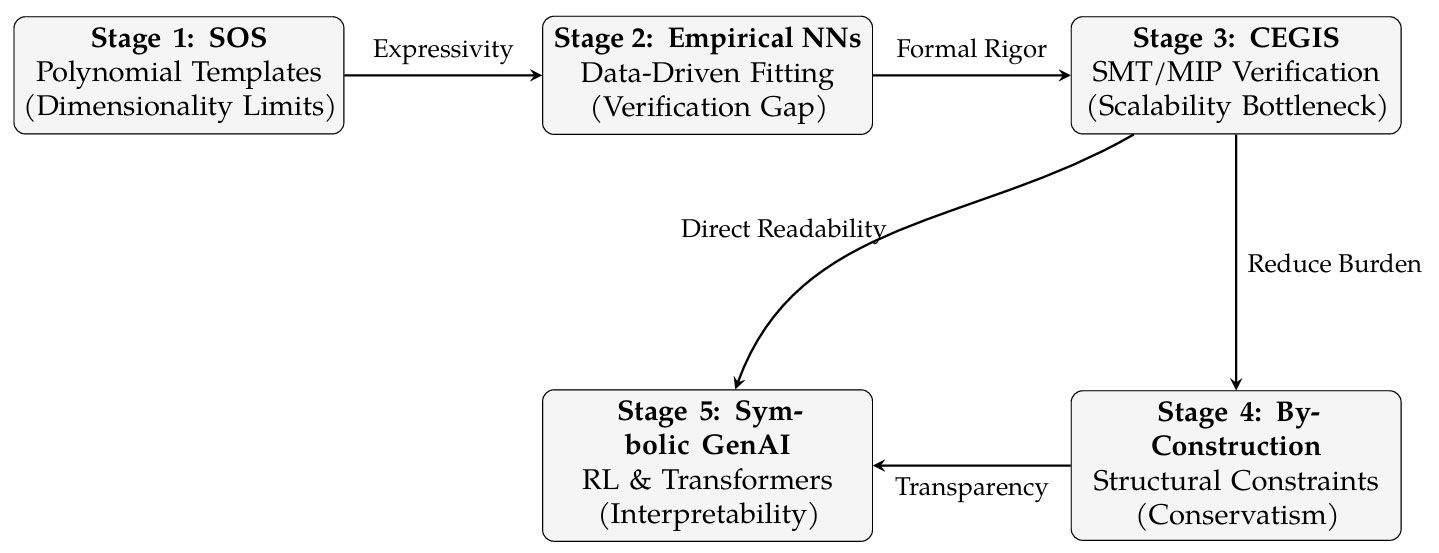
Machine Learning for Lyapunov Function Synthesis: A Comprehensive Review
Aerospace Engineering Communications | Volume 1, Issue 3: 100-109, 2026 | DOI: 10.62762/AEC.2026.822279
Abstract
Lyapunov functions underpin the stability analysis and controller synthesis for aerospace vehicles, from spacecraft attitude control to autonomous flight systems and UAV swarm coordination. This review discusses the development of computational Lyapunov function synthesis methods. Within this scope, it traces the evolution from traditional Sum-of-Squares (SOS) programming to artificial intelligence symbolic discovery technologies, prompted by the increasing complexity of nonlinear systems. Specifically, the following stages can be identified: computational relaxation methods constrained by polynomial templates; data-driven paradigms leveraging neural network-based empirical approximations; a... More >

Graphical Abstract
Machine Learning for Lyapunov Function Synthesis: A Comprehensive Review
Open Access | Research Article | 01 July 2026
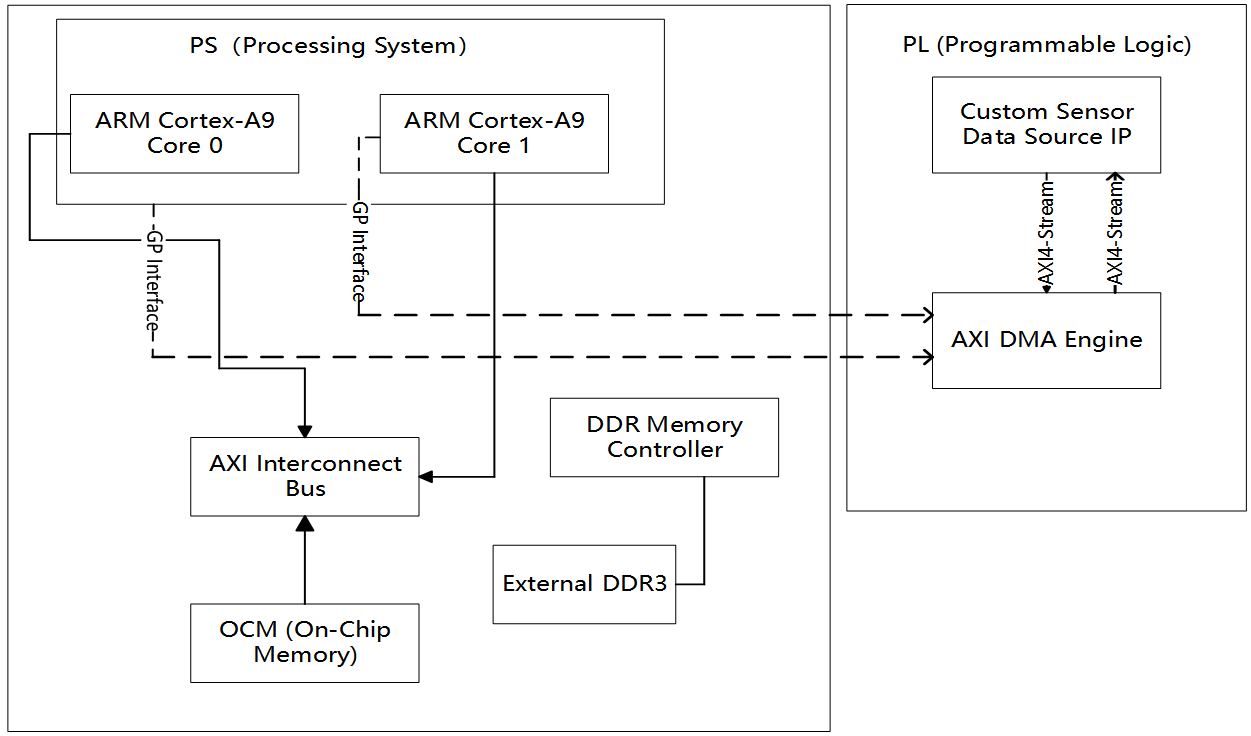
Embedded Multi-Core Gyro Attitude Data Acquisition System for Aerospace Vehicle Based on ZYNQ Platform
Aerospace Engineering Communications | Volume 1, Issue 3: 93-99, 2026 | DOI: 10.62762/AEC.2026.284427
Abstract
Aiming at the interrupt storm performance bottleneck existing in high-speed gyro attitude signal acquisition of aerospace vehicles, an embedded heterogeneous multi-core data acquisition system based on Xilinx ZYNQ-7000 SoC is proposed for inertial measurement unit (IMU) gyro signal sampling. On the hardware layer, a sensor data interface IP conforming to AXI4-Stream protocol is designed in programmable logic (PL) to collect high-frequency gyro original signals, and an AXI DMA controller builds a wideband direct peripheral-DDR transmission channel to realize zero-copy data writing, greatly reducing processor resource occupation under continuous inertial attitude sampling. On the software laye... More >

Graphical Abstract
Embedded Multi-Core Gyro Attitude Data Acquisition System for Aerospace Vehicle Based on ZYNQ Platform
Open Access | Perspective | 25 June 2026
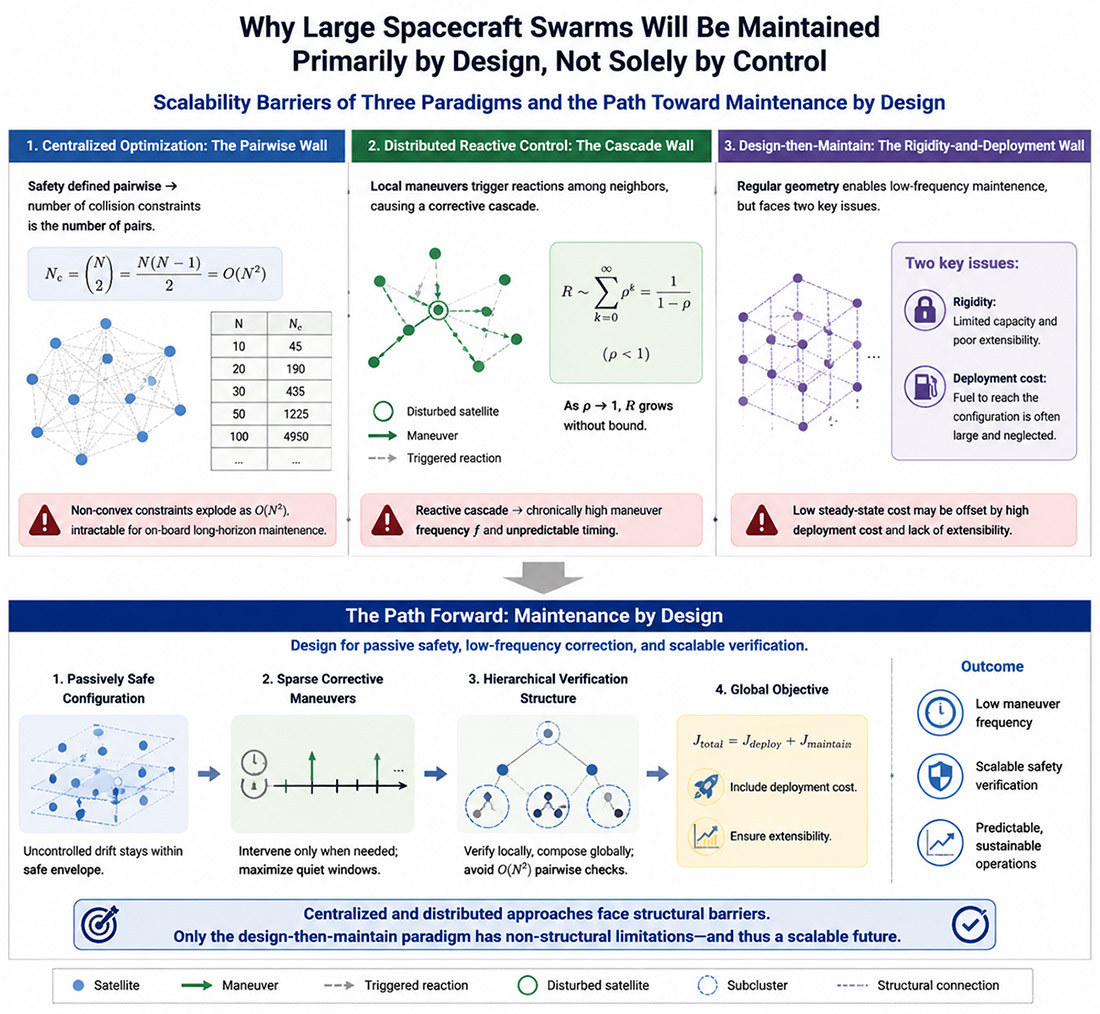
Why Large Spacecraft Swarms Will Be Maintained Primarily by Design, Not Solely by Control
Aerospace Engineering Communications | Volume 1, Issue 2: 87-92, 2026 | DOI: 10.62762/AEC.2026.392649
Abstract
As orbital swarms grow toward populations of tens to hundreds, long-term maintenance changes character. We argue that it is distinct from reconfiguration or trajectory planning, defined by two requirements: it is perpetual, and it must be low-frequency, because every active maneuver arc is stolen from the payload's working time. Against these requirements the three dominant paradigms: centralized planning, distributed reactive control, and configuration design-then-maintain, fail in qualitatively different ways. Two of these failures are structural, properties of how the problem is posed; only the third is fixable. We therefore contend that scalable swarm maintenance will be achieved primari... More >

Graphical Abstract
Why Large Spacecraft Swarms Will Be Maintained Primarily by Design, Not Solely by Control
Open Access | Perspective | 15 June 2026
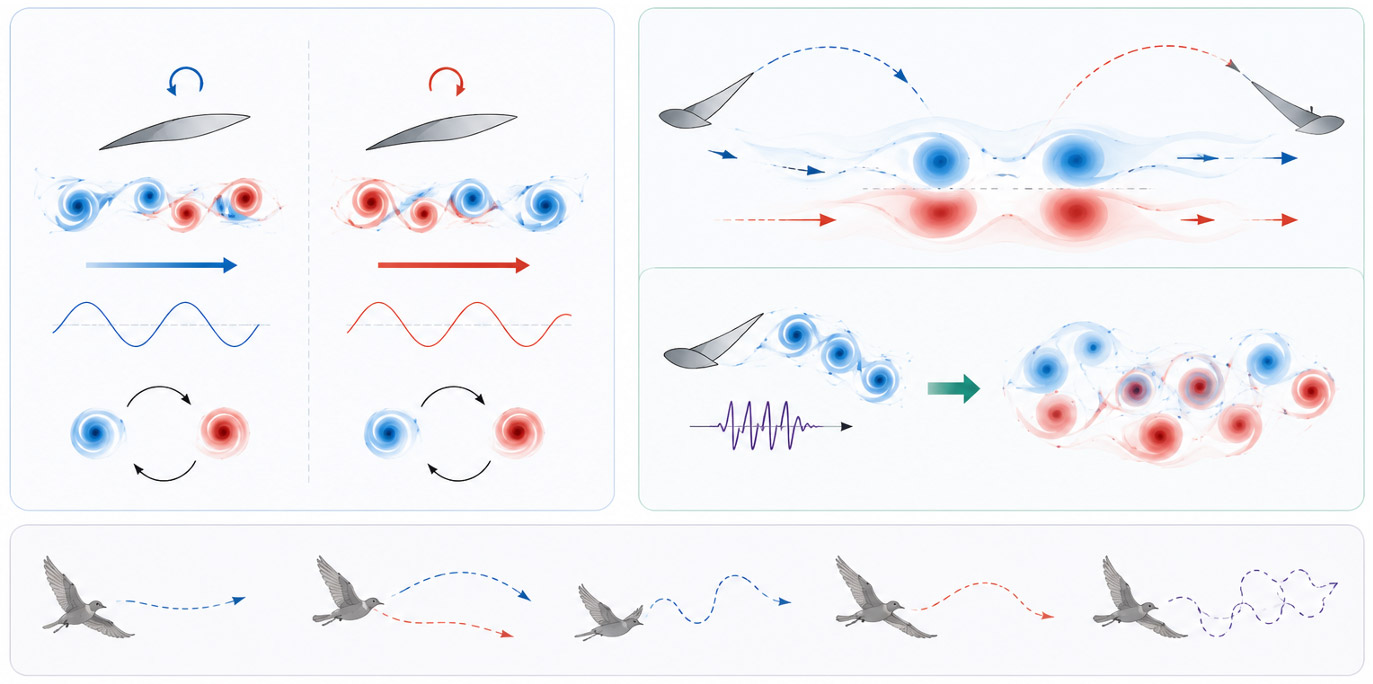
Beyond Periodic Flapping: Adaptive Unsteady Aerodynamics in Bio-inspired Flying Robots
Aerospace Engineering Communications | Volume 1, Issue 2: 81-86, 2026 | DOI: 10.62762/AEC.2026.970989
Abstract
Flapping-wing flight has long inspired bio-inspired aerial robots because of its extraordinary aerodynamic efficiency and maneuverability. Although substantial progress has been achieved in understanding unsteady aerodynamic mechanisms, most existing frameworks remain centered on idealized periodic wing motions and cycle-averaged propulsion. Recent studies increasingly suggest that transient asymmetries and multi-frequency perturbations, traditionally regarded as disturbances, can actively reorganize vortex dynamics and enhance aerodynamic performance. These findings imply that biological flight may rely not solely on stable periodic propulsion, but on continuous adaptation to evolving flow... More >

Graphical Abstract
Beyond Periodic Flapping: Adaptive Unsteady Aerodynamics in Bio-inspired Flying Robots
Open Access | Research Article | 22 April 2026 | Cited: Crossref logo  1 , Scopus 2
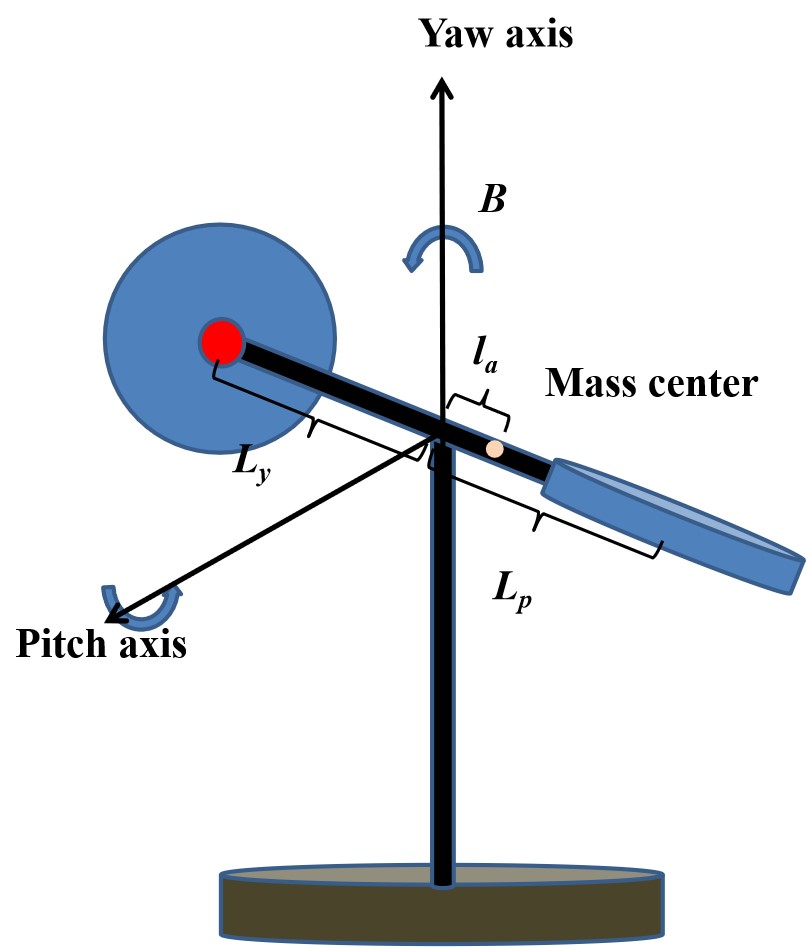
Advanced Barrier Function-Based Robust Prescribed Performance Control with Actuator Fault
Aerospace Engineering Communications | Volume 1, Issue 2: 68-80, 2026 | DOI: 10.62762/AEC.2026.303859
Abstract
This paper investigates prescribed performance control (PPC) using an advanced barrier function (ABF) based adaptive super-twisting control scheme with non-fragility. The specialty of the proposed scheme is that it removes the error transformation process, and therefore simplifies the design of PPC. Furthermore, the ABF is combined with an online adaptation law to solve the problem of fragility inherent to the traditional PPC. The proposed method is robust to actuator faults, unknown initial states, and sudden disturbances. The stability of the system is proved via the Lyapunov framework. Finally, experiments on a two-degree-of-freedom (2-DOF) helicopter platform are conducted to verify the... More >

Graphical Abstract
Advanced Barrier Function-Based Robust Prescribed Performance Control with Actuator Fault

Journal Statistics

37
Authors
4
Countries / Regions
14
Articles
5
Scopus Citations
28.6% Cited
2025
Published Since
25,097
Article Views
5,761
Article Downloads
Aerospace Engineering Communications
eISSN: 3071-1967
Crossref
Crossref
Member of Crossref
Visit Crossref →