Volume 1, Issue 1, Aerospace Engineering Communications
Volume 1, Issue 1, 2026
Submit Manuscript Edit a Special Issue
Article QR Code
Article QR Code
Scan the QR code for reading
Popular articles
Aerospace Engineering Communications, Volume 1, Issue 1, 2026: 36-46

Open Access | Research Article | 29 January 2026
Self-Learning Control under Practical Actuation
1 School of Internet of Things Engineering, Jiangnan University, Wuxi 214122, China
* Corresponding Author: Chengxi Zhang, [email protected]
ARK: ark:/57805/aec.2025.320719
Received: 21 November 2025, Accepted: 12 January 2026, Published: 29 January 2026  
Abstract
This paper develops a general and implementation friendly stability framework for self-learning control (SLC) laws of the form $u(t)=k_1(t)u(t-\tau)+k_2 v(t)$. Uniform ultimate boundedness is established for a class of general linear plants under two engineering actuator assumptions: (i) smoothness and (ii) saturation with maximum value. These assumptions are reasonable for practical systems and yield an explicit bound, which converts the delay learning mechanism into a nominal (delay-free) controller plus a bounded perturbation injection. The most notable feature of SLC is its simplicity of structure coupled with excellent performance. It is compatible with traditional algorithms and can enhance even PD-type controllers. A complete design procedure and a spacecraft attitude tracking simulation example are provided to demonstrate compatibility with aerospace applications while presenting a broadly applicable theoretical result.

Graphical Abstract
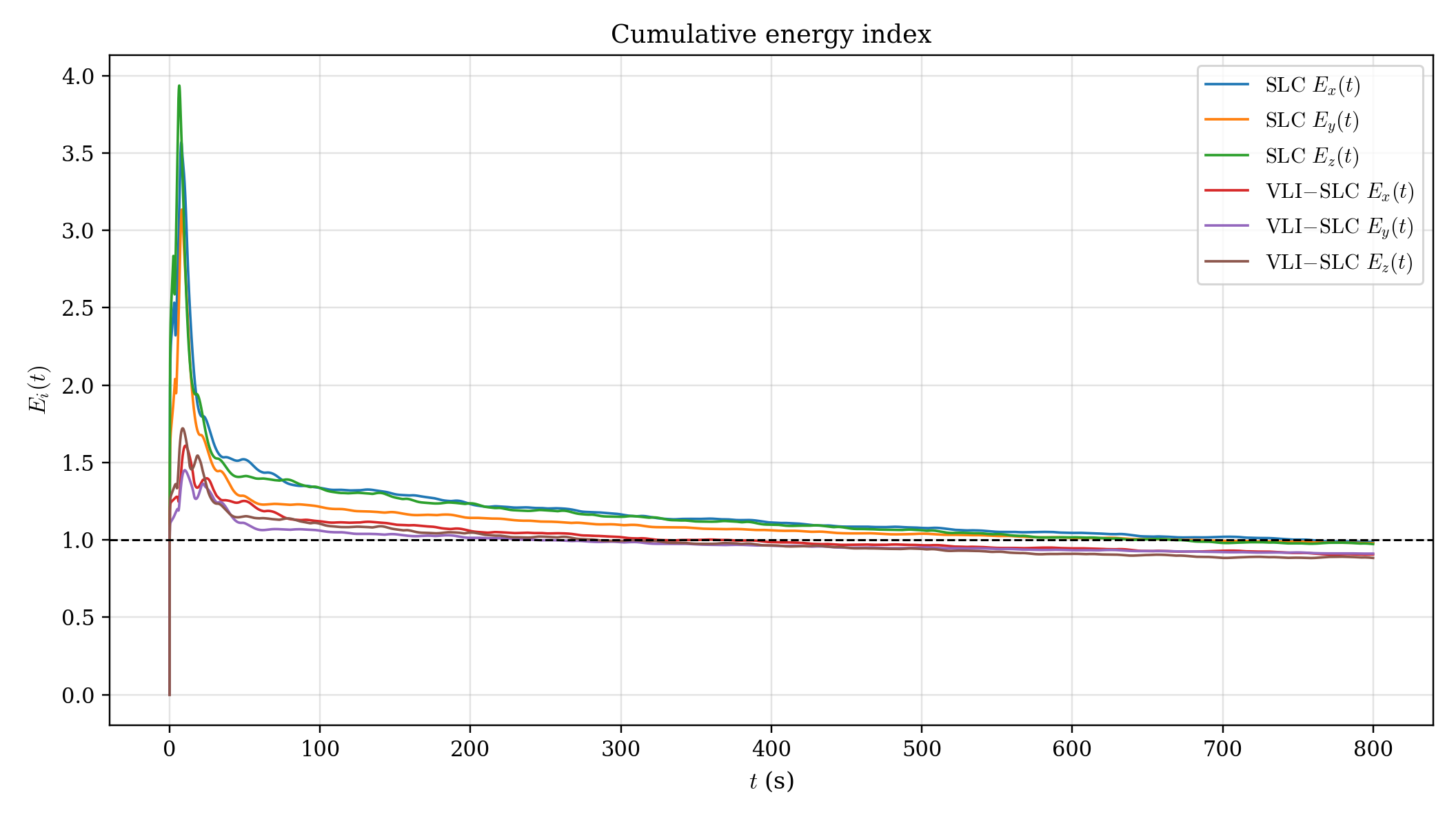
Self-Learning Control under Practical Actuation

Keywords
self-learning control
uniform ultimate boundedness
smooth saturated actuator
spacecraft attitude control

Data Availability Statement
Data will be made available on request.

Funding
This work was supported by the National Natural Science Foundation of China under Grant 62573211.

Conflicts of Interest
The author declares no conflicts of interest.

AI Use Statement
The author declares that no generative AI was used in the preparation of this manuscript.

Ethical Approval and Consent to Participate
Not applicable.

References
  1. Wu, B., & Cao, X. (2018). Robust attitude tracking control for spacecraft with quantized torques. IEEE Transactions on Aerospace and Electronic Systems, 54(2), 1020–1028.
    [CrossRef]   [Google Scholar]
  2. Kristiansen, R., & Hagen, D. (2009). Modelling of actuator dynamics for spacecraft attitude control. Journal of Guidance, Control, and Dynamics, 32(3), 1022–1025.
    [CrossRef]   [Google Scholar]
  3. Carrara, V., & Kuga, H. K. (2013). Torque and speed control loops of a reaction wheel. In Proceedings of the International Conference on Vibration Problems.
    [Google Scholar]
  4. Malekzadeh, M., & Sadeghian, H. (2017). Attitude control of spacecraft simulator with reaction wheels regulation. In 2017 5th RSI International Conference on Robotics and Mechatronics (ICRoM) (pp. 101–106).
    [CrossRef]   [Google Scholar]
  5. Wang, Z., Guo, Z., & Li, S. (2024). Finite-time disturbance rejection control for rigid spacecraft attitude set stabilization with actuator saturation. IEEE Transactions on Aerospace and Electronic Systems, 60(4), 4910–4922.
    [CrossRef]   [Google Scholar]
  6. Tarbouriech, S., & Turner, M. (2009). Anti-windup design: an overview of some recent advances and open problems. IET Control Theory & Applications, 3(1), 1–19.
    [CrossRef]   [Google Scholar]
  7. Chen, B., Shao, X., Yang, H., Li, D., & Hu, Q. (2025). Spacecraft anti-unwinding attitude tracking with guaranteed performance: A DREM-based adaptive control approach. Advances in Space Research.
    [CrossRef]   [Google Scholar]
  8. Arimoto, S., Kawamura, S., & Miyazaki, F. (1984). Bettering operation of robots by learning. Journal of Robotic systems, 1(2), 123-140.
    [CrossRef]   [Google Scholar]
  9. Javaid, U., Basin, M. V., & Ijaz, S. (2024, February). Spacecraft Attitude Stabilization Control Under Actuator Faults and Input Saturation. In 2024 IEEE 18th International Conference on Advanced Motion Control (AMC) (pp. 1-6). IEEE.
    [CrossRef]   [Google Scholar]
  10. Zhang, C., Xiao, B., Wu, J., & Li, B. (2021). On low-complexity control design to spacecraft attitude stabilization: an online-learning approach. Aerospace Science and Technology, 110, 106441.
    [CrossRef]   [Google Scholar]
  11. Zhang, C., Ahn, C. K., Wu, J., & He, W. (2021). Online-learning control with weakened saturation response to attitude tracking: A variable learning intensity approach. Aerospace Science and Technology, 117, 106981.
    [CrossRef]   [Google Scholar]
  12. Zheng, W. H., & Armstrong, J. T. (2010). Wireless intra-spacecraft communication: The benefits and the challenges. In 2010 NASA/ESA Conference on Adaptive Hardware and Systems (pp. 75–78).
    [CrossRef]   [Google Scholar]
  13. Zhang, C., Lu, W., Zhao, S., Wu, J., Zhu, X., Liu, Z., & He, W. (2025). Enhancing attitude tracking with self-learning control using tanh-type learning intensity. IEEE Transactions on Automation Science and Engineering, 22, 16976–16986.
    [CrossRef]   [Google Scholar]

Cite This Article
APA Style
Zhang, C. (2026). Self-Learning Control under Practical Actuation. Aerospace Engineering Communications, 1(1), 36–46. https://doi.org/10.62762/AEC.2025.320719
Export Citation
RIS Format
Compatible with EndNote, Zotero, Mendeley, and other reference managers
RIS format data for reference managers
TY  - JOUR
AU  - Zhang, Chengxi
PY  - 2026
DA  - 2026/01/29
TI  - Self-Learning Control under Practical Actuation
JO  - Aerospace Engineering Communications
T2  - Aerospace Engineering Communications
JF  - Aerospace Engineering Communications
VL  - 1
IS  - 1
SP  - 36
EP  - 46
DO  - 10.62762/AEC.2025.320719
UR  - https://www.icck.org/article/abs/AEC.2025.320719
KW  - self-learning control
KW  - uniform ultimate boundedness
KW  - smooth saturated actuator
KW  - spacecraft attitude control
AB  - This paper develops a general and implementation friendly stability framework for self-learning control (SLC) laws of the form $u(t)=k_1(t)u(t-\tau)+k_2 v(t)$. Uniform ultimate boundedness is established for a class of general linear plants under two engineering actuator assumptions: (i) smoothness and (ii) saturation with maximum value. These assumptions are reasonable for practical systems and yield an explicit bound, which converts the delay learning mechanism into a nominal (delay-free) controller plus a bounded perturbation injection. The most notable feature of SLC is its simplicity of structure coupled with excellent performance. It is compatible with traditional algorithms and can enhance even PD-type controllers. A complete design procedure and a spacecraft attitude tracking simulation example are provided to demonstrate compatibility with aerospace applications while presenting a broadly applicable theoretical result.
SN  - pending
PB  - Institute of Central Computation and Knowledge
LA  - English
ER  - 
BibTeX Format
Compatible with LaTeX, BibTeX, and other reference managers
BibTeX format data for LaTeX and reference managers
@article{Zhang2026SelfLearni,
  author = {Chengxi Zhang},
  title = {Self-Learning Control under Practical Actuation},
  journal = {Aerospace Engineering Communications},
  year = {2026},
  volume = {1},
  number = {1},
  pages = {36-46},
  doi = {10.62762/AEC.2025.320719},
  url = {https://www.icck.org/article/abs/AEC.2025.320719},
  abstract = {This paper develops a general and implementation friendly stability framework for self-learning control (SLC) laws of the form \$u(t)=k\_1(t)u(t-\tau)+k\_2 v(t)\$. Uniform ultimate boundedness is established for a class of general linear plants under two engineering actuator assumptions: (i) smoothness and (ii) saturation with maximum value. These assumptions are reasonable for practical systems and yield an explicit bound, which converts the delay learning mechanism into a nominal (delay-free) controller plus a bounded perturbation injection. The most notable feature of SLC is its simplicity of structure coupled with excellent performance. It is compatible with traditional algorithms and can enhance even PD-type controllers. A complete design procedure and a spacecraft attitude tracking simulation example are provided to demonstrate compatibility with aerospace applications while presenting a broadly applicable theoretical result.},
  keywords = {self-learning control, uniform ultimate boundedness, smooth saturated actuator, spacecraft attitude control},
  issn = {pending},
  publisher = {Institute of Central Computation and Knowledge}
}

Article Metrics
Citations:

Crossref

0

Scopus

0

Web of Science

0
Article Access Statistics:
Views: 32
PDF Downloads: 11

Publisher's Note
ICCK stays neutral with regard to jurisdictional claims in published maps and institutional affiliations.

Rights and Permissions
CC BY Copyright © 2026 by the Author(s). Published by Institute of Central Computation and Knowledge. This article is an open access article distributed under the terms and conditions of the Creative Commons Attribution (CC BY) license (https://creativecommons.org/licenses/by/4.0/), which permits use, sharing, adaptation, distribution and reproduction in any medium or format, as long as you give appropriate credit to the original author(s) and the source, provide a link to the Creative Commons licence, and indicate if changes were made.
Aerospace Engineering Communications

Aerospace Engineering Communications

ISSN: pending (Online)

Email: [email protected]

Portico

Portico

All published articles are preserved here permanently:
https://www.portico.org/publishers/icck/