

Communication Topology Resilience-Guided Optimization for Multi-UAV Cooperative Planning



Article Information
Abstract
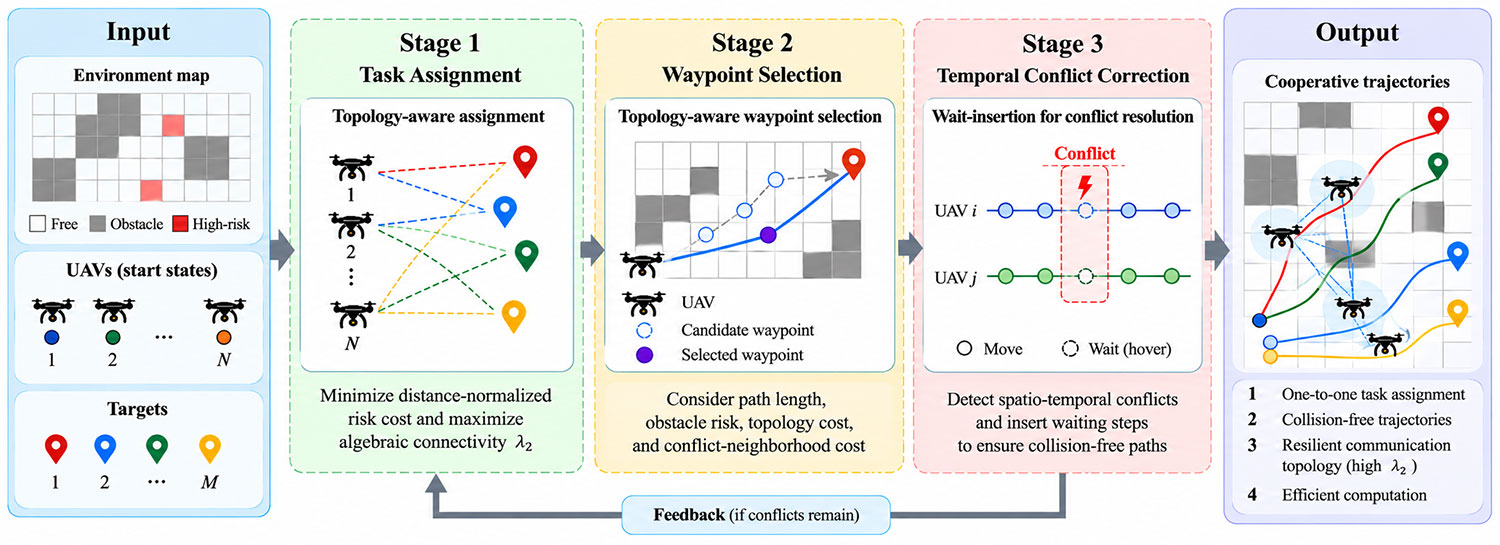
This paper studies cooperative mission planning for multi-unmanned aerial vehicle (UAV) swarms in obstacle-cluttered environments, with particular attention to mission feasibility and communication-topology resilience. Considering that task assignment and waypoint selection directly affect the inter-UAV communication graph, a communication topology resilience-guided (CTR) method is proposed by introducing algebraic connectivity as an explicit topology metric. The method first performs topology-guided one-to-one task assignment using simulated annealing, jointly considering normalized distance, obstacle risk, and algebraic connectivity. It then selects topology-aware key waypoints according to path length, obstacle risk, isolation penalty, and conflict-neighborhood cost, followed by path stitching and wait-insertion-based temporal conflict correction. Compared with prioritized planning (PP) and genetic algorithm (GA) baselines, CTR achieves a higher mission success rate and stronger algebraic connectivity, while substantially improving communication connectivity over the topology-ablated variant with essentially the same success rate. Monte Carlo simulations under different swarm sizes and obstacle densities verify the effectiveness of the proposed method.
Graphical Abstract
Keywords
Data Availability Statement
Funding
Conflicts of Interest
AI Use Statement
Ethical Approval and Consent to Participate
References
- Chung, S. J., Paranjape, A. A., Dames, P., Shen, S., & Kumar, V. (2018). A Survey on Aerial Swarm Robotics. IEEE Transactions on Robotics, 34(4), 837-855.
[CrossRef] [Google Scholar] - Yu, J., & LaValle, S. M. (2016). Optimal multirobot path planning on graphs: Complete algorithms and effective heuristics. IEEE Transactions on Robotics, 32(5), 1163-1177.
[CrossRef] [Google Scholar] - Ma, H. (2022). Graph-Based Multi-Robot Path Finding and Planning. Current Robotics Reports, 3(3), 77-84.
[CrossRef] [Google Scholar] - Van Den Berg, J. P., & Overmars, M. H. (2005, August). Prioritized motion planning for multiple robots. In 2005 IEEE/RSJ International Conference on Intelligent Robots and Systems (pp. 430-435). IEEE.
[CrossRef] [Google Scholar] - Goldberg, D. E. (1989). Genetic Algorithms in Search, Optimization, and Machine Learning. Addison-Wesley. https://www2.fiit.stuba.sk/~kvasnicka/Free%20books/Goldberg_Genetic_Algorithms_in_Search.pdf
[Google Scholar] - Holland, J. H. (1992). Genetic Algorithms. Scientific American, 267(1), 66-73.
[CrossRef] [Google Scholar] - Sharon, G., Stern, R., Felner, A., & Sturtevant, N. R. (2015). Conflict-Based Search for Optimal Multi-Agent Pathfinding. Artificial Intelligence, 219, 40-66.
[CrossRef] [Google Scholar] - Choi, H. L., Brunet, L., & How, J. P. (2009). Consensus-based decentralized auctions for robust task allocation. IEEE transactions on robotics, 25(4), 912-926.
[CrossRef] [Google Scholar] - Zavlanos, M. M., & Pappas, G. J. (2008). Distributed Connectivity Control of Mobile Networks. IEEE Transactions on Robotics, 24(6), 1416-1428.
[CrossRef] [Google Scholar] - Yun, W. J., Park, S., Kim, J., Shin, M., Jung, S., Mohaisen, D. A., & Kim, J.-H. (2022). Cooperative multiagent deep reinforcement learning for reliable surveillance via autonomous multi-UAV control. IEEE Transactions on Industrial Informatics, 18(10), 7086-7096.
[CrossRef] [Google Scholar] - Kong, X., Zhou, Y., Li, Z., & Wang, S. (2024). Multi-UAV simultaneous target assignment and path planning based on deep reinforcement learning in dynamic multiple obstacles environments. Frontiers in Neurorobotics, 17, 1302898.
[CrossRef] [Google Scholar] - Westheider, J., Rückin, J., & Popović, M. (2023, October). Multi-UAV adaptive path planning using deep reinforcement learning. In 2023 IEEE/RSJ international conference on intelligent robots and systems (IROS) (pp. 649-656). IEEE.
[CrossRef] [Google Scholar] - Puente-Castro, A., Rivero, D., Pedrosa, E., Pereira, A., Lau, N., & Fernandez-Blanco, E. (2024). Q-Learning Based System for Path Planning with Unmanned Aerial Vehicles Swarms in Obstacle Environments. Expert Systems with Applications, 235, 121240.
[CrossRef] [Google Scholar] - Kim, Y., & Mesbahi, M. (2005, June). On maximizing the second smallest eigenvalue of a state-dependent graph Laplacian. In Proceedings of the 2005 American Control Conference (pp. 99-103). IEEE.
[CrossRef] [Google Scholar] - Xie, H., Yang, D., Xiao, L., & Lyu, J. (2021). Connectivity-aware 3D UAV path design with deep reinforcement learning. IEEE Transactions on Vehicular Technology, 70(12), 13022-13034.
[CrossRef] [Google Scholar] - Yanmaz, E., Balanji, H. M., & Güven, İ. (2024). Dynamic multi-UAV path planning for multi-target search and connectivity. IEEE Transactions on Vehicular Technology, 73(7), 10516-10528.
[CrossRef] [Google Scholar] - Savkin, A. V., Huang, C., & Ni, W. (2022). Joint multi-UAV path planning and LoS communication for mobile-edge computing in IoT networks with RISs. IEEE Internet of Things Journal, 10(3), 2720-2727.
[CrossRef] [Google Scholar] - Meng, K., He, X., Wu, Q., & Li, D. (2023). Multi-UAV Collaborative Sensing and Communication: Joint Task Allocation and Power Optimization. IEEE Transactions on Wireless Communications, 22(6), 4232-4246.
[CrossRef] [Google Scholar] - Kirkpatrick, S., Gelatt Jr, C. D., & Vecchi, M. P. (1983). Optimization by simulated annealing. science, 220(4598), 671-680.
[CrossRef] [Google Scholar] - Fiedler, M. (1973). Algebraic Connectivity of Graphs. Czechoslovak Mathematical Journal, 23(2), 298-305.
[CrossRef] [Google Scholar] - Olfati-Saber, R., Fax, J. A., & Murray, R. M. (2007). Consensus and Cooperation in Networked Multi-Agent Systems. Proceedings of the IEEE, 95(1), 215-233.
[CrossRef] [Google Scholar]
Cite This Article
TY  - JOUR
AU  - Li, Quan
AU  - Shen, Zitong
AU  - Ding, Qingwen
AU  - Liu, Yaxuan
AU  - Dai, Rui
AU  - Zhou, Jin
AU  - Ni, Yiyang
PY  - 2026
DA  - 2026/09/26
TI  - Communication Topology Resilience-Guided Optimization for Multi-UAV Cooperative Planning
JO  - Aerospace Engineering Communications
T2  - Aerospace Engineering Communications
JF  - Aerospace Engineering Communications
VL  - 1
IS  - 3
SP  - 128
EP  - 136
DO  - 10.62762/AEC.2026.595594
UR  - https://www.icck.org/article/abs/AEC.2026.595594
KW  - multi-UAV swarm
KW  - cooperative planning
KW  - communication topology resilience
KW  - algebraic connectivity
KW  - simulated annealing
AB  - This paper studies cooperative mission planning for multi-unmanned aerial vehicle (UAV) swarms in obstacle-cluttered environments, with particular attention to mission feasibility and communication-topology resilience. Considering that task assignment and waypoint selection directly affect the inter-UAV communication graph, a communication topology resilience-guided (CTR) method is proposed by introducing algebraic connectivity as an explicit topology metric. The method first performs topology-guided one-to-one task assignment using simulated annealing, jointly considering normalized distance, obstacle risk, and algebraic connectivity. It then selects topology-aware key waypoints according to path length, obstacle risk, isolation penalty, and conflict-neighborhood cost, followed by path stitching and wait-insertion-based temporal conflict correction. Compared with prioritized planning (PP) and genetic algorithm (GA) baselines, CTR achieves a higher mission success rate and stronger algebraic connectivity, while substantially improving communication connectivity over the topology-ablated variant with essentially the same success rate. Monte Carlo simulations under different swarm sizes and obstacle densities verify the effectiveness of the proposed method.
SN  - 3071-1967
PB  - Institute of Central Computation and Knowledge
LA  - English
ER  -
@article{Li2026Communicat,
  author = {Quan Li and Zitong Shen and Qingwen Ding and Yaxuan Liu and Rui Dai and Jin Zhou and Yiyang Ni},
  title = {Communication Topology Resilience-Guided Optimization for Multi-UAV Cooperative Planning},
  journal = {Aerospace Engineering Communications},
  year = {2026},
  volume = {1},
  number = {3},
  pages = {128-136},
  doi = {10.62762/AEC.2026.595594},
  url = {https://www.icck.org/article/abs/AEC.2026.595594},
  abstract = {This paper studies cooperative mission planning for multi-unmanned aerial vehicle (UAV) swarms in obstacle-cluttered environments, with particular attention to mission feasibility and communication-topology resilience. Considering that task assignment and waypoint selection directly affect the inter-UAV communication graph, a communication topology resilience-guided (CTR) method is proposed by introducing algebraic connectivity as an explicit topology metric. The method first performs topology-guided one-to-one task assignment using simulated annealing, jointly considering normalized distance, obstacle risk, and algebraic connectivity. It then selects topology-aware key waypoints according to path length, obstacle risk, isolation penalty, and conflict-neighborhood cost, followed by path stitching and wait-insertion-based temporal conflict correction. Compared with prioritized planning (PP) and genetic algorithm (GA) baselines, CTR achieves a higher mission success rate and stronger algebraic connectivity, while substantially improving communication connectivity over the topology-ablated variant with essentially the same success rate. Monte Carlo simulations under different swarm sizes and obstacle densities verify the effectiveness of the proposed method.},
  keywords = {multi-UAV swarm, cooperative planning, communication topology resilience, algebraic connectivity, simulated annealing},
  issn = {3071-1967},
  publisher = {Institute of Central Computation and Knowledge}
}
Article Metrics
Publisher's Note
ICCK stays neutral with regard to jurisdictional claims in published maps and institutional affiliations.
Rights and Permissions
 Copyright © 2026 by the Author(s). Published by Institute of Central Computation and Knowledge. This article is an open access article distributed under the terms and conditions of the Creative Commons Attribution (CC BY) license (https://creativecommons.org/licenses/by/4.0/), which permits use, sharing, adaptation, distribution and reproduction in any medium or format, as long as you give appropriate credit to the original author(s) and the source, provide a link to the Creative Commons licence, and indicate if changes were made.


Portico
