
Impact Time and Angle Control Guidance: Cooperative Guidability and Gain Synthesis



Article Information
Abstract
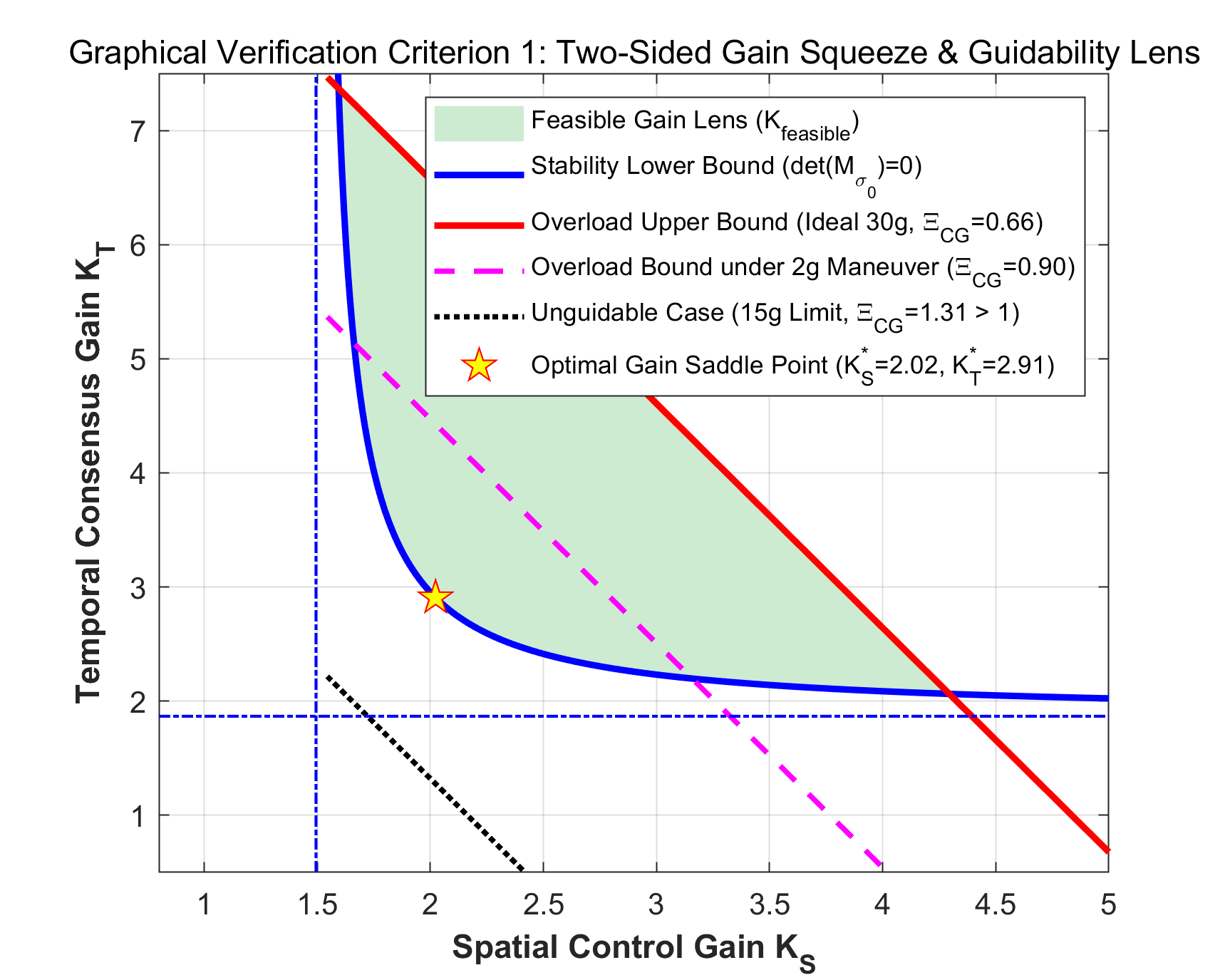
Cooperative guidance of multi-missile salvo systems has emerged as a cornerstone technology in modern aerospace defense and precision strike operations. Impact Time and Angle Control Guidance (ITACG) schemes frequently rely on piecewise stage switching to bypass terminal singularities and brute-force post-hoc tuning that cannot certify gain feasibility under actuator saturation prior to launch. To overcome these limitations, this paper establishes a fully coupled, singularity-free guidance architecture and a pre-launch theoretical framework termed Cooperative Guidability. First, embedding relative distance into a logarithmic Barrier Lyapunov Function (BLF) virtual control law algebraically cancels inverse-range singularities and confines the lead angle, while a smooth threshold mapping eliminates dead-zone chattering. Second, employing Vector Lyapunov Functions (VLF) and M-matrix theory to decouple spatiotemporal perturbations, we reveal a two-sided hyperbolic-linear gain squeeze mechanism and derive closed-form optimal gains. Finally, explicit necessary and sufficient criteria, governed by a dimensionless guidability index and network connectivity thresholds, are established across ideal, uncertain, and maneuvering-target scenarios, yielding two graphical verification tools confirmed by numerical simulations.
Graphical Abstract
Keywords
Data Availability Statement
Funding
Conflicts of Interest
AI Use Statement
Ethical Approval and Consent to Participate
References
- Jeon, I. S., Lee, J. I., & Tahk, M. J. (2006). Impact-time-control guidance law for anti-ship missiles. IEEE Transactions on Control Systems Technology, 14(2), 260-266.
[CrossRef] [Google Scholar] - Yang, X., Zhang, Y., & Song, S. (2023). Two-stage cooperative guidance strategy with impact-angle and field-of-view constraints. Journal of Guidance, Control, and Dynamics, 46(3), 590-599.
[CrossRef] [Google Scholar] - Zhou, J., & Yang, J. (2016). Distributed guidance law design for cooperative simultaneous attacks with multiple missiles. Journal of Guidance, Control, and Dynamics, 39(10), 2439-2447.
[CrossRef] [Google Scholar] - Jeon, I. S., Lee, J. I., & Tahk, M. J. (2010). Homing guidance law for cooperative attack of multiple missiles. Journal of Guidance, Control, and Dynamics, 33(1), 275-280.
[CrossRef] [Google Scholar] - Zhao, Q., Dong, X., Liang, Z., Bai, C., Chen, J., & Ren, Z. (2017). Distributed cooperative guidance for multiple missiles with fixed and switching communication topologies. Chinese Journal of Aeronautics, 30(4), 1570-1581.
[CrossRef] [Google Scholar] - Zhang, Y., Wang, X., & Wu, H. (2015). A distributed cooperative guidance law for salvo attack of multiple anti-ship missiles. Chinese Journal of Aeronautics, 28(5), 1438-1450.
[CrossRef] [Google Scholar] - Zhao, S., & Zhou, R. (2008). Cooperative guidance for multimissile salvo attack. Chinese Journal of Aeronautics, 21(6), 533-539.
[CrossRef] [Google Scholar] - Zhang, S., Guo, Y., Liu, Z., Wang, S., & Hu, X. (2021). Finite-time cooperative guidance strategy for impact angle and time control. IEEE Transactions on Aerospace and Electronic Systems, 57(2), 806-819.
[CrossRef] [Google Scholar] - Zhou, S., Zhang, S., & Wang, D. (2020). Impact angle control guidance law with seeker's field-of-view constraint based on logarithm barrier Lyapunov function. IEEE Access, 8, 68268-68279.
[CrossRef] [Google Scholar] - Lee, J. I., Jeon, I. S., & Tahk, M. J. (2007). Guidance law to control impact time and angle. IEEE Transactions on Aerospace and Electronic Systems, 43(1), 301-310.
[CrossRef] [Google Scholar] - Wang, P., Lee, C. H., Cho, N., & Wie, B. (2025). Generalized time-to-go inversion guidance with impact time and angle constraints. Journal of Guidance, Control, and Dynamics, 48(3), 555-574.
[CrossRef] [Google Scholar] - Chen, Y., Wu, S., & Wang, X. (2022). Impact time and angle control optimal guidance with field-of-view constraint. Journal of Guidance, Control, and Dynamics, 45(12), 2369-2378.
[CrossRef] [Google Scholar] - Wang, C., Dong, W., Wang, J., & Xin, M. (2022). Impact-angle-constrained cooperative guidance for salvo attack. Journal of Guidance, Control, and Dynamics, 45(4), 684-703.
[CrossRef] [Google Scholar] - Zhang, Z., Ma, K., Zhang, G., & Yan, L. (2022). Virtual target approach-based optimal guidance law with both impact time and terminal angle constraints. Nonlinear Dynamics, 107(4), 3521-3541.
[CrossRef] [Google Scholar] - Cai, Y., & Zhao, J. (2026). Graph attention network-enhanced multi-agent proximal policy optimization for cooperative guidance in attack–defense confrontation. Aerospace, 13(7), 626.
[CrossRef] [Google Scholar] - Sun, X., & Xia, Y. (2012). Optimal guidance law for cooperative attack of multiple missiles based on optimal control theory. International Journal of Control, 85(8), 1063-1070.
[CrossRef] [Google Scholar] - Guo, G., Tan, H., Feng, Y., & Wang, Y. (2025). Event-triggered super-twisting fixed-time consensus control for networked nonlinear multi-agent systems with disturbance. IEEE Transactions on Automation Science and Engineering, 22, 11920-11932.
[CrossRef] [Google Scholar] - Wang, L., & Xiao, F. (2010). Finite-time consensus problems for networks of dynamic agents. IEEE Transactions on Automatic Control, 55(4), 950-955.
[CrossRef] [Google Scholar] - Zuo, Z., & Tie, L. (2014). A new class of finite-time nonlinear consensus protocols for multi-agent systems. International Journal of Control, 87(2), 363-370.
[CrossRef] [Google Scholar] - Zuo, Z. (2015). Nonsingular fixed-time consensus tracking for second-order multi-agent networks. Automatica, 54, 305-309.
[CrossRef] [Google Scholar] - Yu, S., & Long, X. (2015). Finite-time consensus for second-order multi-agent systems with disturbances by integral sliding mode. Automatica, 54, 158-165.
[CrossRef] [Google Scholar] - Tee, K. P., Ge, S. S., & Tay, E. H. (2009). Barrier Lyapunov functions for the control of output-constrained nonlinear systems. Automatica, 45(4), 918-927.
[CrossRef] [Google Scholar] - Zhou, B. (2020). Finite-time stability analysis and stabilization by bounded linear time-varying feedback. Automatica, 121, 109191.
[CrossRef] [Google Scholar] - Šiljak, D. D., & Vukčević, M. B. (1976). Large-scale systems: Stability, complexity, reliability. Journal of the Franklin Institute, 301(1-2), 49-69.
[CrossRef] [Google Scholar] - Siljak, D. D. (1972). Stability of large-scale systems under structural perturbations. IEEE Transactions on Systems, Man, and Cybernetics, SMC-2(5), 657-663.
[CrossRef] [Google Scholar] - Nersesov, S. G., & Haddad, W. M. (2006). On the stability and control of nonlinear dynamical systems via vector Lyapunov functions. IEEE Transactions on Automatic Control, 51(2), 203-215.
[CrossRef] [Google Scholar] - Olfati-Saber, R., & Murray, R. M. (2004). Consensus problems in networks of agents with switching topology and time-delays. IEEE Transactions on Automatic Control, 49(9), 1520-1533.
[CrossRef] [Google Scholar]
Cite This Article
TY  - JOUR
AU  - Zhao, Lanhao
AU  - Guo, Guangxin
PY  - 2026
DA  - 2026/11/23
TI  - Impact Time and Angle Control Guidance: Cooperative Guidability and Gain Synthesis
JO  - Aerospace Engineering Communications
T2  - Aerospace Engineering Communications
JF  - Aerospace Engineering Communications
VL  - 1
IS  - 4
SP  - 137
EP  - 153
DO  - 10.62762/AEC.2026.805686
UR  - https://www.icck.org/article/abs/aec.2026.805686
KW  - cooperative guidance
KW  - cooperative guidability
KW  - Vector Lyapunov Function (VLF)
KW  - Barrier Lyapunov Function (BLF)
KW  - $M$-matrix
KW  - terminal singularity
KW  - actuator saturation
AB  - Cooperative guidance of multi-missile salvo systems has emerged as a cornerstone technology in modern aerospace defense and precision strike operations. Impact Time and Angle Control Guidance (ITACG) schemes frequently rely on piecewise stage switching to bypass terminal singularities and brute-force post-hoc tuning that cannot certify gain feasibility under actuator saturation prior to launch. To overcome these limitations, this paper establishes a fully coupled, singularity-free guidance architecture and a pre-launch theoretical framework termed Cooperative Guidability. First, embedding relative distance into a logarithmic Barrier Lyapunov Function (BLF) virtual control law algebraically cancels inverse-range singularities and confines the lead angle, while a smooth threshold mapping eliminates dead-zone chattering. Second, employing Vector Lyapunov Functions (VLF) and M-matrix theory to decouple spatiotemporal perturbations, we reveal a two-sided hyperbolic-linear gain squeeze mechanism and derive closed-form optimal gains. Finally, explicit necessary and sufficient criteria, governed by a dimensionless guidability index and network connectivity thresholds, are established across ideal, uncertain, and maneuvering-target scenarios, yielding two graphical verification tools confirmed by numerical simulations.
SN  - 3071-1967
PB  - Institute of Central Computation and Knowledge
LA  - English
ER  -
@article{Zhao2026Impact,
  author = {Lanhao Zhao and Guangxin Guo},
  title = {Impact Time and Angle Control Guidance: Cooperative Guidability and Gain Synthesis},
  journal = {Aerospace Engineering Communications},
  year = {2026},
  volume = {1},
  number = {4},
  pages = {137-153},
  doi = {10.62762/AEC.2026.805686},
  url = {https://www.icck.org/article/abs/aec.2026.805686},
  abstract = {Cooperative guidance of multi-missile salvo systems has emerged as a cornerstone technology in modern aerospace defense and precision strike operations. Impact Time and Angle Control Guidance (ITACG) schemes frequently rely on piecewise stage switching to bypass terminal singularities and brute-force post-hoc tuning that cannot certify gain feasibility under actuator saturation prior to launch. To overcome these limitations, this paper establishes a fully coupled, singularity-free guidance architecture and a pre-launch theoretical framework termed Cooperative Guidability. First, embedding relative distance into a logarithmic Barrier Lyapunov Function (BLF) virtual control law algebraically cancels inverse-range singularities and confines the lead angle, while a smooth threshold mapping eliminates dead-zone chattering. Second, employing Vector Lyapunov Functions (VLF) and M-matrix theory to decouple spatiotemporal perturbations, we reveal a two-sided hyperbolic-linear gain squeeze mechanism and derive closed-form optimal gains. Finally, explicit necessary and sufficient criteria, governed by a dimensionless guidability index and network connectivity thresholds, are established across ideal, uncertain, and maneuvering-target scenarios, yielding two graphical verification tools confirmed by numerical simulations.},
  keywords = {cooperative guidance, cooperative guidability, Vector Lyapunov Function (VLF), Barrier Lyapunov Function (BLF), \$M\$-matrix, terminal singularity, actuator saturation},
  issn = {3071-1967},
  publisher = {Institute of Central Computation and Knowledge}
}
Article Metrics
Publisher's Note
ICCK stays neutral with regard to jurisdictional claims in published maps and institutional affiliations.
Rights and Permissions
 Copyright © 2026 by the Author(s). Published by Institute of Central Computation and Knowledge. This article is an open access article distributed under the terms and conditions of the Creative Commons Attribution (CC BY) license (https://creativecommons.org/licenses/by/4.0/), which permits use, sharing, adaptation, distribution and reproduction in any medium or format, as long as you give appropriate credit to the original author(s) and the source, provide a link to the Creative Commons licence, and indicate if changes were made.


Portico
