

Agricultural Science and Food Processing
ISSN: 3066-1579 (Online) | ISSN: 3066-1560 (Print)
Email: [email protected]

 Submit Manuscript
Edit a Special Issue
Submit Manuscript
Edit a Special Issue


TY  - JOUR
AU  - Zou, Tianchang
PY  - 2026
DA  - 2026/03/02
TI  - Turning Voyage Time into Value: An Integrated Shipping-and-Aging Intervention for Irish Beef Exports
JO  - Agricultural Science and Food Processing
T2  - Agricultural Science and Food Processing
JF  - Agricultural Science and Food Processing
VL  - 3
IS  - 1
SP  - 19
EP  - 24
DO  - 10.62762/ASFP.2025.926182
UR  - https://www.icck.org/article/abs/ASFP.2025.926182
KW  - Irish beef exports
KW  - cold chain
KW  - maritime logistics
KW  - sustainability intervention
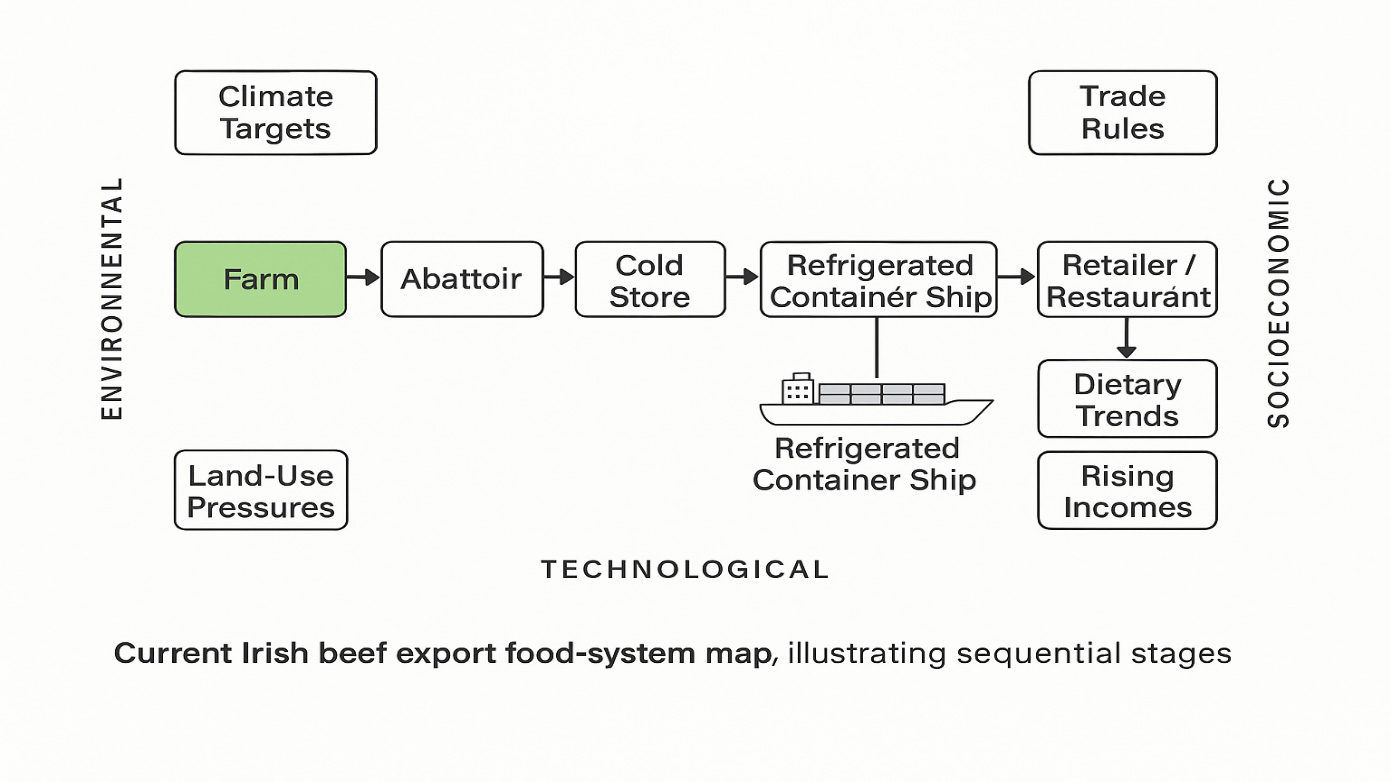
AB  - Irish beef exports illustrate the tension between economic benefits and environmental sustainability in the global food system. While exports support rural livelihoods and national trade revenue, they rely on energy-intensive cold chains and contribute to high greenhouse-gas emissions, land-use pressures and equity concerns. This study proposes an integrated shipping-and-ageing intervention that reconfigures maritime logistics as a site of controlled maturation and circular by-product management. In the redesigned system, beef is slaughtered and inspected in approved land-based plants, then loaded into shipboard ageing rooms where temperature, humidity and airflow are actively controlled and continuously monitored throughout the voyage. By shifting part of the maturation period from static cold stores to voyage time, the intervention aims to reduce land-based refrigeration, minimise handling stages, and improve traceability. The analysis also highlights governance risks—including rebound effects from efficiency gains—and argues that any logistics savings must be coupled to value-based quota or emissions-cap mechanisms and to an internationally recognised certification scheme for mobile processing units to avoid regulatory loopholes. Overall, the intervention is framed as one component of a broader transition strategy that also requires dietary change, regenerative agriculture and fair-trade governance.
SN  - 3066-1579
PB  - Institute of Central Computation and Knowledge
LA  - English
ER  -
@article{Zou2026Turning,
  author = {Tianchang Zou},
  title = {Turning Voyage Time into Value: An Integrated Shipping-and-Aging Intervention for Irish Beef Exports},
  journal = {Agricultural Science and Food Processing},
  year = {2026},
  volume = {3},
  number = {1},
  pages = {19-24},
  doi = {10.62762/ASFP.2025.926182},
  url = {https://www.icck.org/article/abs/ASFP.2025.926182},
  abstract = {Irish beef exports illustrate the tension between economic benefits and environmental sustainability in the global food system. While exports support rural livelihoods and national trade revenue, they rely on energy-intensive cold chains and contribute to high greenhouse-gas emissions, land-use pressures and equity concerns. This study proposes an integrated shipping-and-ageing intervention that reconfigures maritime logistics as a site of controlled maturation and circular by-product management. In the redesigned system, beef is slaughtered and inspected in approved land-based plants, then loaded into shipboard ageing rooms where temperature, humidity and airflow are actively controlled and continuously monitored throughout the voyage. By shifting part of the maturation period from static cold stores to voyage time, the intervention aims to reduce land-based refrigeration, minimise handling stages, and improve traceability. The analysis also highlights governance risks—including rebound effects from efficiency gains—and argues that any logistics savings must be coupled to value-based quota or emissions-cap mechanisms and to an internationally recognised certification scheme for mobile processing units to avoid regulatory loopholes. Overall, the intervention is framed as one component of a broader transition strategy that also requires dietary change, regenerative agriculture and fair-trade governance.},
  keywords = {Irish beef exports, cold chain, maritime logistics, sustainability intervention},
  issn = {3066-1579},
  publisher = {Institute of Central Computation and Knowledge}
}
 Copyright © 2026 by the Author(s). Published by Institute of Central Computation and Knowledge. This article is an open access article distributed under the terms and conditions of the Creative Commons Attribution (CC BY) license (https://creativecommons.org/licenses/by/4.0/), which permits use, sharing, adaptation, distribution and reproduction in any medium or format, as long as you give appropriate credit to the original author(s) and the source, provide a link to the Creative Commons licence, and indicate if changes were made.
Agricultural Science and Food Processing
ISSN: 3066-1579 (Online) | ISSN: 3066-1560 (Print)
Email: [email protected]

Portico
All published articles are preserved here permanently:
https://www.portico.org/publishers/icck/