Volume 1, Issue 3, Biomedical Informatics and Smart Healthcare
Volume 1, Issue 3, 2025
Submit Manuscript Edit a Special Issue
Article QR Code
Article QR Code
Scan the QR code for reading
Popular articles
Biomedical Informatics and Smart Healthcare, Volume 1, Issue 3, 2025: 118-137

Open Access | Research Article | 23 December 2025
HEART: Hybrid Energy-Aware Routing Technique for Dual-Sink Body Area Networks in Smart Healthcare IoT Systems
1 School of Computer Science and Technology, Chongqing University of Posts and Telecommunications, Chongqing 400065, China
* Corresponding Author: Altaf Hussain, [email protected]
ARK: ark:/57805/bish.2025.212535
Received: 08 October 2025, Accepted: 06 December 2025, Published: 23 December 2025  
Abstract
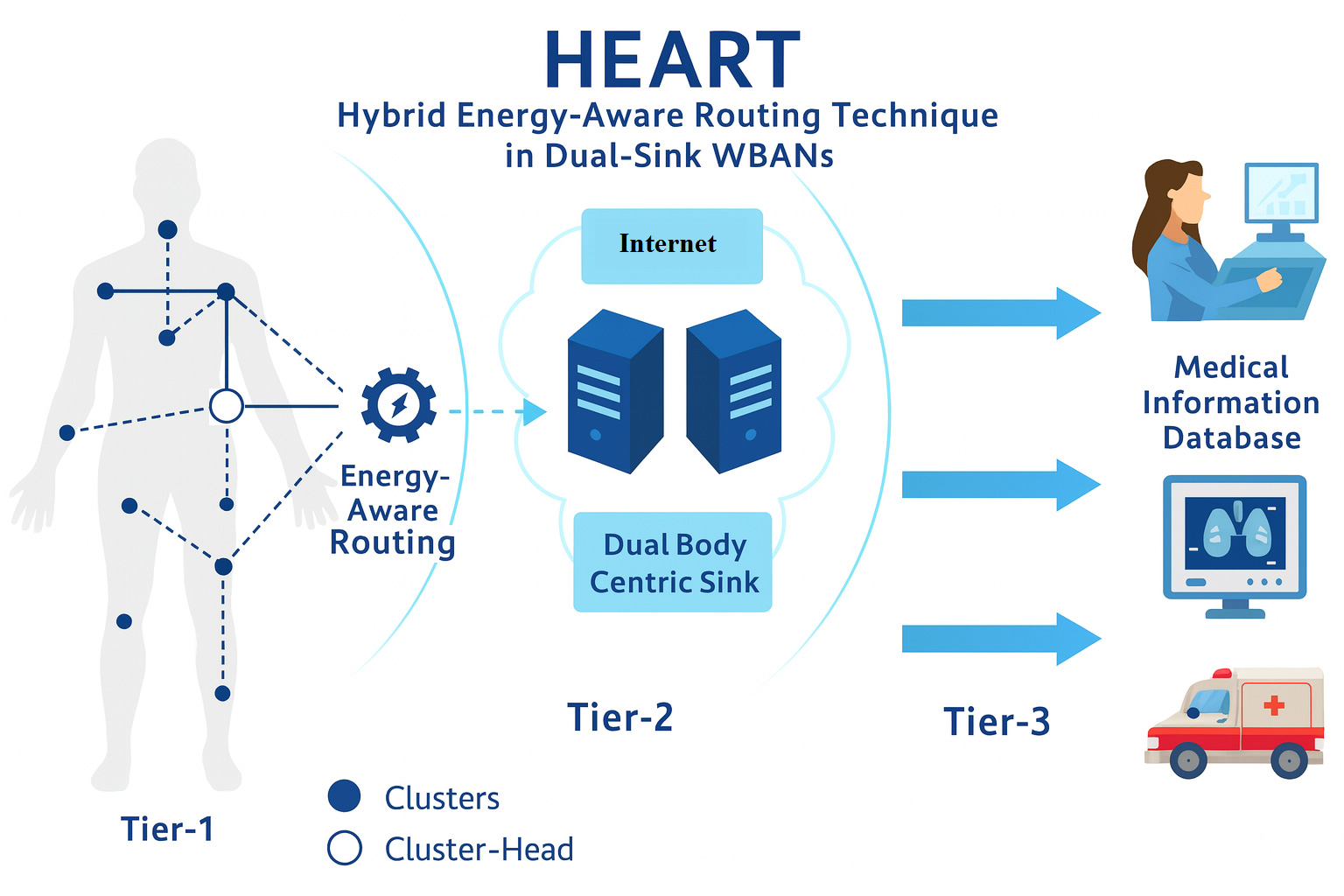
The rapid evolution of the Internet of Medical Things (IoMT) has enabled pervasive patient monitoring through Wireless Body Area Networks (WBANs). However, energy depletion, high path-loss, link instability, and latency remain major barriers to achieving reliability in real-time healthcare applications. Existing schemes, such as Distance Aware Relaying Energy-efficient (DARE) and Link Aware and Energy Efficient Scheme for Body Area Networks (LAEEBA), mitigate individual constraints, distance and link quality respectively, but lack holistic optimization across energy, distance, and reliability dimensions. This paper proposes HEART (Hybrid Energy-Aware Routing Technique), a dual-sink, clustering-based protocol designed to minimize path-loss and balance energy consumption in smart healthcare IoMT environments. HEART employs a cost function combining residual energy and link distance for adaptive Cluster-Head (CH) selection and integrates dual-sink coordination to enhance data reliability and reduce latency. Simulation results (0--\(10^5\) rounds) demonstrate that HEART outperforms DARE and LAEEBA across all performance metrics: achieving \(35.5_{\text{dB}}\) average path-loss, \(1.53_{\text{J}}\) residual energy, \(0.77_{\text{s}}\) end-to-end delay, and \(1.16_{\frac{packets}{s}}\) throughput, while improving packet delivery ratio, data generation rate, and reducing packet/bit error rates. Cumulative distribution analyses further confirm HEART's statistical stability and robustness under dynamic body postures. The proposed protocol significantly prolongs network lifetime and ensures dependable, energy-efficient transmission for continuous medical data acquisition—making it a strong candidate for next-generation smart IoMT healthcare systems.

Graphical Abstract
HEART: Hybrid Energy-Aware Routing Technique for Dual-Sink Body Area Networks in Smart Healthcare IoT Systems

Keywords
smart IoMT
WBANs
real-time monitoring
node deployment
path-loss
energy consumption
network lifetime
DARE
LAEEBA
HEART scheme

Data Availability Statement
Data will be made available on request.

Funding
This work was supported without any funding.

Conflicts of Interest
The author declares no conflicts of interest.

Ethical Approval and Consent to Participate
This work does not involve human subjects, animal experimentation, or personal data. Ethical approval and consent are therefore not applicable.

References
  1. Patel, M., & Wang, J. (2010). Applications, challenges, and prospective in emerging body area networking technologies. IEEE Wireless Communications Magazine, 17(1), 80–88.
    [CrossRef]   [Google Scholar]
  2. Karthiga, I., Sankar, S., & Dhivahar, P. (2015). A study on routing protocols in wireless body area networks and its suitability for m-Health applications. In Proceedings of the 2015 International Conference on Communications and Signal Processing (ICCSP) (pp. 1064–1069).
    [CrossRef]   [Google Scholar]
  3. Preethichandra, D. M. G., Piyathilaka, L., Izhar, U., Samarasinghe, R., & De Silva, L. C. (2023). Wireless body area networks and their applications—A review. IEEE Access, 11, 9202-9220.
    [CrossRef]   [Google Scholar]
  4. Honeine, P., Mourad, F., Kallas, M., Snoussi, H., Amoud, H., & Francis, C. (2011). Wireless sensor networks in biomedical: Body area networks. In Proceedings of the 2011 7th International Workshop on Systems, Signal Processing and their Applications (WOSSPA) (pp. 388–391). https://dx.doi.org/10.1109/WOSSPA.2011.5931518
    [Google Scholar]
  5. Shehu, N. M., & Adam, M. M. (2016). A survey on thermal aware routing protocols in WBAN. Science [ETEBMS-2016], 5(1), 6.
    [Google Scholar]
  6. Ghamari, M., Janko, B., Sherratt, R. S., Harwin, W., Piechockic, R., & Soltanpur, C. (2016). A survey on wireless body area networks for eHealthcare systems in residential environments. Sensors, 16(6), 831.
    [CrossRef]   [Google Scholar]
  7. Hall, P. S., & Hao, Y. (2006). Antennas and propagation for body centric communications. In Proceedings of the 2006 First European Conference on Antennas and Propagation (pp. 1–7).
    [CrossRef]   [Google Scholar]
  8. Popov, M. (2010). The convergence of wired and wireless services delivery in access and home networks. In Optical Fiber Communication Conference (p. OWQ6).
    [CrossRef]   [Google Scholar]
  9. Adhikary, S., Choudhury, S., & Chattopadhyay, S. (2016, January). A new routing protocol for WBAN to enhance energy consumption and network lifetime. In Proceedings of the 17th international conference on distributed computing and networking (pp. 1-6).
    [CrossRef]   [Google Scholar]
  10. Maskooki, A., Soh, C. B., Gunawan, E., & Low, K. S. (2015). Adaptive routing for dynamic on-body wireless sensor networks. IEEE Journal of Biomedical and Health Informatics, 19(2), 549–558.
    [CrossRef]   [Google Scholar]
  11. Akram, S., Javaid, N., Tauqir, A., Rao, A., & Mohammad, S. N. (2013). The-fame: Threshold based energy-efficient fatigue measurement for wireless body area sensor networks using multiple sinks. In Proceedings of the 2013 Eighth International Conference on Broadband and Wireless Computing, Communication and Applications (BWCCA) (pp. 214–220). IEEE.
    [CrossRef]   [Google Scholar]
  12. Harsharan, K. P., & Kirtika, G. (2015). Cost based efficient routing for wireless body area networks. International Journal of Computer Science and Mobile Computing (IJCSMC), 4(2), 295–300.
    [Google Scholar]
  13. Nadeem, Q., Javaid, N., Mohammad, S. N., Khan, M. Y., Sarfraz, S., & Gull, M. (2013, October). Simple: Stable increased-throughput multi-hop protocol for link efficiency in wireless body area networks. In 2013 eighth international conference on broadband and wireless computing, communication and applications (pp. 221-226). IEEE.
    [CrossRef]   [Google Scholar]
  14. Ahmed, S., Javaid, N., Akbar, M., Iqbal, A., Khan, Z. A., & Qasim, U. (2014). LAEEBA: Link aware and energy efficient scheme for body area networks. In Proceedings of the 2014 IEEE 28th International Conference on Advanced Information Networking and Applications (pp. 435–440). IEEE.
    [CrossRef]   [Google Scholar]
  15. Tauqir, A., Javaid, N., Akram, S., Rao, A., & Mohammad, S. N. (2013, October). Distance aware relaying energy-efficient: Dare to monitor patients in multi-hop body area sensor networks. In Proceedings of the 2013 Eighth International Conference on Broadband and Wireless Computing, Communication and Applications (BWCCA) (pp. 206–213). IEEE.
    [CrossRef]   [Google Scholar]
  16. Promwongsa, N., & Sanguankotchakorn, T. (2017). Delay analysis of ARQ protocol for energy-efficient transmission in WBAN. In Proceedings of the 2017 International Conference on Information Networking (ICOIN) (pp. 18–23). IEEE.
    [CrossRef]   [Google Scholar]
  17. Zaman, K., Sun, Z., Hussain, A., Hussain, T., Ali, F., Shah, S. M., & Rahman, H. U. (2023). EEDLABA: Energy-efficient distance-and link-aware body area routing protocol based on clustering mechanism for wireless body sensor network. Applied Sciences, 13(4), 2190.
    [CrossRef]   [Google Scholar]
  18. Hussain, A., Li, S., Attar, R. W., Al Dabel, M. M., Bashir, A. K., Alhomoud, A., & Hussain, T. (2025). Unleashing the potentials of IoT with focus on energy and path loss for Internet of Medical Things. Journal of Circuits, Systems and Computers, 34(11),
    [CrossRef]   [Google Scholar]
  19. Hussain, A., Hussain, T., Attar, R. W., Alhomoud, A., Alnfiai, M. M., & Alsagri, R. (2025). Energy-efficient synchronization for body sensor network in the metaverse: An optimized connectivity approach. EURASIP Journal on Wireless Communications and Networking, 2025(1), 7.
    [CrossRef]   [Google Scholar]
  20. Poon, C. C., Lo, B. P., Yuce, M. R., Alomainy, A., & Hao, Y. (2015). Body sensor networks: In the era of big data and beyond. IEEE Reviews in Biomedical Engineering, 8, 4–16.
    [CrossRef]   [Google Scholar]
  21. Sakshiwala, & Singh, M. P. (2019, December). EEHCR: energy-efficient hierarchical cluster-based routing protocol for wireless sensor networks. In International Conference on Advanced Communication and Computational Technology (pp. 517-533). Singapore: Springer Nature Singapore.
    [CrossRef]   [Google Scholar]
  22. Cavallari, R., Martelli, F., Rosini, R., Buratti, C., & Verdone, R. (2014). A survey on wireless body area networks: Technologies and design challenges. IEEE communications surveys & tutorials, 16(3), 1635-1657.
    [CrossRef]   [Google Scholar]
  23. Sangaiah, A. K., Hosseinabadi, A. A. R., Shareh, M. B., Bozorgi Rad, S. Y., Zolfagharian, A., & Chilamkurti, N. (2020). IoT resource allocation and optimization based on heuristic algorithm. Sensors, 20(2), 539.
    [CrossRef]   [Google Scholar]
  24. Guo, W., Wang, Y., Gan, Y., & Lu, T. (2022). Energy efficient and reliable routing in wireless body area networks based on reinforcement learning and fuzzy logic. Wireless Networks, 28(6), 2669-2693.
    [CrossRef]   [Google Scholar]
  25. Pandey, A. K., & Gupta, N. (2021). An energy efficient adaptive wake-up radio MAC (EEAWuR-MAC) protocol for IoT wireless body area networks. Wireless Personal Communications, 119(2), 1275-1299.
    [CrossRef]   [Google Scholar]
  26. Khan, R. A., & Memon, S. (2025). Cost function based forward node selection towards energy optimization for Internet of Medical Things. Spectrum of Engineering Sciences, 3(4), 132–137.
    [Google Scholar]
  27. Kaur, N., Verma, S., Jhanjhi, N. Z., Singh, S., Ghoniem, R. M., & Ray, S. K. (2023). Enhanced QoS-aware routing protocol for delay sensitive data in Wireless Body Area Networks. IEEE Access, 11, 106000-106012.
    [CrossRef]   [Google Scholar]
  28. Abdullah, A. M. (2025). Energy-efficient and thermal-aware routing protocol for wireless body area networks based on ant colony optimization. Computing, 107(5), 1-32.
    [CrossRef]   [Google Scholar]
  29. Elhayatmy, G., Dey, N., & Ashour, A. S. (2018). Internet of Things based wireless body area network in healthcare. In Internet of Things and Big Data Analytics Toward Next-Generation Intelligence (pp. 3-20). Springer.
    [CrossRef]   [Google Scholar]
  30. Boumaiz, M., Ghazi, M. E., Bouayad, A., Balboul, Y., & El Bekkali, M. (2025). Energy-Efficient Strategies in Wireless Body Area Networks: A Comprehensive Survey. IoT, 6(3), 49.
    [CrossRef]   [Google Scholar]
  31. Li, M., Li, Z., & Vasilakos, A. V. (2013). A survey on topology control in wireless sensor networks: Taxonomy, comparative study, and open issues. Proceedings of the IEEE, 101(12), 2538-2557.
    [CrossRef]   [Google Scholar]
  32. Alatawi, M. N. (2025). Optimizing security and energy efficiency in IoT-based health monitoring systems for wireless body area networks. Scientific Reports, 15(1), 24921.
    [CrossRef]   [Google Scholar]
  33. Esmaeili, H., & Bidgoli, B. M. (2018). EMRP: Evolutionary-based multi-hop routing protocol for wireless body area networks. AEU-international journal of electronics and communications, 93, 63-74.
    [CrossRef]   [Google Scholar]
  34. Swathi, B., Veerabomma, S., Archana, M., Bhadru, D., Somu, N. L., & Bhavsingh, M. (2025, January). Edge-centric IoT health monitoring: Optimizing real-time responsiveness, data privacy, and energy efficiency. In Proceedings of the 2025 6th International Conference on Mobile Computing and Sustainable Informatics (ICMCSI) (pp. 354–361). IEEE.
    [CrossRef]   [Google Scholar]
  35. Dass, R., Narayanan, M., Ananthakrishnan, G., Kathirvel Murugan, T., Nallakaruppan, M. K., Somayaji, S. R. K., ... & Almusharraf, A. (2023). A cluster-based energy-efficient secure optimal path-routing protocol for wireless body-area sensor networks. Sensors, 23(14), 6274.
    [CrossRef]   [Google Scholar]
  36. Quwaider, M., & Biswas, S. (2009, October). Probabilistic routing in on-body sensor networks with postural disconnections. In Proceedings of the 7th ACM international symposium on Mobility management and wireless access (pp. 149-158).
    [CrossRef]   [Google Scholar]
  37. Othmen, S., Khdhir, R., Belghith, A., Hamouid, K., Lhioui, C., & Elmourssi, D. (2025). Enhancing IoT‐Enabled Healthcare Applications by Efficient Cluster Head and Path Selection Using Fuzzy Logic and Enhanced Particle Swarm Optimization. International Journal of Communication Systems, 38(3), e6096.
    [CrossRef]   [Google Scholar]
  38. Salayma, M., Al-Dubai, A., Romdhani, I., & Nasser, Y. (2017). Wireless body area network (WBAN) a survey on reliability, fault tolerance, and technologies coexistence. ACM Computing Surveys (CSUR), 50(1), 1-38.
    [CrossRef]   [Google Scholar]
  39. Bangash, J. I., Abdullah, A. H., Anisi, M. H., & Khan, A. W. (2014). A survey of routing protocols in wireless body sensor networks. Sensors, 14(1), 1322-1357.
    [CrossRef]   [Google Scholar]
  40. Iqbal, A., Nauman, A., Qadri, Y. A., & Kim, S. W. (2025). Optimizing spectral utilization in healthcare Internet of Things. Sensors, 25(3), 615.
    [CrossRef]   [Google Scholar]

Cite This Article
APA Style
Hussain, A. (2025). HEART: Hybrid Energy-Aware Routing Technique for Dual-Sink Body Area Networks in Smart Healthcare IoT Systems. Biomedical Informatics and Smart Healthcare, 1(3), 118–137. https://doi.org/10.62762/BISH.2025.212535
Export Citation
RIS Format
Compatible with EndNote, Zotero, Mendeley, and other reference managers
RIS format data for reference managers
TY  - JOUR
AU  - Hussain, Altaf
PY  - 2025
DA  - 2025/12/23
TI  - HEART: Hybrid Energy-Aware Routing Technique for Dual-Sink Body Area Networks in Smart Healthcare IoT Systems
JO  - Biomedical Informatics and Smart Healthcare
T2  - Biomedical Informatics and Smart Healthcare
JF  - Biomedical Informatics and Smart Healthcare
VL  - 1
IS  - 3
SP  - 118
EP  - 137
DO  - 10.62762/BISH.2025.212535
UR  - https://www.icck.org/article/abs/BISH.2025.212535
KW  - smart IoMT
KW  - WBANs
KW  - real-time monitoring
KW  - node deployment
KW  - path-loss
KW  - energy consumption
KW  - network lifetime
KW  - DARE
KW  - LAEEBA
KW  - HEART scheme
AB  - The rapid evolution of the Internet of Medical Things (IoMT) has enabled pervasive patient monitoring through Wireless Body Area Networks (WBANs). However, energy depletion, high path-loss, link instability, and latency remain major barriers to achieving reliability in real-time healthcare applications. Existing schemes, such as Distance Aware Relaying Energy-efficient (DARE) and Link Aware and Energy Efficient Scheme for Body Area Networks (LAEEBA), mitigate individual constraints, distance and link quality respectively, but lack holistic optimization across energy, distance, and reliability dimensions. This paper proposes HEART (Hybrid Energy-Aware Routing Technique), a dual-sink, clustering-based protocol designed to minimize path-loss and balance energy consumption in smart healthcare IoMT environments. HEART employs a cost function combining residual energy and link distance for adaptive Cluster-Head (CH) selection and integrates dual-sink coordination to enhance data reliability and reduce latency. Simulation results (0--\(10^5\) rounds) demonstrate that HEART outperforms DARE and LAEEBA across all performance metrics: achieving \(35.5_{\text{dB}}\) average path-loss, \(1.53_{\text{J}}\) residual energy, \(0.77_{\text{s}}\) end-to-end delay, and \(1.16_{\frac{packets}{s}}\) throughput, while improving packet delivery ratio, data generation rate, and reducing packet/bit error rates. Cumulative distribution analyses further confirm HEART's statistical stability and robustness under dynamic body postures. The proposed protocol significantly prolongs network lifetime and ensures dependable, energy-efficient transmission for continuous medical data acquisition—making it a strong candidate for next-generation smart IoMT healthcare systems.
SN  - 3068-5524
PB  - Institute of Central Computation and Knowledge
LA  - English
ER  - 
BibTeX Format
Compatible with LaTeX, BibTeX, and other reference managers
BibTeX format data for LaTeX and reference managers
@article{Hussain2025HEART,
  author = {Altaf Hussain},
  title = {HEART: Hybrid Energy-Aware Routing Technique for Dual-Sink Body Area Networks in Smart Healthcare IoT Systems},
  journal = {Biomedical Informatics and Smart Healthcare},
  year = {2025},
  volume = {1},
  number = {3},
  pages = {118-137},
  doi = {10.62762/BISH.2025.212535},
  url = {https://www.icck.org/article/abs/BISH.2025.212535},
  abstract = {The rapid evolution of the Internet of Medical Things (IoMT) has enabled pervasive patient monitoring through Wireless Body Area Networks (WBANs). However, energy depletion, high path-loss, link instability, and latency remain major barriers to achieving reliability in real-time healthcare applications. Existing schemes, such as Distance Aware Relaying Energy-efficient (DARE) and Link Aware and Energy Efficient Scheme for Body Area Networks (LAEEBA), mitigate individual constraints, distance and link quality respectively, but lack holistic optimization across energy, distance, and reliability dimensions. This paper proposes HEART (Hybrid Energy-Aware Routing Technique), a dual-sink, clustering-based protocol designed to minimize path-loss and balance energy consumption in smart healthcare IoMT environments. HEART employs a cost function combining residual energy and link distance for adaptive Cluster-Head (CH) selection and integrates dual-sink coordination to enhance data reliability and reduce latency. Simulation results (0--\(10^5\) rounds) demonstrate that HEART outperforms DARE and LAEEBA across all performance metrics: achieving \(35.5\_{\text{dB}}\) average path-loss, \(1.53\_{\text{J}}\) residual energy, \(0.77\_{\text{s}}\) end-to-end delay, and \(1.16\_{\frac{packets}{s}}\) throughput, while improving packet delivery ratio, data generation rate, and reducing packet/bit error rates. Cumulative distribution analyses further confirm HEART's statistical stability and robustness under dynamic body postures. The proposed protocol significantly prolongs network lifetime and ensures dependable, energy-efficient transmission for continuous medical data acquisition—making it a strong candidate for next-generation smart IoMT healthcare systems.},
  keywords = {smart IoMT, WBANs, real-time monitoring, node deployment, path-loss, energy consumption, network lifetime, DARE, LAEEBA, HEART scheme},
  issn = {3068-5524},
  publisher = {Institute of Central Computation and Knowledge}
}

Article Metrics
Citations:

Crossref

0

Scopus

0

Web of Science

0
Article Access Statistics:
Views: 183
PDF Downloads: 91

Publisher's Note
ICCK stays neutral with regard to jurisdictional claims in published maps and institutional affiliations.

Rights and Permissions
CC BY Copyright © 2025 by the Author(s). Published by Institute of Central Computation and Knowledge. This article is an open access article distributed under the terms and conditions of the Creative Commons Attribution (CC BY) license (https://creativecommons.org/licenses/by/4.0/), which permits use, sharing, adaptation, distribution and reproduction in any medium or format, as long as you give appropriate credit to the original author(s) and the source, provide a link to the Creative Commons licence, and indicate if changes were made.
Biomedical Informatics and Smart Healthcare

Biomedical Informatics and Smart Healthcare

ISSN: 3068-5524 (Online)

Email: [email protected]

Portico

Portico

All published articles are preserved here permanently:
https://www.portico.org/publishers/icck/